


By Jon Sullivan for PCGS ……
Missing Clad Layer Error Coins: A Definitive Collector’s Guide
In 1965, the United States changed its coinage forever. Rising silver prices forced the United States Mint to remove precious metal from circulating dimes and quarters. For the first time since 1792, when the Mint struck its earliest coins in Philadelphia, everyday American coinage no longer relied on silver.
Then, in 1971, the Mint extended that shift to half dollars and dollar coins. Copper-nickel clad coinage had fully replaced traditional silver issues in circulation.
However, this major transition did more than alter metal content. It also introduced one of the most dramatic and collectible modern mint errors: the missing clad layer.
The Birth of Clad Coinage – and a New Error Type
Clad coinage consists of three bonded layers of metal. A pure copper core sits between two outer nickel layers. When struck, the finished coin displays the familiar silver-colored surfaces that most Americans recognize.
Yet this bonded structure also creates the potential for failure. When bonding problems occur, a striking visual error appears. That error leaves copper exposed on one side of the coin. Collectors call it a missing clad layer.

At its simplest, a missing clad layer coin lacks one of its outer nickel layers. As a result, the coin shows copper on one side and nickel on the other. In addition, the coin weighs about 15% less than a properly bonded example.
Collectors recognize three distinct forms of this error: full, partial, and dual missing clad layers. Each type reflects how much of the outer metal layer failed to bond.
How the Mint Creates Clad Coins
To understand the error, you must first understand the production process.
The Mint begins with long strips of bonded metal called planchet strips. Workers bond nickel to both sides of a central copper strip under immense pressure and heat. If the process succeeds, the metals fuse securely. The finished strip resembles a sandwich, with copper in the center and nickel forming the outer layers.
Next, machines punch circular blanks from this strip. Those blanks then pass through upsetting mills and finally into coin presses, where the dies strike them into finished coins.
When bonding holds firm, the coin leaves the press intact. However, when bonding fails, problems appear.
How Missing Clad Layers Occur
In some cases, the nickel layer does not adhere properly to the copper core. The bonding may weaken during manufacturing. Then, when the blanking press punches out planchets, the poorly bonded nickel separates. The blank moves forward without one clad layer attached.
Later, when the Mint strikes that blank, the coin emerges with one copper face and one nickel face. This process creates what collectors call a full missing clad layer error.
Another scenario involves strip alignment. If one nickel strip runs shorter than the copper core during bonding, the end of the bonded strip will expose raw copper. When workers punch blanks from this section, some blanks will lack a full clad layer. Others will display partial separation where nickel and copper meet. Those coins enter circulation as partial missing clad layer errors.
In every case, the problem originates in the bonded strip before striking begins.
Full, Partial, and Dual Missing Clad Layers
A full missing clad layer coin displays complete copper exposure on one side. Collectors describe these pieces as either obverse missing clad layer or reverse missing clad layer, depending on which side lacks nickel. This variety appears most frequently in the marketplace.
A partial missing clad layer retains some nickel on the affected side. For example, if roughly 25% of the outer layer separates, collectors describe the coin as a 25% partial missing clad layer. These errors rank as the second most common type and remain readily available.
The rarest and most dramatic form is the dual missing clad layer. In this case, both outer nickel layers separate from the copper core. The coin shows copper on both sides and weighs approximately 30% less than a normal example.
Dual missing clad layer errors remain extraordinarily rare. Fewer than 10 examples exist for Roosevelt dimes. Experts report five to 10 known for Washington quarters. Only one example has surfaced for Kennedy half dollars. None are known for the dollar coin series.
Because of that rarity, dual missing clad layers rarely appear for sale. When examples reach the market, they typically sell for $1,000 to $5,000, depending on condition and series.
Random Orientation — Obverse or Reverse?
Collectors often ask why one side is missing instead of the other. The answer is simple: chance.
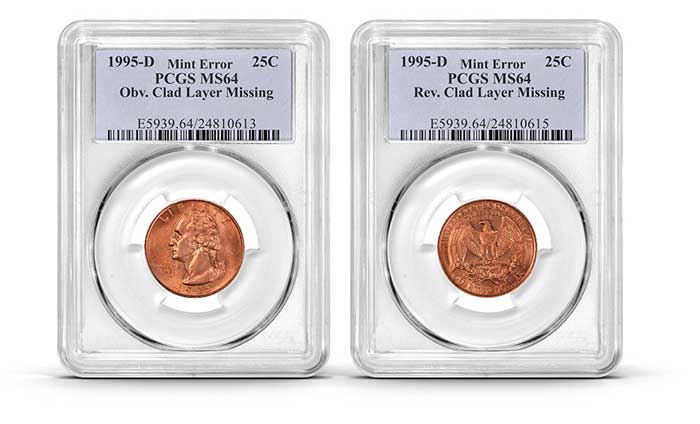
The blank enters the coining press randomly. If the copper side faces the obverse die, the struck coin becomes an obverse missing clad layer. If the copper side faces the reverse die, the reverse displays the exposed copper.
The Mint exerts no control over that orientation. Therefore, the result remains completely random.
Market Preferences and Series Differences
In most denominations, collectors prefer obverse missing clad layer coins. Consequently, obverse examples often bring roughly twice the price of reverse examples.
However, two modern quarter series reverse that preference: the 50 State Quarters and the America the Beautiful Quarters.
These programs highlight state and park designs on the reverse. As a result, collectors strongly prefer reverse missing clad layers for these coins. In many cases, reverse examples sell for five to 10 times more than obverse examples.
Missing clad layers appear across most modern denominations, including dimes, quarters, half dollars, and small dollar coins. However, the Eisenhower Dollar remains scarce with this error. Only a small number of examples exist.
Proof missing clad layer errors also exist, though they remain extremely rare. When offered publicly, they often sell for thousands of dollars.
Building a Missing Clad Layer Collection
Collectors approach missing clad layers in several ways. Some pursue a single example from each denomination. Others collect by date and mintmark, building comprehensive runs from 1965 to the present.

For example, a collector may assemble obverse missing clad layer Roosevelt dimes for every year of issue. That goal remains achievable with patience.
More ambitious collectors attempt a reverse missing clad layer example for each state in the state quarter program. While challenging, the goal remains possible. Most states appear with some regularity. However, later issues grow significantly scarcer. States such as Oklahoma and Arizona rank among the rarest, with perhaps five or six known for the most elusive entries.
A Modern Error with Lasting Appeal
Missing clad layer errors represent one of the most visually striking modern U.S. mint errors. They trace directly to the historic removal of silver from circulating coinage in 1965. They also offer measurable weight differences and unmistakable copper exposure.
For collectors, they combine history, manufacturing drama, and strong market demand. Above all, they stand as a reminder that even modern minting technology cannot eliminate every production flaw.
In the world of modern U.S. numismatics, few errors capture attention as quickly — or as convincingly — as a missing clad layer.
* * *



I’m quite surprised that an author from PCGS would state that the outer cladding layers are nickel. They’re of course CUPROnickel, the same 75% copper / 25% nickel alloy used in 5¢ pieces.
Right! If the clad layers were pure nickel, the coins would stick to a magnet!
I have a question for anyone that could help with answering.I have a1994 D quarter that is missing the clad its just copper on obverse and reverse and it’s not in the best shape. Any information or direction to a website or company that knows about it would be greatly appreciated. Thanks Mark
Hello Mark, I have some questions regarding about them coins that I’ve have from many years like 1956 nickels, 1976 quarters and so on I like to talk to you can you please kindly give me a call at 808-493-6788 I’m Nicky . Much Mahalo.
I have a 1995-D Kennedy half dollar missing clad layers both observe and reverse sides uncirculated.
Hi,
I have came across a 1966 dime that from the uniqueness of this coin has sparked my curiosity to find out why it appears as it does and hopefully you have given me the answer.
I believe I have a rare double sided missing nickel clad 1966 dime with what looks like is a P (Philadelphia) mint mark. But where do I go from here on being certain of this ? I’m new to coin collecting, therefore any help is greatly appreciated.
Hi @carmenstone
I’m also fairly new with coin collecting and since Covid have more time, I started learning a lot more about it coin collecting and from different coin collecting applications or people that are doing it in research I have heard the best place to check your coins out. It are a local coin dealer I heard it’s kind of tricky because you need to have someone you can trust a good rapport with so just do your research in your area and if you don’t like what they have to say go get a second opinions it wouldn’t hurt to get a second opinion anyway in my opinion just to make sure they know what they’re talking about. I guess there’s some coin apps that you could scan your coin and they’ll tell you if it’s rare and it’s worth it, you might have to pay money for that that service but I don’t know if that’s something you’re willing to entertain entertain.
Your post is from 2023. I see no one had answered your question and that has always bothered me when I see that and even though I’m not a professional, I still think that giving any kind of advice is better than being ghosted. I hope this helped a little bit. Good luck to you and your coin collecting it’s fun and remember… Never never ever clean your coins I’ve already made that rookie mistake 100 years ago lol take care ✌
@Carmen Stone: A good place to start would be by weighing the coin. A normal clad dime weighs 2.27 gm +/- a small tolerance for normal production variability. As the article notes, a coin that’s missing both outer layers will weigh measurably less than a normal strike.
Also, it’s not possible for a 1966 dime to have a P mint mark. First, from 1965 to 1967 the use of mint marks was suspended in a (by all accounts misguided) effort to discourage hoarding. Second, dimes struck at Philadelphia didn’t carry a mint mark until 1980. An experienced dealer or collector should be able to held identify what the marking is.
I also have a 1966 dime with a mint mark that seems to be a P, so that information seems to be incorrect
@Beau: The information that I quoted can be verified by any number of reliable sources including the Red Book and the US Mint itself. It’s all been well-known to numismatists for decades. Most specifically, the use of mint marks was suspended by the 1965 Coinage Act (Public Law 89–81, 79 Stat. 254). In addition, at that time mint marks were added to dies manually and no coins, circulating or otherwise, had been struck with a P mint mark since the so-called war nickels of 1942-45. Creating a pre-1980 dime with a P mint mark would have involved preparation of a punch much smaller than that used on war nickels plus its surreptitious use by a Mint employee – certainly not impossible but highly unlikely.
Any time a coin appears to have an anomaly it should be examined in person by a numismatic expert. For every genuine rarity there can be dozens of fakes, cases of post-mint damage, and other curiosities that should be ruled out.
Hi Jon. This is the first time seeing your web site. I was seaching for information on Kennedy half dollars that are missing their clad. I enjoy looking for silver halves and have recently found an unclad 1972 D; both sides. It’s in good condition and reminds me of the 1800’s large 1 cents. Any idea what it might be worth ? Thanks Sam
Very interesting errors.
Informative article about that type of error on the coin.
This is one of my favorite errors to find. I found a cpl dimes and 1 quarter.
Those errors are interesting. I’ll have to look for these also.
I have a 2000 D quarter dollar missing the clad layer on both sides can I sell it