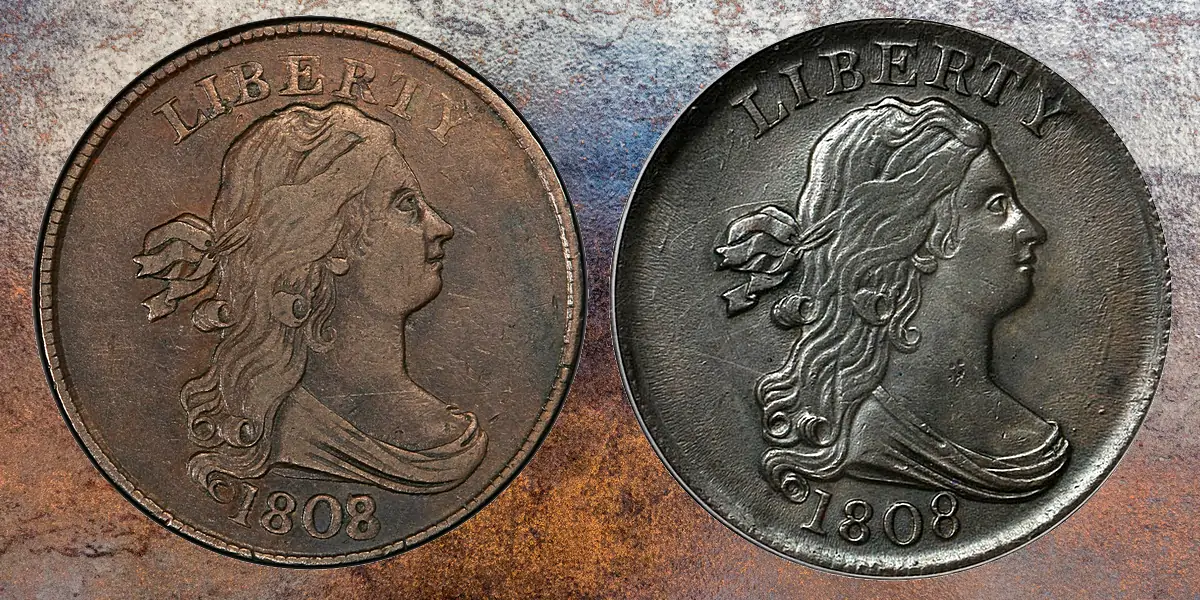
The 1808 Half Cent also marks the final chapter of the Draped Bust design. It also produced one of the rarest die varieties in the entire half-cent series.
Collectors know it simply as the 1808/7 overdate. Specialists know it as Cohen-1.
And advanced copper enthusiasts call it a prize that rarely appears and never disappoints.
This is the story of Mint economy, misaligned dies, artistic rivalry, and a variety so rare that fewer than two dozen examples likely survive.
The Final Year of the Draped Bust Half Cent
The Draped Bust half cent debuted in 1800. The design features Liberty with flowing hair on the obverse and a laurel wreath surrounding HALF CENT on the reverse.
Chief Engraver Robert Scot created the design.
However, by 1808, change was underway.
Assistant Engraver John Reich began introducing new Classic Head designs. His work replaced Scot’s designs on larger denominations first. Yet the half cent lingered one more year with the older Draped Bust motif.
That delay produced something unexpected.
Why Were 1808 Half Cents Struck at All?
The Mint had more than 167,000 half cents in storage at the end of 1807. Demand for the denomination was low. Research confirms that the denomination saw only modest commercial use.
Yet in 1808, the Mint struck approximately 312,000 to 400,000 additional pieces before deliveries ended on June 29.
Why?
Mint economy likely drove the decision. Engravers reused existing dies rather than prepare entirely new ones. That practical choice led directly to two of the most fascinating varieties in early American copper.
The “Tall 8” Variety (Cohen-3)
Collectors often call it the “weird” or “childish” 8.
In reality, it reflects improvisation.
 When preparing one obverse die, the engraver did not have an “8” punch available. Instead, he stacked two small “0” punches, normally used in the 1/200 fraction on reverse dies, to create the final digit.
The result appears tall and narrow. It looks distinctly different from the 8 seen on the overdate variety.
This is the Cohen-3 variety. It represents the most common 1808 half cent.
Still, the Tall 8 remains a fascinating artifact of early Mint resourcefulness.
The 1808/7 Overdate: A Die Saved, Then Transformed
The 1808/7 overdate began as an unused 1807 obverse die.

When the calendar changed, Mint engravers modified the die by punching an 8 over the existing 7. Small remnants of the underlying 7 remain visible. Specialists describe them as “horns” projecting from the upper curves of the final 8.
That single decision created one of the most important varieties in the half cent series.
Understanding the Cohen Designations
Half cent varieties follow the system created by Roger S. Cohen, Jr., author of American Half Cents: The Little Half Sisters.
For 1808, three primary varieties exist:
- C-1 – 1808/7 Overdate, extremely rare
- C-2 – 1808/7 Overdate, scarcer but collectible
- C-3 – Normal Date “Tall 8,” most common
The key difference between C-1 and C-2 lies in the reverse die.
Cohen-1 (B-1): The Rarest Die Pairing
The 1808/7 Cohen-1 carries a High R.6 to R.7 rarity rating, depending on the authority cited.
Some specialists estimate 16 to 20 examples. Earlier estimates ranged from 12 to 15. Others have documented as few as nine confirmed specimens over decades of study.
What remains clear is this: survival numbers are tiny.
Diagnostic Features
- Overdate with visible 7 beneath the 8
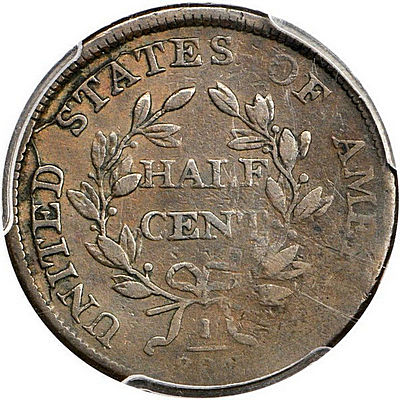
- Reverse A, with a leaf point below the upright of the D in UNITED
- Die cracks through portions of UNITED STATES in later states
- Evidence of misaligned dies causing weakness on the lower right reverse
The reverse die sat slightly askew in the press. That misalignment created uneven strike pressure. As a result, heavy cracks developed through legend letters. Eventually, a retained cud formed between D and S in STATES in advanced die states.
Die failure ended production quickly.
Therefore, rarity followed naturally.
The 2012 Discovery: Second Finest Known
In 2012, a newly discovered Cohen-1 surfaced and went to auction at Stack’s Bowers Galleries.

The coin graded Fine-12 by PCGS and earned CAC approval. Specialists described it as the second finest known example at the time.
Most C-1 survivors show corrosion, pitting, or damage. Early copper often suffers from environmental issues. However, this example displayed smooth, satiny surfaces and only light handling marks.
When the discovery coin appeared in 1992 in Good-4, it realized $18,150. The 2012 example carried stronger technical quality and entered a market with increased demand.
The message was clear. When a Cohen-1 appears, the market responds.
The XF40 Plate Coin: Finest of the Variety
In August 2022, Heritage Auctions offered an 1808/7 Cohen-1 graded XF40 by PCGS.
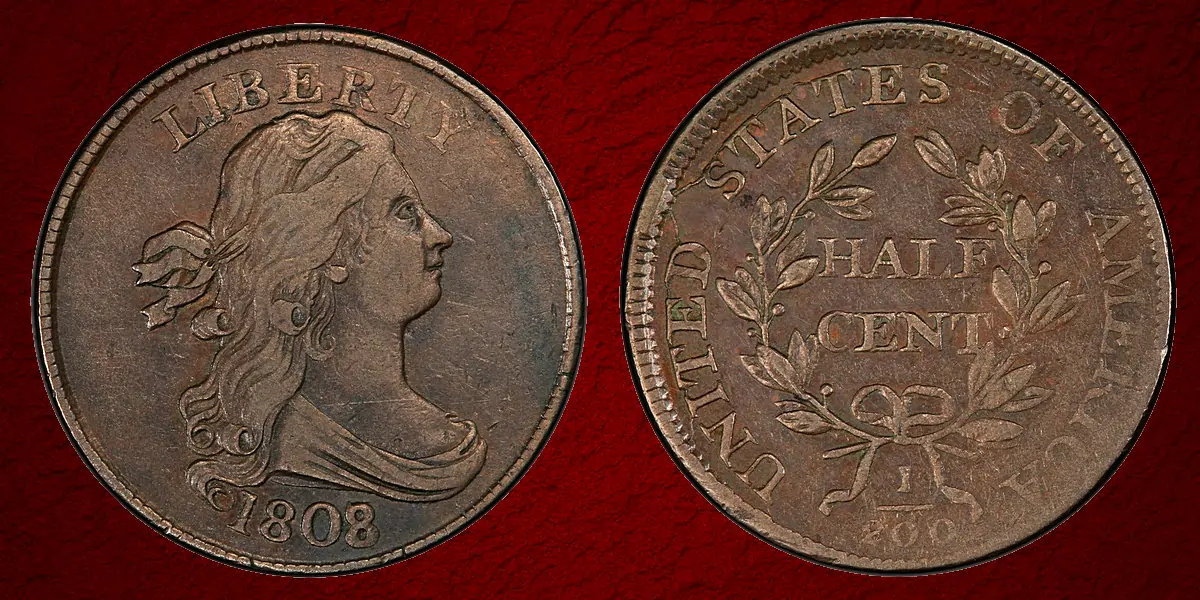
The catalog described it as the finest of the variety. It served as the plate coin in multiple reference works, including Cohen’s book and Breen’s encyclopedia.
PCGS reported only two attributed submissions of the 1808/7 B-1, C-1 pairing at that time: one in Fine 12 and the XF40 specimen.
Experts doubt that unattributed examples remain hidden in higher grades.
This coin also carried a remarkable provenance. It passed through important collections, including the Missouri Cabinet and the James R. McGuigan Collection. The piece inspired McGuigan’s lifelong pursuit of half cents.
Some coins change collections. Others change lives.
- Cohen-2: The More Obtainable Overdate
- Cohen-2 shares the same overdate obverse as C-1 but pairs it with a different reverse die.

This variety carries a much lower rarity rating. Estimates suggest approximately 650 survivors. Still, most examples grade below Very Fine.
Even so, EF and better examples remain elusive. Demand among early copper specialists keeps pressure on available supply.
For collectors building a date set, Cohen-2 often serves as the practical representative of the 1808/7 overdate.
For specialists, however, Cohen-1 defines the challenge.
A Dramatic End to the Draped Bust Era
The 1808 half cent tells a larger story.
It reflects a Mint in transition, and shows Robert Scot’s final effort to keep his design in circulation. The highlights John Reich’s rise. It demonstrates the realities of worn presses and failing dies.
Moreover, it reveals how small technical decisions create enduring numismatic legends.
The misaligned reverse die likely produced only a few hundred Cohen-1 coins before failure. A survival rate of just a few percent reduced that number to fewer than two dozen known today.
That combination of low production and fragile copper preservation explains the variety’s enduring rarity.
Why the 1808/7 Half Cent Matters Today
The 1808/7 half cent ranks among the rarest die varieties in the entire series. Only the 1804 Cohen-3 variety rivals it in scarcity, and debate surrounds that attribution.
Collectors pursue the 1808/7 for several reasons:
- It represents the final Draped Bust year.
- It showcases a dramatic overdate.
- It features visible die cracks and cuds.
- It offers elite-level rarity without requiring six-figure expenditure in lower grades.
Most importantly, it connects modern collectors to the real working conditions of the early Philadelphia Mint.
You can see the 7 beneath the 8, and can trace the cracks in STATES, and study the weakness from misaligned dies.
Few coins display their history so openly.
That is not just rarity, it is numismatic drama
The 1808/7 Cohen-1 stands as the rarest die pairing of the Draped Bust half cent series.
Fewer than two dozen likely exist; One misaligned die, One reused obverse, One year of transition.
And more than two centuries later, specialists still wait years for a single opportunity.
.