


1895 Liberty Head Quarter Eagle: Gold, Politics, and Market Rarity
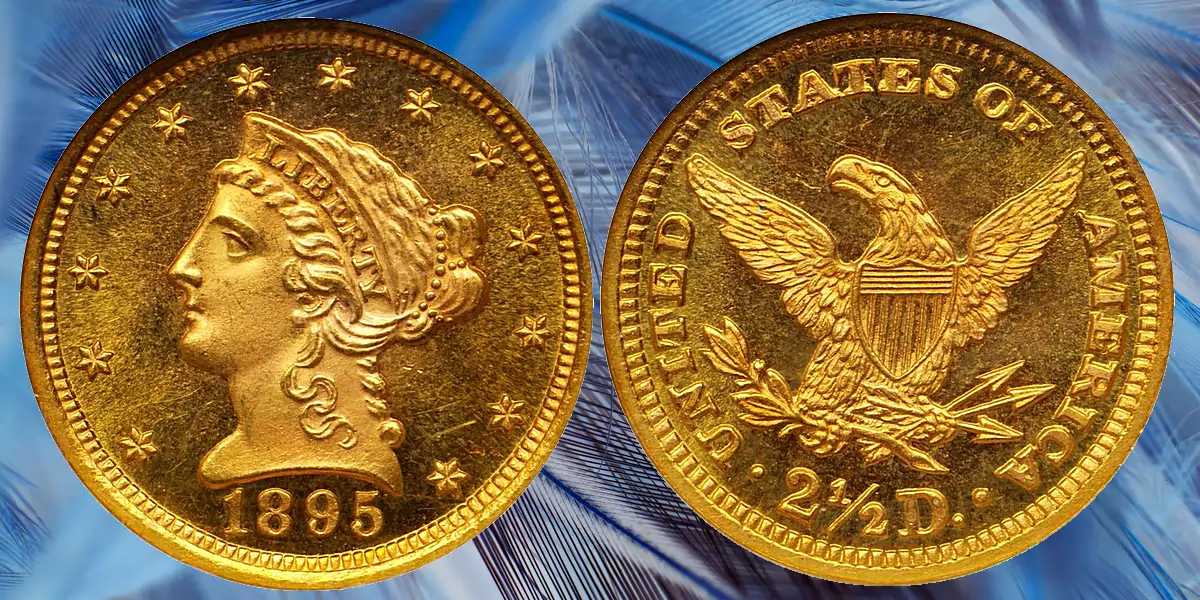
The year 1895 tested the American economy. Moreover, it reshaped U.S. politics and the gold coin market. At the center of this moment stands the 1895 Liberty Head Quarter Eagle, a low-mintage $2.50 gold coin struck in Philadelphia.
This CoinWeek analysis presents fully fact-checked historical context, certified population data, and auction performance. In addition, we examine how the Panic of 1893 influenced gold reserves and shaped the coin’s long-term rarity.
America in 1895: Depression After the Panic
In 1895, the United States remained trapped in a severe economic depression. The crisis followed the Panic of 1893, one of the most damaging financial collapses in 19th-century America.
During the Gilded Age, the U.S. economy had expanded rapidly. Real wages rose roughly 60% between 1860 and 1890. By 1890, American industry produced about twice as much as Britain’s. Industrial output soared. Confidence ran high.
However, the Panic halted that momentum.
Banks failed. Businesses collapsed. Credit markets froze. Unemployment peaked near 19% in 1894. Railroads and agriculture suffered most. Farm prices dropped sharply. Industrial production contracted.
Although America remained a long-term industrial power, growth stalled. Per capita income stagnated. Recovery proved uneven.
The panic began in February 1893. A stock market crash triggered bank runs. Over-speculation and monetary instability deepened the crisis. Agricultural decline made matters worse. Furthermore, a global downturn spread across Europe and amplified the shock.
A brief rebound appeared in mid-1894. Yet another slump followed in late 1895. Full recovery did not arrive until mid-1897.
By 1895, deposits in surviving banks averaged just 68% of pre-panic levels. Public distrust persisted. Economic uncertainty continued.
Political Upheaval and the Gold Standard Debate
The depression reshaped American politics.
Under President Grover Cleveland, the Democratic Party lost massive ground in the 1894 midterm elections. Consequently, Republicans began a period of national dominance.
At the same time, the nation debated monetary policy. Supporters of the gold standard clashed with advocates of silver coinage. Farmers and laborers demanded relief. The Populist movement gained strength. Major strikes hit coal mining and railroads.
This turmoil set the stage for the 1896 presidential election between William McKinley and William Jennings Bryan. McKinley supported gold. Bryan championed “free silver.”
Thus, economic distress turned into a political battlefield.
The Sherman Silver Purchase Act and Gold Reserves
At the heart of the debate stood the Sherman Silver Purchase Act of 1890.
The law required the Treasury to buy 4.5 million ounces of silver each month. In exchange, the government issued notes redeemable in gold or silver. Lawmakers hoped to expand the money supply and support silver mining interests.
Instead, the policy weakened confidence in gold.
Note holders redeemed paper for gold. Gold flowed out of the Treasury. Reserves dropped dangerously low. Although the act increased paper currency circulation by roughly $156 million, it destabilized the system.
President Cleveland pushed for repeal in 1893. Congress complied during a special session.
Still, the damage lingered. Silver prices had fallen from about 89 cents per ounce in 1878 to roughly 50 cents by 1895. Calls for free silver intensified.
In January 1895, gold reserves reached critical levels. Financier J. P. Morgan arranged a bond syndicate to replenish Treasury gold.
The gold standard survived. Later, Congress formally adopted it in 1900. However, in 1895, it stood under real strain.
Gold Coinage in 1895
Since 1879, the United States had operated under a de facto gold standard. Gold coins played a central role in commerce.
Popular denominations included:
- $20 Double Eagles
- $10 Eagles
- $5 Half Eagles
- $2.50 Quarter Eagles
These coins contained 90% gold and 10% copper. The alloy increased durability.
In 1895, the Philadelphia Mint struck over 1.1 million Liberty Head $20 Double Eagles. However, the Liberty Head Quarter Eagle received a token business strike mintage of just 6,000 pieces.
That tiny mintage defines the rarity of the 1895 Liberty Head Quarter Eagle today.
1895 Liberty Head Quarter Eagle
The 1895 Liberty Head Quarter Eagle ranks among the scarcer Philadelphia gold issues of the 1890s.
Mintage and Survival
- Mintage: 6,000
- Mint: Philadelphia (no mintmark)
- Strike Type: Business Strike
Unless a new hoard emerges, the market should not expect a sudden influx of MS66 or MS67 coins. Over decades, no such discovery has appeared.
Certified Populations and Market Trends
The following population data comes from major auction appearances between September 1997 and July 2025. The data reflects coins certified by PCGS and NGC.
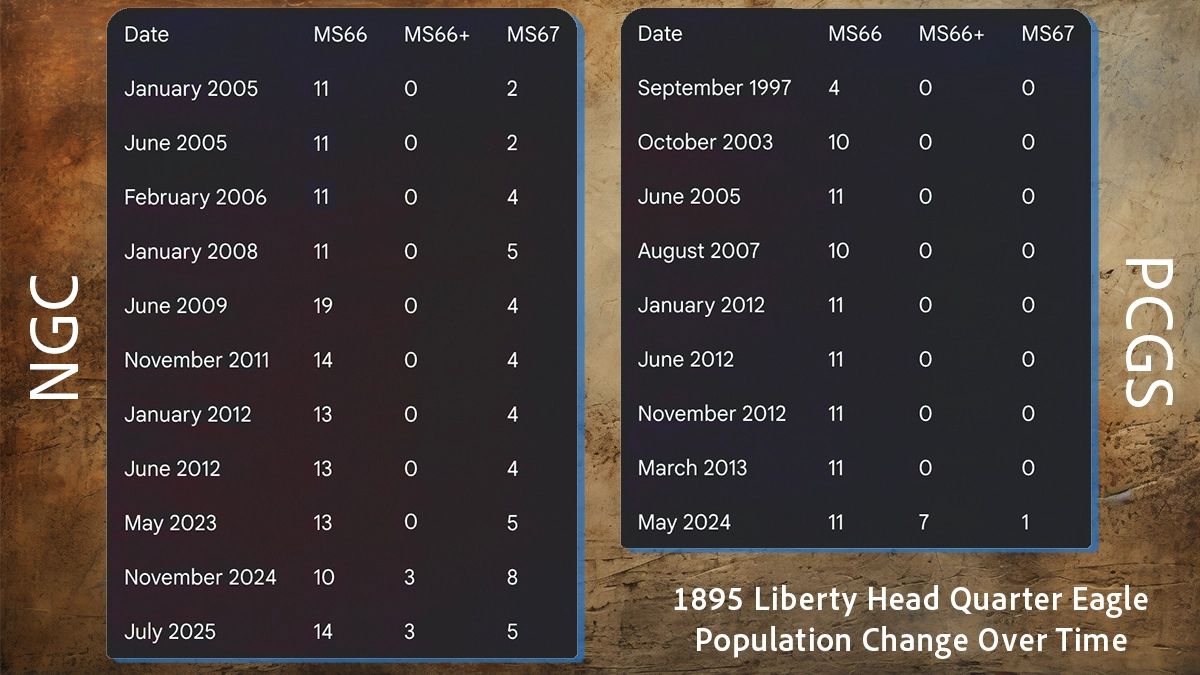
However, collectors must exercise caution. Crossovers, resubmissions, and cataloging errors can inflate population counts.
Grading Trends
Importantly, the data shows no sudden surge of superb gem coins.
MS66+ and MS67 coins increased gradually.
Plus grades appeared after grading services adopted the “+” designation around 2010.
Earlier records reflect the pre-plus era.
Typically, MS66 coins upgrade to MS67 over time. However, that pattern remains limited here. High-end examples have surfaced slowly and steadily over the past two decades.
Eventually, the finest survivors will likely surface. At that point, population growth should plateau.
Top Certified Populations (As of August 2025)
- PCGS MS67: 3
- NGC MS67: 5
- CAC MS67: 0 stickered / 1 graded
1895 Liberty Head Quarter Eagle Specifications
- Country: United States of America
- Year: 1895
- Denomination: $2.50
- Mintmark: None (Philadelphia)
- Mintage: 6,000
- Alloy: .900 Gold, .100 Copper
- Weight: 4.18 grams
- Diameter: 18.00 mm
- Edge: Reeded
- Designer: Christian Gobrecht
- Quality: Business Strike
Final Analysis: A Low-Mintage Survivor of a Financial Crisis
The 1895 Liberty Head Quarter Eagle reflects more than a small mintage. It embodies a moment of economic anxiety and political transformation.
Gold reserves stood on the brink. The nation debated silver versus gold. Financial confidence faltered. Yet gold coinage continued.
Today, superb gem examples appear only occasionally. Population growth remains gradual. No evidence suggests a hidden supply.
For advanced collectors, the 1895 Liberty Head Quarter Eagle offers both historical depth and certified scarcity. It stands as a tangible reminder of America’s struggle to preserve monetary stability during one of its most volatile decades.









Very informative
Very good article
never seen one
LEGENDARY COIN.
I do have A USD20 1877 GOLD COIN WHAT IS THE VALUE I CAN EXPECT. HOW TO SELL
Value depends on Condition, authenticity and rarity (mint mark and surviving population) Get the coin certified by PCGS or ngc and then sell on ebay or through one of the major us Coin Auction forms like Stack’s Bowers, Heritage or GreatCollections. Run a search on Google for “1877 $20 liberty coins” do see some coins and what the asking prices are.
Never seen one. Very good article.
Looking for one, good article, thanks
Fascinating article on the 1895 Liberty Head Quarter Eagle.