


By Doug Winter – RareGoldCoins.com ……
How I Judge Quality in Rare U.S. Gold (1795–1933)
Recently, a reader, D.N., sent me a thoughtful email. He wrote:
“…you may be the only dealer of any US series (including gold) that strictly employs an advanced copper collector approach to quality: originality, luster, surfaces, color, eye appeal, etc. with little compromise.”
First, I appreciate the comment. Second, it made me reflect on how I evaluate rare U.S. gold coins struck from 1795 to 1933.
I did not consciously adopt a “copper collector’s mindset.” However, I do apply strict standards. In fact, I believe collectors of early and branch mint gold must demand the same discipline.
Below, I will explain exactly how I judge quality. We will focus on:
- Originality
- Luster
- Surfaces
- Color
- Eye Appeal
- Strike
These standards guide every purchase I make for inventory.
Originality: The Most Important Factor in Rare U.S. Gold
Originality drives everything. Without it, the rest hardly matters.
Unfortunately, the term “original” gets abused. Dealers and collectors use it loosely. Yet no one can prove that a coin has never been cleaned, dipped, processed, or altered. Therefore, originality remains an informed opinion—not a documented fact.
That said, experience matters.
I estimate that at least 90% of circulated U.S. gold coins have seen some form of cleaning. Many pieces received light wiping more than 100 years ago. Over time, they developed secondary toning. Today, that color can mimic true first-generation surfaces.
However, certain coins offer better odds.
Repatriated Hoards and Fresh Material
Over the years, I have handled hoards repatriated from overseas sources. These coins often sat untouched for generations. As a result, they display a look that feels unquestionably original.
For example, Swiss banks did not dip No Motto eagles to make AU50 coins resemble AU58 pieces. Coins stored overseas often escaped the “improvement” culture common in the United States.
Applying Standards by Rarity
Importantly, I adjust my strictness based on rarity.
An 1848 half eagle appears commonly in grades up to MS62–MS63. Therefore, I demand exceptional originality.
An 1865 half eagle, however, ranks rare to very rare in all grades. In this case, I may accept light cleaning if the coin checks other boxes.
In short, common coins must be exceptional. Rare coins get more flexibility, but never a free pass.
Luster: The Life of an About Uncirculated or Mint State Gold Coin
For coins grading About Uncirculated or Mint State, luster plays a critical role.
In fact, luster matters far more in gold than in copper.
Collectors must learn to recognize different types:
- Frosty
- Satiny
- Semi-prooflike
- Prooflike
- Hybrid textures
Each type reflects die state, mint practices, and planchet quality.
For instance:
- An 1888 Three Dollar gold piece typically shows thick, frosty luster.
- An 1861 Three Dollar gold piece displays a more satiny texture.
- Low-mintage issues such as 1881 or 1885 often appear prooflike.
Since third-party grading began, many circulated coins have received artificial treatments to simulate luster. These bright, flashy surfaces fool novices. However, experienced buyers immediately reject them.
True luster flows. Artificial brightness sits on the surface.
Surfaces: Preservation, Marks, and Hidden Problems
When I discuss surfaces, I focus on preservation, especially contact marks.
Gold ranks as the softest coinage metal. Therefore, coins transported in bags or circulated heavily pick up deep abrasions. Large denominations, particularly double eagles, suffer the most.
Location Matters
A mark on Liberty’s cheek kills eye appeal.
The same mark on the lower reverse may not matter at all.
Prime focal areas determine acceptability.
Mint-Made Surface Issues
Early gold coins often show adjustment marks. I accept them unless they appear deep or land directly on Liberty’s face.
Other mint-made issues include:
- Black grease stains
- Copper spots
- Laminations
These factors require judgment, not automatic rejection.
Hidden Problems and Third-Party Grading
I remain astonished at the number of early gold and Territorial pieces that receive straight grades despite:
- Tooling
- Scratches
- Burnishing
- Collectors must inspect carefully, even in slabs.
- The edge represents the “third side” of the coin. Always check for rim nicks or edge tooling.
Color in U.S. Gold Coins: Subtle but Critical
Copper collectors obsess over color. Gold collectors should care more than they do.
Unlike copper, gold does not command massive premiums for color alone. However, truly natural and unusual color increasingly attracts attention.
In my books, I describe the “correct” color for specific issues. Collectors must train their eyes.
For example, the proper color of an 1852-C quarter eagle differs from that of a Philadelphia issue.
Why?
All U.S. gold coins contain 90% gold. However, the alloy mix varies. Gold from the Comstock Lode carries a different hue than gold mined in Appalachia. Copper and silver percentages shift subtly. Those shifts influence color.
Deep Toning in Gold
Occasionally, U.S. gold coins display spectacular deep color. Storage in leather pouches or volatile environments can create this effect.
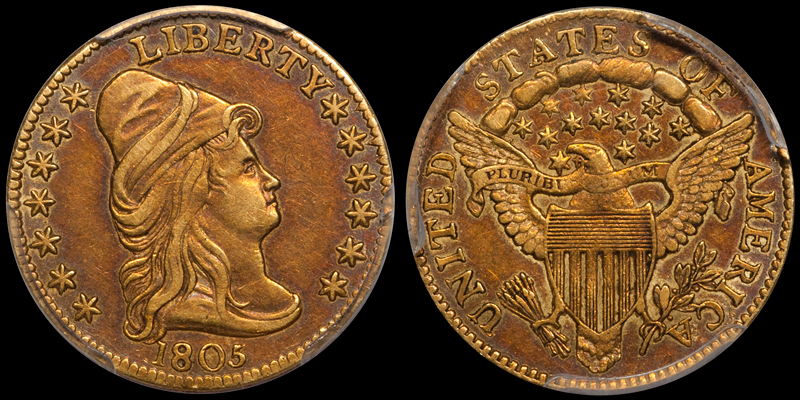
While premiums remain modest compared to rainbow-toned silver or red copper, I expect strong premiums for beautifully toned gold in the coming years.
Eye Appeal: The Sum of All Parts
Eye appeal combines:
- Originality
- Surface preservation
- Luster
- Color
Grading services now emphasize eye appeal heavily.
For example, a coin with more marks than typical for AU55 may still grade AU58, MS61, or even MS62 if it displays strong eye appeal.
Collectors who rely solely on technical grading standards struggle in today’s market. Standards evolved. The market rewards beauty and originality.
Right or wrong, that reality governs pricing.
Strike: A Minor Factor in Most U.S. Gold
Finally, let’s address strike.
I consider strike a minor factor in most buying decisions.
However, context matters.
- 1844-D quarter eagle often appears weakly struck, yet sharply struck examples exist. Therefore, I may wait for a better piece.
- 1850-C half eagle sometimes shows weak mintmarks. I prefer sharp mintmarks when available.
- 1856-D quarter eagle almost always comes weakly struck. Waiting for a sharply struck example makes no sense. It likely does not exist.
In other words, understand the issue before rejecting the coin.
Final Thoughts on Buying Rare U.S. Gold Coins
I thank D.N. again for his thoughtful comment.
Yes, I apply strict standards. I demand originality, scrutinize luster, analyze surfaces, evaluate color carefully, and I always weigh overall eye appeal.
Above all, I buy coins, not plastic holders.
If you would like me to address a specific question about rare U.S. gold coins from 1795–1933, feel free to contact me.
Doug Winter
Doug Winter Numismatics
RareGoldCoins.com
A toned 1805 $2.50 PCGS AU50, from the Douglas Winter Numismatics Archives
About Doug Winter
 Doug has spent much of his life in the field of numismatics; beginning collecting coins at the age of seven, and by the time he was 10 years old, buying and selling coins at conventions in the New York City area.
In 1989, he founded Douglas Winter Numismatics, and his firm specializes in buying and selling choice and rare US Gold coins, especially US gold coins and all branch mint material.
Recognized as one of the leading specialized numismatic firms, Doug is an award-winning author of over a dozen numismatic books and the recognized expert on US Gold. His knowledge and an exceptional eye for properly graded and original coins has made him one of the most respected figures in the numismatic community and a sought after dealer by collectors and investors looking for professional personalized service, a select inventory of impeccable quality and fair and honest pricing. Doug is also a major buyer of all US coins and is always looking to purchase collections both large and small. He can be reached at (214) 675-9897.
Doug has been a contributor to the Guidebook of United States Coins (also known as the “Redbook”) since 1983, Walter Breen’s Encyclopedia of United States and Colonial Coins, Q. David Bowers’ Encyclopedia of United States Silver Dollars and Andrew Pollock’s United States Pattern and Related Issues
In addition, he has authored 13 books on US Gold coins including:
- Gold Coins of the New Orleans Mint: 1839-1909
- Gold Coins of the Carson City Mint: 1870 – 1893
- Gold Coins of the Charlotte Mint: 1838-1861
- Gold Coins of the Dahlonega Mint 1838-1861
- The United States $3 Gold Pieces 1854-1889
- Carson City Gold Coinage 1870-1893: A Rarity and Condition Census Update
- An Insider’s Guide to Collecting Type One Double Eagles
- The Connoisseur’s Guide to United States Gold Coins
- A Collector’s Guide To Indian Head Quarter Eagles
- The Acadiana Collection of New Orleans Coinage
- Type Three Double Eagles, 1877-1907: A Numismatic History and Analysis
- Gold Coins of the Dahlonega Mint, 1838-1861: A Numismatic History and Analysis
- Type Two Double Eagles, 1866-1876: A Numismatic History and Analysis
Finally, Doug is a member of virtually every major numismatic organization, professional trade group and major coin association in the US.







I cannot agree more with the explanation on Gradng, considering Strike, Color. eye appeal and
lustre are the major factors is ascertaining a Grade of a Gold Coin. I believe, as many old time
dealers and specialists have told me, that the SIMPLISTIC NUMERICAL GRADING, omits what
can and does express what the buyer should see. We at Stack’s and later Stack’s Bowers. had
in the earlier days of describing a coin, adhered to the ADJECTIVAL GRADE, for it exprressed,
with the average coin can reveal, more exact description of the actual GRADE as seen by a
qualified Grader. NUMERICAL GRADE is to me a Short Cut in expressing a grade, and therefore
can be misleading when one who is not fully trained to understand the NUMBER , looks at
the highest number, and feels it is a correct grade. The variance between a 61 and 63, or
say a 55 and 58, or between a 67,68 or 69, is so infinitesimal that higher sums are paid for
the higher number, because of the ARBITRARY NUMERICAL GRADE assigned to it by a Service
or Professional. Since I have lived through the development from the SHELDON NUMERICAL
GRADE SYSTEM FOR LARGE COPPER CENTS , till today with the use of the NUMERICAL GRADE,
(which is primarily the SYSTEM used by the Various GRADING SERVICES and making the
buyer feel that they know best ! (For the record, I know of many , many cases, where
the simple NUMERICAL GRADE was raised, (UPGRADED) when resubmitted from one SERVICE
TO ANOTHER, ( OR SENT BACK TO THE ORIGINAL SERVICE) that the exact qualities that make
one opinion SUPERIOR to ANOTHER, starts to become a VERY MUTE POINT.
YES , WE USE NUMERICAL GRADING, BUT , WHEN DESCRIBING A COIN we also express our
opinion as to the use in conjunction with the number, a extended ADJECTIVAL EXPRESSION,
so that the buyer can evision what he is getting and can visualize the grade.
I believe all who GRADE A COIN, should adhere to the following : ‘”GRADING IS IN THE EYE
OF THE OBSERVER,” and when used with a fuller ADJECTIVAL grade, provides more of
on indication, just what one is acquiring. I always think of the famous saying I heard for
decades, ”OLD SYSTEM DO NOT DIE, THEY JUST FADE AWAY ” , I SURELY FEEL THAT
ADJECTIVAL GRADING HAS A LONG WAY TO GO BEFORE IT WILL FADE AWAY !!!!!!
What a great source of info for ways to judge your coins or do a self evaluation of your personal collection.