


n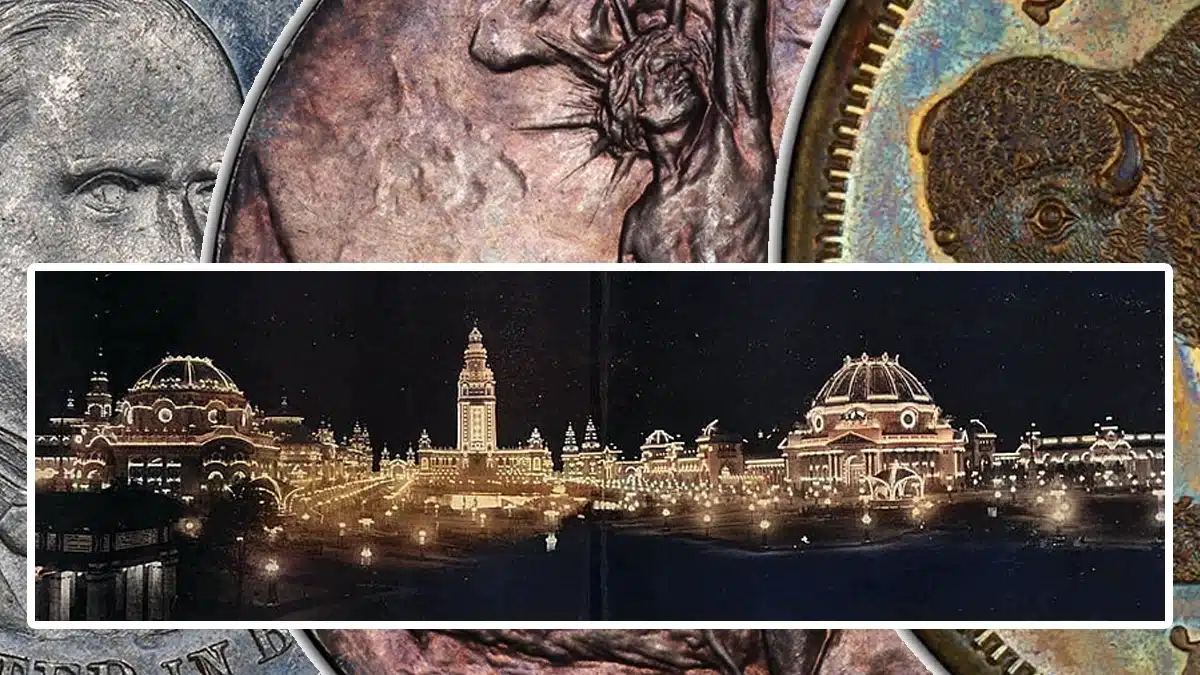
By Vic Bozarth for PCGS ……
This article continues my series on medals and tokens from World’s Fair expositions held between 1876 and 1926. It focuses on the medals and tokens of the 1901 Pan-American Exposition in Buffalo, New York.
Only three Pan-American medals or So-Called Dollars came from the expo. However, the tragedy that occurred there makes the event essential to any survey of major world’s fairs.
Triumph and Tragedy at the Buffalo Expo
The exposition ran from May 1 to November 2, 1901. More than eight million people attended. At least 5.3 million visitors paid the 50-cent admission fee.
Investors quickly bought $5 million in stock and capital bonds. State and federal grants added another $800,000.
Rail service determined the success of most expositions. Organizers depended on easy travel for visitors. The Chicago and North-Western Railway promoted “through” train service to several major cities. Buffalo secured the expo over Niagara because it offered better rail access.
Visitors also enjoyed attractions on the fairgrounds.
The McGarigle Brothers built and operated a popular miniature railway. For 10 cents, guests could ride the train around the grounds. A nine-foot engine pulled small gondola cars with double seats along a 15-inch track. Six stations served the route across the fairgrounds. McGarigle miniature railways also appeared at many other expositions.
The Buffalo Pan-American Exposition holds an important place in American history. Electric lights illuminated the fairgrounds. At the time, large-scale electric lighting still seemed new and exciting.
McKinley visits the Exposition
Another major event occurred on September 5, 1901. President William McKinley visited the exposition and delivered a speech. During his address, he said:
“Expositions are the timekeepers of progress. They record the world’s advancement and stimulate the energy, enterprise, and intellect of the people; and quicken human genius. Whehey go into the home. They broaden and brighten the daily life of the people. They open mighty storehouses of information to the student.”
Few presidents supported international expositions and world’s fairs as strongly as McKinley. Sadly, history remembers his visit for tragic reasons.
On September 6, McKinley greeted citizens at the exposition. During the reception, an assassin shot the president. McKinley died from his wounds nine days later. His young vice president, Theodore Roosevelt, assumed the presidency.
Organizers later printed McKinley’s “Last Public Address and Proclamation” in a pamphlet for the Louisiana Purchase Exposition. The quote above represents only a small portion of his thoughtful 30-minute speech.
McKinley’s assassination shocked the nation. The event also marked a cultural turning point. McKinley represented the steady conservatism of the 19th century. Roosevelt soon introduced a more energetic and progressive style of leadership. Numismatists know Roosevelt as the driving force behind the redesign of American coinage. Events like these help connect the dots in the broader march of history.
Pan-American Expo Medals and Tokens
The United States Treasury Department operated an exhibit inside the U.S. government building. The building stood near the main entrance from the esplanade.
Inside the exhibit, the United States Mint struck official exposition medals on site.
Mint workers produced the official medal in silver, copper, and brass. Designer G. T. Brewster created the piece. The obverse shows a Native American figure riding a soaring eagle. The reverse features a relief map of the Western Hemisphere along with the exposition’s official logo.
Official Medals
These official medals are designated as follows:
- PCGS #642671, HK-287 – Silver (Rarity-6)
- PCGS #642672, HK-288 – Copper BN (R-7)
- PCGS #642673 – Copper RB
- PCGS #642674 – Copper RD
- PCGS #642675, HK-289 – Brass (R-8)

Other So-Called Dollars issued for the Pan American Expo include the President McKinley Assassination Dollar and the Buffalo Dollar. These medals are designated as:
- PCGS #642676, HK-290 – McKinley Brass (R-6)
- PCGS #642677, HK-290a – Aluminum (R-6)
- PCGS #642678, HK-291 – Buffalo Brass (R-5)


In addition to the Mint and Treasury Department installation, there was another highly significant numismatic display at the Pan-American Expo. Separate from the Mint exhibit, in a small dedicated building bordering the midway, was an exhibit housing what was dubbed the “First Coin Machine Used By the U.S. Mint” serving as a souvenir concession. This steam press, which was used at the Philadelphia Mint from 1836 through 1874, was earlier displayed at the Centennial and then the Columbian expositions in 1876 and 1893, respectively.
This steam-operated press struck souvenir medals in two designs, including one serving as a Pan-American memento and the other featuring the Lord’s Prayer. They were offered from 25 cents to $2.50 for gold-plated and 14K compositions. The Lord’s Prayer design was offered in sterling silver for 35 cents, in addition to the gold issues.
Lord’s Prayer Medal
- Gold-plated
- Sterling Silver
- 14K gold
Pan-American Medal
- Gold-plated
- 14K gold
Each of these souvenir coins included a card describing the press itself and the two souvenir token designs available from Historic Coin Press Co. of Buffalo, NY.
After the Expo
As with most fairs, the majority of the buildings and grounds of the Buffalo Pan-American Expo were cleared afterward. The only major building to survive from the fair is the New York State Building. But in a case of pure happenstance, the souvenir Pan-Am Coin Concession Hut survived the teardown. William Simon of the Simon Brewing family bought the hut and moved it to his property in Gardenville, New York, shortly after the fair.
The hut, used as a gazebo and goat shed, was rediscovered in 1999, although the story of the hut’s history was known to the family. The Werner family, current owners of the Gardenville property, contacted the Buffalo History Museum in 1999, inquiring if they would be interested in having it. Today, the shed has been restored to its original glory and is housed at the Forest Avenue Resource Center of the Buffalo Museum. Incidentally, the original fairgrounds has been a residential neighborhood for more than a century.

* * *
For more information from PCGS, the sponsor of this article, click on the image below.

* * *






These articles are always usefully informative.
Great article. And great exonumia at that exposition.