


Collectors rarely encounter a $2 note like this.
A 1928E $2 Legal Tender Star Note graded PMG Choice Uncirculated 64 EPQ will appear at auction when Stack’s Bowers Galleries presents its U.S. Currency Rarities Night sale on March 12.
At first glance, it may resemble a typical small-size $2 bill. Yet the note tells a far deeper story. Its rarity stems from a perfect storm of factors: a short-lived signature combination, replacement-note status, and exceptional preservation.
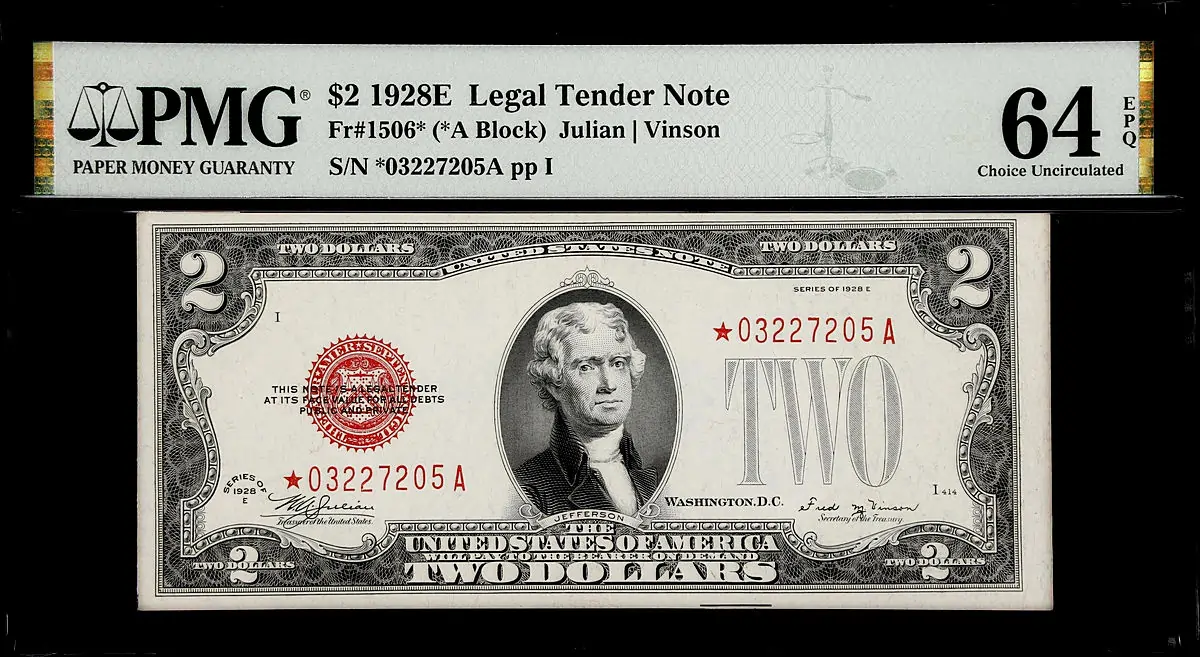
For advanced collectors, this piece represents far more than a denomination novelty. It stands among the most elusive survivors of its kind.
The Enduring Appeal of the $2 Note
The $2 note has always occupied a special place in American currency collecting.
Although millions entered circulation over the decades, the denomination never achieved the everyday familiarity of the $1 or $5 bill. As a result, collectors developed a lasting fascination with the note.
However, the importance of this example begins with its series.
The Series of 1928 introduced the first reduced-size U.S. paper money. The government adopted the smaller format to reduce printing costs and simplify handling. Consequently, the issue marked the beginning of the modern era of American currency.
Collectors today often seek high-grade examples from these early small-size issues.
A Signature Pairing That Barely Lasted a Year
The historical story behind this note centers on its signatures.
The note carries the engraved signature of Treasurer of the United States W.A. Julian, who served from 1933 to 1949. Julian’s tenure set a record for length of service. During those years, he worked with multiple Treasury Secretaries under two presidential administrations.

One of those officials was Fred M. Vinson of Kentucky.
President Harry S. Truman appointed Vinson as Secretary of the Treasury in 1945. Yet his time in the position proved brief. In 1946, Truman nominated Vinson to become Chief Justice of the United States.
The Senate confirmed the appointment. Vinson therefore joined a small group of Americans who served in all three branches of the federal government.
Because of this transition, the Julian–Vinson signature combination appeared on currency for less than a year, between 1945 and 1946.
Naturally, that short window limited the number of notes produced.
Replacement Star Notes Are Always Scarcer
This particular note becomes even more desirable because it is a replacement star note.
The Bureau of Engraving and Printing issued star notes only when it needed to replace defective sheets during production. These substitutes carried a star symbol in the serial number instead of a letter suffix.
Because of this process, replacement notes always exist in smaller quantities than regular issues.
The Series 1928E $2 Legal Tender Notes themselves are scarce. In fact, the entire printing represents only about 4.4% of the total number produced for the preceding Series 1928D.
Precise replacement totals remain unknown. Still, collectors understand that very few star notes emerged from such a limited production.
An Elite Survivor in Remarkable Condition
The rarity of this note becomes even clearer when examining population data.
According to Track & Price, only 32 examples appear in their database. Meanwhile, the PMG Population Report lists just 30 graded examples across all grades.

This particular note carries the grade PMG Choice Uncirculated 64 EPQ.
Even more remarkable, PMG reports only three notes at this level with none graded higher.
Auction records also tell a striking story. Only two examples at this grade have appeared publicly in the past twenty years.
In other words, collectors seldom receive an opportunity like this.
A Building Block for an Elite Collection
Serious currency collectors often search for notes that combine multiple layers of rarity.
This example delivers exactly that combination.
It features:
- The widely collected $2 denomination
- A first-generation small-size issue from 1928
- The short-lived Julian–Vinson signature pairing
- Replacement star note status
- Exceptional preservation
Taken together, these attributes create a note that few collectors will ever encounter in person.
When the hammer falls on March 12 at Stack’s Bowers Galleries, bidders will compete not simply for a $2 bill, but for one of the finest known survivors of a remarkable chapter in U.S. paper money history.






THAT is a lucky 2 dollar bill!
Not sure I understand how a smaller size makes for easier handling. Since currency is usually given and taken in multiple denominations at a time, having a smaller size for one denomination would not help it stack neatly with others. But maybe I’m missing the whole picture.
@SuzieB: To add some more information, US currency underwent a full reworking in 1929. All denominations were reduced to the same size, approximately 66.3 x 156 mm. In addition standardized portraits were chosen and specific seal colors were adopted to designate each of the four then-extant currency types. While the new bills were released in the middle of that year they were printed with 1928 series dates.
It’s also worth noting that a lot of nations commonly issue bills whose sizes differ by denomination as an anti-counterfeiting measure. My experiences while travelling abroad is that there aren’t problems with stacking, etc. plus the different sizes can actually help with identification.
The $2 note was commonly used for betting on horse races: “The Daily Double”.
@Richard Vail: Very true! Many decades ago that association as well as some others that were um, even less mainstream, contributed to the $2 note’s low use. Using $2 notes was seen as an indication that you’d been visiting a racetrack or other, more-dubious venues :)
It also didn’t help that $2 bills acquired the obvious nickname “deuce”. The word was a euphemism for the Devil; e.g. someone might say “What the deuce!” as opposed to using a cruder expression. That connection spawned a strange myth that the bills themselves were tainted (really!), in turn leading yet more people to reject what should otherwise be a perfectly ordinary denomination.
Very interesting! Nice