


By Jeff Garret for NGC
Want to collect this series? Start by looking at the assorted inaugural 2000 issues and deciding what your budget is.
The US Mint recently made an unusual move when it auctioned five examples of the 2000-W Sacagawea Dollar, which had been struck in gold. These previously unavailable numismatic “delicacies” sold for prices between $350,000 and $500,000 each. The history of these coins and the short-lived Sacagawea Dollar series is quite interesting.
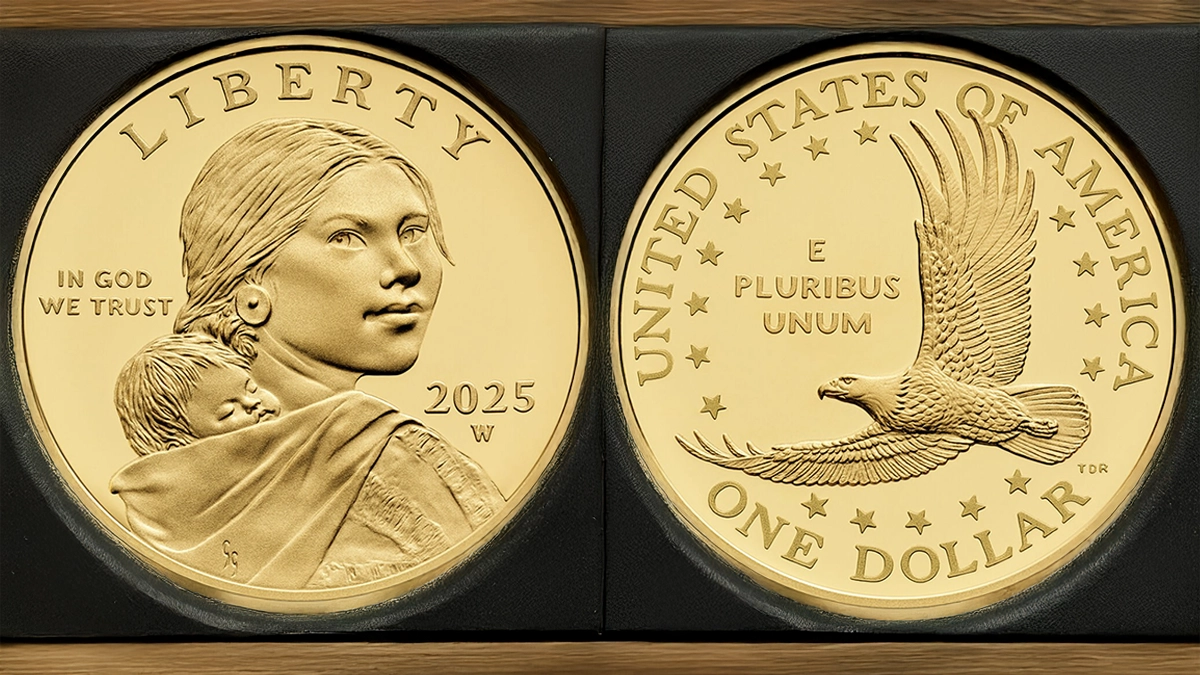
The 2025 release of another gold coin to commemorate the 25th anniversary was met with an enthusiastic response, as all 7,500 coins sold out quickly. A collection of Sacagawea Dollars struck from 2000 to 2008 can easily be assembled but would not be complete without spending a considerable fortune.
The Sacagawea Dollar was created in 2000, with a golden color and plain edge to distinguish it from other coins of a similar size. The ill-fated Susan B. Anthony coin was too close in size and color to circulating Quarter Dollars. The new Dollar coinage alloy and change of appearance were mandated by the United States Dollar Coin Act of 1997. The new Sacagawea Dollar coin was struck in pure copper, with a golden outer layer of manganese brass. The obverse design featuring Sacagawea, the Shoshone Indian who assisted the Lewis and Clark expedition, was created by the famed sculptor, Glenna Goodacre. The reverse was designed by Thomas D. Rogers.
The coins produced in 2000 for the introduction of the Sacagawea Dollar are among the most complex and rarity-filled debuts of a coin ever. The following are the different coins issued in just the first year:
2000-P Goodacre Presentation Finish
- Mintage: 5,000
- Graded by NGC: 302
- Finest Graded by NGC: MS 68
Glenna Goodacre had a good working relationship with then-Mint Director Philip Diehl. She had the incredible foresight to request her design fee of $5,000 to be paid in the newly minted coins. At a special ceremony on April 5, 2000, the coins were delivered to her studio by the Mint Director and two Mint Police officers. During early production of the Sacagawea Dollar, the US Mint was having issues with discoloration and many of the coins were produced with a burnished finish, giving the coins a special and distinctive appearance.
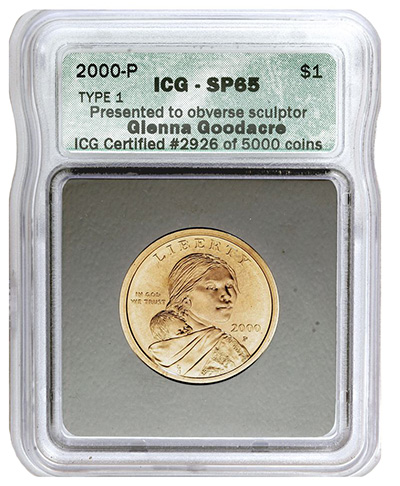
These special coins would prove a bonanza for Goodacre. Her studio began selling the presentation coins for about $200 each, and nearly 3,000 were sold before officials at the US Mint protested. Goodacre stopped selling the coins. In 2010, Coin World ran a 10th anniversary article about the Sacagawea Dollar and mentioned the presentation coins and the controversy around her sales. The article also noted that 2,000 coins had remained unsold. Thanks to the power of Google, I was able to contact her agent to inquire about the unsold coins.
After a few months, her agent, Dan Anthony, contacted me to apologize for the delay and shared that they had misplaced the coins. The coins had been found in the wine cellar, and they would indeed be interested in selling them. A quick trip to Sante Fe resulted in me purchasing the 2,000 coins. The coins were sold into the marketplace quickly, with the exception of a few coins retained for my collection. I also developed a great relationship with Goodacre and her agent. I was able to facilitate the transfer of her archival material for early designs to the Smithsonian Numismatic Collection, where they reside today. The collection is a wonderful example of numismatic “what could have been.”
2000-P Cheerios Prototype Sacagawea Dollar
- Mintage: 5,500
- Graded by NGC: 62
- Finest Graded by NGC: MS 69
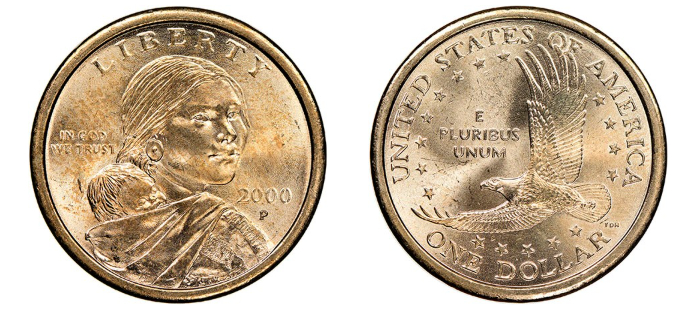
This famous variety of the Sacagawea Dollar is an early release coin with the tail feathers showing prominent diagonal lines. This was the first type of die in use, and the same one used for the small number of 2000-W gold coins mentioned above. The eagle was later modified to show the tail feathers in parallel lines, this being the regular release. To promote the newly released Sacagawea Dollars, the US Mint arranged with General Mills to create a treasure hunt by placing one of the 5,500 coins struck in every 2,000 boxes of Cheerios.
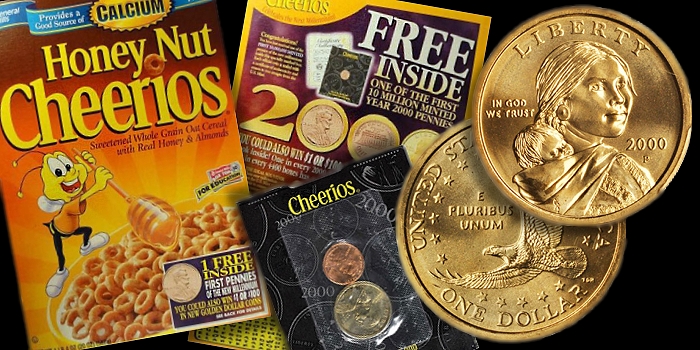
The unique reverse variety was not recognized until 2005, when a collector sent one to NGC for authentication and grading. By then, most of the issue had been spent and well dispersed. Coins still show up on occasion and still command prices in the thousands of dollars when sold at auction. This issue is one of the most annoying inquiries for coin shops around the country, as the general public has a hard time understanding the subtleties of the variety.
2000-W Gold Sacagawea
- Mintage: 39
- Net Mintage: 12
The US Mint produced 39 Sacagawea Dollar coins in 22-karat gold at the West Point Mint (or possibly Philadelphia) in 1999. All but 12 coins were later melted. These coins were struck with the prototype reverse design, featuring boldly detailed tail feathers. As mentioned above, the prototype reverse design was later used for early circulation strike coins that were packaged as a promotion in boxes of Cheerios cereal.
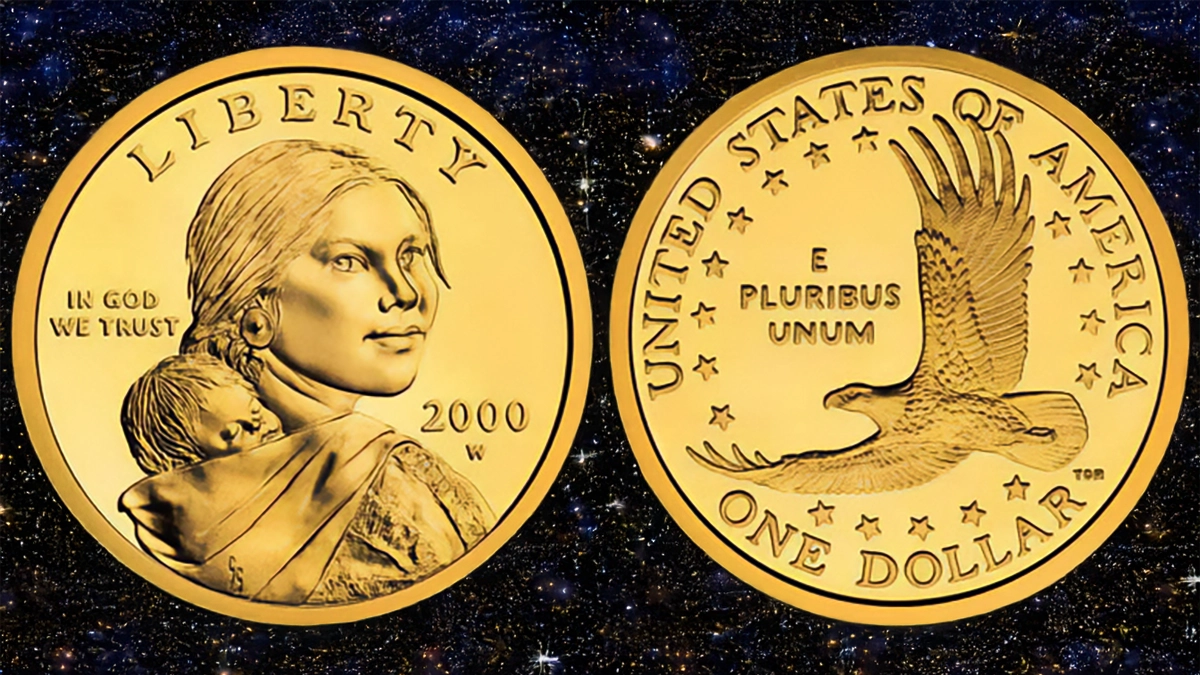
The one dozen gold examples were sent on the US space shuttle Columbia to honor astronaut Eileen Collins, the first female commander of a space shuttle flight. The coins traveled 1.8 million miles. After years of being stored at Fort Knox, the coins were last publicly displayed at the 2007 World’s Fair of Money in Milwaukee. The US Mint recently sold five examples, creating one of the rarest and most expensive modern coins ever.
2000-P Sacagawea
- Mintage: 767,140,000
- Graded by NGC: 7,089
- Finest Graded by NGC: MS 69
As can be guessed from the high mintage, this issue is very common and can be found with little effort. Interestingly, several hundred million of these and the Denver Mint issue were sent to Ecuador, where they saw extensive circulation.
2000-D Sacagawea
- Mintage: 518,916,000
- Graded by NGC: 1,751
- Finest Graded by NGC: MS 69
IMAGE – A 2000-D Sacagawea Dollar
Another common issue, scarce only in the highest states of preservation.
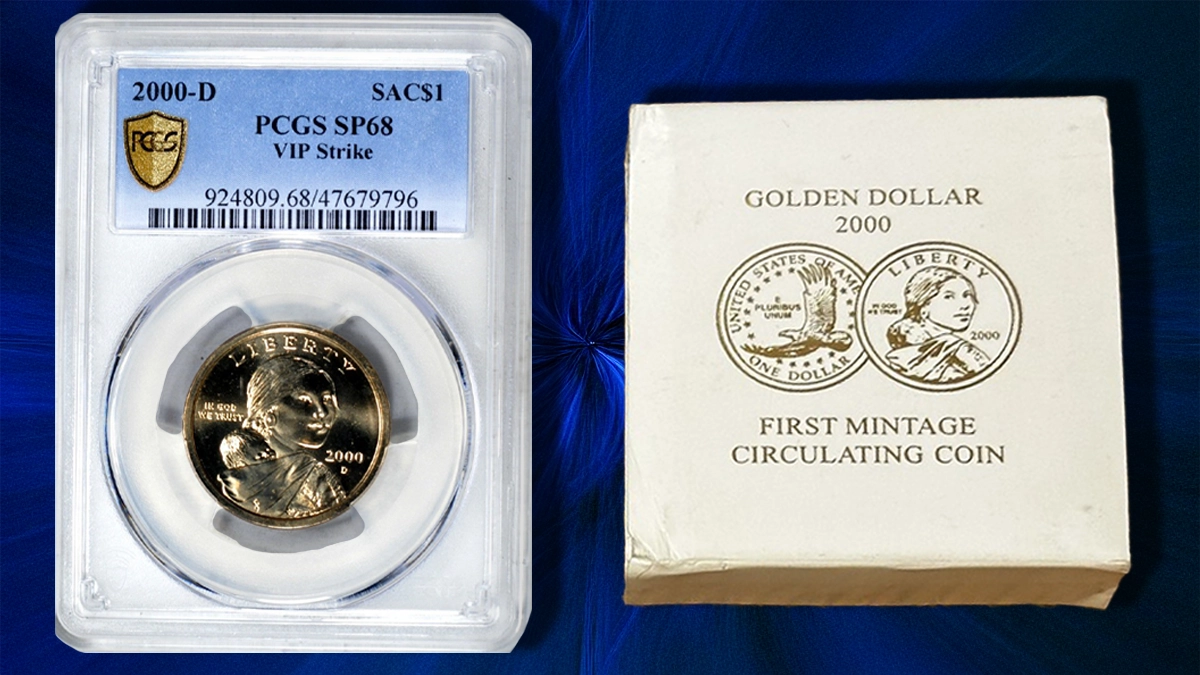
2000-D Sacagawea Burnished Millenium
- Mintage: 75,000
- Graded by NGC: 439
- Finest Graded by NGC: MS 69
In the US Mint’s 2000 Holiday Catalog, one of the celebratory products offered was the United States Millennium Coin and Currency Set. The set contained a 2000 Silver Eagle, a 2000-D Sacagawea Dollar and a $1 Federal Reserve Note, with the serial number starting with 2000. These sets were offered for $39 each. The Goodacre Dollar was struck with a finish similar to the Goodacre Presentation coins mentioned above.
2000-S Sacagawea Proof
- Mintage: 4,047,904
- Graded by NGC: 17,963
- Finest Graded by NGC: PF 70 Ultra Cameo
(The mintage represented the total coins produced for the Clad and Silver Proof sets of the year.)
Additional Coins
In addition to the above coins produced in 2000 for the Sacagawea Dollar, there were also limited numbers of coins struck during VIP ceremonies at the Philadelphia and Denver Mints. Invited dignitaries and guests could, in some cases, push buttons to have a coin struck. Today, these coins are very rarely encountered and highly desirable.
As if there were not enough regular and special issues of the 2000 Sacagawea Dollar produced, the US Mint also created one of the most desirable mint errors ever. In the 2000s, a small number of coins were struck with a Washington Quarter obverse and the Sacagawea Dollar reverse. Research reveals that the coins were probably intentionally produced.
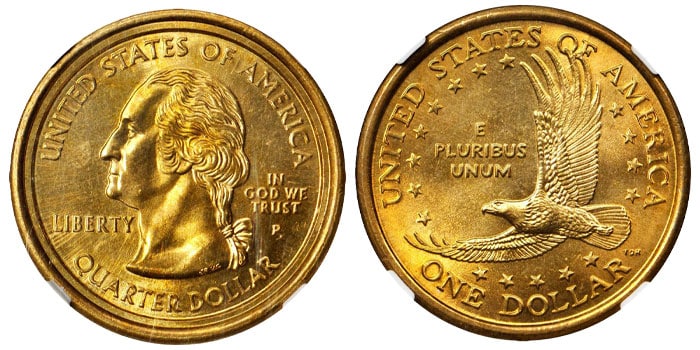
Two different mint employees were arrested in the case. The US Mint never pursued the return of the coins and they trade freely, yet expensively, in the marketplace. One collector became enamored with the issue and at last count owned the majority of the known examples.
Collecting the first year of issue is a popular pursuit for many numismatists. The 2000 Sacagawea Dollars can create quite the challenge for any collector. The issue is an interesting chapter in the attempt by the US Mint to produce an alternative to the paper dollar. Despite decades of trying, the effort has never been successful. Today, coin collectors are the beneficiaries of the attempt.
Want to see more articles like this? Subscribe to the free NGC Weekly Market Report.





IMHO the failure of $1 coins in the US can be traced to lack of action by both Congress and the Treasury. Every other country that’s successfully introduced a 1-unit coin has also taken two other steps to ensure circulation:
First, they’ve discontinued their equivalent paper note once enough coins had been struck. Our Congress however has bent to the paper lobby and forced continued printing of a billion or more paper dollars every year.
Second, those countries make wide use of a 2-unit denomination. By reducing the number of coins needed to make change, it blunts the very real objection to carrying “a pocketful of $1 coins” often cited by opponents. The US as we all know still treats the denomination as a historical curiosity
Those are great observations. I noticed in the CCAC minutes not long ago, they made recommendations for larger denomination coins. I don’t recall if those were intended for circulation, or just for collecting purposes. As both a collector and someone that uses dollar coins regularly to try to spark more interest in them, I would love to see the Mint produce larger denomination coins.
Thank you for rescuing the archival material and getting it into the safe hands of the Smithsonian.
Great article on the Sacagawea Dollar.
fingers crossed
who knew? A lot of money was made for early buyers!
Such a beautiful coin! Interesting about the Washington quarter obverse error.
very good article!
never knew there were so many examples of this coin. I do wish the US would encourage more $ 1 and $2 coin use.
interesting read
Very nice set of coins
Interesting Article!
Hope I win!
This was one of my favorites!
I am not a big fan of modern coins unless it has some gold or silver in it.
I have a couple of these, I’ll have to take a closer look!
I always end up tucking them away somewhere when I come across one.
More information I was not aware of.
Hope I win!!
Very interesting article. I would not have guessed there were so many variations
I knew about the Cheerios dollars (wish I had one) but never knew about this history. My issue with the Susan B.s were the size… I spent one as a quarter once, never carried another one. Great article and interesting information!!
@Charles Emerick IMO the issue wasn’t so much the coin’s size but the fact that the Mint and Treasury ignored expert advice to strike it with a distinctive color and planchet. E.g. cents and dimes are closer in size than quarters and dollars, but the only ones that were ever mixed up were the 1943 “steelies” that were similar in color. More currently, Canada’s quarter and the iconic “Loonie” are almost identical in size to their US counterparts but are rarely if ever confused, because they have distinctive appearances and tactile signatures.
This comment is for the extra entries in the coin giveaway #612 thank you
I loved the article about the Sacagawea dollars! Very informative.
I inadvertently misspelled my last name. It is Hackenkamp not Hacy.
Great info!……
Great article!
This is a great article about an often overlooked coin. I am currently working on a dollar set that includes the Sacagawea, Native American, Presidential and Innovation Dollars in Proof and/or Reverse Proof. This set would be easy enough, both in cost and availability,to complete for new and old collectors and is beautiful to boot. I never considered trying to collect some of these others within the 2000 Sacagawea, but you may have just given me a challenge!
When the first Sacagawea dollars were produced I thought it felt like a real gold coin. Don’t remember the Cheerios contest.
Super informative article.
Didn’t know they made them 8n gold
I love this coin
I just never got into Burnished coins. Cameo looks SO nice! :)
Very interesting information on this coin.
Had no idea there was this much info about this coin.
still looking
@burt eschen If by “still looking” you mean looking for one of the gold specimens, finding one will be *very* unlikely. As the article explains, only minuscule numbers were struck and their travels were closely monitored.
Quite interesting
Great article. Didn’t realize there were that many different releases.
Couple of eyebrow raising moments in here for this casual reader: Cheerios! and, Ecuador?
I missed the 2000 Cheerios coin. Started collecting in 2002 when my son was born. Grabbed the 2025 gold coin this year. Personally I have a problem when the mint auctions off coins like the Flowing Hair on Stack’s Bowers. Mint should be for all the people and not just the rich. At least the silver flowing hair gave you a chance to get one randomly.
I would love to find a Cheerios dollar! I check every 2000 P dollar that I come across, in the unlikely event that I actually do find one.
nice article
Very educational read! Thanks!
Nice article, didn’t know about some of these scarcer issues. Thanks
Great artoc;e1
Great article!
Have a few, must check.
Mule coins are pretty interesting. I didn’t know about this one but I’ll be looking for them now!
Great article. Not sure why $1 coins never seen to be used in circulation
Now I’m going to looking for them and looking closely at them.
What an interesting coin series, I learned quite a bit.
Great article. Thanks for your diligence in research.
Previously unaware of the Sacagawea story or coins..Very interesting read..Would really love to win one to add to my collection.
I like reading these articles. They are always so in formative.
I did not know they were released in solid gold.
Have to check my 2000’s.
Iconic coin!
I think the Cheerio dollars and the mule are the best part of the series. The gold coins is a money grab by the mint.
Very informative! Thank you
The eagle in flight depicted on the reverse of these coins is one of the nicest looking eagle representations on any US Mint coin, IMHO.
very interesting
Love these.
I have a small coin collection , included is a 1947 wheat penny a a John Adams gold tone dollor with no mint mark . I would like to sell them , somethings have come up in my life and I would like there value and your thoughts. Thanks Ms Michelle.
@Michelle Even today, late-1940s wheat cents don’t bring major premiums unless they’re in top condition. In average condition most will retail for less than $1, often much less.
Your presidential dollar (sp) DOES have a mint mark, but it’s on the coin’s edge where it’s almost impossible to find … or read.
I love coins, but the fact is that people just don’t want to carry a pocket full of dollar coins when bills are far more convenient. Basically, dollar coins are for collecting, not spending.
@JG: As I mentioned in my introductory comments, other countries have successfully used higher-denomination coins for many years. Unlike the US they all make wide use of a $2 (or equivalent) denomination which blunts the very real objection to needing multiple dollar coins. I’ve spent time in Canada, Australia, and the EU; it was very rare to receive more than a single $1 / €1 coin in change.
Very good article.
Interesting stuff
Not so long ago yet my grandchildren never heard of these. I like a dollar coin but can’t find them, even at the bank. Now if I could only remember how to spell her name…
Interesting article. These coins were distributed as change out of vending machines at the Indianapolis airport. When we traveled we always used the vending machines and collected these $1 coins.
Very nice explaination of the coins history
Great article. The dollar coin will never flourish as long as the $1 bill remains prevalent.
Very interesting article
I have a few of these. I need to get a closer look at them!
Maybe I AM an odd duck. Just do not comprehend why half dollar and dollar coins are not more often used by public, especially the dollar coin over a paper dollar.
@Michael Gabany: I’ve examined the half dollar’s saga in some depth. The coins circulated regularly until 1964, albeit at somewhat lower levels than other denominations. That year the Treasury made two decisions that in retrospect ensured its demise.
> First, instead of striking the JFK design a one-year commemorative honoring the beloved president they chose to make it permanent. That led to significant hoarding of half dollars as mementos, not just in the US but abroad. Arguably a return to the Franklin design in 1965 – something that reportedly was discussed but quickly dismissed – would have short-circuited hoarding.
> More importantly, Mint Director Mary Brooks agreed to a compromise with silver interests who wanted the half dollar to become what they called a “prestige” coin. Retaining 90% silver composition was a non-starter so as all collectors know, 1965 and later half dollars were to be struck in 40% precious metal. At the time it was thought that demand for raw silver would never exceed the debased coins’ face value …
… until it did.
The Mint however clung to the 40% composition for five years. Nearly all silver-clad halves were hoarded just like their 90% predecessors. By the time the Mint *finally* opted to strike halves in cupronickel, people had become accustomed to using multiple quarters to make change. The fifth slot in most cash drawers became a catch-all for paper clips and such; some manufacturers even eliminated it entirely from new production.
By the mid-1970s the half dollar had become a curiosity to many people. My experience using them was that it was treated much like $2 bills – as a curiosity, as a supposed “rarity”, or even as a suspected counterfeit. And here we are.
Wish I’d bought a few.
Always enjoying learning new things!
A great coin and a great article.
Excellent article! Lot’s of information, new to me.
nice.
Nice article. I always liked the native American coin series.
Never realized there were so many variations of her dollar..used to see them regularly in circulation. Good, informative article.
$1