


Baldwin’s upcoming March 30 auction delivers an exceptional lineup of historic British gold. Notably, it features naval heroism, political symbolism, and royal tragedy, all captured in rare numismatic form. From Admiral Earl St. Vincent’s prestigious presentation medal to a powerful Oliver Cromwell gold broad and a poignant Edward VI half sovereign, this sale offers collectors remarkable opportunities.
Admiral St. Vincent’s Gold Medal: Loyalty, Victory, and Naval Legacy
At the center of the sale stands a remarkable gold presentation medal issued by Admiral Earl St. Vincent, also known as Sir John Jervis (Lot 369).

This large medal displays Jervis’s bust on the obverse. Meanwhile, the reverse shows a naval officer and an enlisted seaman shaking hands before a Union flag, an unmistakable symbol of unity and loyalty within the Royal Navy.
Encased in two glass lunettes with a contemporary gold brace and suspension loop, the medal remains in pristine condition. It measures 47mm in diameter and weighs approximately 61.5 grams, consistent with known unglazed examples. The medal itself is struck in 22-carat gold, while the brace and loop test as 18-carat.

The Battle Behind the Medal
The medal commemorates the British victory at the Battle of Cape St. Vincent in February 1797. During that engagement, Admiral Jervis defeated a significantly larger Spanish fleet led by Admiral Don José de Córdoba y Ramos.
As a result, Jervis received elevation to Baron Jervis of Meaford and Earl St. Vincent. In addition, the Crown awarded him a lifetime pension of £3,000 per year.
Rewarding Loyalty During Crisis
Three years later, Jervis distributed silver and bronze versions of this medal to officers and sailors who demonstrated loyalty during the mutiny at the Nore. That mutiny involved more than 10% of Royal Navy seamen, making it one of the most serious internal crises in British naval history.
Gold examples, however, remain extremely rare. One specimen went to King George III and now resides in the British Museum. Another example sits in the National Maritime Museum. Both feature the raised edge inscription: +(SOHO)+ STRUCK AT THE MINT OF MATTHEW BOULTON.
Importantly, correspondence from June 1801 confirms that Lady Spencer designed the medal.
Today, the number of gold specimens remains unknown. Still, records confirm that Jervis distributed several during his lifetime.
Estimate and Bullion Value
The medal carries an estimate above £7,500. Notably, its intrinsic gold value alone already exceeds £7,300, underscoring its significance.
Oliver Cromwell Gold Broad: Power, Symbolism, and Ambition
Another highlight emerges in Lot 113: a striking 1656 gold broad issued under Oliver Cromwell.
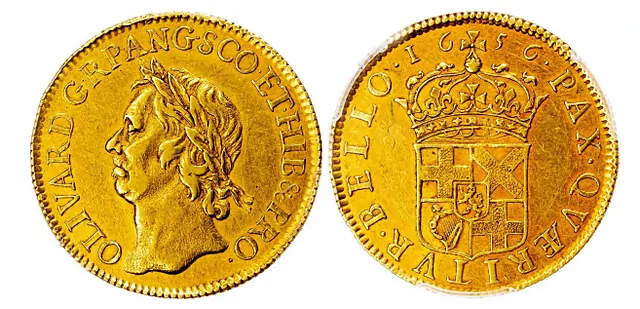
This twenty-shilling piece features Cromwell’s laureate portrait facing left. The reverse presents a crowned, quartered shield representing the Protectorate, with the date flanking the crown. The coin appears boldly struck and remains in good very fine condition. PCGS has graded it AU50.
Estimated at £12,000–£14,000, this coin represents one of only two gold denominations issued during Cromwell’s rule as Lord Protector. The other, a fifty-shilling piece engraved by Thomas Simon, remains exceedingly rare, with perhaps only a dozen known examples.
A Republican with Royal Imagery
The coin’s imagery raises fascinating questions. Cromwell appears wearing a laurel wreath, a symbol traditionally associated with Roman emperors and monarchs.
On the reverse, the arms of England, Scotland, and Ireland surround a central shield bearing Cromwell’s personal arms: a lion rampant. A crown tops the entire design.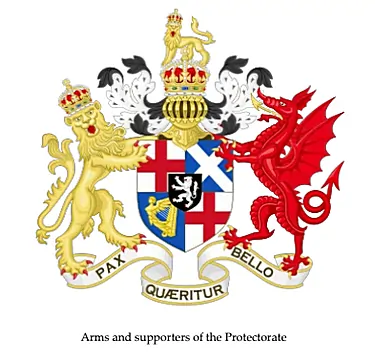
This imagery signals something deeper. Cromwell had refused the crown when Parliament offered it in 1653. However, his coinage increasingly adopted royal language and symbolism. Latin inscriptions replaced earlier English legends, while regal iconography became more prominent.
At the same time, Cromwell accepted the title “Your Highness.” Therefore, his coinage suggests a delicate, and perhaps shifting, balance between republican ideals and monarchical authority.
Some historians even draw comparisons to ancient Rome. After abandoning kingship, Rome evolved from republic to empire. Cromwell’s trajectory may hint at a similar path. He died in 1658, shortly after these coins entered circulation.
Two Examples in One Sale
Interestingly, Baldwin’s offers two Cromwell broads in this auction. Lot 113 stands as the superior example. Meanwhile, Lot 112 shows similar detail but includes a skillfully plugged area.
As a result, the lesser piece should realize around £9,000, while the finer example could exceed £14,000.
Edward VI Gold Half Sovereign: A Portrait of a Doomed King
The sale also features a deeply moving Tudor issue: a gold half sovereign of Edward VI struck at Southwark (Lot 89).

This coin captures a striking portrait of the young king at approximately twelve years old. The son of Henry VIII, Edward would die just three years later at age fifteen.
The obverse portrait stands out for its clarity and minimal wear. The youthful features, crowned head, and cuirassed bust appear sharply defined. Only slight doubling in parts of the legend interrupts an otherwise strong strike.
The reverse displays the crowned Royal Arms within an ornate ogee shield. An arrow mintmark confirms production at Southwark.
The Short Life of the Southwark Mint
The Southwark Mint operated briefly, from 1543 to around 1553. It stood within Suffolk Place, located near today’s Borough High Street and Marshalsea Road.
Originally part of a manor granted by Henry VIII to Jane Seymour, the site later declined. After demolition in 1557, the area transformed into a notorious district offering legal protection to debtors. By the 19th century, redevelopment erased it entirely.

Edward VI: Illness and Early Death
Edward’s health declined rapidly in 1553. He suffered persistent fevers, coughing, and breathing difficulties beginning in January. Although he experienced temporary recoveries, his condition worsened over time.
By June, reports described alarming symptoms, including discolored sputum and severe weakness. His legs swelled, preventing him from walking. Observers described him as “thin and wasted” in his final days.
Edward died on July 6, 1553, at Greenwich Palace.
Cause of Death: Tuberculosis Likely
While rumors of poisoning circulated, no evidence supports them. Instead, contemporary accounts and modern historians point to tuberculosis.
Earlier illness, including measles and smallpox in 1552, likely weakened his immune system. This vulnerability may have allowed latent tuberculosis to develop. Postmortem findings of lung damage and abscesses support this conclusion.
Ultimately, Edward’s death marked the end of a short but impactful reign. Despite his youth, he played a key role in advancing the English Reformation.
A Coin of Beauty and Tragedy
This half sovereign preserves Edward at the height of health and royal authority. Therefore, it stands as both a beautiful artifact and a poignant historical reminder.
The coin carries an estimate of £4,000 to £6,000, an accessible price for a rare and contemporary portrait of the last Tudor king.
Conclusion: A Landmark Auction for Historic British Gold
Baldwin’s March 30 auction brings together extraordinary pieces that tell powerful stories. Each lot connects collectors to defining moments in British history, from naval triumph and political ambition to royal fragility.
Importantly, these coins and medals do more than preserve the past. They reveal the personalities, struggles, and transformations that shaped a nation.






Beautiful gold coins and love the history behind them. Would love to start my collection with any one of them.