By Mike Markowitz for CoinWeek …..
Akragas (Agrigentum in Latin, now Agrigento, Italy) was founded around 582 BCE by Greek colonists from the nearby city of Gela on the south coast of Sicily.
Located between two small rivers and blessed with fertile soil in the surrounding area, it grew to be the second-largest city of Sicily, exceeded only by the great port of Syracuse. Akragas issued some of the most beautiful and admired ancient coins ever struck. The well-preserved “Valley of Temples” at Akragas is a World Heritage Site and a popular tourist attraction today.
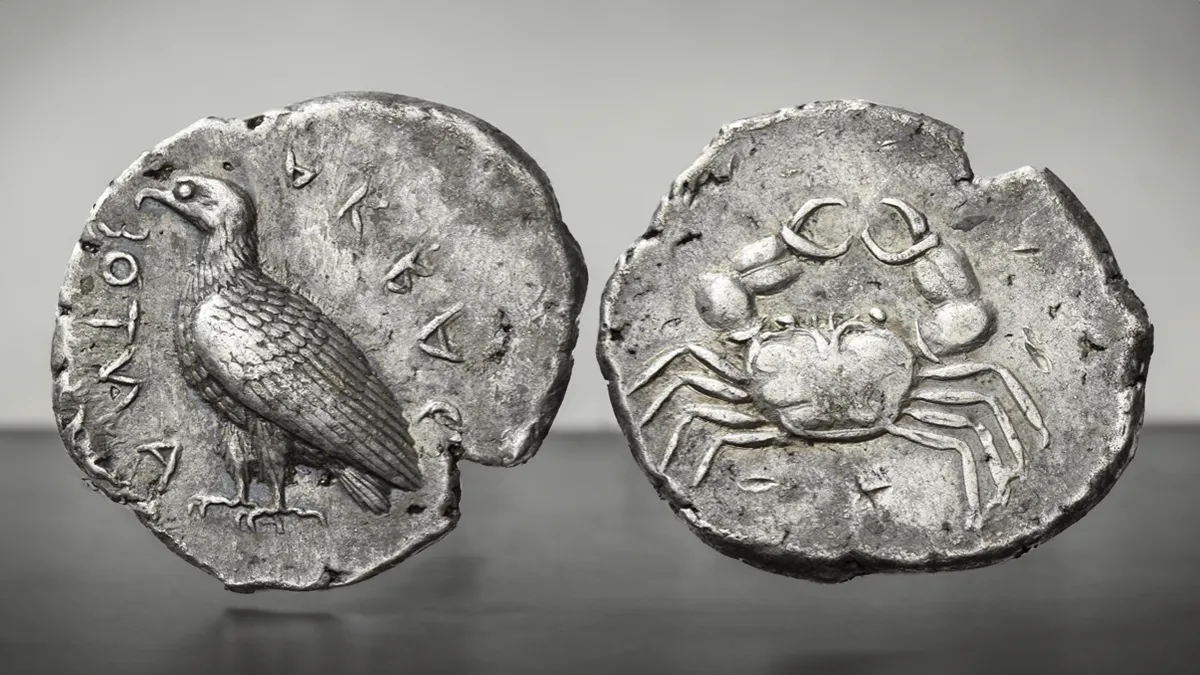
Akragas began issuing its silver coinage about 510 BCE (possibly as early as 520). Weighing about 8.5 grams, the coins are described as didrachms or two-drachma pieces. The obverse bears a standing eagle, surrounded by the city name in Greek letters, either spelled out in full (AKRAΓ- ANTOΣ ) or abbreviated (AK – RA). The reverse shows a crab, which became the city’s distinctive badge. The creature is depicted in such detail that the species can be identified: Potamon fluviatile, a small, edible freshwater crab native to southern Europe. The eagle and crab didrachms were issued for about forty years. Worn examples can be found for as little as $200, while exceptional pieces have sold for as much as $6,700 in recent auctions.
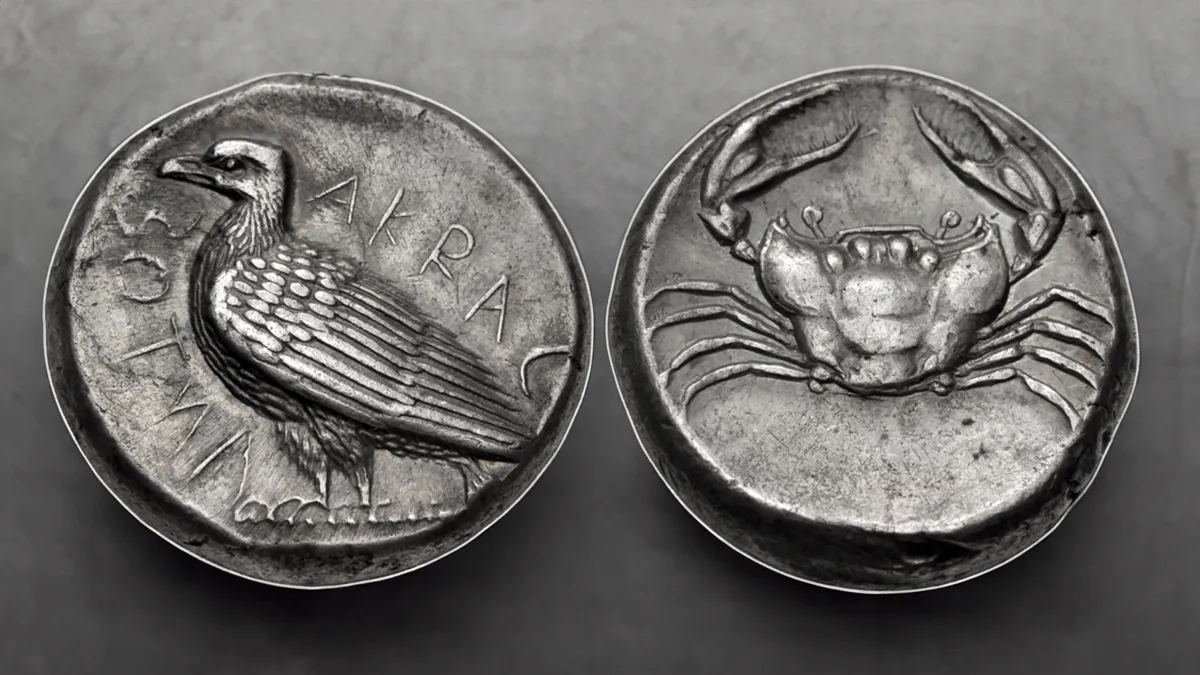
As the city prospered, there was a need for a higher-value coin, and a silver tetradrachm on the “Attic” standard of Athens (17.2 grams) was introduced about 470 BCE. The design is almost the same as the didrachm, but the eagle now stands on a dotted ground line, and sometimes a small symbol, such as a lotus flower, appears below the crab on the reverse. Examples typically sell for about $1,500 at the low end, and as much as $30,000 at the high end of the market.
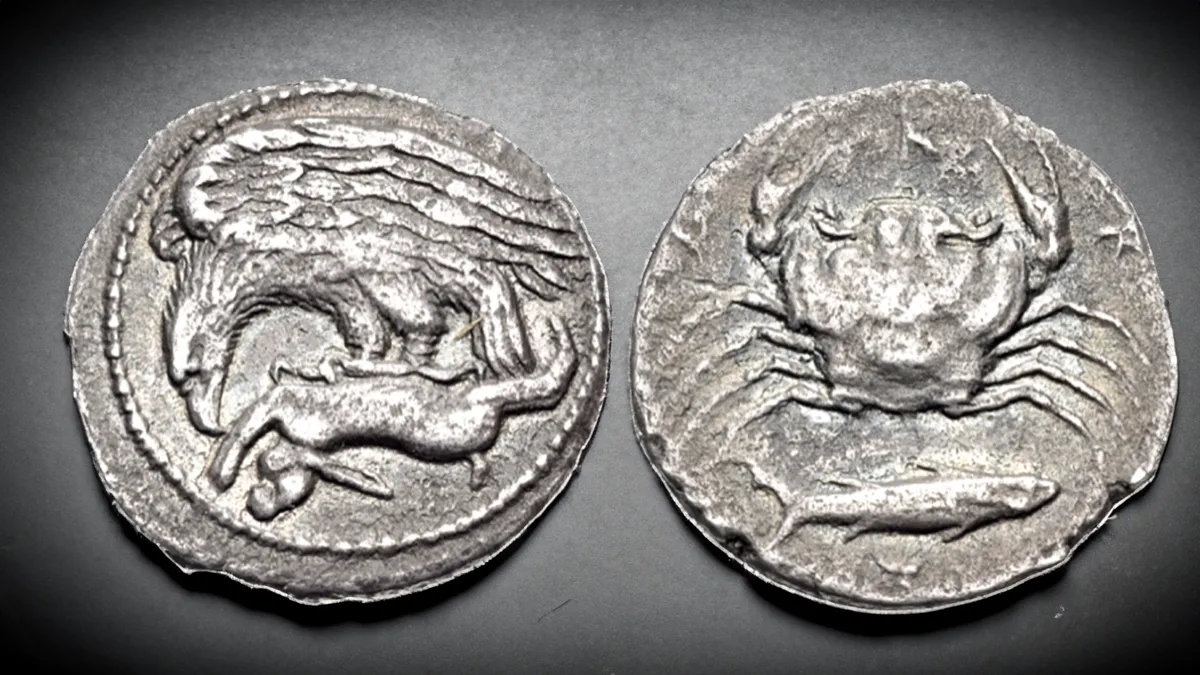
There was also a need for fractional denominations for small daily purchases. Beginning around 465 BCE, a little silver hemidrachm of about 2 grams was struck with the usual standing eagle and crab design. About 420 BCE, the design was changed to a dramatic image of an eagle clutching a hare in its talons. These were issued in large quantities, and well-worn examples can be found for under $100. On some pieces, a sea monster or fish appears below the crab on the reverse.
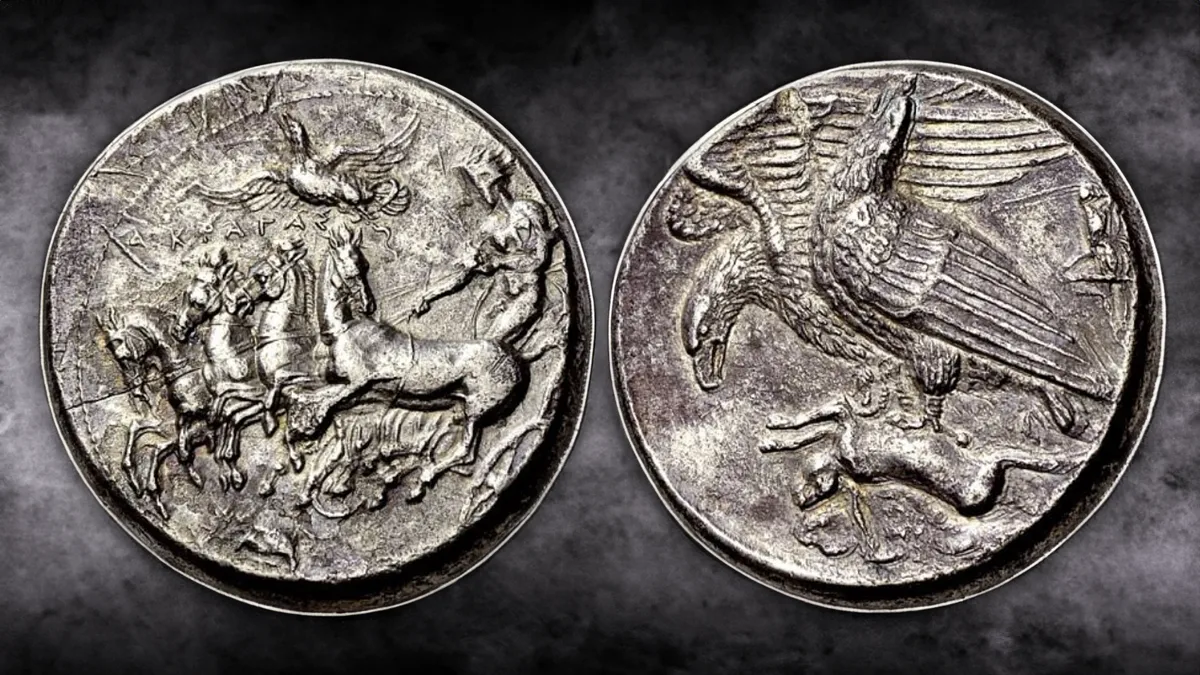
The most famous coin of Akragas is the massive 42-gram decadrachm issued c.409-406 BCE, shortly before the Carthaginians destroyed the city. Struck from just five dies (two obverse, three reverse), the coins are extremely rare, with about ten examples known, most in museums.
The sun god Helios’s chariot on the obverse is (uncertainly) attributed to an engraver named Myron. An eagle flying above the horses, and a crab below, locates the scene between sea and sky. The superb pair of eagles on the reverse is considered the work of an engraver named Polyainos. When I visited Akragas in 2017, the British Museum specimen of this coin was on loan to the local museum. Two carabinieri armed with submachine guns stood guard beside the display case. An example of this coin from the famous Hunt Collection drew a bid of almost $2.5 million in a 2012 Swiss auction; at the time, a record for an ancient Greek coin.
On Harlan Berk’s list of the 100 Greatest Ancient Coins, this coin is #8.
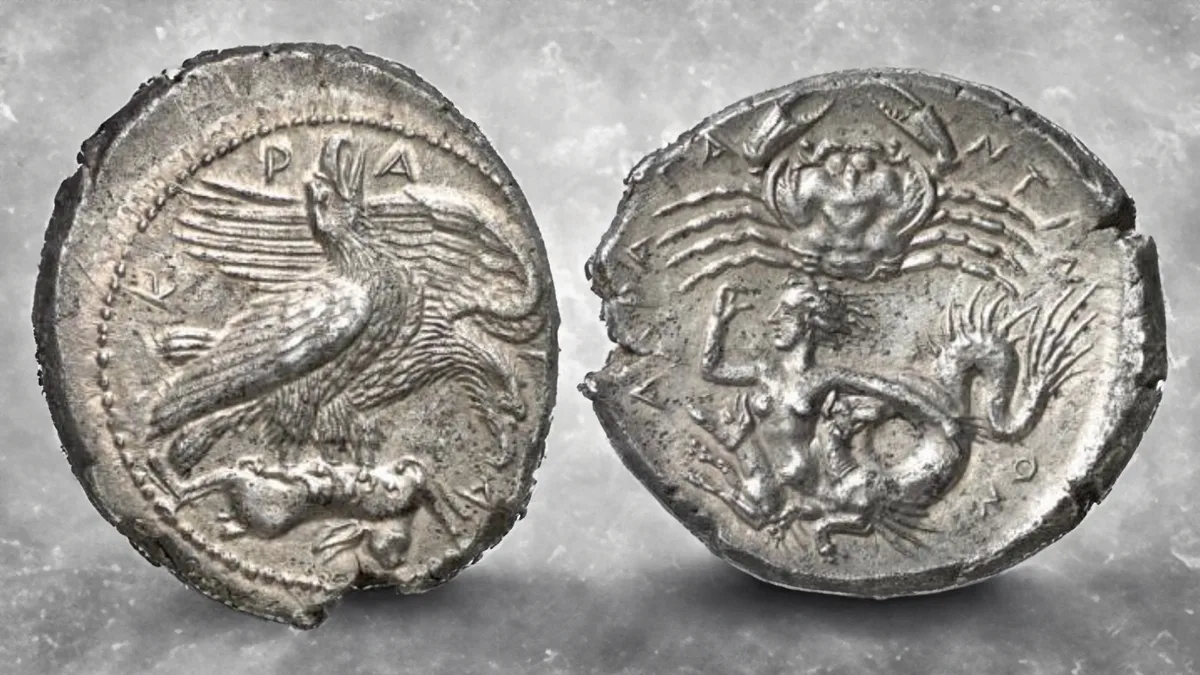
Struck about 420 BCE, the “Skylla” tetradrachm is considered a masterpiece of Greek art. Skylla (or Scylla) was a man-eating mythical beast with a woman’s upper body, a sea monster’s tail, and fierce dog heads sprouting from her midsection. She was said to inhabit the Strait of Messina, which separates Sicily from the Italian mainland, where she fed on passing mariners.
On Harlan Berk’s list of the 100 Greatest Ancient Coins, this coin is #21. Berk writes:
Although the obverse is brilliantly conceived and executed, the reverse is even more magnificent. The crab, a traditional Acragas badge, occupies the upper part of the design. It has been so skillfully depicted that it appears alive. Below the crab is a wonderful mythic sea creature…She is shown in rapid action, cutting through the ocean, her hair streaming behind her…one human arm raised to shade her eyes as she scans the horizon. Fewer than 20 of these wonderful coins are recorded.
In a 2007 New York auction, an example struck on a “slightly irregular” flan sold for $160,000.
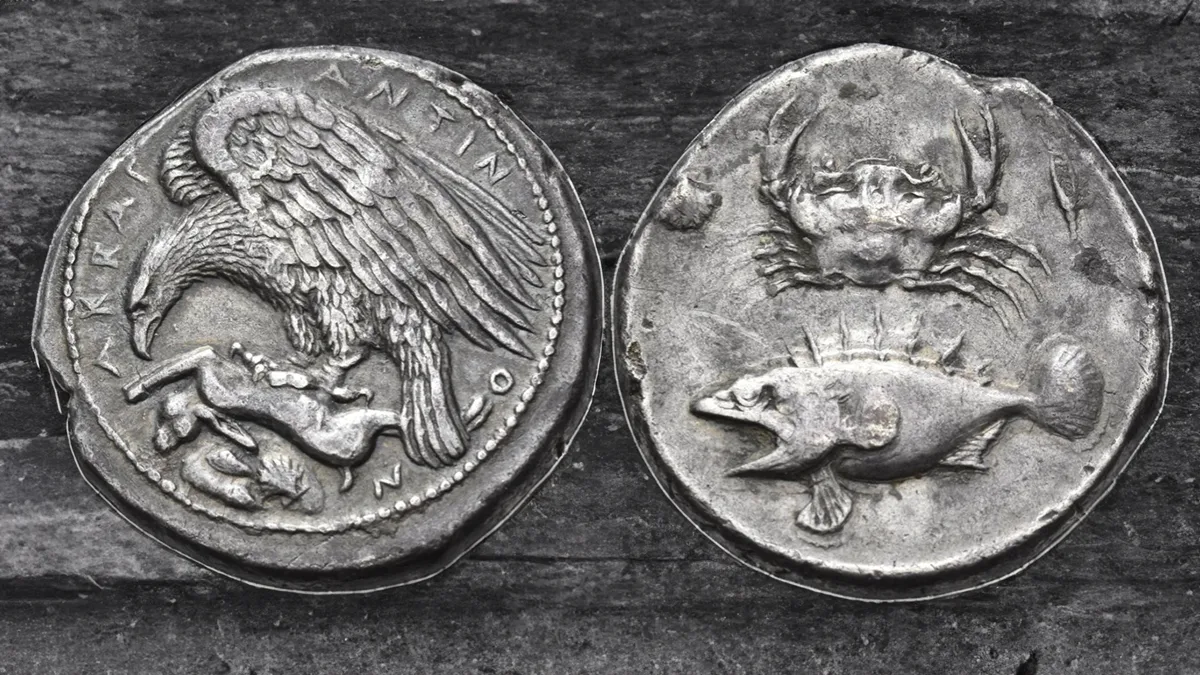
The fish on the reverse is identified as the dusky grouper or mero (Epinephelus marginatus), a valued food fish now threatened by overfishing in the Mediterranean.
In a recent Swiss auction, an example of this coin brought over $130,000.
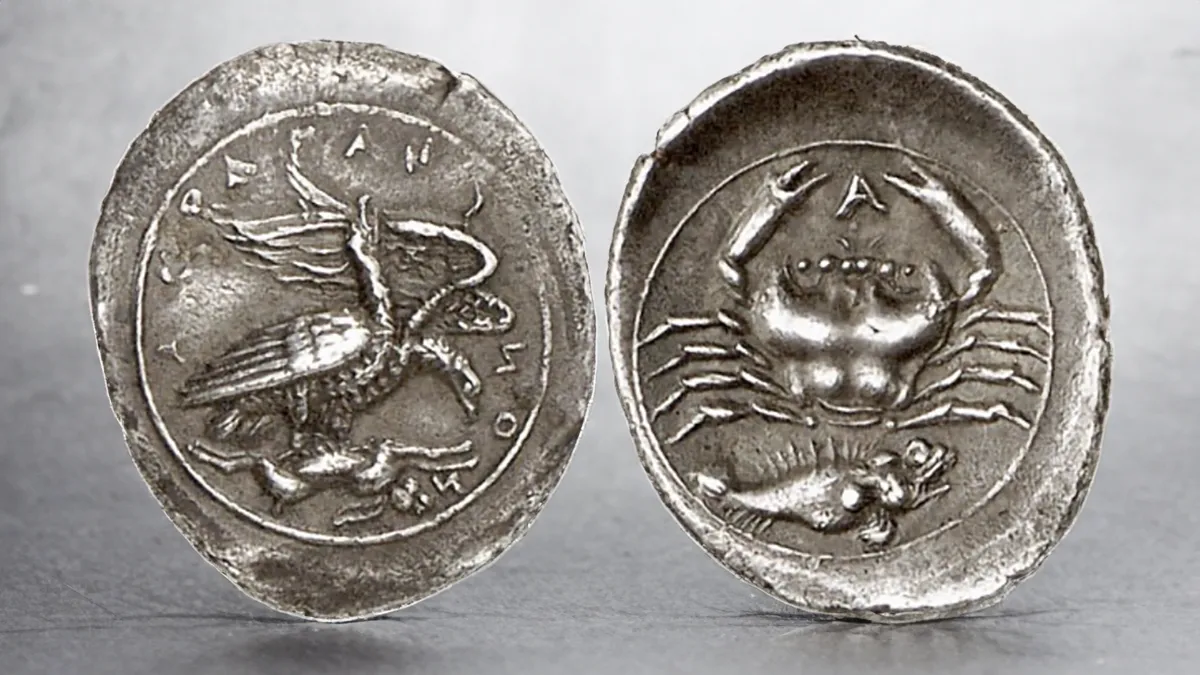
The tiny obol weighing less than a gram (0.79 g) had the same basic design as the Eagle/Crab and Fish tetradrachm. Both sides had a simple linear border, and the inscription on the reverse was reduced to a single letter A between the crab’s claws. An example of this very rare type brought almost $30,000 in a 2008 Swiss auction.
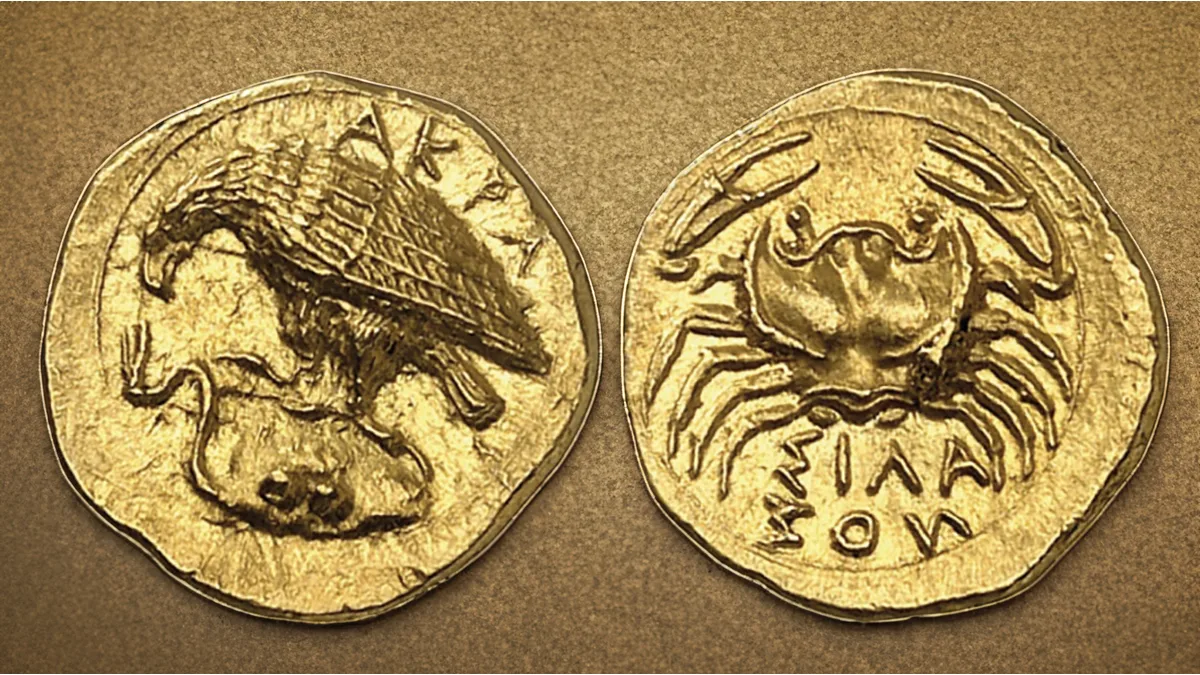
Gold was not a regular feature of Akragas’ coinage. However, several issues of small gold coins were struck, probably as an emergency issue to pay mercenaries during the final siege of the city, before its destruction by the Carthaginians in 406 BCE. On the obverse, an eagle perched on a rock tears at a snake clutched in its talons. The abbreviated city name, AKRA, appears above, and two pellets below indicate the denomination, variously described as a dilitron or diobol. The city’s crab emblem appears on the reverse, above the name of an official, Silanos, who is otherwise unknown to history. In a recent Swiss auction, an example “very sharply struck in high relief” brought over $32,000.
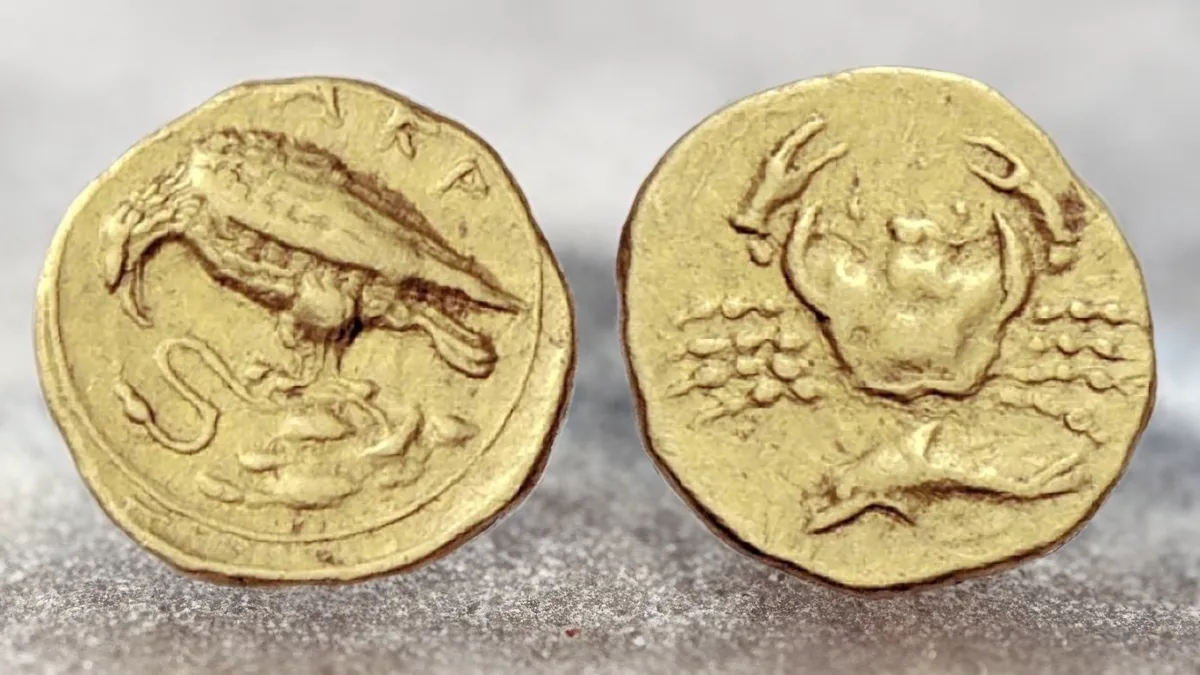
A rare variant of the gold issue, known from just three examples, has a small dolphin below the crab rather than the name Silanos.
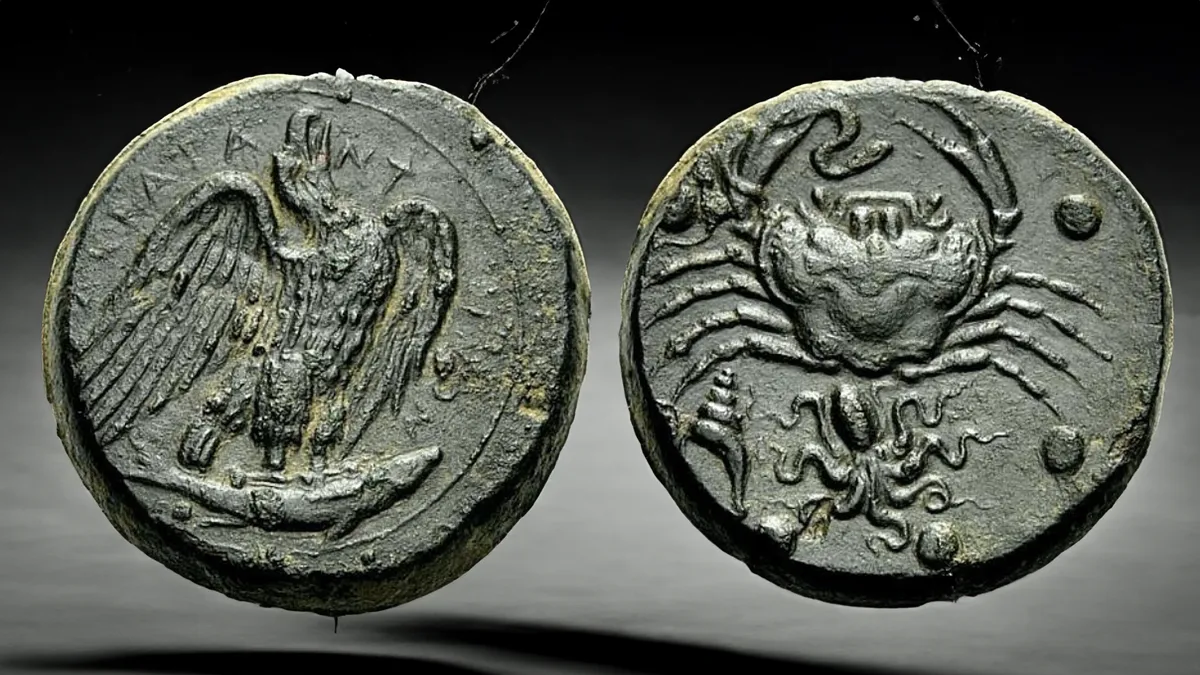
To meet the needs of an urban economy, workers needed to make small daily purchases, and Akragas produced an extensive range of bronze coin denominations. The system was based on a small unit called an onkion, with 12 onkia to the litra. The number of pellets on the coin indicated its value. A bronze hemilitron or 6-onkia piece dated to c. 410-406 BCE bears a riot of marine life on the reverse, with a crab grasping a snake in its claw, a conch shell, and an octopus. Two of the six surrounding pellets are barely off the edge. The eagle holds a fish in its talons on the obverse, and the city name is fully spelled out.
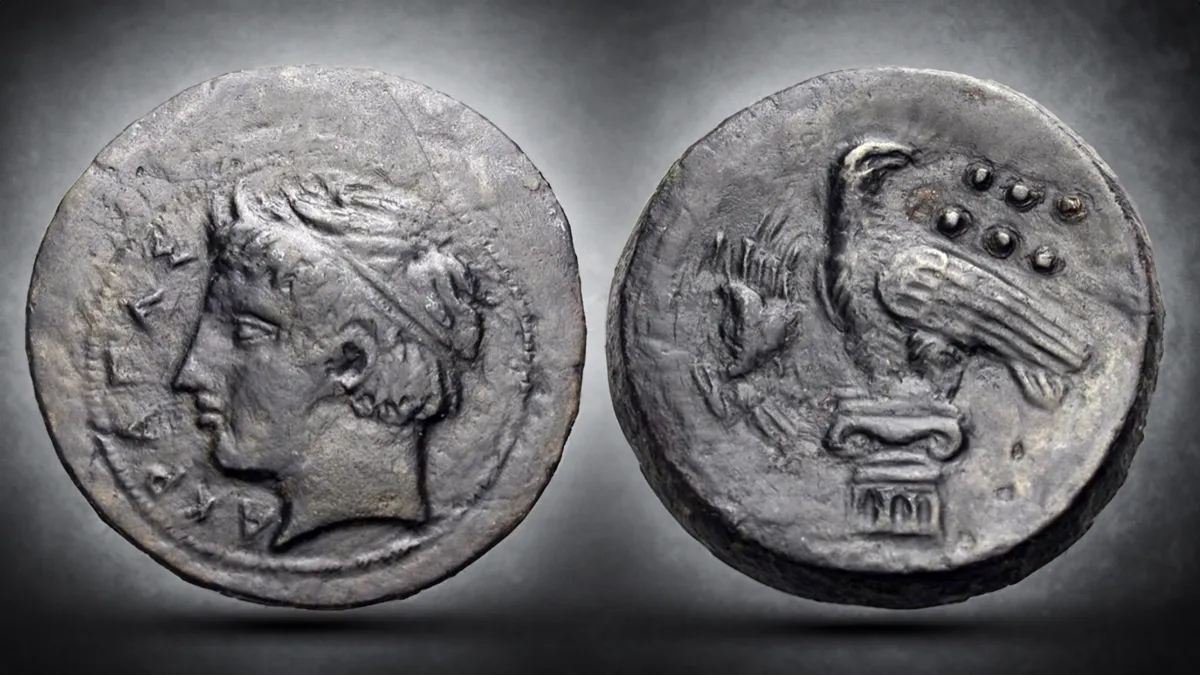
Another common type of hemilitron, dated to c. 400 – 380 BCE, bears the youthful head of a river god on the obverse, and an eagle perched atop an Ionic column on the reverse, with six pellets neatly arrayed above, and a crab in the field to the left.
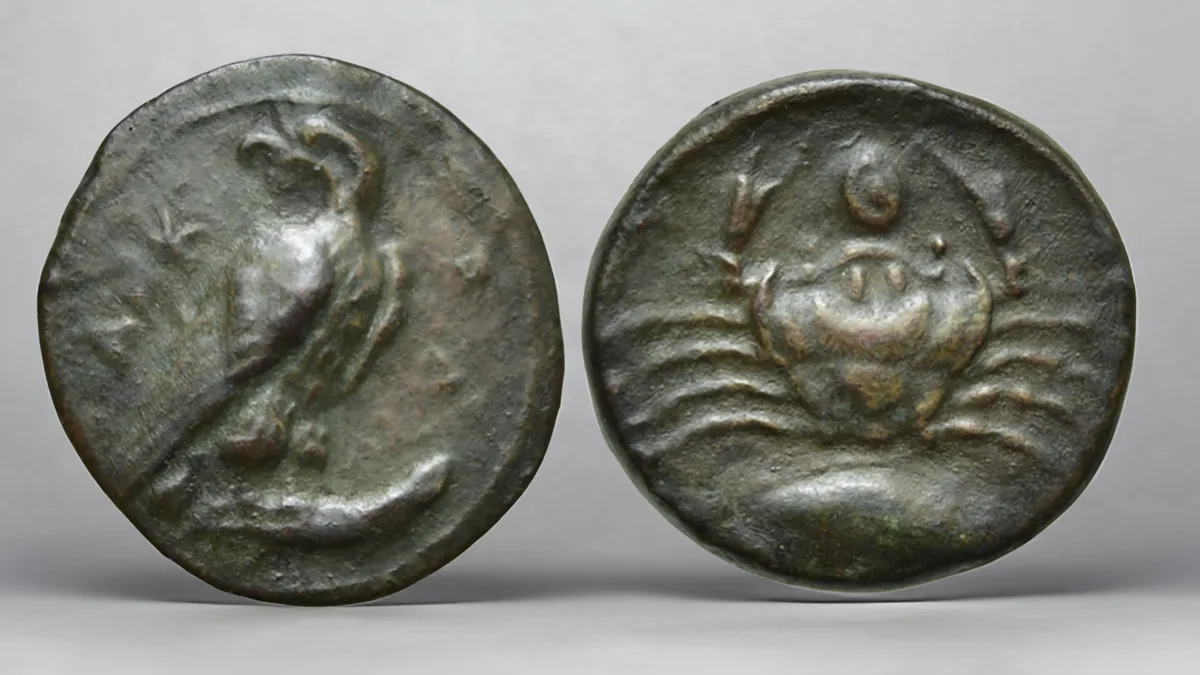
Weighing just over three grams, the humble bronze onkia might have been the price of a small loaf of bread or a cup of cheap wine. A well-worn example dated to c. 415 – 406 BCE went for under $100 in a recent European auction.
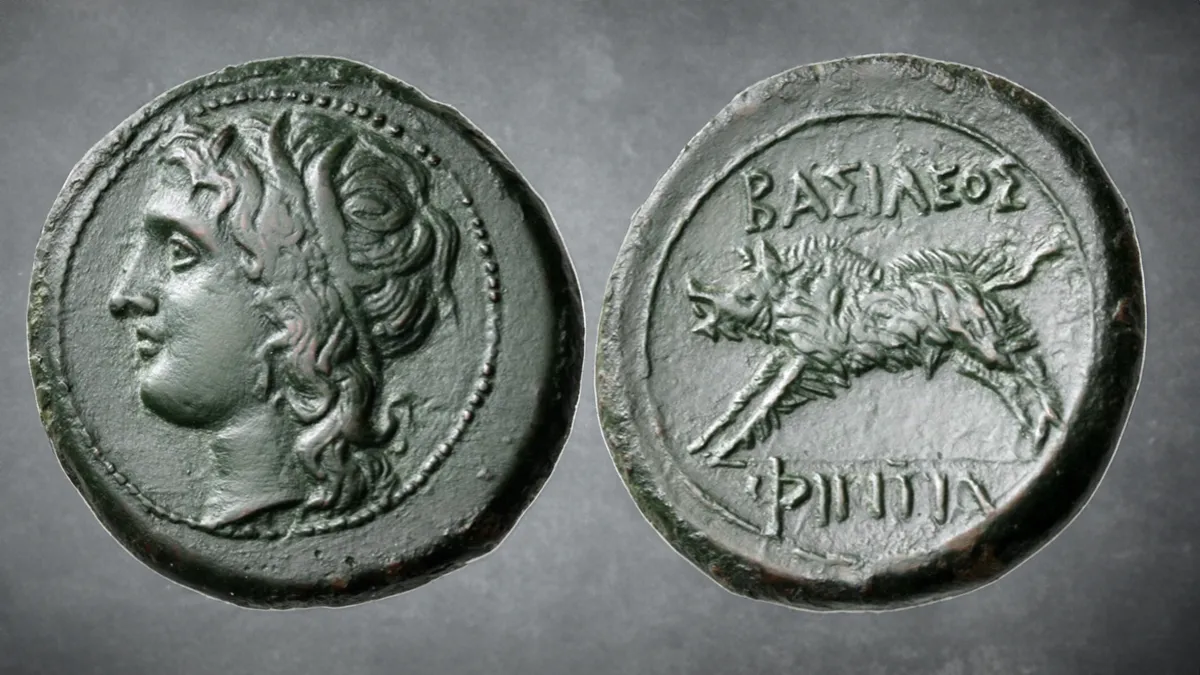
Attractive and well-struck with a dark brown-green patina. Image: Nomos AG / CoinWeek.
Akragas gradually recovered from the Carthaginian destruction of the city, and the site was repopulated in the 3rd century BCE. A tyrant named Phintias declared himself king and issued bronze coins bearing the head of Apollo on the obverse and a running boar on the reverse. In 210 BCE, Akragas came under Roman rule and issued bronze coins for local circulation, a story for another day…
Collecting Akragas
Coins of Akragas appear in most major European and American ancient coin auctions. The CoinArchives Pro database, which lists over 2.5 million auction records, returned 6,766 hits on the search term “Akragas.”
The standard reference work is Westermark (2018), a massive two-volume work totaling 744 pages that can be found online in PDF format. Ulla Westermark (1927-2020) was a Swedish numismatist and Director of the Stockholm Coin Cabinet from 1979 to 1983.
References
Berk, Harlan J. 100 Greatest Ancient Coins. Third Edition. Pelham, AL (2023)
Jenkins, Gilbert Kenneth. Ancient Greek Coins. New York (1972)
Sayles, Wayne. Ancient Coin Collecting II: Numismatic Art of the Greek World. Iola, WI (1997)
Seltman, Charles. Greek Coins 2nd edition. London (1955)
Westermark, Ulla. The Coinage of Akragas: c.510-406 BC. 2 volumes. Uppsala, Sweden (2018)