


By Mike Markowitz for CoinWeek …..
In Latin, “maximus” means “the greatest,” as in the name of Rome’s famous chariot racing stadium, the Circus Maximus. The high priest of the Roman state religion was the Pontifex Maximus[1], a title later adopted by the Popes. In the film Gladiator (2000), the hero, played by Russell Crowe, is named “Maximus Decius Meridius.” Maximus was mostly an honorific title, not a common Roman personal name[2], but several emperors had names containing the root *max. On coin inscriptions, which are often heavily abbreviated and may be partly illegible, this can be a source of endless confusion, especially for beginners. A survey of the coins of these similarly-named rulers gives us a glimpse into the often chaotic history of the Roman Empire in the third, fourth, and fifth centuries.
Maximinus Thrax
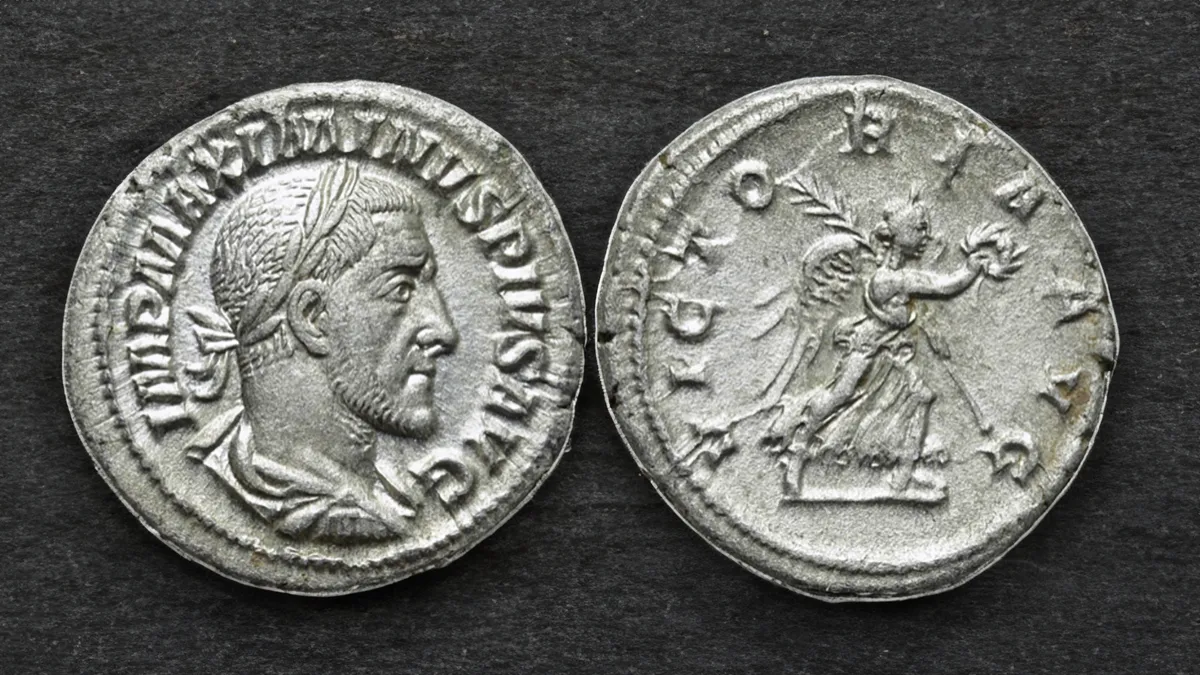
Gaius Julius Verus Maximinus was born about 173 CE to a peasant family in the Balkan region of Thrace. He is known to history as Maximinus Thrax: “the Thracian.” He was tall and strong – according to one ancient source, 2.4 meters tall (7 feet 10 inches!) Emperor Septimius Severus made him an imperial bodyguard. Emperor Severus Alexander promoted him to army commander. Following the murder of Alexander in 235, Maximinus was proclaimed emperor by the army. His coinage is extensive, with one reference listing seven types in gold, 21 in silver, and 37 in bronze.[3] A magnificent gold aureus[4] dated to Summer 236 bears his bearded, heavy-jawed profile. The reverse bears a standing figure of Providentia, the personification of forethought, “in the sense of a prescient power capable of creating or altering future events.”[5] The denarii of Maximinus (which are only about 50% silver) are common and affordable, even in high grades.[6] Maximinus campaigned successfully against the Germans, Sarmatians, Dacians, and North African tribes, but his high taxes alienated the Roman senatorial class, which revolted against him. His troops murdered him, a fate that would befall many of his successors during the following decades. During his reign, he had never set foot in Rome.
Maximus Caesar
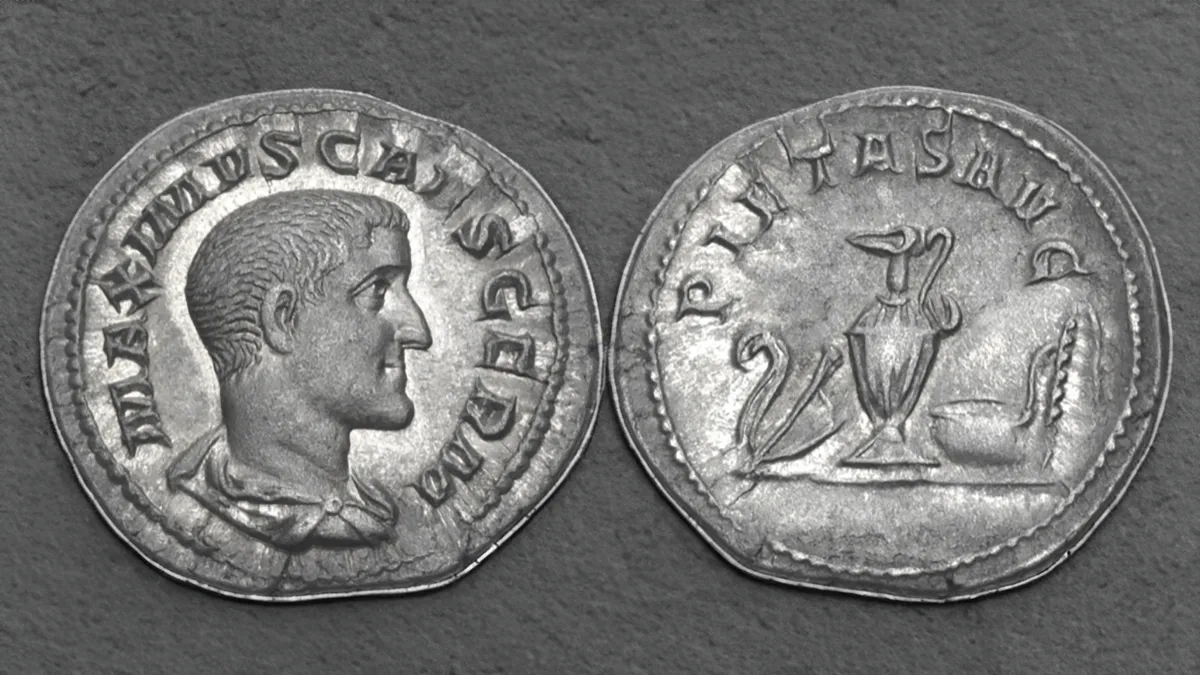
In 236 CE, Maximinus made his son, Gaius Julius Verus Maximus (born between 217 and 220), his designated successor and gave him the title of “Caesar.” The coins of Maximus Caesar bear a youthful portrait that strongly resembles his father.[7] He was murdered along with his father by mutinous troops at Aquileia in May 238.
Maximianus
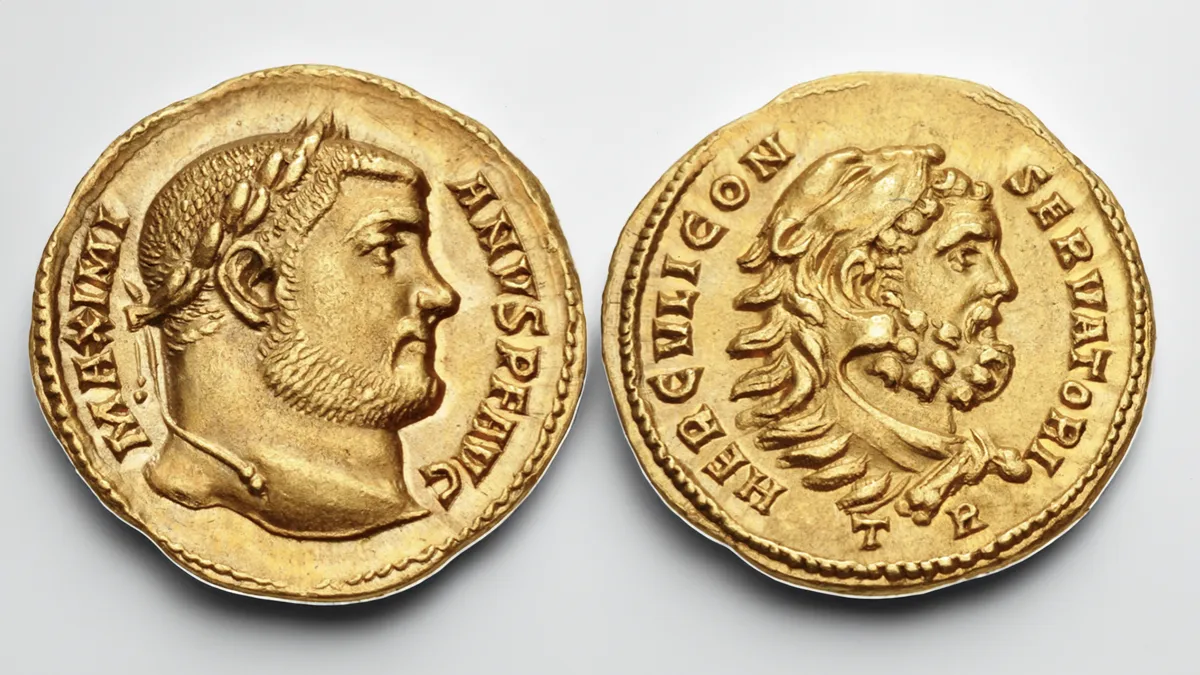
Born about the year 250 to a family of shopkeepers near the vital garrison town of Sirmium (today Sremska Mitrovica, Serbia), Marcus Aurelius Valerius Maximianus had a successful military career during the reigns of emperors Aurelian (270 – 275) and Probus (276 – 282). He established a lifelong friendship with his colleague Diocletian, who elevated him to the rank of Caesar (co-emperor and designated successor) in 285. While Diocletian identified himself on his coins with the god Jupiter, Maximianus was identified with the hero Hercules, adding the epithet “Herculius” to his name. There are no coins of Maximianus as Caesar, but by 286, he is identified as “Augustus.” He ruled in the West with his capital in Milan, while Diocletian ruled the East from a capital in Nicomedia.
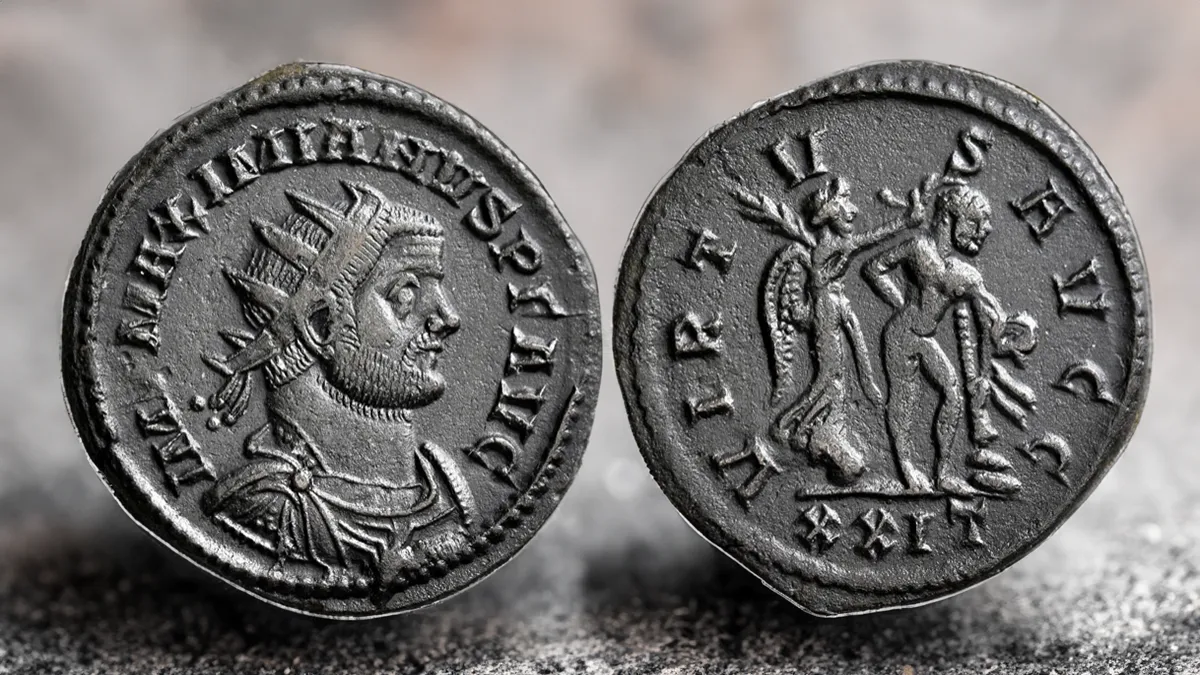
A superb gold aureus from the famous Beaurains Hoard of 1922[8], struck at the mint of Treveri (today Trier, Germany), bears a profile bearded bust of Maximianus, with the thick, muscular neck characteristic of imperial portraits in this era.[9] The reverse depicts Hercules wearing his signature lion-skin headdress. A common antoninianus[10] dated to 294 from Ticinum in northern Italy depicts Victory crowning Hercules, with the inscription VIRTUS AUGG (“Manliness of the Emperors“). By this time, the debased antoninianus was a bronze coin with barely a trace of silver in the alloy.
On May 1, 305, Diocletian and Maximianus abdicated, transferring power to their chosen deputies: Constantius Chlorus in the West and Galerius in the East. This arrangement did not sit well with Maxentius, the son of Maximianus, who staged a rebellion in Rome. Maximianus reluctantly resumed the imperial title from late 306 to November 308, when he abdicated for a second time. Finally, in 310, he revolted against Constantine “the Great.” Defeated and captured at Massilia (today, Marseille, France), he was allowed to commit suicide.
Maxentius
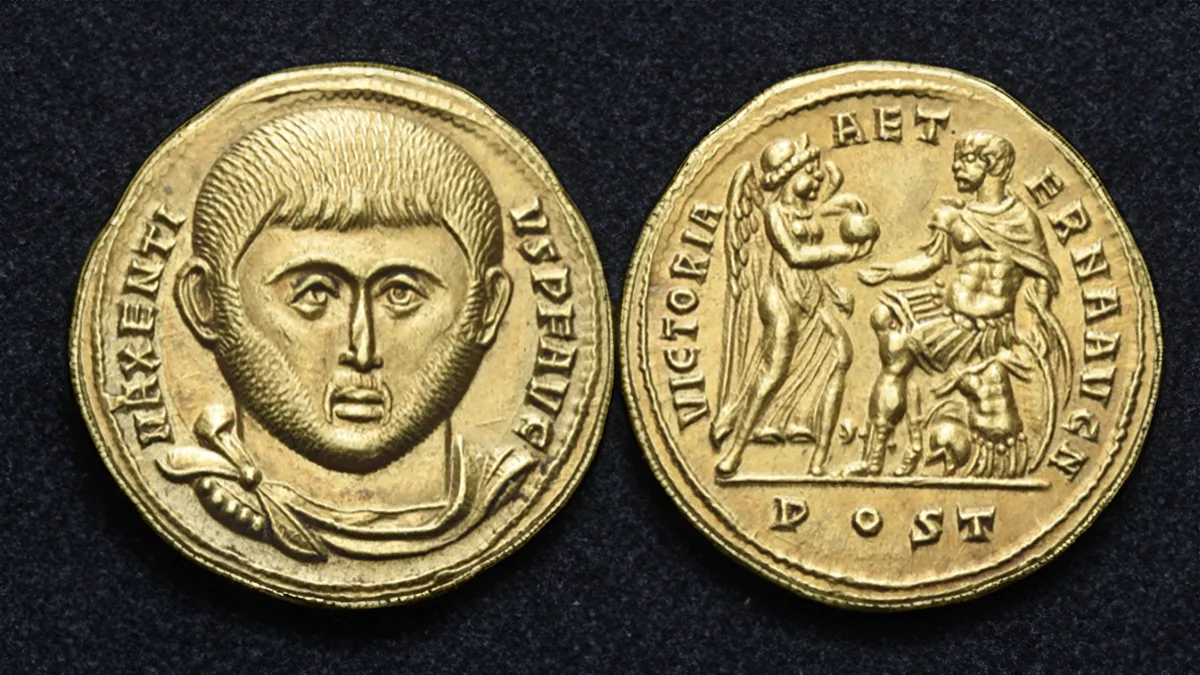
Born about 283, Marcus Aurelius Valerius Maxentius was the son of Maximianus and his Syrian wife Eutropia. After his father became emperor in 285, he might have expected to become a designated successor as Caesar. However, this never happened, and Marcus did not assume any civil or military posts when he came of age. He retired to an estate near Rome, nursing a grudge against the emperors Galerius and Constantius I. When riots broke out in Rome over new taxes and the dissolution of the Praetorian Guard, Maxentius seized the moment and was declared emperor on October 28, 306.
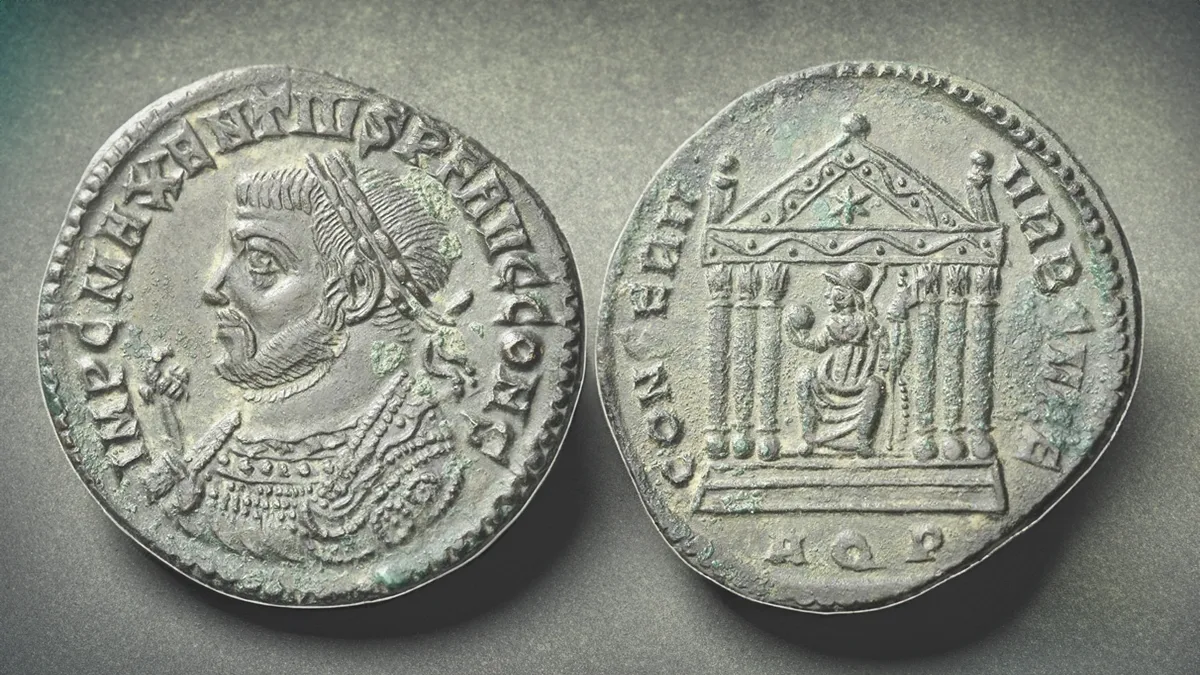
Determined to crush this revolt in 307, Galerius sent his deputy, Severus II, to march on Rome, but many of his troops deserted to Maxentius, forcing Severus to retreat. Maximianus soon came out of retirement to join his son, Maxentius, on the throne. One of the fourth century’s rarest and most dramatic coins was a gold aureus issued for Maxentius from a mint at Ostia, the port of Rome, between 310 and 312. A bare-headed, facing portrait of Maxentius stares out soulfully at the viewer. On the reverse, a winged Victory presents a globe to a seated Maxentius. The surrounding inscription translates as “Eternal Victory of Our Emperor.” The cataloguer gushes: Of the highest rarity, only two specimens are known. Undoubtedly one of the most important and impressive Roman aurei.[11]
Maximinus Daia
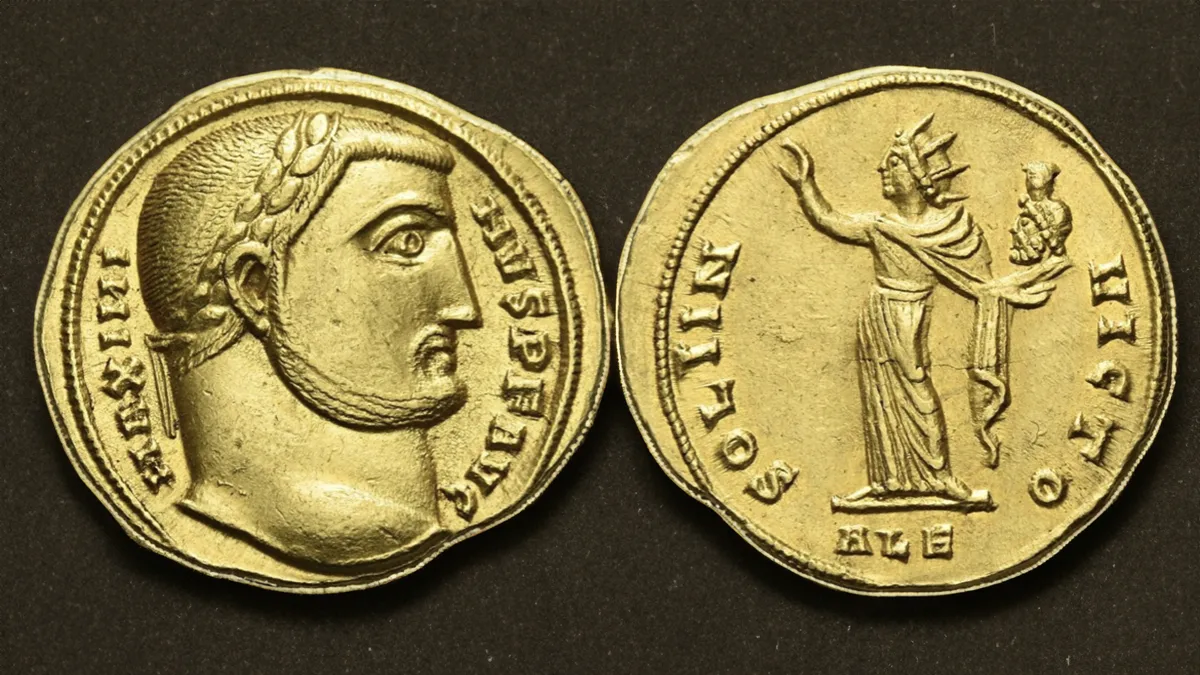
Gaius Valerius Maximinus was born about the year 270 in what is now Serbia. His given name was “Daza,” and the more common Latin form “Daia” is now considered a scribal error. He is often listed as “Maximinus II” to avoid confusion with the unrelated Maximinus Thrax. His mother was the sister of Galerius, who became emperor in 305. Galerius adopted Maximinus and elevated him to Caesar, granting him authority over Egypt and Syria. At about 310, he took the title of Augustus. After the death of Galerius in 311, he shared control of the Eastern empire with Licinius. A devout pagan, Maximinus persecuted Christians despite the edict of toleration[12] decreed by Galerius. Christian writers, therefore, denounced him as a monster. Defeated in battle by Licinius in 313, he died of uncertain causes at Tarsus in Cilicia. On a gold aureus from the mint of Alexandria, Egypt, his portrait appears in the stern, blocky style favored by rulers during the Tetrarchic era.[13] The reverse honors Sol Invictus (“The Unconquered Sun“), a solar deity favored by the Army. Constantine I, ruling in the west, struck coins bearing the portrait of Maximinus, hailing him as Sol Invicto Comiti (“Companion of the Unconquered Sun“).[14]
Magnus Maximus
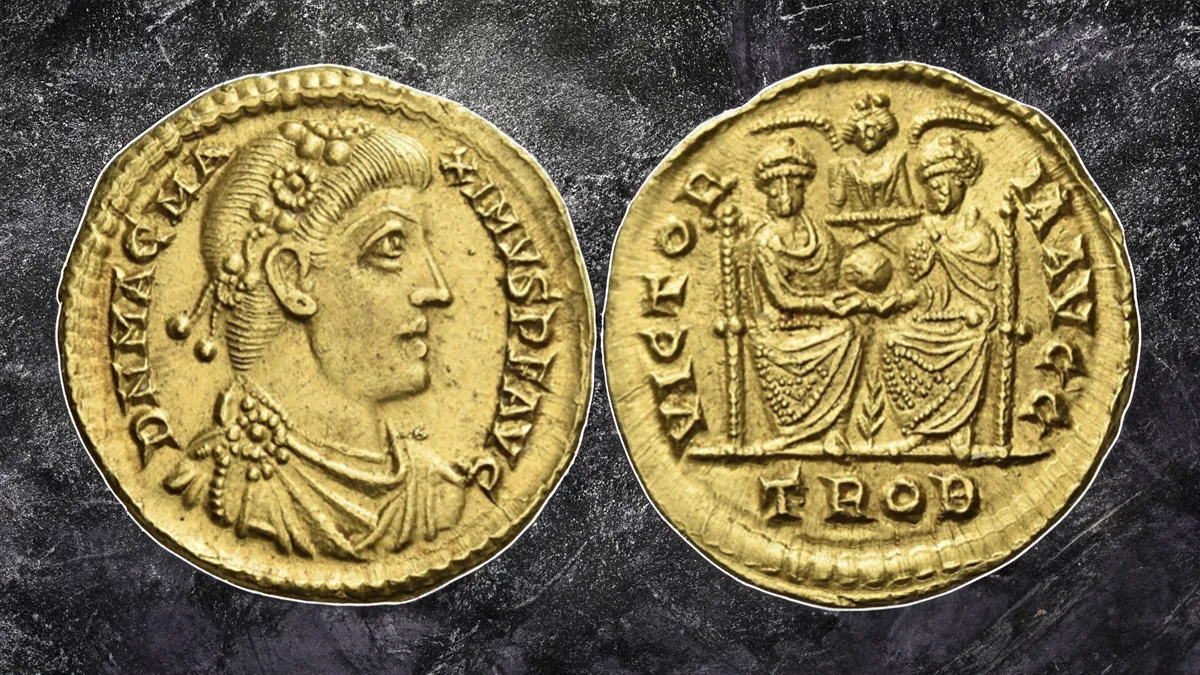
Born in Spain around 345, Magnus Maximus was distantly related to the family of Emperor Theodosius I. He had a successful military career, serving in Britannia and North Africa. In 383, the legions in Britain, unhappy with Emperor Gratian’s favoritism towards his barbarian Alan[15] bodyguards, proclaimed Magnus emperor. Advancing into Gaul, Magnus defeated Gratian. Gratian’s troops assassinated the defeated emperor as he fled. Eastern emperor Theodosius I (ruled 379-395) sent a powerful force to block Magnus from invading Italy. Eventually, he recognized him as co-emperor in the West, alongside Gratian’s young brother, Valentinian II, aged 12. Magnus later made his son, Flavius Victor, co-emperor, and issued coins in his name. Magnus issued coins mainly from the mint of Trier, but there are also coins in his name struck at London, Milan, Arles, Lugdunum, and Aquileia. There are gold solidi[16], rare gold fractions, silver miliarenses and siliquae, and various bronze denominations. Defeated in battle when the army of Theodosius invaded Italy in the Summer of 388. Theodosius had Magnus and his son executed.
Maximus of Hispania
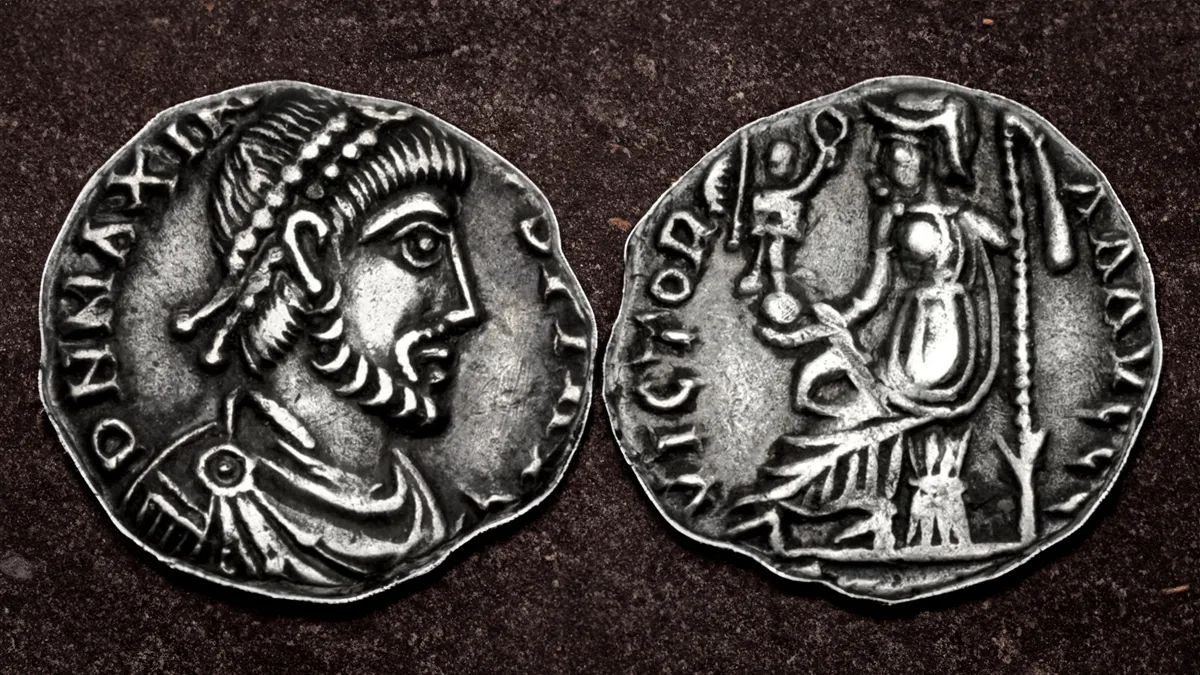
“By the beginning of the fifth century, the state of government in the West had become so confused that usurpers were toppling usurpers.” (Sayles 2007, page 187)
In 407, a soldier named Constantinus (unrelated to the family of Constantine “the Great”) was proclaimed emperor by troops in Britain. He is known as the usurper “Constantine III.”[17] Establishing his base in Gaul, he attempted to extend his control into Spain but was defeated and killed in 411 by another obscure usurper named Maximus. Little is known about this short-lived rebel, who briefly held power in Spain and issued rare coins from a mint at Barcino (today Barcelona). In 409, he was declared emperor by a general named Gerontius, who might have been his father. Defeated and captured by troops of Emperor Honorius in 411, he was pardoned, but he may be the same Maximus who was executed at Rome for rebellion in 422. The silver siliqua of Maximus is very rare, with only about 20 known examples, most of which are in museum collections. Like many silver coins of this era, the example sold in 2013, described as “Good VF,” is for $6,500 and is clipped down to a weight of just over one gram.[18]
References
- https://en.wikipedia.org/wiki/Pontifex_maximus
- The current Queen of the Netherlands, born in 1971 in Argentina, is named “Maxima”
- Sear, David. Roman Coins and Their Values, Vol. 3: The 3rd century crisis and recovery, AD 235-285. London (2005), pages 78-86.
- NAC Auction 38, March 21, 2007, Lot 135, realized CHF 180,000 ($148,124)
- Adkins, Lesley and Roy Adkins. Dictionary of Roman Religion. New York (1996), page 186.
- Numismatik Naumann Auction 149, February 2, 2025, Lot 753, realized €100 ($104), estimate €40
- CNG E-auction 577, December 18, 2024, Lot 595, realized $450 (estimate $300)
- https://en.wikipedia.org/wiki/Beaurains_Treasure
- CNG Triton XXVIII, January 14, 2025, Lot 753, realized $90,000 (estimate $20,000)
- Leu Web Auction 32, December 7, 2024, Lot 2160, realized CHF 220 ($251), estimate CHF 50
- NAC Auction 146, May 8, 2024, Lot 2396, replied CHF 600,000 ($660,720), estimate CHF 500,000
- https://en.wikipedia.org/wiki/Edict_of_Milan
- NAC Auction 138, May 18, 2023, Lot 829, realized CHF 12,000 ($13,255), estimate CHF 7,500
- Roma Numismatics Auction XIX, March 26, 2020, Lot 936, realized £1,700 ($2,063), estimate £500
- https://en.wikipedia.org/wiki/Alans
- NAC Auction 138, May 18, 2023, Lot 865, realized CHF 8,500 ($9,389), estimate CHF 6,000
- https://en.wikipedia.org/wiki/Constantine_III_(Western_Roman_emperor)
- CNG Auction 94, September 18, 2013, Lot 1117, realized $6,500 (estimate $5,000)
Additional Reading on Roman Coins
- Omissi, Adrastos. Emperors and Usurpers in the Later Roman Empire. Oxford (2018)
- Sayles, Wayne. Ancient Coin Collecting III: The Roman World – Politics and Propaganda. Iola, WI (2007)
- Sear, David. Roman Coins and Their Values, Vol. 4: The Tetrarchies and the Rise of the House of Constantine, AD 284-337. London (2011)
- Stevenson, Seth. A Dictionary of Roman Coins. London (1964 reprint of 1889 ed.)
- Vagi, David. Coinage and History of the Roman Empire. 2 vols. Sidney, OH (1999)







Back in the late 90s when a huge amount of new material was hitting the market, we used to ask newbies to distinguish between the coins of Maximianus, Maximinus, and Galerius. This was not an easy task, as a little wear, and some interesting legend breaks made Maximinus and Maximianus appear to be the same in many cases. And then Galerius essentially used the same titlature as Maximianus making it even more fun. Ah, the good old days