



By Mike Markowitz for CoinWeek …..
The Roman system of coinage outlived the Roman Empire itself. Prices were still being quoted in silver denarii in the time of Charlemagne, king of the Franks, from 768 to 814. The difficulty was that by the time Charlemagne was crowned Imperator Augustus in 800, there was a chronic shortage of silver in Western Europe.… So rare was the denarius in Charlemagne’s time that twenty-four of them sufficed to buy a Carolingian cow. (Ferguson, 2008. page 24)
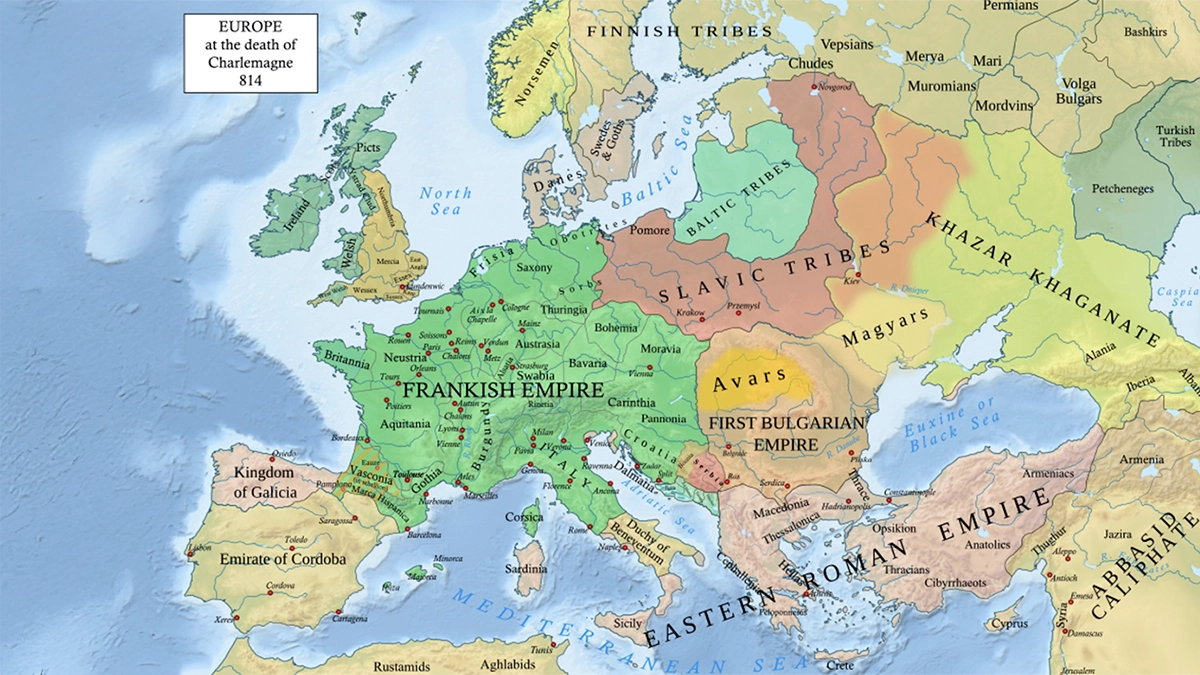
We don’t know where he was born – possibly somewhere in what is now Belgium. The year is uncertain – some sources indicate 742, while others suggest 747 or 748. Ironically, his name in the English-speaking world is Charlemagne, a French version of “Charles the Great,” although his mother tongue was Old High German, and he would have referred to himself as Karlus (or Carlus). This name appears on many of his coins. His father, Pepin “the Short,” was king of the Franks (ruled 751-768). His grandfather was Charles Martel (c. 688-741), the legendary warlord who defeated the Muslim invasion of Gaul at the Battle of Tours (October 10, 732). He fathered at least twenty children by numerous women; some historians regard Charlemagne as the “Father of Europe.” The extensive coinage in his name set the pattern for Western European currency for centuries to come.
The Coins of Charlemagne Tell a Story
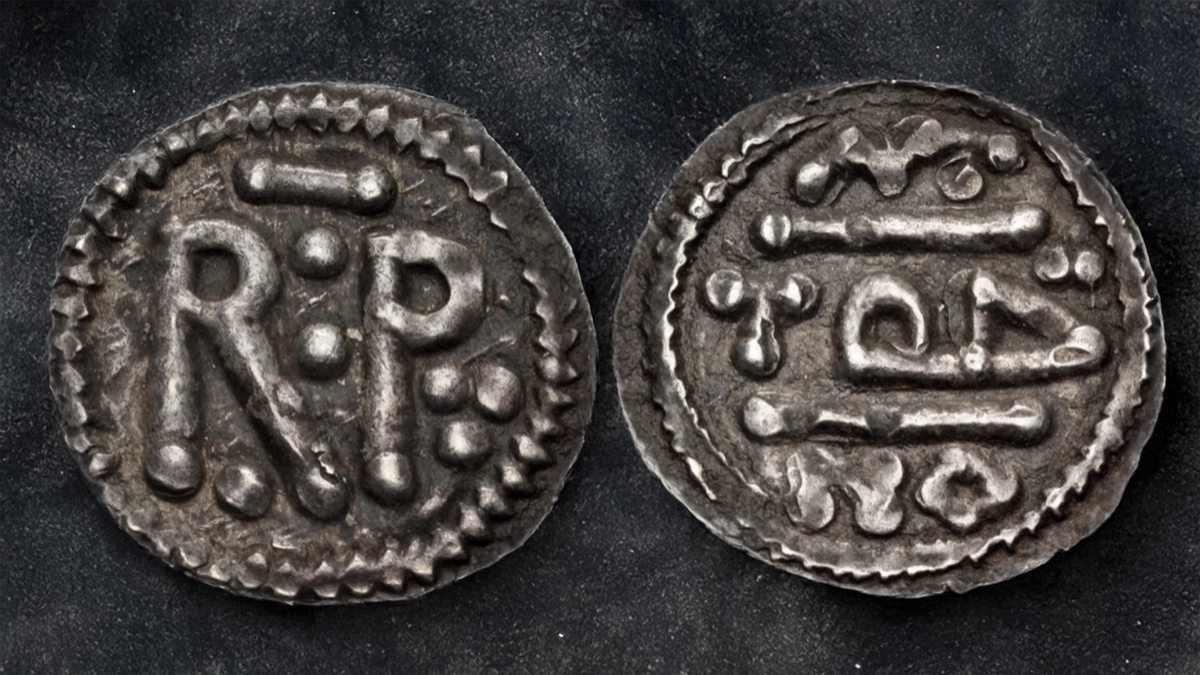
When Karl’s father, Pepin “the Short,” came to the throne in 751, the currency of the Frankish kingdom was a mess. Under the “do-nothing” kings of the previous Merovingian dynasty, hundreds of local mints – often just a village blacksmith or goldsmith’s shop – turned out a bewildering variety of crudely struck pieces in small batches without any standardization of weight, silver alloy fineness, or design. Most coins were deniers (from the Latin denarius), nominally weighing about 1.3 grams, although many were severely underweight. There was also a small obole, valued at half a denier. In 755, Pepin initiated a major coinage reform, bringing all minting under royal control. Pepin’s new denier bore bold letters R:P on the obverse, abbreviating the Latin Rex Pipinus (“King Pepin.”) Reverses bore a few garbled letters, possibly an abbreviated name of the mint; many of these have never been deciphered.
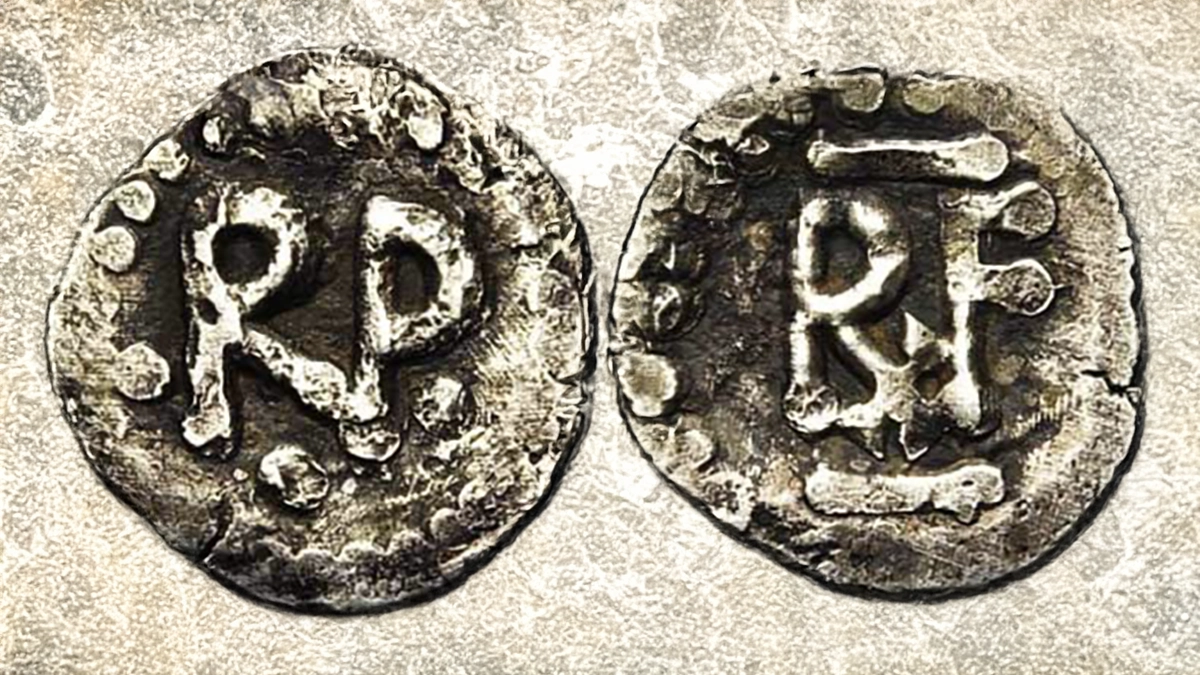
Pepin’s silver oboles are very rare. The reverse often bears the letters R F for Rex Francorum (“King of the Franks.”) An example described as “Unique and Unpublished, Very Fine” was unsold against an estimate of €7,500 in a 2014 Belgian auction.
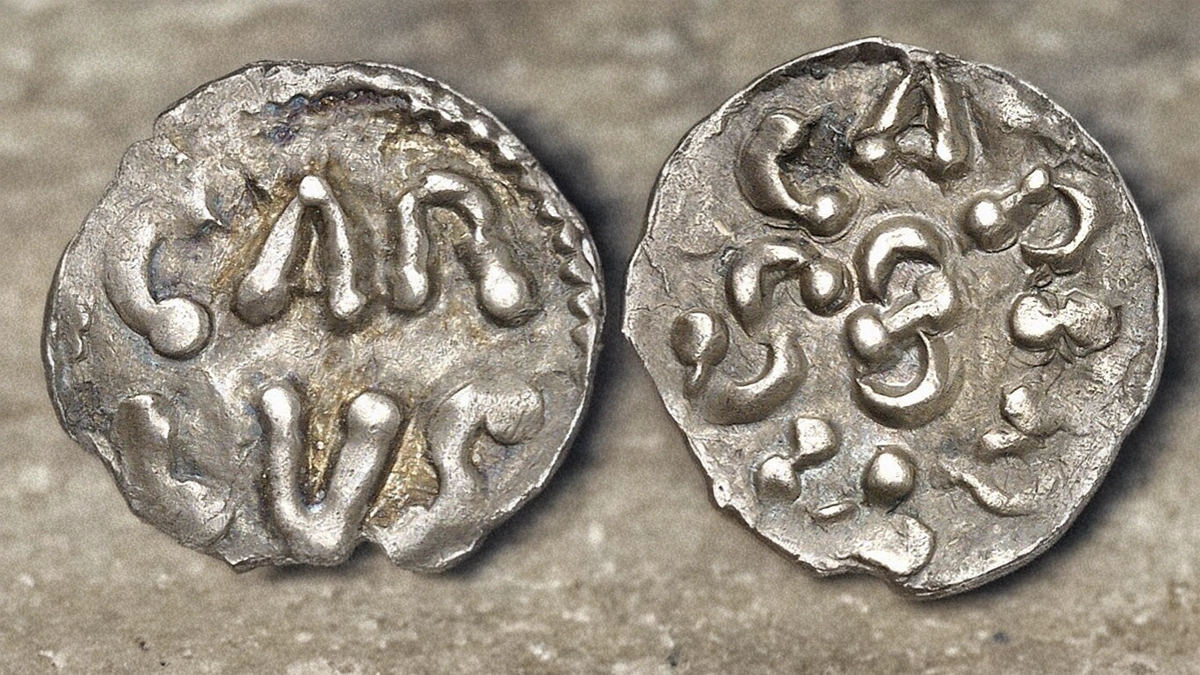
When he became king following the death of Pepin at the age of about 54 on September 24, 768, Karl continued to issue coins of similar weight (a bit over one gram) and crude design for about three years. These are described as “Class 1” deniers and are very rare – less than a dozen authentic specimens have appeared on the market in recent years, all from the mint of Chartres (identified on the reverse of the coin by its Latin name CARNOTIS). Another example can be found in the collection of the American Numismatic Society in New York.
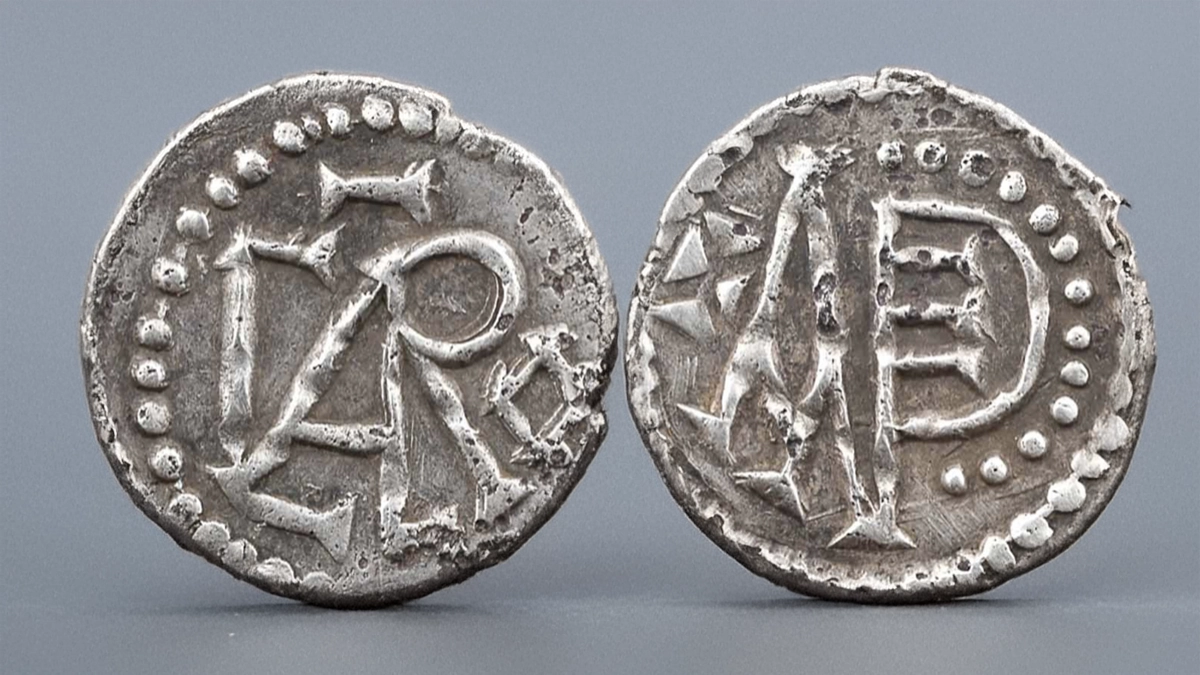
Initially, power was divided between Karl and his younger brother Carloman, who died at the age of 20 in 771, apparently of natural causes (life in the eighth century was precarious!), leaving Karl as the sole ruler. There are some rare coins bearing Carloman’s name, abbreviated as CARLO or CARLM. An example from the mint of Angers in western France, “perhaps the fourth known example,” brought over $21,000 in a 2014 European auction.
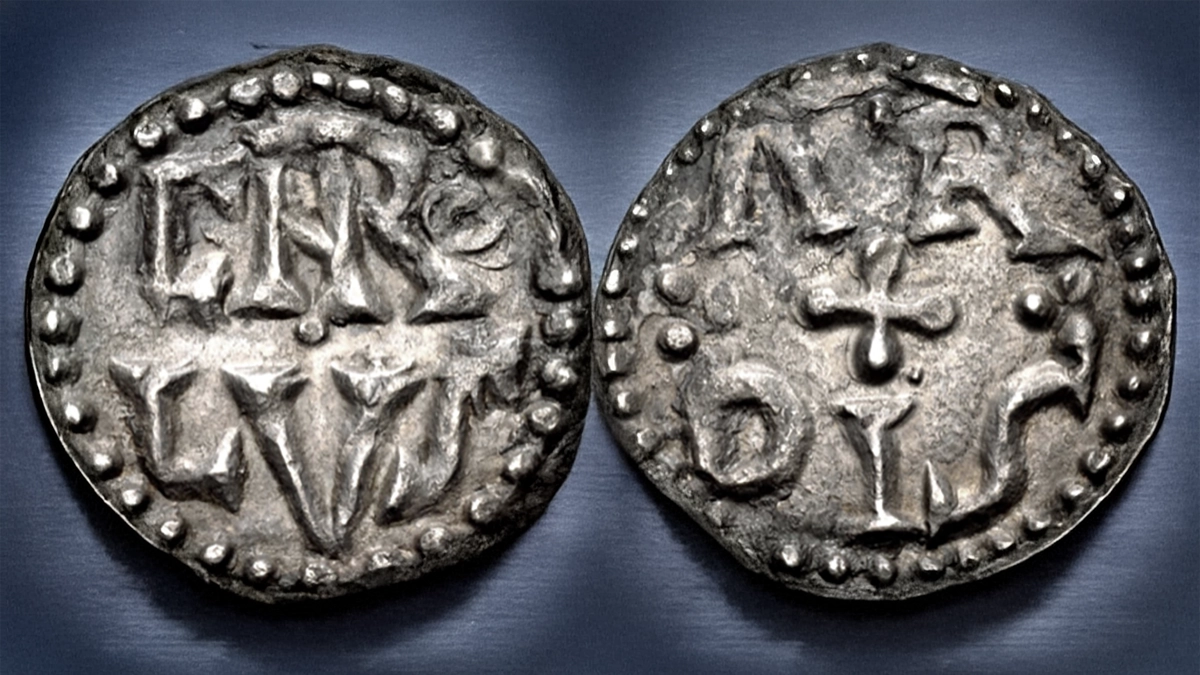
In 771, the Class 2 denier was introduced, eventually being struck at over 100 different mints. The weight of the coin remained the same, but the obverse inscription was standardized as CARO / LVS on two lines, with the A and R ligatured together (when two letters are mashed together into a single symbol, typographers call it “ligature.”) The reverse design was still unregulated, often just a few crude letters, making the mint attribution uncertain. These coins are scarce but more common than the rare Class 1 types.
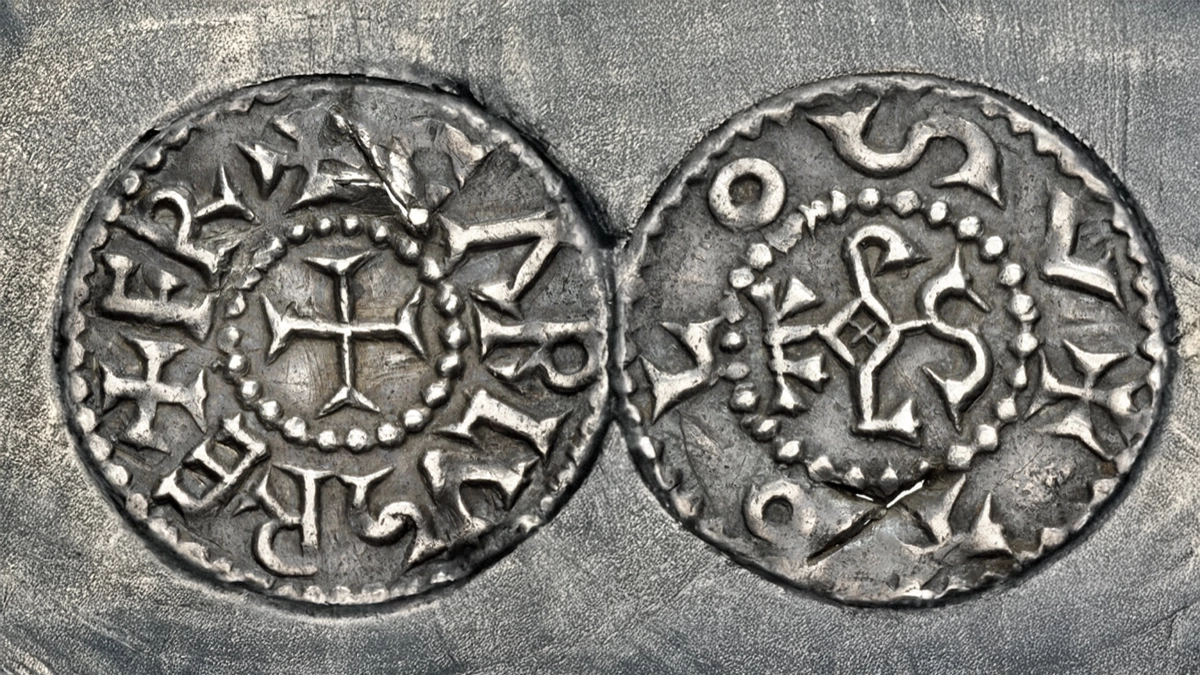
In 793, as part of an extensive reform of weights and measures, Charlemagne revised the coinage, standardizing the design and increasing the weight of the denier from about 1.1 grams to 1.6 or 1.7 grams. He reduced the number of mints to about 40. The coins bore a simple cross in a beaded circle on the obverse surrounded by the inscription CARLVS REX FR (“Karl, King of the Franks.”) The reverse bore the cross-shaped monogram of Karl’s name, usually surrounded by the name of the mint. This monogram became an emblem of the dynasty and appears on coins of many of Charlemagne’s successors.
There is little reliable wage and price data for eighth-century Europe; however, a 794 royal decree, the “Frankfurt Capitulary,” prescribed that one modius of oats should be priced at one denier, barley at two deniers, rye at three deniers, and wheat at four deniers. The modius was an ancient Roman grain measure equivalent to 8.73 liters, about two gallons, or a quarter of a bushel. It also decreed that twelve two-pound loaves of wheat bread should be sold for one denier. The “Carolingian pound” was lighter than ours, about 408 grams.
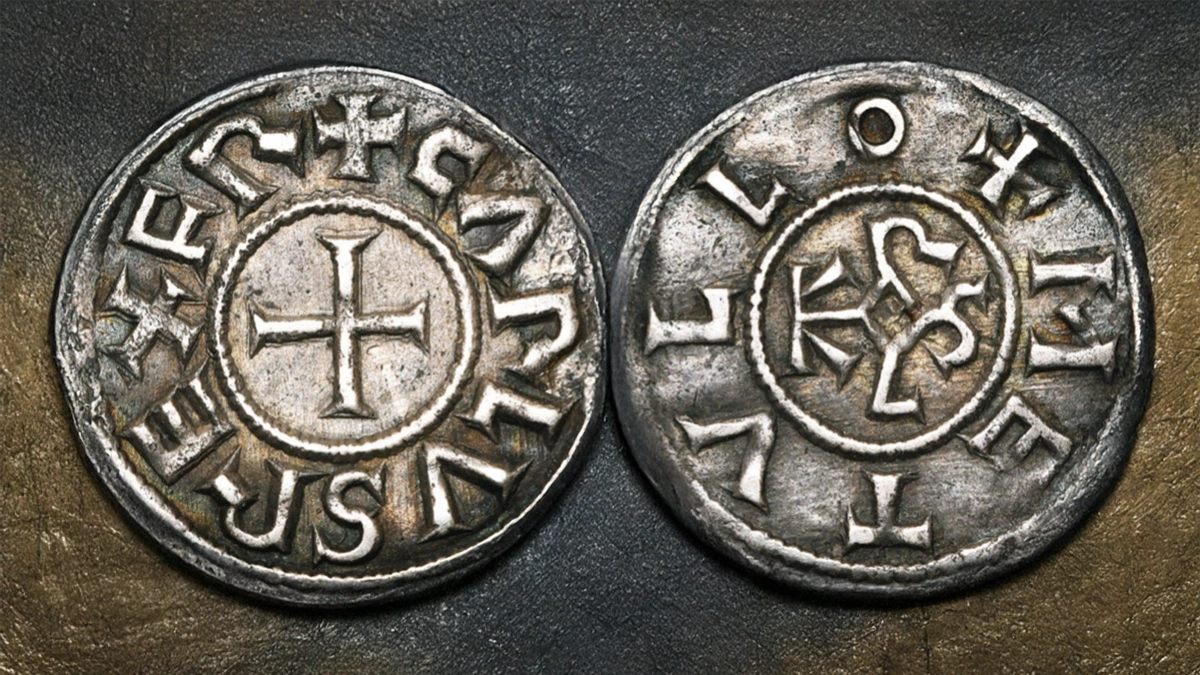
The town of Melle in central France was the site of an important mine that produced lead and silver in such vast amounts that Greenland ice cores show a spike in atmospheric lead particulates from the refining process during this era. It became a major mint, where coins were struck bearing its Latin name METVLLO. Charles “the Bald,” who reigned from 840 to 877, used the same design and inscriptions. However, coins of Charlemagne, which are relatively common, are distinguished by longer, thinner crosses on the obverse.
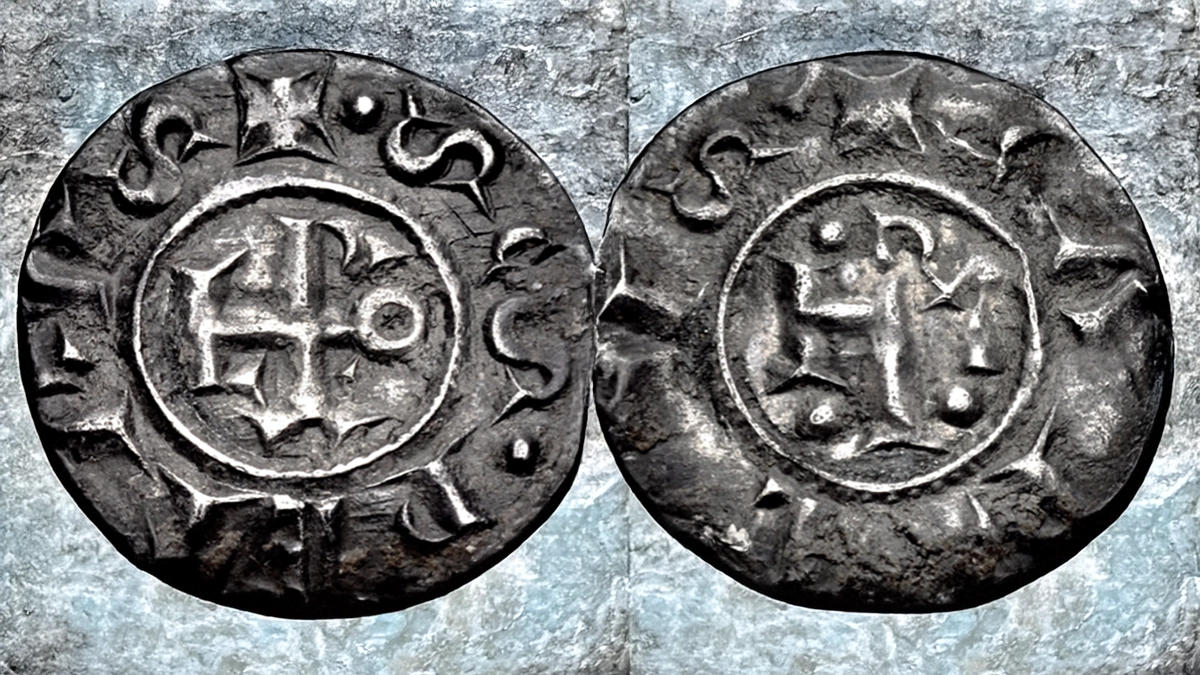
The mint of Rome issued a rare and historic coin sometime after Karl’s coronation as a “Roman” emperor by Pope Leo III (Pope from December 795 to June 816). The coin is a papal denaro struck at the old weight standard of 1.2 – 1.3 grams. The obverse bears Leo’s monogram in a circle, surrounded by the inscription +•SCS•PETRVS (“Saint Peter”). The reverse features the letters “IMP” as a monogram for “Emperor,” surrounded by Karl’s name. At a 2017 New York auction, an example of this rare type sold for $12,000, exceeding the $2,000 estimate.
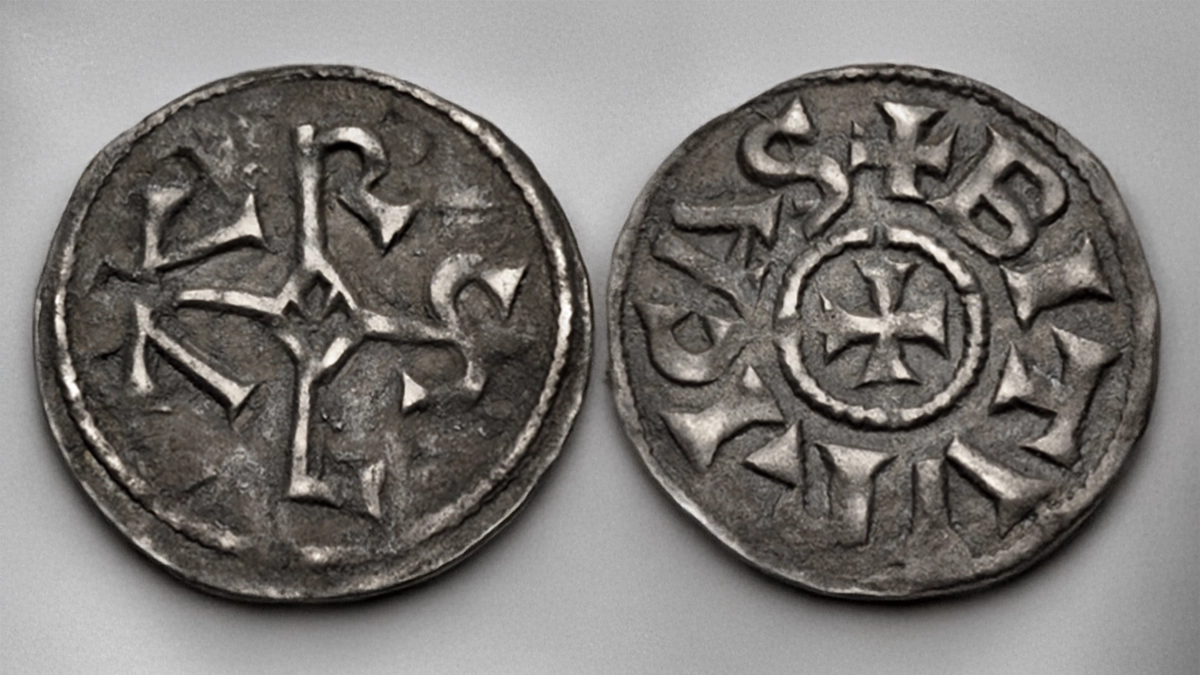
Many mints issued Class 3 obols to meet the need for small change. These little coins have a low survival rate and are quite scarce. An example from the mint of Bourges (bearing the town’s Latin name, BITVRICAS) brought $8,000 against an estimate of $1,000 in a 2022 US auction.
Charlemagne and the Formation of the Holy Roman Empire
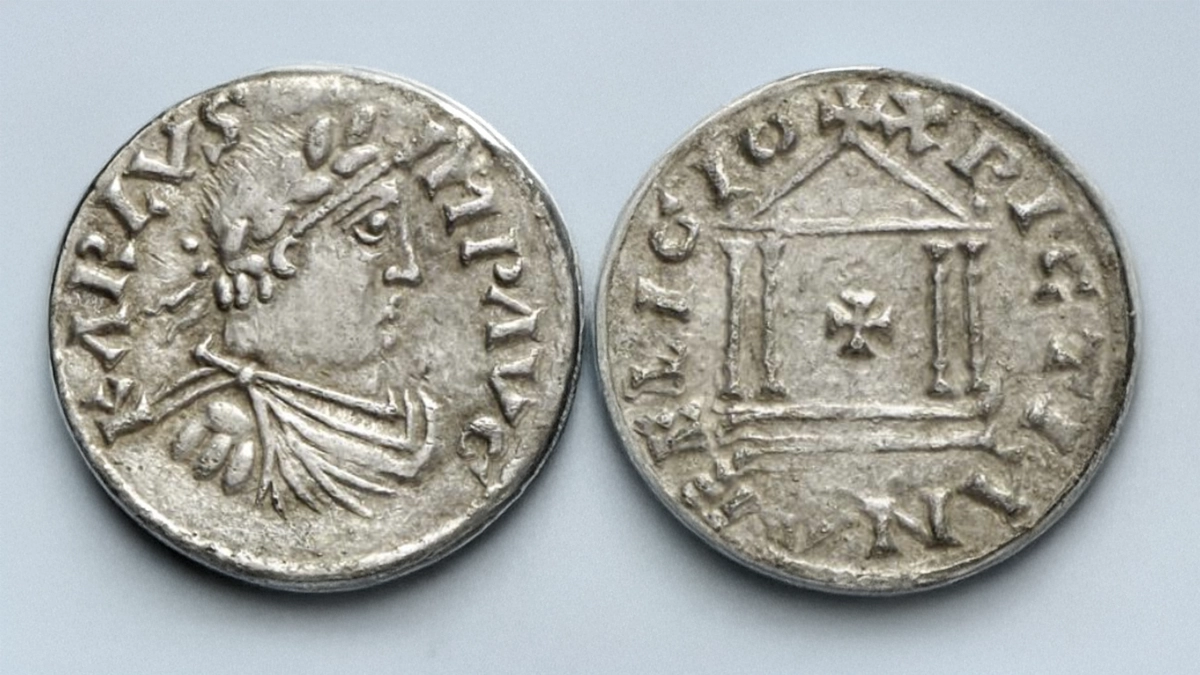
On Christmas Day in the year 800, Pope Leo III crowned Charlemagne as “Roman Emperor,” initiating the so-called “Holy Roman Empire,” which French philosopher Voltaire (1694-1778) noted “was neither holy, nor Roman, nor an empire.” This coronation was politically possible because Empress Irene in Constantinople had deposed and blinded her son, Constantine VI, in 797, seizing the imperial throne for herself. As far as the Franks were concerned, the absence of a male ruler meant the imperial throne was vacant. In 812, envoys from the Byzantine Empire finally recognized Karl’s imperial title. Possibly to celebrate this event, Karl issued the rare Class 4 denier, bearing his laurel-crowned portrait, with the Latin inscription KARLVS IMP AVG (“Karl Emperor Augustus.”) To reinforce the message that his imperial coronation was blessed, the reverse bears the image of a church with the inscription XPICTIANA RELIGIO (“The Christian Religion.”) Only about 55 examples of this rare type are known, struck from several different dies, at an uncertain mint or mints (possibly Karl’s capital of Aachen).
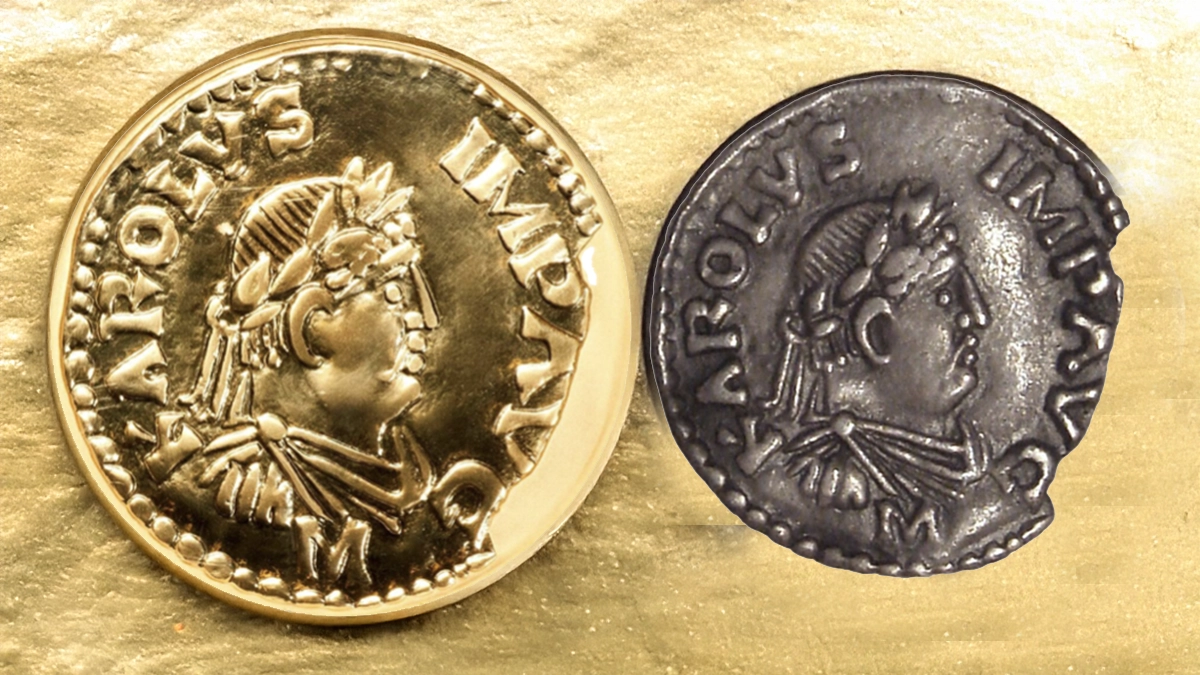
In 2000, the French Republic issued a commemorative gold 100 franc coin copying the obverse design of Karl’s portrait denier. The example copied from the French national collection is damaged, with part of the rim missing from approximately 2 to 4 o’clock on the obverse. Mintage was limited to just 1000 pieces. Weighing 17 grams, with a diameter of 31 mm, the coin was struck in .920 gold. The Paris Mint also issued a 5 franc (copper-nickel) and 10 franc (silver) coin with the same design.
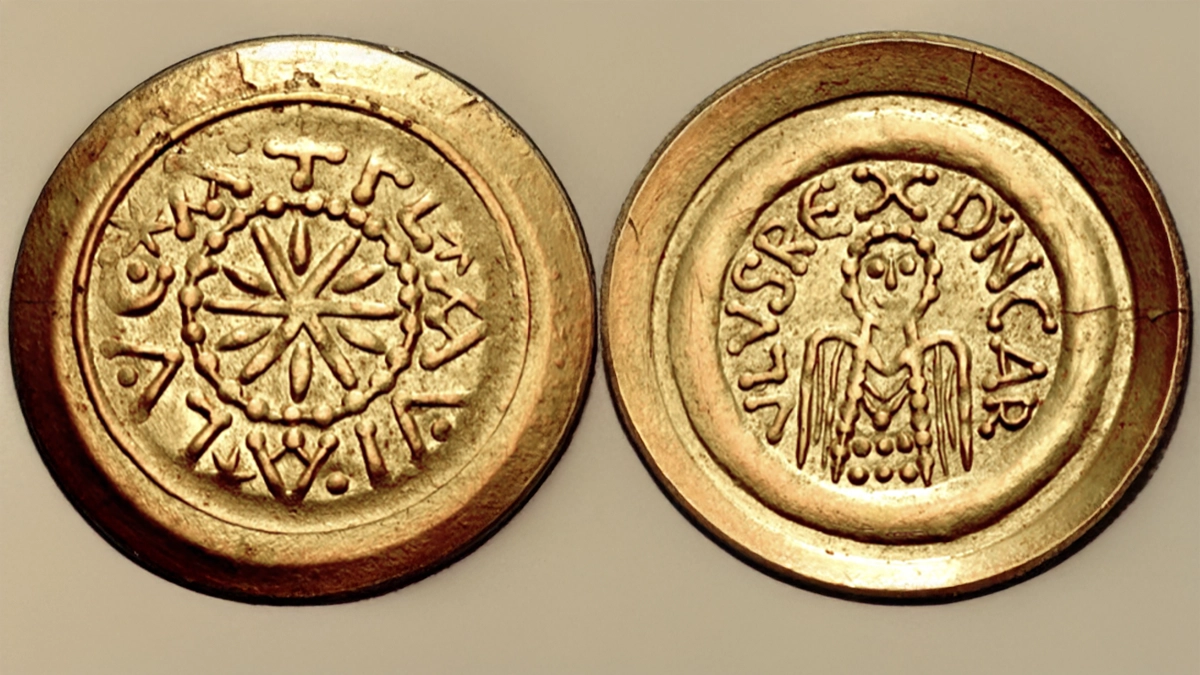
In 774, Karl conquered the Lombard kingdom in northern Italy, adding “King of the Lombards” to his titles. The Lombards had continued to issue gold tremisses long after gold had gone out of circulation in the rest of Western Europe, although the alloy was increasingly debased. Karl issued gold tremisses of similar style in his own name for a few years, bearing a crude portrait. An example from the mint of Lucca bears the inscription D • N CAR VLVS RЄX (“Our Lord, King Karl”).
Karl died on January 28, 814, at Aachen. He had reigned for a remarkable 47 years. Louis “the Pious” (Ludwig der Fromme in German), Karl’s only surviving legitimate son, succeeded him.
Collecting Charlemagne
There is a vast literature on the life of Charlemagne. Scholars widely regard Rosamond McKitterick’s biography (2008) as the best modern English-language treatment. The standard reference for his coinage, usually cited in auction catalog listings, is Depeyrot (2017) in French. One can find secondhand copies of earlier editions for about $50. Morrison and Grunthal (1967), published by the American Numismatic Society, is outdated but still useful. The British Museum, the American Numismatic Society in New York, and the national collections in Paris, Rome, Brussels, and Berlin hold significant collections of these coins.
Like most coins of famous historical figures, coins of Charlemagne are in high demand from collectors, and high-grade examples command strong prices, especially the rare Class 4 portrait coins. There is a superb Charlemagne museum in the German city of Aachen, located next to the extensively rebuilt cathedral he founded in 796 as his palace chapel, and where his mortal remains are enshrined.
References
Cantor, Norman (ed.) Encyclopedia of the Middle Ages. New York (1999)
Collins, Roger. Charlemagne. Toronto (1998)
Coupland, Simon. “Charlemagne and his coinage.” in Rolf Große and
Michel Sot (eds.) Charlemagne: les temps, les espaces, les hommes. Construction et déconstruction d’un règne (Turnhout, 2018)
Depeyrot, Georges. Le Numéraire Carolingien: Corpus des Monnnaies. (4th ed.) Wetterin, Belgium (2017)
Eginhard (Samuel Turner, translator) Life of Charlemagne. New York (1880)
Ferguson, Niall. The Ascent of Money: A Financial History of the World. New York (2008)
Grierson, Philip. Coins of Medieval Europe. London (1991)
Grierson, Philip and Mark Blackburn. Medieval European Coinage 1: The Early Middle Ages (5th – 10th centuries). Cambridge (1986)
McCormick, Michael. Origins of the European Economy: Communications and Commerce AD 300-900. Cambridge (2001)
McKitterick, Rosamond. Charlemagne: The Formation of a European Identity. Cambridge (2008)
Morrison, Karl and H. Grunthal, Carolingian Coinage, ANS Numismatic
Notes and Monographs 158. New York (1967)
Spufford, Peter. Money and Its Uses in Medieval Europe. Cambridge (1988)
Walker, Ralph S. Reading Medieval European Coins. Fairfield, CT (2009)






Very interesting article!
Minor correction: his mother tongue was not “Old High German” but that which was spoken in the county of Laon, Northern France, where his mother was born. It is referred to as Franconian and is closest to today’s Luxembourgish.
Interesting read! Beautiful coins.