


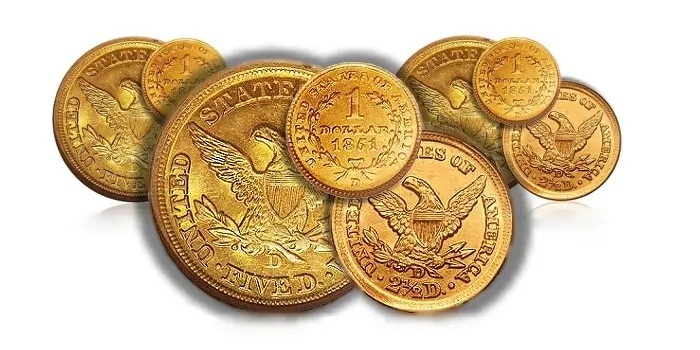
Southern gold coins combine history, scarcity, and real collecting appeal. As a result, they have become one of the most popular segments of United States coinage. In recent years, auction results for attractive circulated pieces have surged. In many cases, prices have more than doubled. Even problem coins now bring strong money because collectors see fewer of them at shows and in dealer inventories.
Years ago, collectors could walk a major convention floor and find several Southern gold coins with little trouble. Today, that task looks much harder. Supply has tightened. Meanwhile, demand has strengthened. That combination has pushed Southern gold coins into one of the strongest-performing corners of the rare-coin market in recent memory.
America’s first gold rush began in North Carolina
Many people still connect America’s first major gold story to California in 1848. However, the first significant discovery came much earlier in North Carolina. In 1799, Conrad Reed found a yellow rock in Little Meadow Creek on his family’s land. The rock weighed about 17 pounds, and the family used it as a doorstop for three years before a jeweler identified it as gold in 1802.

That discovery helped launch the Carolina gold rush. Soon afterward, the Bechtler family established a private mint near Rutherfordton. By July 1831, the Bechtlers had begun striking $2.50 and $5 gold pieces, and in 1832 they introduced the first gold dollar produced in the United States. Gold production in the region grew enough to justify a federal branch mint in Charlotte, which opened in 1838.
Georgia gold created another Southern mint

Next, another rush took shape in northern Georgia. Gold discoveries in 1828 and 1829 drew thousands of miners into land that belonged to the Cherokee Nation. By 1830, the region reportedly produced more than 300 ounces of gold a day. At the same time, private minters such as Templeton Reid, and later the Bechtlers, turned local bullion into coinage. In response, Congress authorized a federal mint at Dahlonega, and that branch entered service in 1838.
The Georgia gold rush carried consequences far beyond coinage. It accelerated white settlement, fueled land lotteries, and helped drive Cherokee removal. Therefore, every Dahlonega gold coin links directly to one of the most important and painful chapters in Southern and American history.
Then California changed the national story
Of course, the discovery that most Americans remember came in California. On January 24, 1848, James W. Marshall found gold at the sawmill he was building with John Sutter. Marshall and Sutter tried to keep the find quiet. However, word spread quickly, and gold fever soon swept across the West. Sutter later lamented the discovery because workers abandoned his businesses to chase gold.
Mintmarks turned history into a collecting category
As the nation expanded, the Mint struck gold coins at Philadelphia, Charlotte, Dahlonega, New Orleans, Carson City, Denver, and San Francisco. Branch mints placed mintmarks on their coins, while Philadelphia generally did not.

The United States Mint notes that mintmarks first appeared on U.S. coins when Charlotte, Dahlonega, and New Orleans opened in 1838. Later, Augustus G. Heaton’s 1893 treatise on branch-mint coinage helped popularize collecting by mintmark.
Each mint developed a distinct identity. Collectors often associate Dahlonega pieces with weak strikes and uneven quality. By contrast, Philadelphia usually produced the strongest workmanship. Those differences give Southern gold coins much of their charm. They also explain why collectors prize them for more than rarity alone.
Southern gold coins from Charlotte and Dahlonega span 1838 to 1861. New Orleans gold issues run from 1839 to 1861 and again from 1879 to 1906. Then, in 1861, Confederate forces seized all three Southern mints. Charlotte and Dahlonega never reopened as coining facilities. New Orleans did reopen, and it continued striking coins until 1909.
The Southern mints
Charlotte, North Carolina (1838-1861)

The Charlotte Mint opened to process locally mined gold. In 1844, fire damaged much of the facility and halted coin production for 1845. Then, in 1861, Confederate forces seized the mint and turned it into a hospital and headquarters during the Civil War. After the war, the government reopened the site as a U.S. Assay Office in 1867, and that office operated until 1913. Later, preservationists moved the building, and today the Mint Museum Randolph occupies it as North Carolina’s first art museum.
Charlotte used the mintmark “C.” The mint struck only gold coins there, and most issues carry low mintages. In general, Charlotte coins fall short of Philadelphia quality. Still, collectors usually find them better made than their Dahlonega counterparts.
Dahlonega, Georgia (1838-1861)
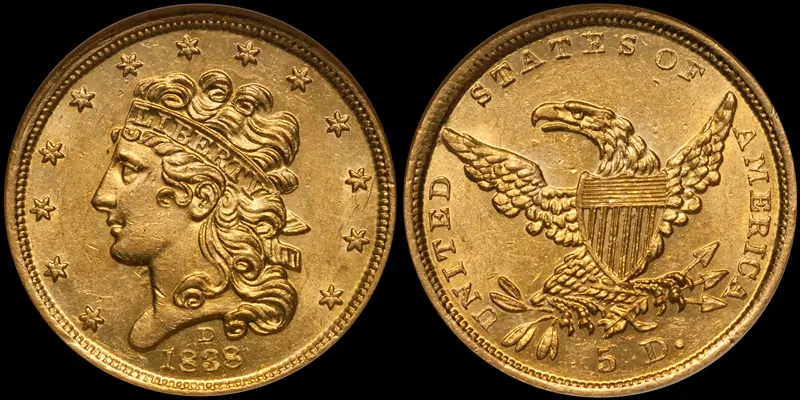
The Dahlonega Mint also opened in 1838 to process local gold. Output stayed low throughout its life. Even so, the mint operated until Confederate forces seized it in 1861. The building burned in 1878. Today, Price Memorial Hall stands on the original foundation.
Dahlonega used the mintmark “D.” That letter later served Denver as well, but the two mints never operated at the same time. Dahlonega struck only gold coins, and collectors know many of them for weak strikes and rough production quality. That weakness, however, has become part of the series’ appeal.
New Orleans, Louisiana (1838-1909)
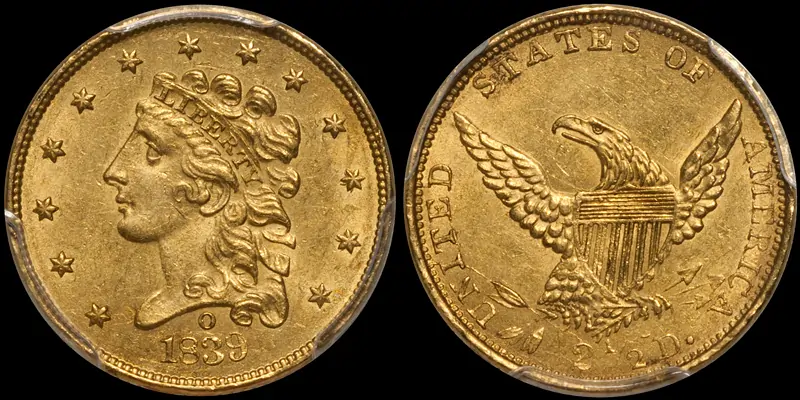
The federal government opened the New Orleans Mint in 1838 because the city served as a major port and commercial center. Gold from Mexico also moved through New Orleans in large quantities, which made the site especially important. Confederate forces seized the mint in 1861. Union forces later recaptured the city, and federal authorities eventually returned the building to mint service in 1879. Coinage continued there until 1909.
New Orleans used the mintmark “O.” Unlike Charlotte and Dahlonega, New Orleans struck both gold and silver coins, and mintages range from rare to common. Collectors generally regard the output as solid, though many issues show soft strikes. Today, the Old U.S. Mint still stands on the edge of the French Quarter as part of the Louisiana State Museum system and as home to the New Orleans Jazz Museum.
Why collectors still chase Southern gold coins
Southern gold coins remain popular for good reason. First, they carry a rich story that ties directly to America’s early gold rushes, branch-mint history, and Civil War disruption. Second, collectors can realistically pursue a complete set because the series does not include the kind of impossible mega-rarity that stops most set builders cold. That mix of history and attainability has helped make the series one of the most desirable areas in U.S. numismatics.
Moreover, Southern gold coins draw strength from more than melt value. Gold hit record highs earlier in 2026, although prices pulled back sharply in March before rebounding in early April. Even so, Southern gold has shown that collector demand can support values beyond bullion alone. With supply still thin, this segment of the U.S. gold market looks well positioned for continued long-term interest. We will explore different ways to collect Southern gold in a future article.
Want more articles like this? Subscribe to the free NGC Weekly Market Report.






The last photo is NOT a New Orleans coin. It’s the exact same Dahlonega coin as in the pic before it.
JD. You are 100% correct. Our error. The ismage has been changed to display the correct 1839-O. Thanks for letting us know.
While they STILL matter? Was there someone doubting whether the southern mints coins still mattered?
Southern mints put out some great coins.
Love this wonderful coin history.