


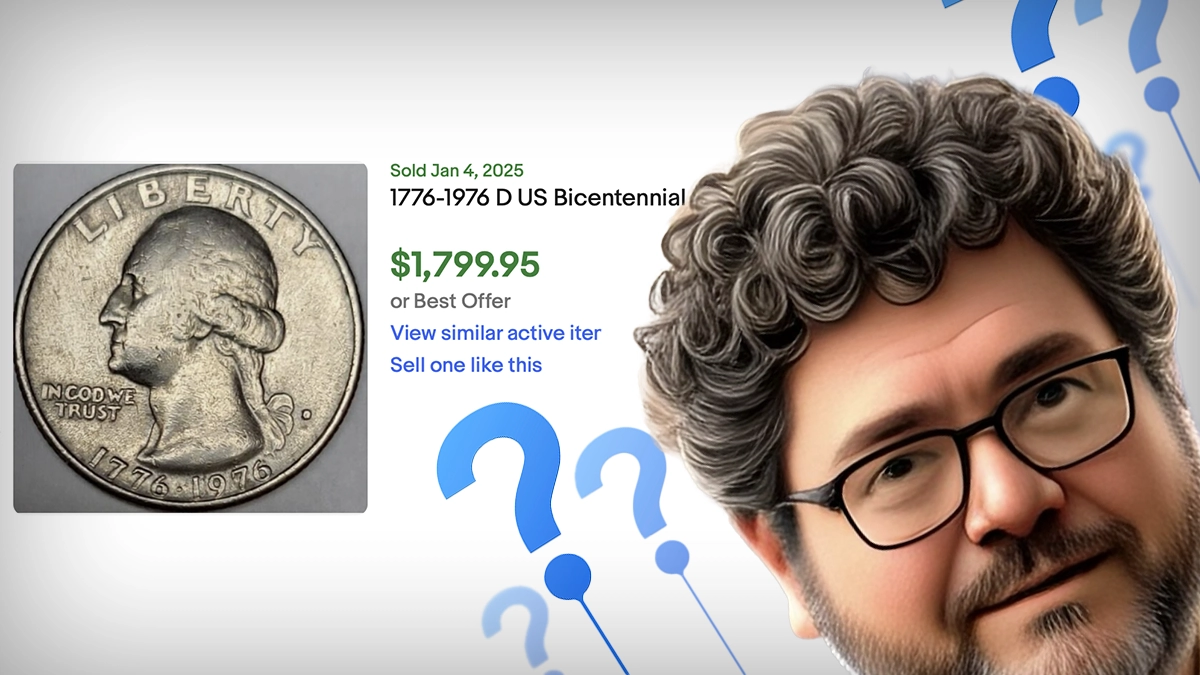
Original by Charles Morgan, Updated by CoinWeek …..
Call me old-fashioned, but I’m the kind of fella who believes in paying an honest price for an honest product. And I believe there’s an honest price for every kind of collectible and a justifiable reason for any collector to pursue any area of collecting if they so desire.
I say that because today, I think we need to talk about the 1776-1976 Bicentennial Quarter, a perennial favorite among collectors and an eternal chestnut for SEO companies looking to hoodwink Google. I’ve written about this before, but the TL:DR of it is that, thanks to flaws in Google’s algorithm, tens of thousands of articles have been written claiming this common coin still found in circulation is worth big bucks. Some of these spammers even claim the coin is worth hundreds of millions of dollars. I’m not kidding. Let’s call it for what it is: a “big lie” and fraud. And this “big lie” is hurting people.
Now, before you say that I’m some blowhard who doesn’t appreciate the appeal of modern coins, know this. When I started my journey as a numismatic writer, I felt that the traditional rare coin market was missing the boat on modern coins. In modern coins, I saw an approachable area of the hobby that would resonate with coming generations of collectors who recalled spending Kennedy Half Dollars or seeing Wheat Pennies in change, or, yes, how cool it was when the Bicentennial coins were released as part of the nationwide observance of the 200th anniversary of the birth of American Independence.
Speaking for myself, I have no idea how many 1776-1976 quarters have been in my hands over the course of my lifetime. You certainly used to see them more frequently than you do now that the coin is approaching 50 years old.
Also, I don’t know if you know this, but the first article Hubert Walker and I wrote for CoinWeek when we were freelancers was about the risks and rewards of collecting the Bicentennial Quarter. Millions have read that article and watched the video version (see link) over the years, but it’s still not enough. If more people had read our level-headed analysis on the collectibility of the famous Drummer Boy quarter, then a beat-up circulated example would have never honestly sold on eBay for $1,799.
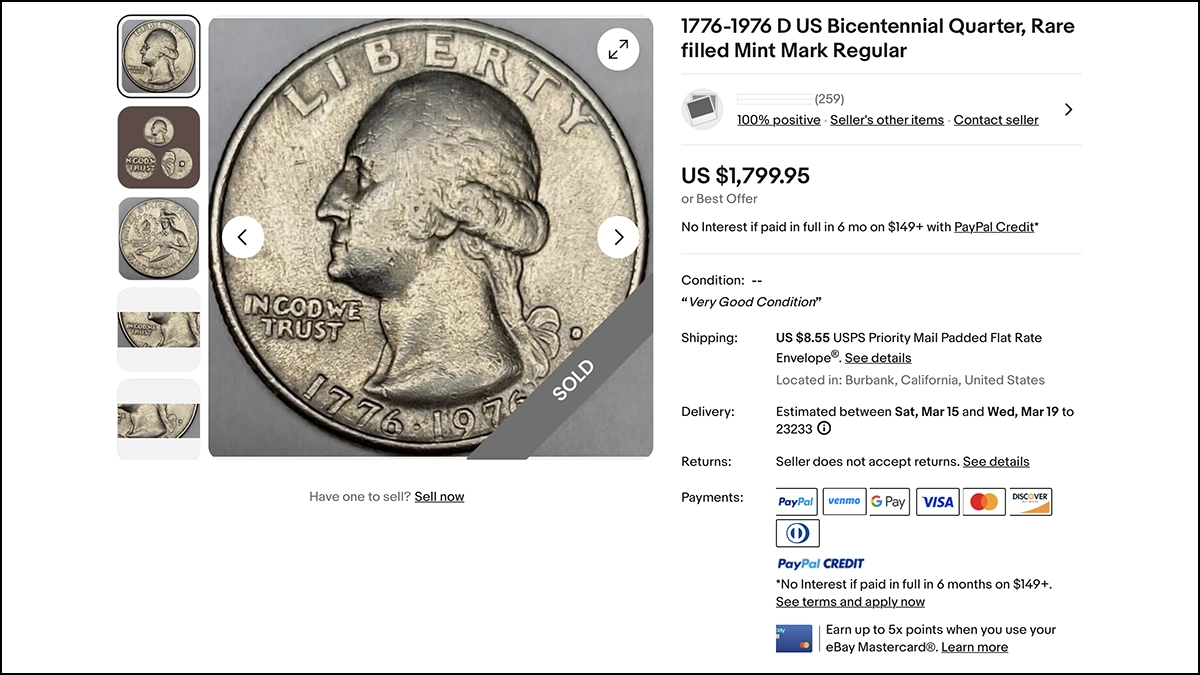
The seller of this worn Bicentennial Quarter makes a remarkable claim, saying it has a “rare filled mint mark.” On this coin, the mintmark is the small “D” located to the right of George Washington’s pigtail. This design element was struck onto dies by hand, usually by the United States Mint’s assistant engravers. Some accomplished this in one punch, while others had to tap the mintmark into the die multiple times. When the mintmark shows clear evidence of multiple punches due to the spread between impressions, we call this a Repunched Mintmark (acronym: RPM). If a mintmark variety existed for the 1976-D Washington Quarter, it would be an RPM. However, no RPMs for the 1976-D quarter are listed in the Cherrypicker’s Guide, and none are attributed by the industry’s leading third-party grading services.
The seller doesn’t call his rare variety an RPM; instead, he calls it a “filled mint mark.” A filled or clogged mintmark is a type of error where the mintmark is either bungled or clogged. Looking at the images provided by the seller, the “D” mintmark on this coin is neither filled nor clogged. Instead, what is plainly visible is wear. Over time and subsequent use, the finer details of a coin’s design will wear down. If a coin circulates for long enough, then the raised elements of a coin will wear completely flat until the coin is no longer identifiable. With clad coins, one will likely never encounter one that has had its design completely worn down, but those who collect America’s pre-1964 silver coins are well familiar with this phenomenon.
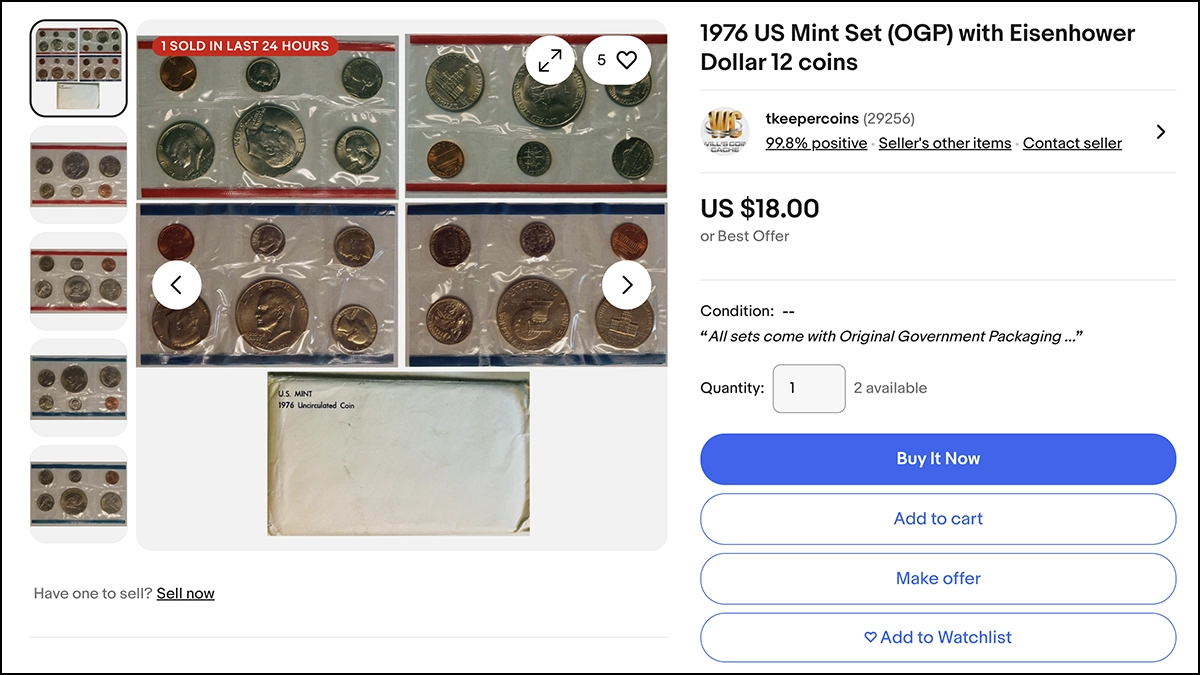
Now that we’ve cleared up the nonsense about the rare error, let me provide some incontrovertible evidence that the 1776-1976 Bicentennial Quarter is not worth the thousands to hundreds of millions of dollars these salacious internet posts claim. The above listing from the reputable Round Table Trading coin dealer tkeepercoins is for a complete 1976 U.S. Mint Set in Original Government Packaging. This set includes an uncirculated example of every business-strike coin issued by the United States Mint in 1976, including the 1976 Washington Quarter and the 1976-D. Why would a beat-up, circulated example be worth nearly 100x times more than a premium uncirculated one? The answer is obvious: it wouldn’t.
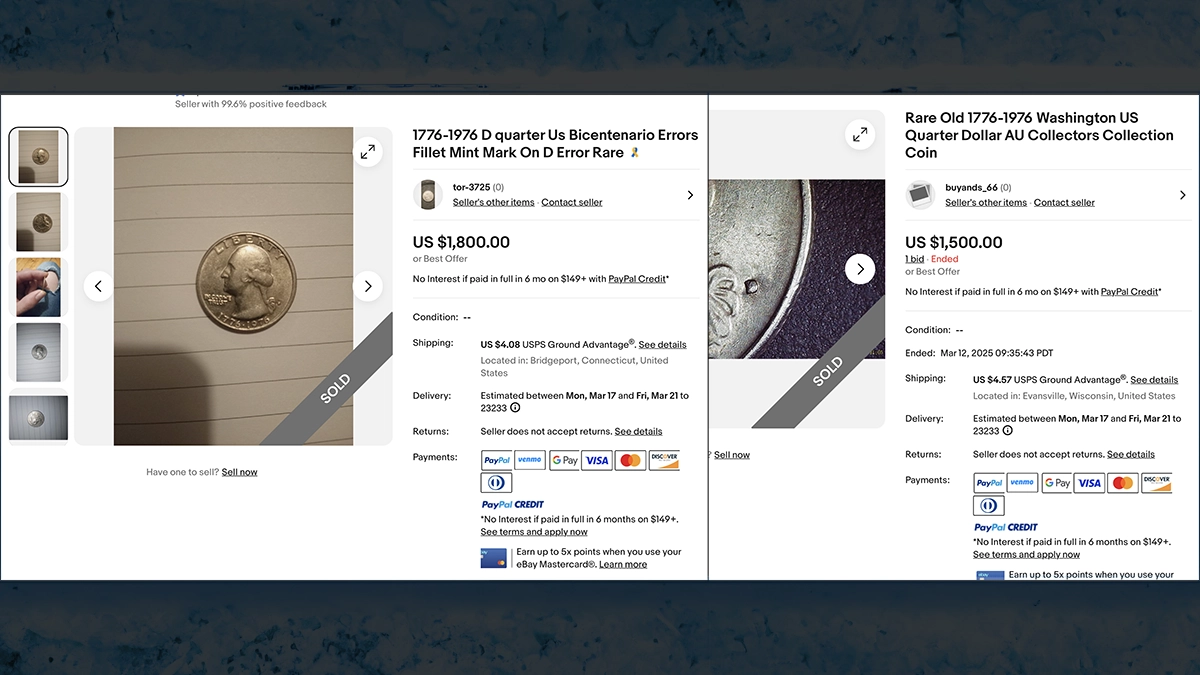
The offending listing, which reportedly sold for $1,799.95, isn’t the only recent sale reported by eBay of a Bicentennial Quarter going for exorbitant sums. The two listings imaged above were from sellers with zero feedback ratings. One hopes that these sales were never actually carried out.
Until humans take a bigger role in curating the type of content that Google and other social media companies disseminate, disinformation will continue to proliferate, and no amount of human expertise will be able to outshout a computer algorithm. I’ve done my part, but it remains to be seen if the refutation of a noted numismatic expert will be able to out-disseminate the 1976 quarter’s Big Lie.
* * *







I thought that the reason for the outlandish prices for common coins was part of a money laundering scheme. That’s the only reason I can think of that makes any sense.
Yup.
Author needs to do some research
THANK YOU CHARLES!! As a collector with over 50 years of experience, bluntly put I’m disgusted by the amount of deliberate misinformation being spread to separate the unwary from their wallets. A major problem is that the hosting sites seem little-bothered by these scams, probably because they generate lots of clicks.
Another significant scam plays on people’s lack of familiarity with the Mint’s somewhat inconsistent mint mark practices. Quick scans of both eBay and another site whose four-letter name also starts with e and ends in y turned up dozens of ads for “rare” pre-1980 “error coins with missing mint marks”.
A pox on all these fakers!
Well said… It’s really not good.. bad for buyer, seller is scammer, potential collector discouraged, etc… it really gives the hobby a bad name..
Only cure is to call’em out… Thanx
Yup
There is so much bad and misleading info out there that you need to know your stuff just to sort through it all. Thanks for the article and wisdom Charles!
I’ve been coin collecting for most of my life. These transactions are definitely Money Laundering. Think about it. They need a “sale” and 3rd party written instruments in order to provide documentation for “cash”. It’s just like that most money laundering operations are cash rich store fronts where the customer pays cash.
The opposite would be cash transactions where the person “under reports” their income. And as a 40 year long Fraud Investigator, I can NOT figure out why ebay does absolutely nothing about these criminal activities. But then again, ebay has a reputation for hammering sellers’ items for ridiculous reasons and then ignoring other items. Especially with the new technology of being able to put porn photos on silver bars and rounds. They do nothing to stop it. Even with their bloated I.T. Dept. that does nothing but constantly change the platform to make everything more confusing.
Moreover, couterfeiting is a huge problem that ebay does nothing about and because the “operation” is not huge and committed by many different actors, the Secret Service does nothing either. I can tell you this for sure, there is only a very minute fraction of 1% of those coin sales where there is a complete idiot buying the coin at an incredibly inflated price.
These ebay transactions are 99.9999999% criminal activity. Probably even drug related. Think about this, the person needs to account for all the drug cash. They aren’t going to store it all in a mini storage building like you have heard the stories about with the weed sellers up in the NorthWest. If they are doing that, then they truly are morons. Just use all that cash to buy a cash rich business and launder the money that way so it can be stored securely in a bank.
It’s a pretty elementary operation on the surface, but gets very complicated as more and more transactions compile for investigators to sort through. And that takes resources and a lot of time. And the crime isn’t violent, so, a lot of times, financial crimes are ignored or tolerated. Dang, in a lot of places in this country, some violent crimes are now being tolerated and ignored!
I don’t understand how they get away with spreading misinformation! Just seems crazy that they tell plain lies for profit and nothing is done! Same with coin apps! Bogus stuff people!!
Why take advange of honest people. So so wrong.
How people can take advange of people is sickening. thank you for this article.
Based upon what I just read, the 250th Anniversary coins will be worth a lot of $$$$.
This article is confusing due to its use of unexplained terms. For example, What is a SEO company? Next, what does TL:DR mean? Thankfully, at least you were kind enough to explain the meaning of RPM.
I can only say TL:DR = Too Long, Didn’t Read
It has been said that a fool and their money soon do part and this is a great illustration of that!!
Really have to watch your self on ebay.
Why does ebay allow this?
You have to wonder if those sales actually took place. I love the bicentennial quarter though, that’s the coin that got me into collecting coins when I was a kid.
Wonderful, article about scam jobs at work? As for the quarters
Would like to have a mint set again, most younger people
Have never seen one little on a dollar coin that size or something
Like it? The whole set was a great collection and very beautiful
This is a really useful article. Thanks for posting.
Truly sad that people do this to honest people.
Buyer beware.
Best means of money laundering scheme for cartels with less expenses than laundering thru vegas
Sounds fishy, laundering bring to mind a baseball card a few years ago worth about a dollar or so, going for thousands. I have never heard about the guy. “1990 JOSE URIBE “ look him up crazy read.
I’ve seen more than Bicentennial quarters. Ike dollars , coins from the 1860s listed as Civil War which technically it was but raise the price I’m guessing so people who don’t know any better are getting ‘a piece of history’. And there is pocket change stuff going for 4 and even 5 figures. And it probably isn’t a violation if some dummy is willing to pay for it. If I were dishonest I have plenty of these coins to possibly become a millionaire. It is aggravating to see this.
I wish EBay could some how spot fakes and dishonest postings. I have noticed lately that the 1921D Mercury dime is showing up frequently on EBay and closer looks shows the date appears to the off. Not to mention the fact that is is coming from China. I agree, Buyer Beware.Ro
Thank you for the warning!
I can’t believe there are that many idiots out there that are willing to buy into all the misinformation from some of the eBay sellers.
The Bicentennial Quarter is my favorite coin, regardless of value. Have around 350 of them.
And eBay listings confuse so many new sellers. Everyone says to look only at the “Sold” listings, but even these are confusing most of the time. I typically advise new collectors to avoid eBay.
TicTok videos are also a problem. Generating hype for Views and Likes and got people thinking they’re going to find a 1982 Denver Smalll Date Copper Cent. Shameful.
I hope eBay does something about these crooks. Scams are one reason I don’t buy on eBay.
Be careful out there!
Thank you for bringing this to our attention. With artificial intelligence it becomes even more difficult to recognize a scam.
Somewhere P.T. Barnum is laughing.
Found this article interesting and helpful.
I have a couple hundred of these quarters. maybe if I sold them on ebay I could become a millionaire, LOL. I don’t think eBay is a place to buy coins.
It’s just honest criminals doing their jobs..
eBay has always had scammers, from the early keyword spammers (where you could highlight the white background and reveal the entire Oxford English Dictionary in white type) to outright knockoffs and fakes. They probably do nothing because, like Facebook who ALSO does NOTHING, fake accounts and scammers represent advertiser numbers.
I don’t know who would be dumb enough to buy any common coin at a ridiculous price, but then I just hang around the coin shop long enough, and my inquiry gets answered.
Interesting article. Someone is trying to scam someone out of money? or do they really believe the coin is valuable because of some garbage article they’ve read? Someone is too lazy to research information at reputable sites when buying and just accepts what strangers tell them? money laundering? A lot of angles to consider. Most just come down to greed.
I need to research a couple of coins also. Thanks.
I wish more folks were aware of information like this.
My son would fall for something like this. Thanks for shining a light on this.
Crazy. Grandma had me saving buckets of these as a kid.
Ebay and all the other selling sights have gotten filled with fake and miss-represented coins and no one does anything about it! Until there is a penalty to list fakes large enough to stop it. Its going to continue to get worse!
So, Buckle up buttercups!
Flippers are out of control and so is the eBay costs.
Great article – no substitute for research and buying from reputable dealers
Easy to get scammed today on anything – do your homework before buying and forget the hype
Will there be a semiquincentennial (250th USA anniversary) coin from the US mint?
Yep probably money laundering
And I am concerned with AI we are going to see more and more fake articles, items and accounts popping up. Too bad.
Let the buyer beware.
I a 1975 s Bicentennial quarter uncirculated out of a proof set and it weighs 5.55. What’s that about
I have a 1975