By Kelvin Cheung – Director and Senior Numismatist, Stack’s Bowers Galleries ……
Globalization has been a driving force behind prosperity since ancient times, beginning with the Silk Road, which first connected East and West through an extensive network of trade. Over the centuries, successive waves of globalization have emerged, each bringing faster connections and significant benefits to the world.
The era of proto-globalization began with the rise of maritime European empires in the 15th and 16th centuries; Spanish, Portuguese, Dutch, French, and British fleets sought to establish colonies and extensive trade networks during the “Age of Discovery“. Over the following centuries, trade continued to grow, leading to the first major wave of globalization as we know it from around 1870 to 1914. While the exchange of goods and knowledge had taken place for millennia before that point, it was during that period that 20th-century globalization was established, and the world slowly began to change into how it is now.
The invention of the steamship in the mid-19th century revolutionized the movement of goods, capital, and labor across continents at an unprecedented pace. This period also saw a flourishing exchange of technology, science, and cultures. For example, in 1800, it took at least nine months for tea grown and harvested in Asia to be brought to market in London and be seeped in the teacups of its residents. A century later, thanks to advances in steamship technology and the opening of the Suez Canal in 1869, that same process had been reduced to just a few months.
The impact of this transformation was most acutely felt in the ancient empires of the East, which had long been leaders in science and technology but had also restricted foreign nations’ access to their markets. However, following the Qing Empire’s defeat in the First Opium War in 1841, China was compelled to open its doors to global trade, a trend that has persisted, with minor interruptions, to the present day.
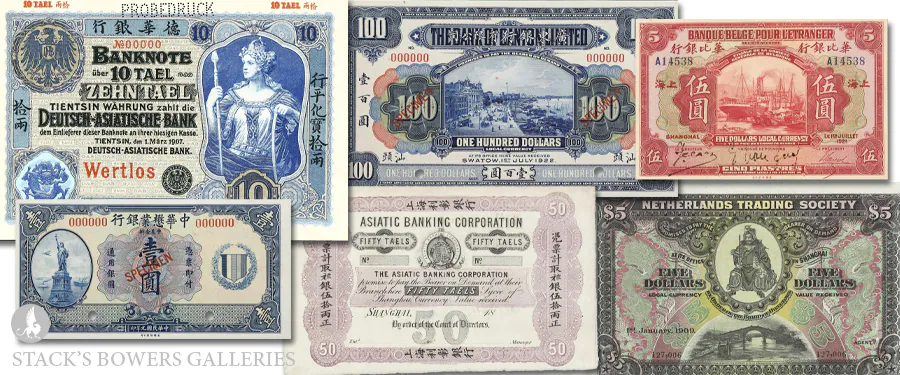
From then on, Western merchants and banks began arriving in China, seeking opportunities to amass wealth. This led to the establishment and expansion of ‘Foreign Banks’ in the region, starting with institutions like the Mercantile Bank of India; The Chartered Bank of India, Australia and China; the Asiatic Banking Corporation; and the Hongkong and Shanghai Banking Corporation in the 1860s. These early foreign banks were virtually all British and were often expansions of earlier banks formed elsewhere in Asia. These were later joined by banks from France, Belgium, Germany, Russia, Italy, and the United States in the late 19th and early 20th centuries.
In addition to their standard banking operations, these institutions issued a wide variety of banknotes, making “Foreign Banks” a significant category in the field of Chinese notaphily. Notes from these banks made up a large part of the money supply in China in the early 20th century. Often, the notes feature unique designs, with references made to the country of origin of many of these banks. For example, a series of notes from the Chinese-American Bank of Commerce (Lots 30262-66) features a vignette of the Statue of Liberty in New York City!
Stack’s Bowers and Ponterio is proud to present one of the largest sales of these banknotes in recent history, offering 250 lots in the April 2025 Hong Kong Auction, including rare specimens, early notes and seldom-seen issued notes. The section, drawn primarily from the Voyager, Norman Lin, and Al Kugel collections includes numerous rare and top-grade notes. This catalog is poised to become an essential reference for the genre and set a new benchmark for an already heavily collected section in Chinese numismatics.
To view all lots in the April Hong Kong Auction, visit StacksBowers.com.
* * *