

In the years following the Civil War, the United States entered a period of financial uncertainty. Inflation fears grew as “greenbacks”, paper notes not backed by gold, circulated widely.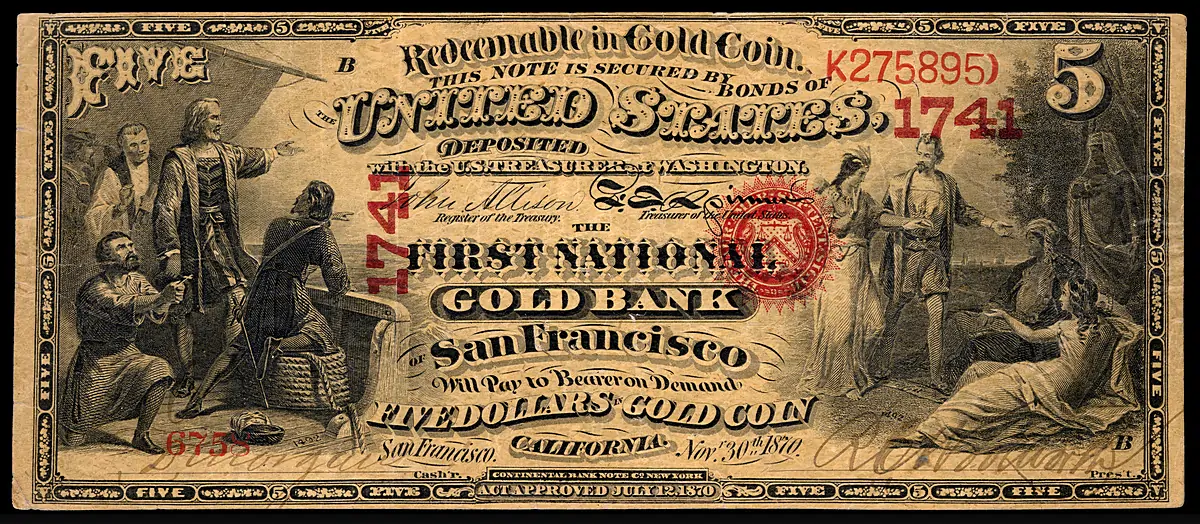
Seeking stability, Congress passed what is commonly referred to today as the National Gold Bank Act of 1870 (actually part of the Currency Act of July 12, 1870). This legislation authorized a select group of banks, almost entirely in California, to issue a new form of currency: National Gold Bank Notes.
Though their lifespan was brief, these notes occupy an extraordinary place in U.S. monetary history. Today, they stand among the most coveted and visually impressive large-size notes ever produced by the Bureau of Engraving and Printing.
Why Gold Bank Notes Were Created
Unlike standard National Bank Notes, redeemable in “lawful money” and backed by U.S. government bonds, National Gold Bank Notes were redeemable strictly in gold coin.
This redemption promise was key. Californians, long accustomed to hard money and deeply distrustful of paper currency, demanded assurances that any paper note they accepted could be traded for real gold.
The solution was simple in concept but rare in practice: create a circulating note that loudly, visually, and legally guaranteed gold payment.
Between 1871 and 1883, the ten authorized National Gold Banks issued nearly 200,000 notes, totaling $3,465,240 in face value, but only a tiny fraction still survives today.
The Ten Chartered National Gold Banks
Congress authorized only a limited number of institutions to issue these notes, just ten, all located in California except for one bank that later moved operations to Boston.
Chartered National Gold Banks
- First National Gold Bank of San Francisco, CA
- Second National Gold Bank of San Francisco, CA
- California National Gold Bank of San Francisco, CA
- Farmers National Gold Bank of San Jose, CA
- First National Gold Bank of Santa Barbara, CA
- Union National Gold Bank of Oakland, CA
- First National Gold Bank of Petaluma, CA
- First National Gold Bank of Stockton, CA
- Kidder National Gold Bank. Charter #1699. of Boston, MA [You might find the name to be familiar. This is one of the origin companies of what would latter be known as Kidder Peabody.]
- First National Gold Bank of Sacramento, CA
Most banks issued $5, $10, and $20 notes. Far fewer produced $50 or $100 denominations, and the elusive $500 notes, while authorized, have no known surviving examples.
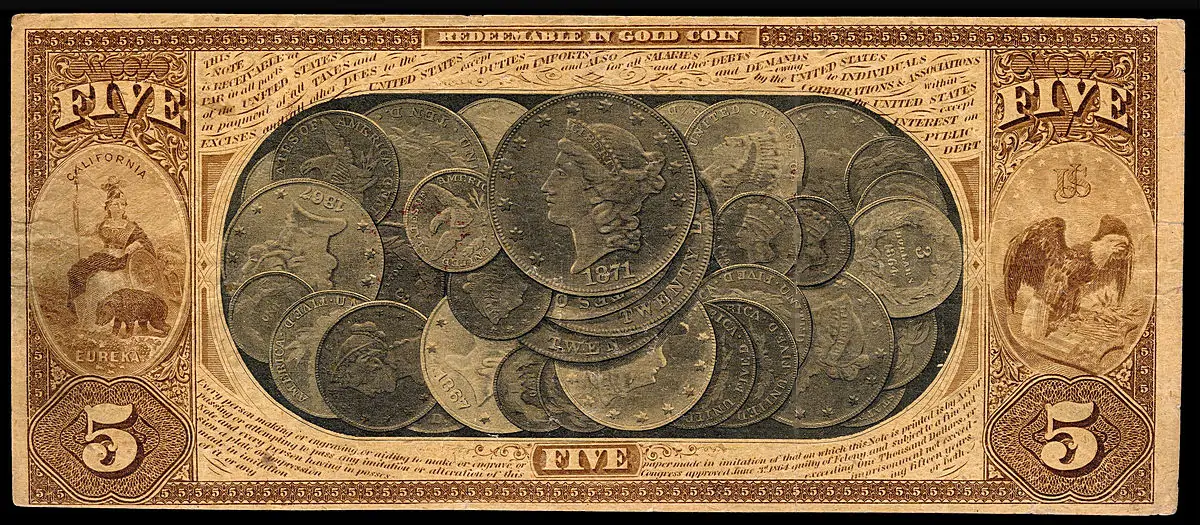
A Distinctive and Artistic Currency
National Gold Bank Notes stand out as some of the most visually compelling notes ever printed by the U.S. Treasury.
Key Design Features
- Bold “Redeemable in Gold Coin” statements
- Gold-tinted Treasury seals
- Bank-specific titles, charter numbers, and serials
- Vivid orange-yellow reverses, unlike the common green seen on typical Nationals
The craftsmanship reflected the era’s highest engraving standards, with meticulous shading, lifelike vignettes, and ornate borders designed to exude trust and stability.
The Most Elusive Notes by Denomination (With representative auction appearances).
Fewer than 600 National Gold Bank Notes are known across all denominations, and the vast majority grade Very Fine or lower.
Below is a summary of the rarest survivors by type.
$5 Notes
Most Scarce Issuer: Farmers National Gold Bank of San Jose
Only a handful survive, with high-grade pieces virtually unknown.
Auction Example:
Stack’s Bowers – 1870 $5 National Gold Bank Note. First National Gold Bank of San Francisco (Fr. 1136) Sold March 2018 Baltimore – Session 5 – The A.J. Vanderbilt Collection of U.S. Paper Money – Lot 11033. PMG Extremely Fine 40 EPQ
From the A. J. Vanderbilt Collection. At time of sale, PMG Population (for Fr. 1136); 1; none finer.
$10 Notes
The Rarest: First National Gold Bank of Petaluma notes are highly sought after. Only 2–3 examples are believed to exist. At the 2014 ANA Stack’s Bowers sale A PMG Fine-15 Petaluma $10 note sold for $126,500.
Auction Example:
Stack’s Bowers – 1873 $10 The First National Gold Bank-Stockton. Charter #2077. PCGS Currency Very Fine 35. 1146 (W-1324). Sold $52,800 August 2018 ANA – Session 4 – The Joel R. Anderson Collection of U.S. Paper Money, Part II – Lot 2068
PCGS Population: 1; none finer
$20 Notes
Rarest: First National Gold Bank of Santa Barbara Only 1–2 known, likely institutionally held.
Auction Example:
Stack’s Bowers – 1875 $20 The First National Gold Bank. Charter #2193 of Petaluma (Fr. 1157), PCGS Currency Extremely Fine 45. Sold for $228,000 August 2018 ANA – Session 4 – The Joel R. Anderson Collection of U.S. Paper Money, Part II – Lot 2069
Tied for Finest Known with the PMG-Ex Fine 45 example listed below.
$50 Notes
Among the rarest large-size notes of the National Banking era. Rarest Issuer: California National Gold Bank of San Francisco
Auction Example:
Stack’s Bowers – 1870 $50 The First National Gold Bank. Charter #1741 -San Francisco Friedberg 1160 (W-2825). PCGS Currency Very Fine 35. Sold $384,000 August 2018 ANA – Session 4 – The Joel R. Anderson Collection of U.S. Paper Money, Part II – Lot 2070.
This 1870 $50 National Gold Bank Note is one of just six such notes known for the type.
$100 Notes
Rarest: National Gold Bank & Trust Co. of San Francisco (later Boston)
Auction Example:
Heritage Auctions – 1873 $100 Original National Gold Bank Note, Santa Barbara, Charter # 2104. Fr. 1164. Sold on Apr 28, 2017 for: $282,000.00 as Lot #21432. PCGS Fine 12
This note is from the Eureka Collection, and is a unique $100 Santa Barbara National Gold Bank Note.
$500 Notes
Authorized but no known survivors. No firm evidence suggests any were ever issued into circulation.
Related Materials:
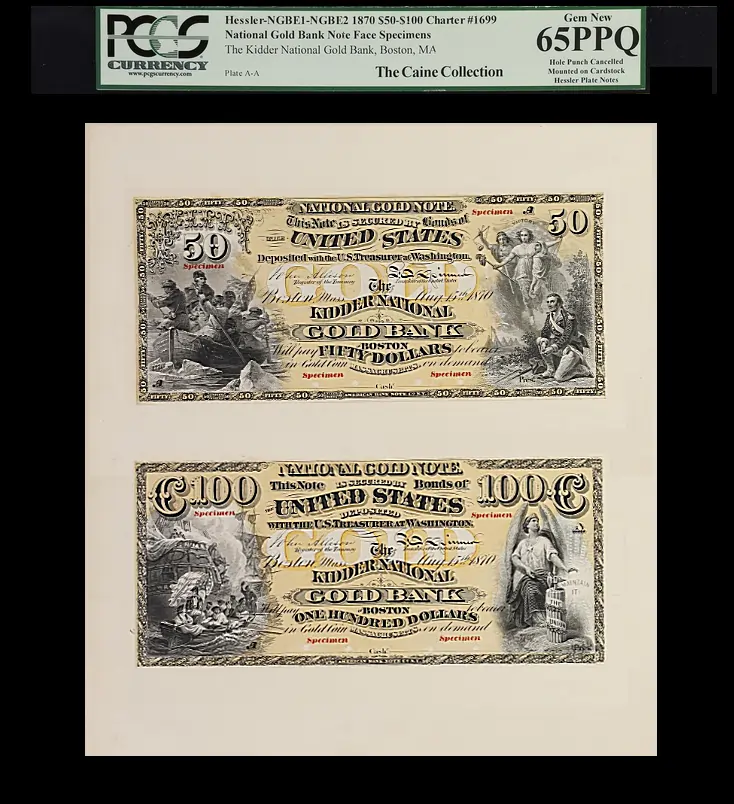
Uncut Specimen Sheet of (2). 1870 $50 & $100 National Gold Banknotes. Fr. 1160-1166 (W-2834, 3526). Kidder National Gold Bank. Charter #1699. PCGS Currency Gem New 65 PPQ. Face Specimens.
Sold for$66000 at the Stack’s Bowers Summer 2025 Global Showcase Auction: Session 3: U.S. Currency Part 2: National Bank Notes – Lot 21165
There are no known examples of actual notes issued by The Kidder National Gold Bank and all that is available is a handfull of these Face Specimen sheets.
The Iconic Reverse Vignette: A Tribute to American Coinage
One of the most celebrated features of National Gold Bank Notes is their spectacular reverse vignette. Here is a image of the actual engraving with notes.
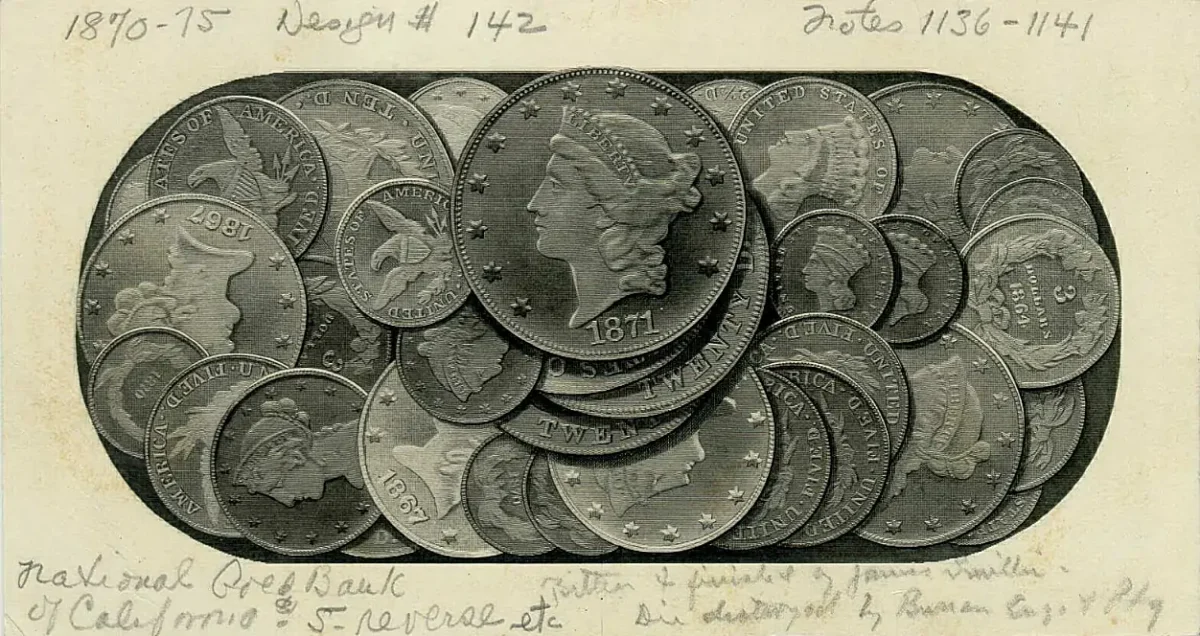
Instead of allegorical figures, the Bureau of Engraving and Printing engraved actual U.S. gold coins, piled together in extraordinary detail. This coin vignette was created and used exclusively on the reverses of National Gold Bank Notes.
Some sources claim that Seated Liberty silver dollars, half dollar, and even smaller denominations like the silver quarter and dime are part of the Vignette. This engraving has also been mis-attributed in the past to master engraver Charles Burt. Both assertions are incorrect.
In fact, James Smillie engraved the “reverse pile-of-coins vignette” used on National Gold Bank Notes and shown on Die Proofs. [2] The attribution to Charles Burt appears in some secondary sources, but primary documentation, including engraver roll records and BEP proofs, points strongly to Smillie as the engraver. [3]
All the coins in the engraving are US Gold Coins.
Main Coins Depicted Include:
- $20 Liberty Head Double Eagle
- $10 Eagle
- $5 Half Eagle
- $3 Three Dollar Gold
- $2.50 Quarter Eagles
- $1.00 Gold dollars
The central vignette, includes different denominations of Coronet gold coins ($20, $10, $5, $2.50) as well as Indian Head gold coins ($3 and $1). is considered the largest, most detailed depiction of U.S. Gold coinage ever printed on federal currency.
These are all nestled together in a lifelike arrangement that seems almost three-dimensional in its engraving depth.
It served as a visual guarantee: This note is backed by real gold, here is the gold itself.
No other circulating U.S. note before or since has featured coinage so boldly or so prominently.
The End of the Gold Note Experiment
By the late 1870s, issuing banks found gold redemption increasingly difficult to maintain. As federal monetary policy shifted toward national uniformity, the special status of gold banks faded. Many notes were redeemed and destroyed; others simply disappeared with time.
By the early 20th century, National Gold Bank Notes were effectively extinct in commercial circulation.
Legacy and Modern Collectability
Today, National Gold Bank Notes occupy a special place in numismatics:
- They are exceedingly rare.
- They represent a unique regional experiment in gold-backed currency.
- Their artistry and scarcity place them among the crown jewels of U.S. paper money.
Even heavily worn notes often bring five-figure prices, while high-grade or rare-issuer pieces command six figures with ease.
Collectors’ Tip
If you encounter a National Gold Bank Note, especially from Petaluma, Santa Barbara, or San Jose, consult expert authenticators and recent auction records immediately. Many notes are unique or nearly so, and the market for them remains extremely strong.
Citations
[1] James Smillie National Gold Bank Note Engraving “reverse pile-of-coins” vignette – LOT #5418 – 2001 Cincinnati, OH September (CAA) Sale #269 – James Smillie National Gold Bank Note Engraving.
Smillie engraved the Gold Coin vignette that graces the backs of the California Gold Bank notes. This lot consists of a Proof of that engraving printed directly on card, which is pencil-attributed to James Smillie.
“The die was engraved by James Smillie for [the] American Bank Note Co. of N.Y. Sold by the Co. to U.S. Govt.Trasy. Dept. and destroyed by the Bureau of Engraving and Printing under condemnation process – which shows the measure of intelligence exercised in the government management.” An irreplaceable piece of currency history.
[2] Die proof Auction Record of Stacks Bowers – The 52 Collection: Part I – Lot 5531 – Jun 29, 2010
[3] Gene Hessler, former curator at the BEP and the leading authority on U.S. engraving personnel, attributes the reverse coin vignette to James Smillie in “The Engraver’s Line and U.S. Essay, Proof, and Specimen Notes” which lists the vignette title: “Coins—pile of coins” as engraved byJames Smillie.



Great article…I do like the novelty ones made today and looking forward to the Arizona one to come out.