


By Joshua McMorrow-Hernandez for PCGS ……
Collectors often refer to Large-Size United States paper money as “Horse Blankets,” and for good reason. Before the introduction of today’s smaller notes beginning with Series 1928, American currency carried significantly larger dimensions. Among these iconic issues, one note continues to spark fascination, debate, and strong collector demand: the Series 1923 $5 Silver Certificate, better known as the Lincoln Porthole.
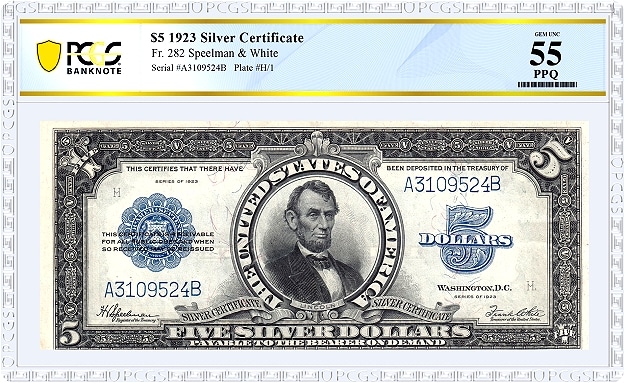
This installment of Notable Notes focuses on one of the most popular and recognizable large-size notes of the 20th century. Thanks to its unusual design and enduring historical resonance, the Lincoln Porthole $5 Silver Certificate holds a permanent place in the upper tier of U.S. paper money collecting.
Abraham Lincoln and the $5 Bill Tradition
The Series 1923 $5 Silver Certificate features a portrait of Abraham Lincoln, a statesman who has long defined the $5 denomination. Lincoln served as the 16th president of the United States and guided the nation through its darkest chapter during the Civil War. His leadership helped preserve the Union, but his life ended tragically when John Wilkes Booth assassinated him on April 14, 1865, at Ford’s Theatre in Washington, D.C.
In the years following his death, Americans honored Lincoln with countless tributes. Artists and engravers placed his likeness on coins, postage stamps, and eventually paper money. During the late 19th century, Lincoln appeared posthumously on Fractional Currency and Silver Certificates, establishing a legacy that continued into the 20th century.
Therefore, when Treasury officials prepared a new issue of Silver Certificates in 1923, they selected Lincoln as the obvious choice for the $5 denomination.
The “Lincoln Porthole” Controversy
Despite Lincoln’s popularity, the note’s portrait design immediately drew criticism. Designers placed Lincoln’s likeness inside a perfectly circular frame, a bold departure from earlier rectangular vignettes. Unfortunately, many members of the public reacted negatively.
At the time, critics argued that the circular frame resembled the view through the barrel of a gun. As a result, controversy erupted, and public sentiment turned sharply against the design. However, as years passed, the uproar gradually faded.
Eventually, collectors and historians embraced a far less ominous nickname: the Lincoln Porthole. The name referenced the round windows found on ships, and it reframed the design as distinctive rather than disturbing. Today, that once-controversial feature stands as the note’s defining characteristic.
Rarity, Survival, and Collector Demand
Today, the Lincoln Porthole $5 Silver Certificate ranks among the most desirable large-size U.S. notes. Although thousands originally circulated, experts estimate that only about 5,000 examples survive across all grades. Moreover, high-grade specimens remain especially scarce, which drives intense competition among advanced collectors.
Recently, one outstanding example entered the PCGS Banknote grading room. The note earned a PCGS 55PPQ grade, indicating only light circulation wear along with exceptional paper quality and eye appeal. As a result, it represents an impressive survivor from a century-old issue.
Collectors interested in professional grading and encapsulation can learn more by visiting www.PCGS.com/banknote
or by calling PCGS Customer Service at (800) 447-8848.
From Rare Coin Market Report
This article originally appeared in the March – April 2020 issue of Rare Coin Market Report. Readers who wish to explore the full issue can access the digital edition by logging in with the email address associated with their PCGS account. All current PCGS Collectors Club members receive complimentary access.
Collectors may also purchase individual issues or annual subscriptions through the RCMR Homepage. Those who are not yet members can join the PCGS Collectors Club by visiting www.pcgs.com/join






Can someone explain how this note is “gem uncirculated” per its slab AND lightly circulated?
The threads in the paper are very clear and they usually fade away with lite to moderate wear. Very few notes of this quality still around.
That would be a nice addition to my collection. Looking
Very cool piece of history!
Any other notes feature this ‘porthole’ design? Quite striking.
Love learning about paper money!
Great note! The reverse is also worth showing.
The $5 porthole is one of my favorite historical notes
Interesting how it got the name “Porthole”. Good luck on the coin giveaway, everybody!
This is a beautiful piece of currency.