


Although collectors no longer encounter them in circulation, high-denomination Federal Reserve Notes once played an important role in the U.S. monetary system.
The United States issued $500, $1,000, $5,000, and $10,000 notes to support large commercial and interbank transactions. While these notes remain legal tender today, their scarcity and history make them far more valuable as collectibles than as spending money, even in circulated condition.
Among these, the $1,000 note stands out for its long production history, evolving designs, and enduring appeal to collectors.
A Short History of the $1,000 Bill
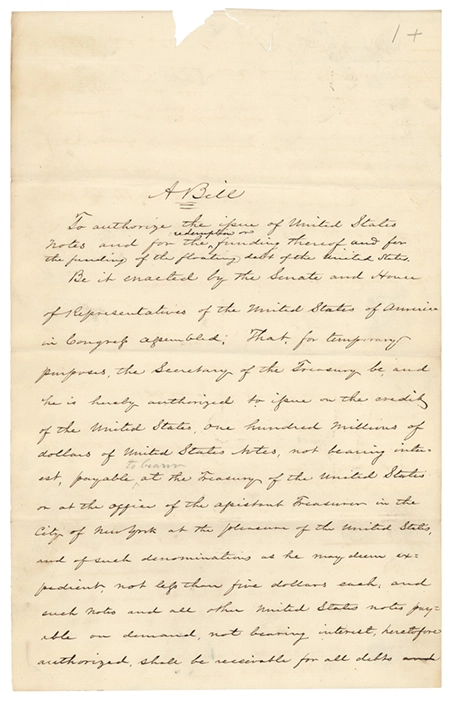
The story of the $1,000 bill begins during the American Civil War. Congress first authorized high-denomination paper money following the Act of February 25, 1862, commonly known as the Legal Tender Act of 1862. This landmark legislation reshaped the nation’s monetary system at a moment of national crisis.
By 1861, the Civil War had pushed the federal government into severe financial distress. Military expenses soared as the Union armed soldiers, built infrastructure, and sustained prolonged campaigns. At the same time, traditional revenue sources, taxation and borrowing, failed to meet these extraordinary demands.
The United States still relied heavily on gold and silver coinage under the specie standard. However, widespread hoarding and shortages of precious metals disrupted commerce and made it difficult for the government to pay soldiers or creditors. Ordinary Americans also struggled to conduct everyday transactions.
In response, Congress and President Abraham Lincoln embraced a more flexible monetary solution. The Legal Tender Act authorized the issuance of paper currency, soon nicknamed “greenbacks”, that citizens and businesses had to accept for most debts and transactions.
The First $1,000 Paper Money
The Legal Tender Act empowered the U.S. Treasury to issue $150 million in United States Notes. These notes represented fiat currency backed by the credit of the federal government rather than by gold or silver. By the end of the war, Congress approved hundreds of millions more.
Although these notes qualified as legal tender for most public and private debts, the government still required payment in specie for customs duties and interest on federal bonds. Even so, the legislation marked a decisive departure from the traditional gold standard.
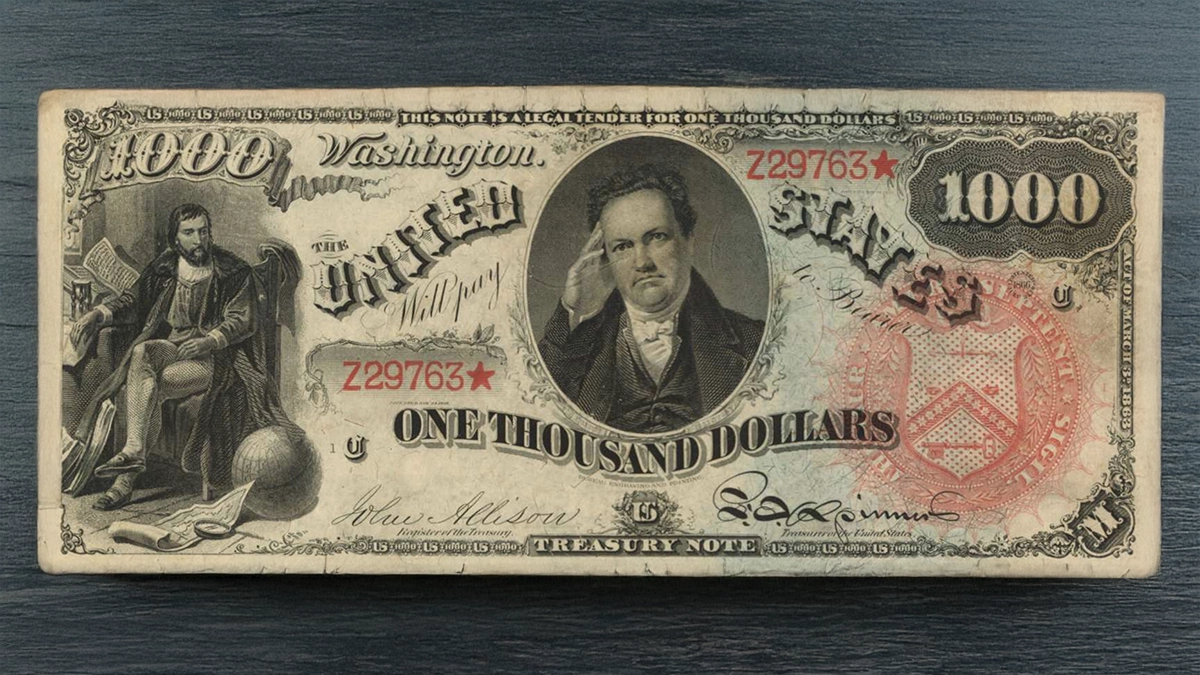
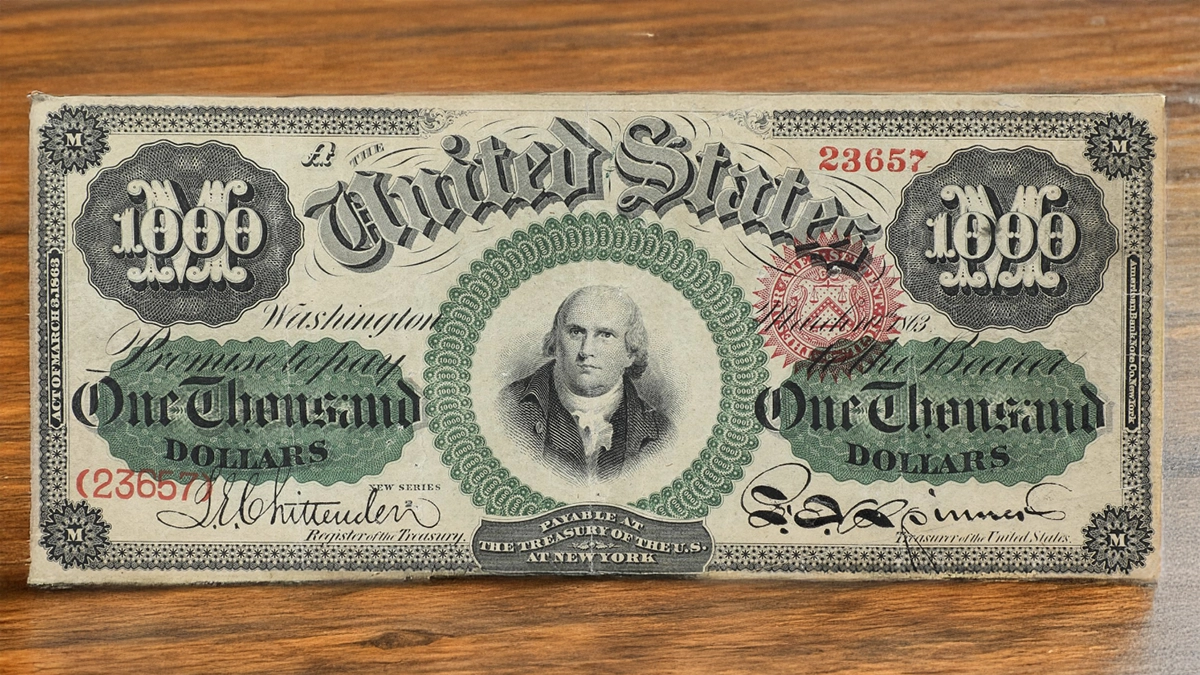
The Treasury issued three distinct $1,000 Legal Tender Note designs. The first featured a portrait of Robert Morris, the financier of the American Revolution. Later designs replaced Morris with a portrait of DeWitt Clinton, the former mayor of New York City. These large, imposing notes reflected the extraordinary financial demands of wartime America.
From Greenbacks to the Federal Reserve
The rapid expansion of fiat currency proved inflationary. After the Civil War ended, the United States required more than a decade to resume full payment in specie. By that time, however, paper money had become a permanent fixture of American life.
For much of the late 19th century, banks issued many notes. Eventually, a series of financial reforms returned the responsibility for issuing paper money to the federal government. These reforms laid the groundwork for the modern currency system and, ultimately, for Federal Reserve Notes.
The $1,000 Federal Reserve Note
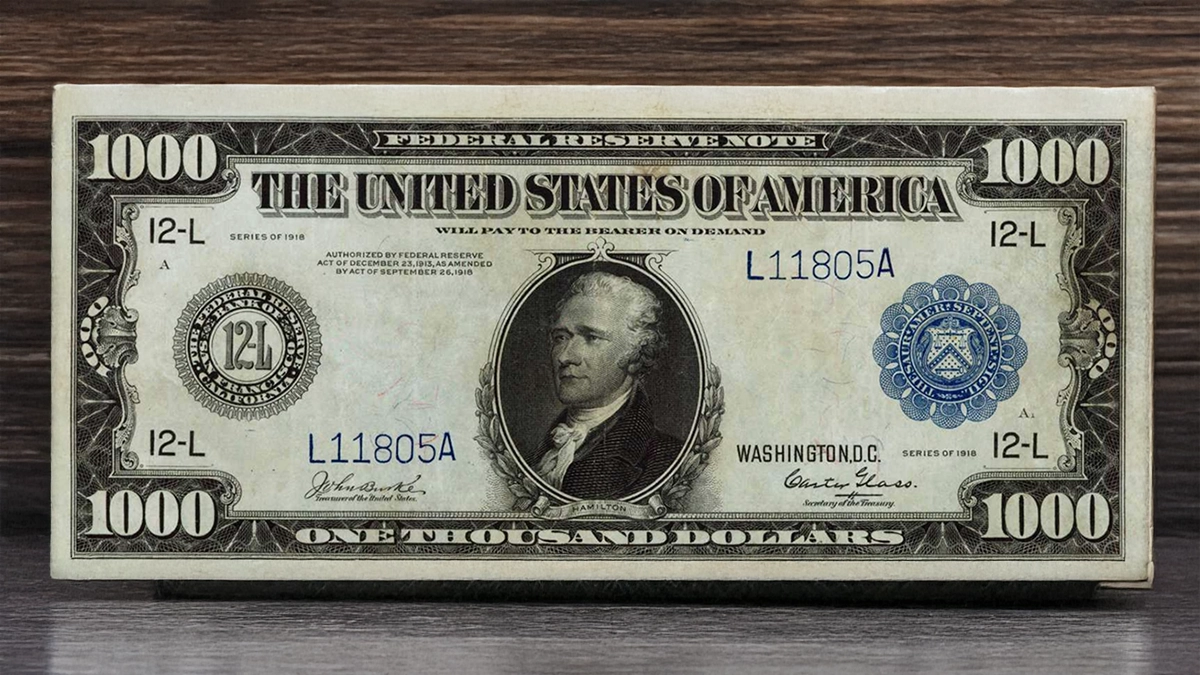
Congress authorized the first $1,000 Federal Reserve Notes under the Federal Reserve Act of 1913. The law followed the financial panic of 1907 and created the Federal Reserve System as the nation’s central bank.
Early Federal Reserve Notes measured 7-3/8 by 3-1/8 inches. Collectors often call these large-format notes “horseblankets” because of their size. The large-size $1,000 Federal Reserve Note featured a portrait of Alexander Hamilton, the same portrait later used on the small-size $10 bill.
These notes are rare in all conditions and across all series. Collectors recognize three signature combinations: Burke–Glass, Burke–Houston, and White–Mellon. An example such as the one illustrated above commands a value of roughly $40,000.
The 1929 Size Reduction and New Design
In 1929, the Federal Reserve reduced U.S. currency to its current dimensions of approximately 6.14 by 2.61 inches. Production of $1,000 notes continued in this smaller size, with issues released by Federal Reserve Bank branches in cities including New York, Chicago, San Francisco, and Philadelphia.
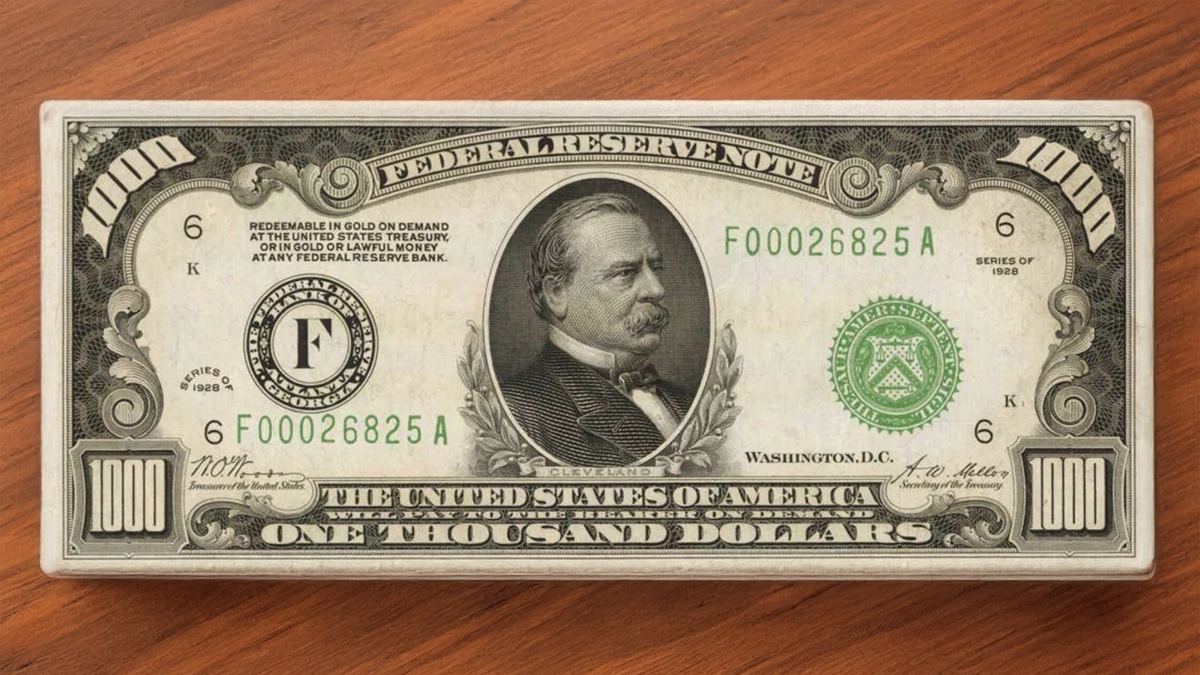
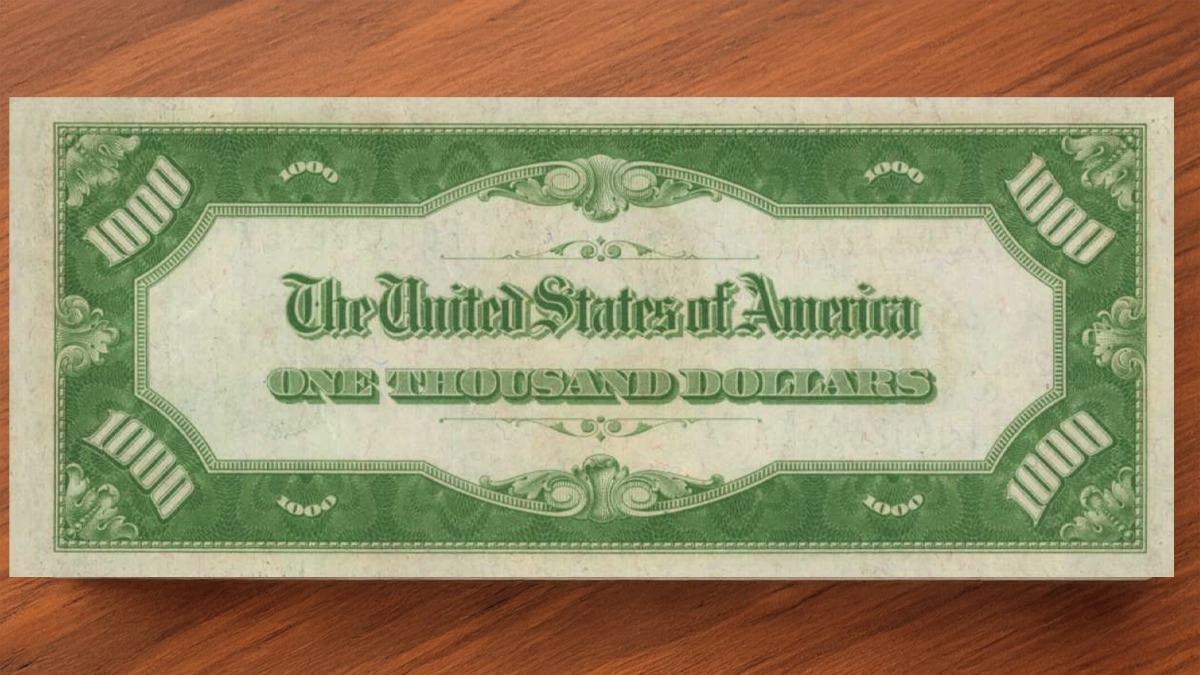
The first small-size $1,000 notes, known as the Series of 1928, bear the signature combination of Woods and Mellon. In circulated condition, these notes begin at about $3,000, while crisp uncirculated examples often exceed $10,000.
The new design introduced several changes. The portrait of Hamilton gave way to President Grover Cleveland, and engravers made the guilloché patterns on both sides more intricate. Production continued through 1946, with the final authorized signature combination being Julian and Snyder.
According to Bureau of Engraving and Printing records, only 1,368 notes with this final combination were produced, and none have ever appeared publicly. The previous Julian–Morgenthau series continued through 1945.
Discontinuation and Modern Collecting
Although the government last printed $1,000 Federal Reserve Notes in 1945–46, banks continued to distribute them for decades. On July 14, 1969, the U.S. Treasury and the Federal Reserve System announced the immediate discontinuation of $500, $1,000, $5,000, and $10,000 bills due to a lack of use.
Collectors quickly recognized the opportunity. Anyone who set aside these high-denomination notes preserved a tangible piece of American monetary history.
The $1,000 Federal Reserve Note remains legal tender today, but inflation has sharply reduced its purchasing power. According to the Bureau of Labor Statistics, $1,000 in 1945 equals approximately $17,847 today.
Market Values and Buying Advice
Collectors should approach purchases carefully. Buying from a reputable currency dealer or selecting notes certified by PMG or PCGS Banknote helps ensure authenticity and guards against alterations. With proper due diligence, the $1,000 Federal Reserve Note remains one of the most historically rich and visually impressive U.S. paper money collectibles available.
CoinWeek Article Updated January 19, 2026
* * *






Just remembering having these in your possession when you were younger would drive you crazy. Just another chance at being rich out the window.