


Few American currency notes command instant respect. Even fewer define the absolute pinnacle of their type. However, the 1907 $1,000 Gold Certificate, Friedberg 1219e, does exactly that. In March 2025, this extraordinary note realized $264,000 at Stack’s Bowers Galleries during The D. Brent Pogue Collection Part VI, reaffirming its position as one of the most important large-size notes available to collectors today.
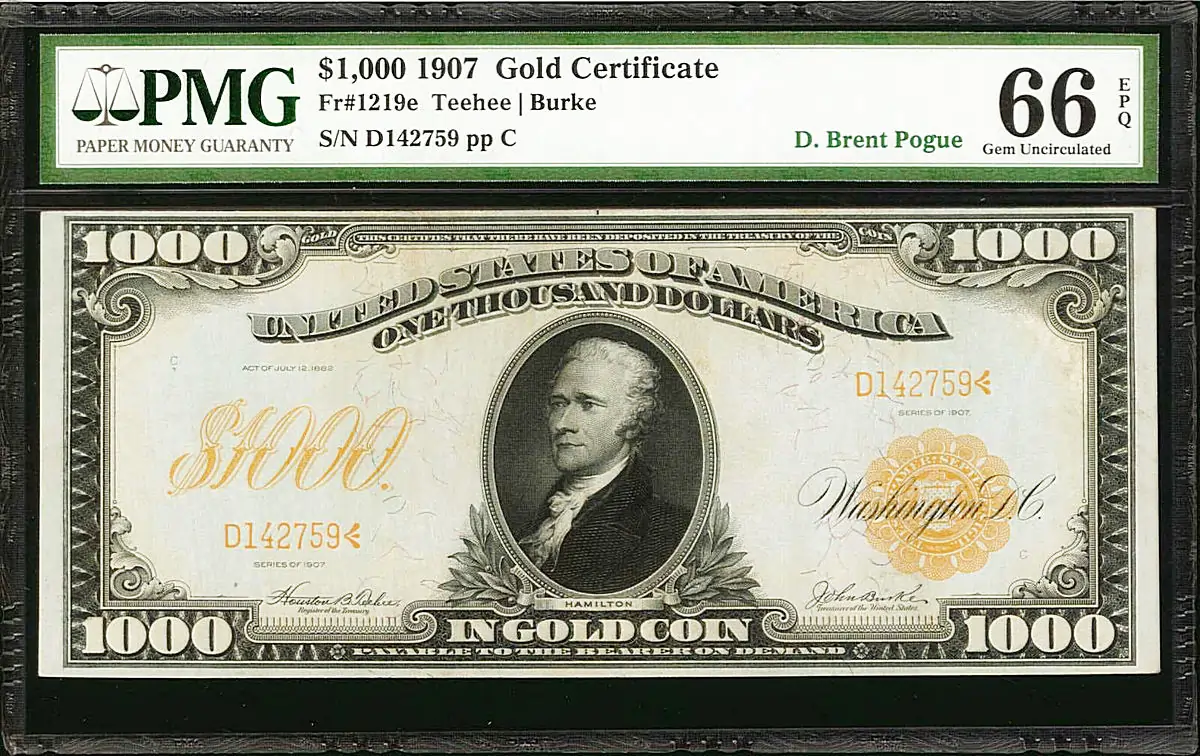
Certified PMG Gem Uncirculated 66 EPQ, this example stands alone at the top of the census. Although researchers long recorded a three-note serial number run as Crisp Uncirculated, modern third-party grading has clearly separated this note from its peers. Of the 22 examples of Friedberg 1219e certified by PMG, only four achieve an Uncirculated grade. One stands at Choice Uncirculated 63. Two reach Choice Uncirculated 64. This note, however, rises above all others as the only Gem Uncirculated 66 EPQ, with no equals and none finer.
Consequently, this Gold Certificate now defines the top of the market for the entire Friedberg number. For advanced collectors, that distinction carries enormous weight. In elite numismatics, condition rarity often outweighs absolute scarcity. This note proves that principle without compromise.
Design That Defines an Era of American Finance
Issued in 1907, the $1,000 Gold Certificate ranks among the most visually commanding notes ever produced by the Bureau of Engraving and Printing. At the center, Alexander Hamilton anchors the face with a bold, engraved portrait that reflects his enduring influence on the nation’s financial system. Meanwhile, rich gold overprints frame the design at left and right, reinforcing the authority of gold-backed currency.
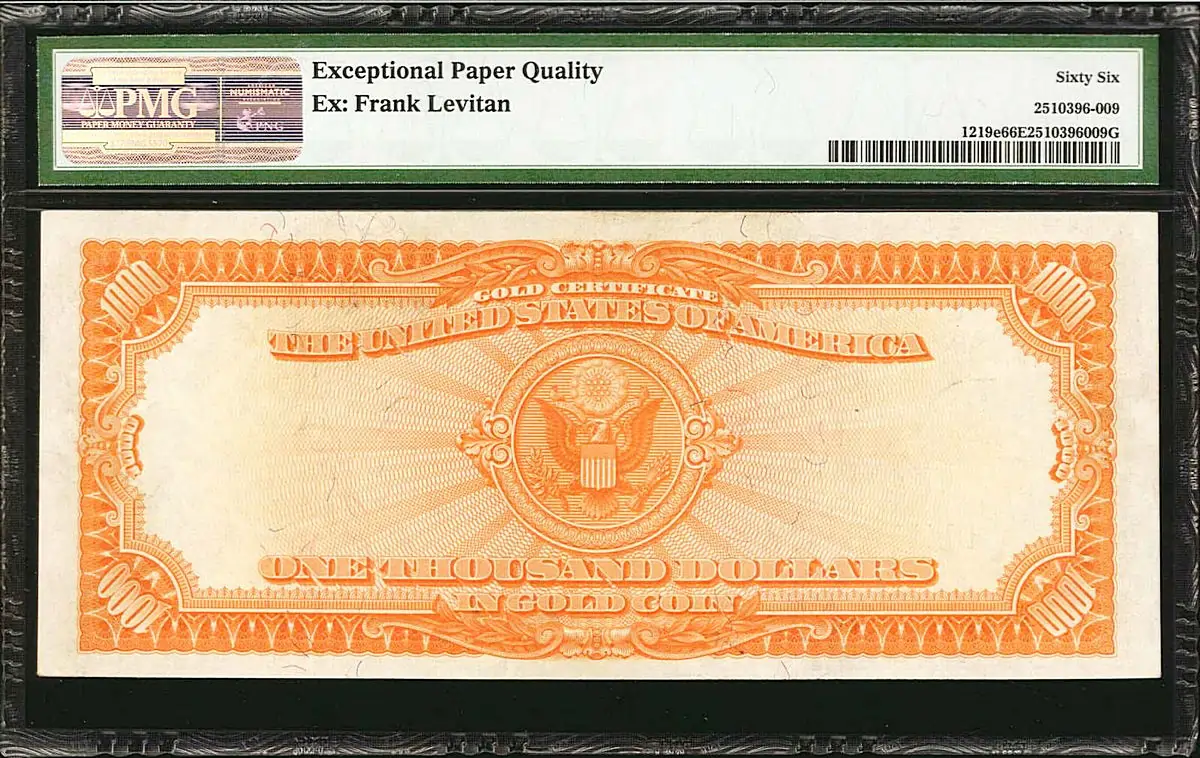
Large “1000” counters dominate each corner, while engraved signatures of Treasury officials Teehee and Burke appear crisply below the portrait. Turn the note over, and the visual impact intensifies. A brilliant orange-gold reverse displays the Great Seal of the United States at center, supported by sharp counters in each corner. Together, these elements create one of the most striking backs in American paper money.
Not surprisingly, Q. David Bowers and David M. Sundman ranked this issue #75 in 100 Greatest American Currency Notes, reflecting both rarity and enduring collector demand.
Condition, Provenance, and Ultimate Status
Beyond rarity and design, condition elevates this note into a category of its own. Generous margins, precise centering, and vividly saturated gold overprints define the face. Likewise, the reverse shows remarkable depth of color and sharpness of detail. The EPQ designation confirms fully original paper quality and embossing. Simply put, few Gold Certificates approach this level of technical and aesthetic perfection.
Equally important, the provenance matches the note’s stature. The pedigree traces through Ossie’s Fixed Price List (1976), Frank Levitan, Lyn Knight’s 1998 sale, Jay Parrino’s 1999 offering, and ultimately the legendary Pogue Collection.
Ultimately, the $264,000 result confirms what seasoned collectors already understood. This note occupies a class of its own. For those pursuing the highest echelon of United States currency, the finest known 1907 $1,000 Gold Certificate does not merely represent excellence, it defines it.






This is rare. I would like to own it.
Worth the equivalent of 50 Double-Eagle gold coins, when gold was valued at $20/ounce.
great article fantastic bill
Amazing article! I would love to own one.
I can think of 1,000 reasons why I need this in my collection!
Enjoyed the article on the 1907 $1000 gold certificate. That would be a great bill to own
Enjoyed the article on the 1907 gold certificate.
STUNNING
A stunning work of art. History you can learn alot. thanks
Love this note. Wish I could get one. I would love to see our paper money be more colourful.
A 66! Just amazing! Would have loved to find one of these!
Very interesting article, thank you.
Unbelievable, I want one. Good luck on the coin giveaway everybody!
Cannot imagine very many could afford these. Sad to say one day there may be no more paper currency.
I would love to have this in my collection!