


The 1928 $10 Gold Certificate Star Note, cataloged as Friedberg #2400* and graded PCGS Banknote Choice Uncirculated 63, stands as one of the most desirable issues in small-size United States paper money. Its appeal comes from a rare combination of first-year design status, limited production, and strong collector demand.
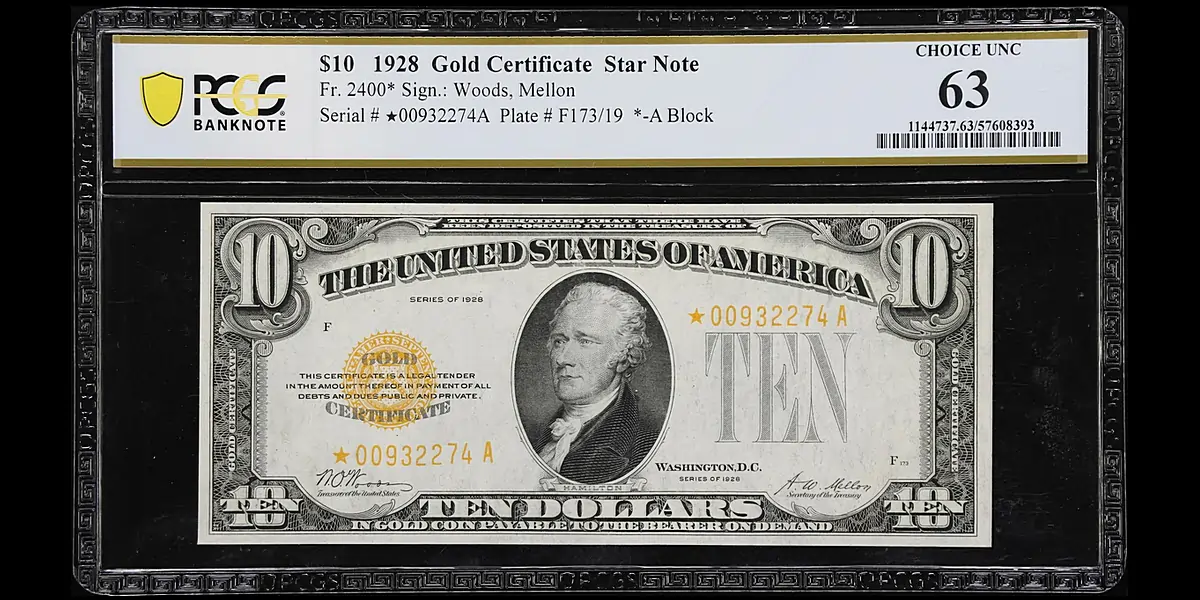
Most importantly, this note represents the first small-size $10 gold certificate ever issued. When combined with its replacement note designation, the issue occupies a distinct position within the gold certificate series.
A Landmark Issue in Small-Size Currency
The Series 1928 redesign marked a major shift in U.S. paper money. The $10 gold certificate introduced the smaller format still familiar today. It also debuted several defining visual elements.
Most notably, the note features a yellow-gold Treasury seal and matching serial numbers. These characteristics identified the bill as redeemable in gold at the time of issue and clearly separated it from Federal Reserve Notes and other paper money types.
The design also introduced Alexander Hamilton to the $10 denomination for the first time. While Hamilton had long appeared on U.S. currency, 1928 marked his debut on this specific value, adding long-term historical significance to the series.
The note carries the signatures of Treasurer W. O. Woods and Secretary of the Treasury Andrew Mellon, firmly placing it within the early small-size era.
The Significance of the Star Note Designation
The asterisk in the Friedberg number Fr. 2400* identifies the note as a replacement, or “star,” note. These notes replaced defective or damaged examples discovered during production.
Because the Bureau of Engraving and Printing printed replacement notes in much smaller quantities, star notes remain significantly scarcer than standard serial number issues. As a result, collectors consistently assign them a substantial premium, especially in higher grades.
Current Market Value and Pricing Range
As of February 2026, market data shows that a 1928 $10 Gold Certificate Star Note graded MS 63 typically sells for $2,250 to $2,500.
Prices across the series vary widely depending on condition. Lower-grade star notes can sell for around $200, while high-grade examples have reached as much as $15,000.
The premium becomes even clearer when compared to non-star notes. A regular 1928 $10 Gold Certificate in MS 63 condition often sells for approximately $480 to $1,000, underscoring the rarity of replacement issues.
Recent public listings support these figures. High-grade star notes have appeared on major online platforms, including eBay, with asking prices near $2,388.88.
What Choice Uncirculated 63 Indicates
A Choice Uncirculated 63 grade confirms that the note never entered circulation. However, the grade allows for minor handling characteristics.
Margins may show slight misalignment. In addition, faint counting marks or light surface distractions may be present. Importantly, the note displays no folds, creases, or bends, which preserves its uncirculated status.
For the 1928 $10 Gold Certificate series, uncirculated examples remain particularly difficult to locate. Most notes saw heavy use or redemption shortly after issuance, sharply limiting the number of survivors in high grade.
The Impact of the 1933 Gold Recall
The production window for these gold certificates proved brief. In 1933, the federal government issued the Gold Recall Order, which required citizens to surrender gold coins and gold-backed paper money.
Following the recall, authorities destroyed millions of gold certificates. While exact survival numbers remain unknown, the destruction significantly reduced the available population. Consequently, surviving examples — especially star notes in uncirculated condition — remain scarce today.
A Key Issue for Advanced Collectors
The 1928 $10 Gold Certificate Star Note combines multiple layers of collector appeal. It represents a first-of-type small-size issue, introduces a major design milestone, and survives in limited numbers due to historical events beyond its control.
When paired with a Choice Uncirculated grade, those factors help explain the note’s sustained demand and long-standing market premium. For collectors focused on U.S. gold certificates or replacement notes, Fr. 2400* remains a cornerstone issue within the series.
This Note is for sale at the Stack’s Bowers Spring 2026 Showcase Auction Session 6 – U.S. Currency – Mar 12, 2026 – Lot 6157
* * *








A star variety! :-)
I wish u had bought that $10 gold redeemable star nite when u had the chance