


Original Article By Christopher Bulfinch, Updated and Reformatted by CoinWeek
(Editor’s note: This article discusses and depicts historical language and imagery that some collectors may find offensive. We present it to preserve historical context and to document the scholarship that followed.)
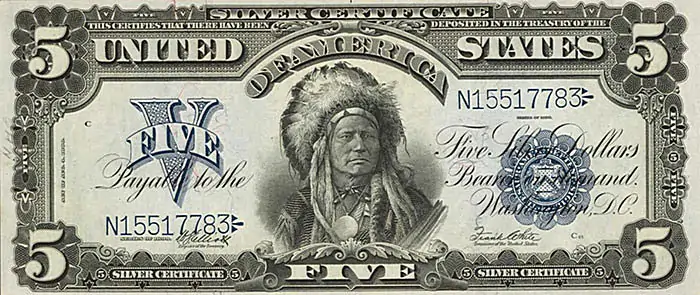
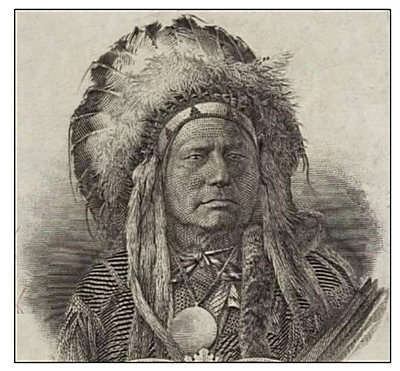
On the eve of the 20th century, the United States placed a Native American portrait on the face of a $5 Silver Certificate. Collectors now call the note the “Chief” or “Indian Chief” note. Importantly, this issue marked the first time a Native American appeared as the central subject on American paper money.
Collectors have debated the identity of the man for more than a century. He appeared on the note as Ta-to’-ka-in’-yan-ka, commonly known as Running Antelope. That debate never faded. Auction prices and decades of commentary prove it.
In 1978, Coins magazine called the notes “the high point in US paper money design.”[1] Later, Coin World called the design “the most familiar image of a Native American on a piece of U.S. paper money.”[2] Heinz Tschachler, an Austrian professor of American Studies, described the portrait as “an icon of American nationalism.”[3]
Native Americans appeared on U.S. currency long before 1900. Still, the Series 1899 $5 Silver Certificate landed at the intersection of powerful forces in American history.
Early Collector Speculation and a Long-Running Misunderstanding
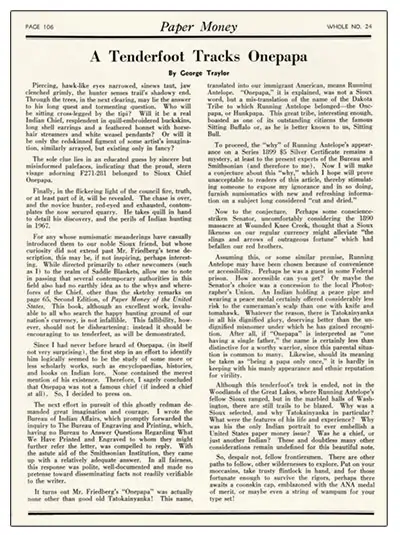 In 1967, the Society of Paper Money Collectors journal Paper Money published an article titled “A Tenderfoot Tracks Onepapa.” George Traylor wrote it. He speculated on “the perils of Indian hunting in 1967,” or “the ‘why’ of Running Antelope’s appearance on a Series 1899 $5 Silver Certificate.”[4]
Traylor suggested that a conscience-stricken senator might have wanted to atone for the 1890 massacre at Wounded Knee Creek. He imagined that placing a Sioux likeness on “regular currency” might ease national guilt. Then he leaned into stereotypes and joking violence:
Traylor wrote that Running Antelope might have been chosen for “convenience or accessibility,” and even floated the idea that officials could have found him in a federal prison. Then he joked that a peace pipe and peace medal posed less danger to a photographer than “knife or tomahawk.”[4]
Traylor then lamented misunderstandings around Running Antelope. At the same time, he praised the chief’s “manly appearance and ethnic reputation for virility.”
He ended with questions that later scholarship would answer with more care:
- Why did officials select a Sioux?
- Why did they select Tatokainyanka (Running Antelope) in particular?
- What shaped his life?
- Why did his portrait stand alone on U.S. paper money?
- Did he lead as a chief, or not?[5]
Speculation and Acuracy
Traylor’s piece admitted speculation. It still got key points wrong. He correctly noted that “Onepapa” misnamed Running Antelope and that convenience shaped the choice. However, he omitted crucial context. He also repeated ethnic chauvinism and the “vanishing Indian” trope.
Notably, paper money collectors did not hold a monopoly on curiosity. In The Inconvenient Indian, Thomas King wondered why currency did not “immortalize” leaders such as Sitting Bull, Crazy Horse, Geronimo, Chief Joseph, or Osceola. He concluded, “Perhaps one Indian was more than enough.”[6]
A Better Account Emerged in 1969
Two years after Traylor, Paper Money published a more detailed analysis in 1969.[7] That issue identified the portrait subject as Ta-to’-ka-in’-yan-ka (spellings vary). It also located him historically as a Hunkpapa Lakota chief. Furthermore, it framed his appearance on the $5 note as a symbolically powerful decision shaped by the political realities of the late 1890s.
Many stories converge in the Series 1899 $5 note. Two dominate:
- Running Antelope’s life
- The rise of Silver Certificates in U.S. monetary policy
- Told together, they clarify the subtext behind the portrait.
Running Antelope’s Early Life on the Northern Plains
Ta-to’-ka-in’-yan-ka entered the world in 1821 in South Dakota, near what people today call Grand Forks.[8] He belonged to the Hunkpapa Lakota. That tribal identity later fueled the long-running naming error. Many collectors called him “Onepapa,” which simply offered another spelling of “Hunkpapa.” The variant “Oncpapa” also appeared, including in Littleton Coin Co. advertisements.
The Hunkpapa Lakota ranged over the Northern Plains. In the 18th century, European fur traders introduced firearms and trade to many Plains groups.[9] Around the same time, many Northern Plains tribes developed deep horsemanship skills.
Large-scale Euro-American settlement did not surge until the mid-19th century. The California Gold Rush drove much of that movement.[10] By Running Antelope’s youth, outsiders still moved through a landscape anchored by trading posts. However, the mid-century brought rapid change.
The Gold Rush transformed U.S. coinage and Indian policy alike. Silver prices rose as western gold flooded markets. The Mint lowered silver coin weights, and the episode exposed a core weakness in bimetallism. Congress also outlawed circulation of world coinage in an effort to draw silver into domestic channels. Meanwhile, settlers kept pouring west.
As a result, violence and negotiation increased. The First Treaty of Fort Laramie (1851) affirmed Indian claims to an enormous territory and promised safer travel for westward migrants.[11] The Lakota joined roughly 30 tribes in signing the treaty. That same year, Running Antelope became one of four “shirtwearers” of the Hunkpapa, a major leadership role.[12]
Conflict, Diplomacy, and a Reputation as an Orator
Violence shook the Plains in the 1850s and 1860s. Some groups accepted reservation life and tolerated travel corridors. Others resisted.
A retrospective newspaper account published in The Bossier Banner in 1879 claimed that Running Antelope saved an Army scout’s life in 1857. The account described an Army unit stumbling into a large Hunkpapa camp. Running Antelope supposedly intervened during a confrontation and declared, “This is a fine day to die,” meaning he would die for his friends. He tried to escort the soldiers away as fighting broke out. The account also claimed that he returned emptyhanded so his people would not think he saved whites to rob them.[13]
In 1867, Running Antelope described his relationship to American colonizers in blunt terms:
“Since the days when we first allied ourselves with the whites I have been faithful to them at all times and all places. The skin of my body is red but my flesh is white, since for many years I have eaten the bread of the whites.”[14]
Running Antelope embraced reservation life in the way federal officials wanted. He farmed. But he also spoke with force and purpose. Government records and newspapers repeatedly mentioned his skill as an orator.
The 1868 Treaty and a Peace Medal That Echoed into Currency Design
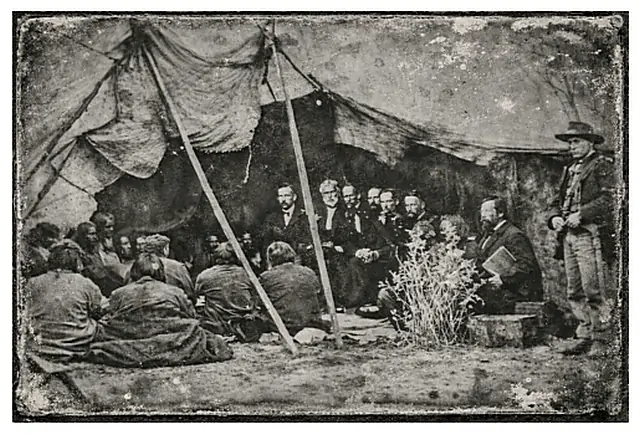
After Red Cloud’s forces handed the U.S. Army a series of defeats, the government signed the Second Treaty of Fort Laramie (1868). The treaty established the Great Sioux Reservation. Hunkpapa Lakota warriors fought alongside Red Cloud. Running Antelope signed the treaty. His signature took the form of a running antelope. He received a peace medal bearing President Andrew Johnson’s likeness.
That detail mattered. Years later, his visit to a later president would help place his likeness on American paper money.
Still, not all Hunkpapa accepted the treaty. Sitting Bull refused to sign.[15] In 1869, he became the leader of all non-treaty Lakota.[16] He later fought alongside Crazy Horse.
1872: Washington, Alexander Gardner, and the Photograph Behind the Note
In 1872, officials invited Running Antelope to Washington to meet President Ulysses S. Grant. During that visit, photographer Alexander Gardner took two images: a profile and a frontal portrait.
Gardner’s career mattered here. He photographed Civil War battlefields and served as the official photographer for the Union-Pacific Railroad beginning in 1867. Interestingly, Gardner and Running Antelope both began life in 1821.
In the images, Running Antelope wore traditional Hunkpapa attire. He wore three long feathers and a peace medal that accounts link to the one he received in 1868. The Bureau of Ethnology archived the portrait as part of a larger effort to document Native Americans in what photographers and researchers considered traditional clothing.
Running Antelope did not stop in Washington. He also visited St. Louis, Cincinnati, and New York. A 1921 Saturday Evening Post article described a party on Coney Island hosted by an opera singer. A veteran reporter claimed the Native visitors traveled east “to bewail their wrongs.”[17]
The Black Hills, Custer, and the Last Push onto Reservations
Treaty violations continued. Tensions rose as gold seekers poured into the Black Hills after the 1874 discovery, despite the 1868 treaty’s promises.
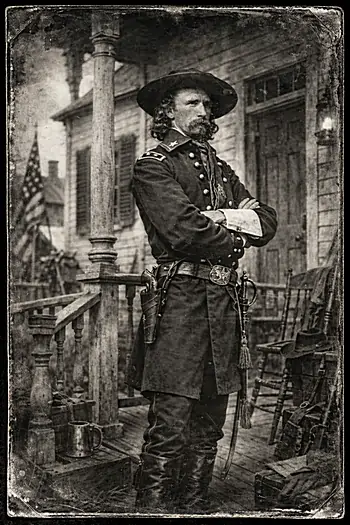
A Bismarck Tribune article from 1874 claimed Running Antelope predicted the seizure of the Black Hills. It also claimed that he and other leaders tried to keep young men home while Custer’s expedition operated.[18]
Running Antelope met George Armstrong Custer in the summer of 1874.
After the U.S. Army lost Custer’s 7th Cavalry at the Little Bighorn in 1876, federal resolve hardened. In 1877, Sitting Bull and many non-treaty Hunkpapa fled into Canada.
The government forced the Hunkpapa onto reservations late in the process. After Sitting Bull moved his band into what people today call Saskatchewan, they eventually surrendered in 1881.
Running Antelope joined the party that met Sitting Bull and escorted him back to the reservation.[19]
Sitting Bull reportedly disliked Running Antelope. He “regard[ed] him as a fool” because of his cooperation with whites.[20]
Reservation Leadership, Conflict with Agents, and the Buffalo’s Collapse
Federal officials pushed reservation communities toward farming. By the 1880s, Running Antelope held the post of district farmer. The Standing Rock Reservation divided into 20 farming districts, each led by a district farmer who oversaw agricultural programs. Running Antelope’s name appeared often in newspapers from the 1870s through the 1920s. An 1889 federal register listed him as a district farmer earning $120.[21]
Yet conflict did not disappear.
In 1878, Running Antelope and other Native Americans abducted Indian agent William T. Hughes. They brought him to the Missouri River and planned to row him across.[22] Hughes claimed they meant to drown him. Running Antelope denied that claim.
In 1880, another agent, Joseph A. Stephans, tried to cancel Sioux religious ceremonies. A confrontation nearly sent Stephans into the river too. The territorial press praised Running Antelope and attacked Stephans with ethnic and religious slurs.[23]
In 1882, accounts say Running Antelope joined the last Great Buffalo Hunt. By then, systematic bison extermination had devastated the herds. That same year, Stephans testified to the Dawes Senate Committee Investigation and labeled Running Antelope a “politician Indian,” “all soft soap and smoothness.”[24]
In 1883, the Bismarck Tribune interviewed Running Antelope and called him “the silver-tongued orator of the Sioux nation.”[25] When asked about the buffalo slaughter, he predicted that if it continued, “buffalo will not last more than two years.”[26]
Then Congress passed the Dawes Act (1887). The act authorized surveyors to parcel reservation land into individual allotments. It also opened “surplus” lands to purchase by non-tribal members when officials deemed them “advantageous for agricultural or grazing purposes.”[27] Running Antelope later became involved in land purchases, or thefts, linked to that system.
1890: Sitting Bull’s Death and Wounded Knee’s Aftermath
Sitting Bull died during an altercation with Indian police at his home on the Grand River. He died on December 15, 1890. Running Antelope reportedly attended the funeral.
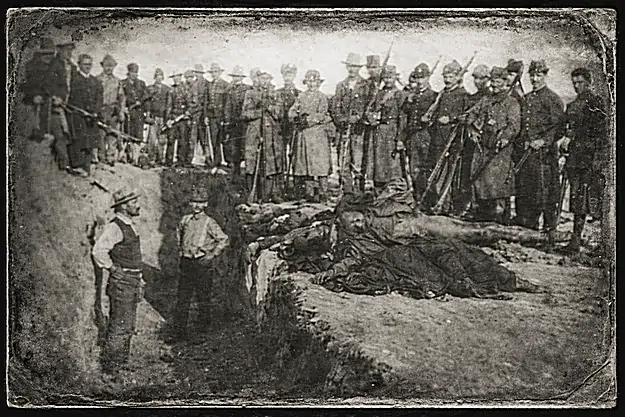
Sitting Bull’s death set the stage for Wounded Knee. After the shooting, some of his followers left Standing Rock to join Spotted Elk at Cheyenne River. Spotted Elk’s group, along with some Miniconjou and 38 Hunkpapa, traveled toward the Red Cloud Agency. The 7th Cavalry intercepted them on December 29, 1890. A scuffle followed. The cavalry opened fire and killed hundreds. Some historians point to Wounded Knee as the end of the “Indian Wars” and the closing of the frontier.
David Treuer, in The Heartbeat of Wounded Knee: Native America 1890 to the Present, described the policymakers behind the events culminating in Wounded Knee as “feckless, cruel, shortsighted, hypocritical, and shameful…,” and he argued that “the ways of life that had evolved over thousands of years were gone.”[28]
Running Antelope did not go to Wounded Knee. He lived out his final years at Standing Rock. By 1892, his health failed. He died near what people today call Little Eagle, South Dakota, sometime between June 1896 and June 1897.
In that 1883 interview, he spoke with frustration:
“The Indians to whom the buffalo belong are poor; if they were allowed to kill the buffalo they would save every bit of the meat for their families. I have done the best I can for the white man and I do not see why the Great Father cannot do me the favor of stopping the whites from killing our game.”[29]
Currency Policy and the Road to Silver Certificates
U.S. money policy shifted dramatically during Running Antelope’s lifetime. The Civil War consolidated federal control over paper money. Demand Notes and United States Notes reshaped American currency in the 1860s. Early federal issues did not feature Native Americans. Later designs did. Those later vignettes also carried an ideology that would later absorb Running Antelope’s portrait.
Then came the Coinage Act of 1873, often called the “Crime of ’73.” The law adjusted silver weights to align with the metric system, eliminated some denominations, and demonetized silver. Mining and banking interests in the West, plus farmers and others who favored free silver, rallied behind the Free Silver Movement.
In 1878, Congress passed the Bland-Allison Act. Silver dollars returned. The Bureau of Engraving and Printing then issued Silver Certificates, paper notes redeemable in silver.
In 1890, the Sherman Silver Purchase Act expanded federal silver purchases. It increased silver dollar and Silver Certificate production. It also introduced Coin Notes in 1890–1891. Those notes became the first to feature Philip Sheridan, one of Running Antelope’s predecessors on the $5 Silver Certificate.
Sheridan’s biography carried sharp edges. He served as a Civil War general and then went to the frontier in 1868 after the Johnson administration punished him for his aggressive Reconstruction enforcement as military governor of Texas and Louisiana.[30] He had fought Indian wars in the Pacific Northwest in the 1850s. Accounts describe him hanging Indian warriors and exporting that aggression west.[31] He led campaigns between 1868 and 1876 marked by brutality and atrocity.
The Educational Series and the Decision to Use Running Antelope
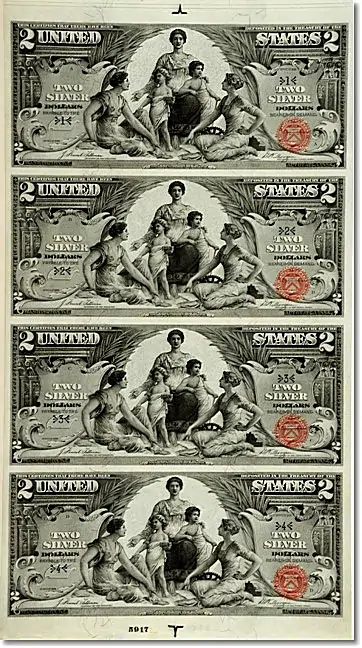
In 1896, the Treasury introduced the Educational Series of Silver Certificates. These notes preceded the Series 1899 designs. The Series 1896 $5 Silver Certificate placed two portraits on the back: Ulysses S. Grant at left and Philip Sheridan at right.
Grant’s presence followed a decade-long pattern of depicting former presidents on paper money. Sheridan’s presence matched his long military record and reputation as an “Indian fighter.” Roy Morris Jr. even reported that Sheridan advocated medals for buffalo hunters that depicted a dead bison and a “discouraged Indian.”[32]
The Educational notes proved short-lived. Designers sought a new look. They chose Running Antelope as the central design motif for the $5 denomination.
In November 1899, engraver George F. C. Smillie translated Gardner’s 1872 photos into engraving for the $5 Silver Certificate. During that process, Smillie altered the headwear dramatically.
The Warbonnet Problem and the “Pawnee” Headdress Debate
Running Antelope wore a three-feather headdress in Gardner’s photos. That headdress rose too high to fit the note’s portrait frame. Smillie faced a choice. He could select a different subject. He could let the feathers break the frame. Instead, he found an image of a large feathered warbonnet and superimposed it over the original headdress.
Many writers describe the substituted warbonnet as Pawnee in origin. However, scholars of Native American dress do not speak with certainty.
Therefore, the note immortalized Running Antelope in the regalia of a culture that likely did not belong to him.
A large Roman numeral V appeared at left in blue ink. That blue signaled Silver Certificate status. A large Treasury Seal appeared at right. On the back, ornate borders framed another V and text explaining the legal basis for the note. Smillie designed the back as well.
The Series 1899 $5 Silver Certificate outlasted its Educational predecessor. Running Antelope remained on the note until 1923. Collectors identify eleven signature combinations, produced between fiscal years 1900 and 1926, with no production in fiscal years 1919 or 1920.
In 1923, Abraham Lincoln replaced Running Antelope on the $5 Silver Certificate. Designers placed Lincoln’s portrait inside a thick black frame that resembled a ship’s window. Collectors later called those notes “Porthole Notes.”
Why Did the BEP Choose Running Antelope?
The Bureau of Engraving and Printing could have chosen countless other Native American subjects in the late 1890s. Chiefs such as Red Cloud and others visited Washington in May 1872, and many sat for Gardner’s camera. The Bureau of Ethnology held thousands of images.
So why did the BEP return to Running Antelope? Did officials choose the most photogenic portrait? Or did they choose a life story that aligned with federal priorities?
Philip Deloria’s Playing Indian describes American appropriation of Native imagery since the Revolution. Deloria explained how Americans used Indian garb to “negotiate” meanings and identities.[33]
“Playing Indian” on Money Began Long Before the United States
Americans “played Indian” in currency design even before the Union.
In 1690, Massachusetts Bay Colony issued bills of credit in 5, 10, and 20 shillings and in 5 pounds. Those notes displayed a Native American figure from the colonial seal, a seal dating to 1629.[34] Heinz Tschachler later noted the similarity between that early Native figure and the European “Wildman” motif found on early modern coinage.[35] Wildman imagery often showed long hair, muscular bodies, and an uprooted tree used as a club or staff.
Those similarities reveal a deeper pattern. Colonial designers forced unfamiliar peoples into a European cultural frame. They did not treat Native Americans as discrete peoples. Instead, they cast them as incarnations of a “savage” archetype.
Tschachler described how early modern Europeans racialized “savagery” and cast their mission as domesticating it.[36]
Two long-term tendencies emerged:
- Designers essentialized Native physical appearance.
- Designers fixated on “civilizing the savage.”
Over time, those tendencies produced stereotypes about strength and “virility.” They also encouraged misuse of Native cultural objects.
Tschachler also described an inverse relationship between Native presence and Native imagery on money. As Native peoples faced displacement, depictions of them increased on Obsolete Banknotes.[37] Many such notes show Native figures watching “progress” unfold through farms and railroads. Some depict “enlightenment.” Others show quiet disappearance through the “Vanishing Indian” trope.
Federal paper money continued those symbolic habits. Eventually, those habits culminated in Running Antelope’s appearance on the Series 1899 $5 Silver Certificate.
Coinage Joined the Pattern: The Indian Princess Motif
Coin designs followed a related path. In 1854, the U.S. Mint introduced Liberty wearing a Native American headdress on the $1 and $3 gold pieces. Collectors now call this design the Indian Princess motif. It depicts Liberty, often read as white, wearing an Indian headdress. The motif spread widely. Similar portraits appeared on the $1 and $3 gold pieces, the cent (1859–1909), and the gold eagle (1907–1933).
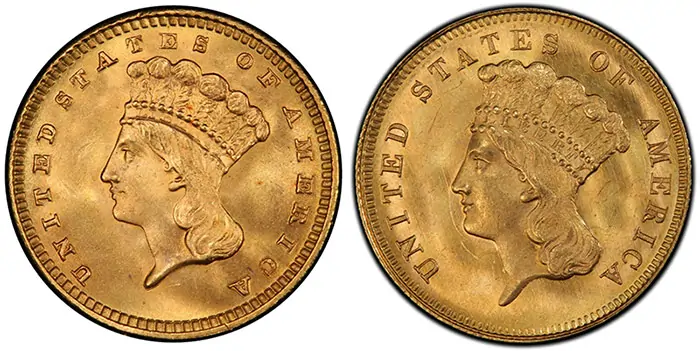
Deloria argued that American identity always used Native imagery as a mirror. Around the turn of the 20th century, he wrote, Americans faced upheaval from monopolies, strikes, competition, and reform movements. That upheaval fueled attempts to “salvage” an older, disappearing America.[38] Native symbols offered a link to that imagined past.
Silver, Gold, and Racialized Ideas of Value
Running Antelope’s portrait also intersected with monetary politics over silver and gold. Michael O’Malley’s Face Value described how many Americans conflated precious metals with race well into the 20th century. “Goldbugs” treated gold as “civilized” money. They often framed the gold standard with Social Darwinist rhetoric.
O’Malley wrote that goldbugs believed “gold formed the ‘natural’ money of the Anglo-Saxon races” while “Pagan Asiatics” and Latin Americans used silver.[39] Gold advocates also distrusted paper money from the Civil War through the Great Depression. Many of them gathered around “Redeemer” ideology after the Civil War, a movement that fought Reconstruction and upheld white supremacy.
O’Malley traced “carpetbagger” language to carpet valises used by bank representatives who introduced paper currency in the Antebellum period.[40] He then argued that many Americans retreated into “twin forms of essentialism”: ferocious racism and “fantastic” beliefs about gold’s properties.[40] He further connected the gold standard to renewed white supremacy.[41]
Therefore, paper money, especially paper redeemable in silver, carried stigma in that worldview.
1900: The New York Times Notices “Indian Bills”
A New York Times article published on June 26, 1900 noted the new Silver Certificates. It misidentified Running Antelope as “Red Jacket.” Additionaly, article then joked that “Indian bills” would appeal to “Tammany men,” while noting that some of those men “have no objection to any kind of bills.”[42]
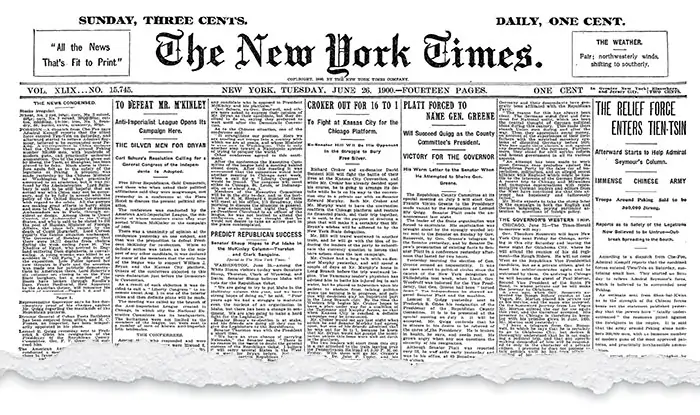
That line targeted fraternal societies and political organizations that adopted Indian symbols, including Tammany Hall, the New York political machine. Deloria explained that after the Revolution, groups remade “Indian Others” to build identities that fit early Republic politics.[43] The Tammany Society used “the Indian” to build a political party shaped by class and ethnic inflections.[44]
In other words, white Americans often used “Indianness” for domestic political ends. The Times and the BEP likely understood at least some of those meanings.
Furthermore, Bigelow-era ideas about metal hierarchy made the Times’ joke sharper. The article implied that Tammany men would accept “worthless” paper currency. That implication linked (real or faux) Indian identity with silver and paper money.
Gold Coins Adopted Native Portraits Too, and Controversy Followed
Between 1908 and 1929, gold quarter eagles and half eagles carried distinctly Native portraits. Bela Lyon Pratt designed them. Pratt studied under Augustus St. Gaudens, created sculpture for major expositions, and taught at the School of the Museum of Fine Art in Boston. He produced a recessed design that placed a Native American head on the obverse and an eagle on the reverse.
The Native portrait drew criticism. The Red Book reported that some numismatists “condemned loudly” the artistry.[45]
In December 1908, The Numismatist predicted “strong differences of opinion” about placing a “red Indians’ head” on coins. The article described the portrait with “strong characteristic virile features of our aboriginal race.”[46] Again, writers emphasized strength and virility.
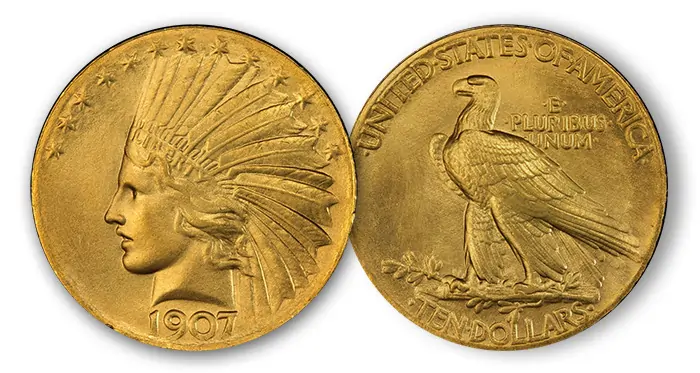
In contrast, designers voiced no comparable public worry in 1899 when officials selected Running Antelope for a Silver Certificate. Still, the debate over Pratt’s gold coins later swept the $5 Silver Certificate into its orbit.
Theodore Roosevelt’s Praise
In February 1909, The Numismatist published President Theodore Roosevelt’s praise for St. Gaudens’ Liberty design, which depicted a white woman wearing a Native headdress. Roosevelt argued that the Indian “finely symbolizes freedom.” He rejected “hackneyed” conventions for Liberty.[47] He then called it “eminently fitting” for such a head to wear a “purely and characteristically American headdress.”[48]
Roosevelt conflated American identity with Native symbolism. He also endorsed a white Liberty “playing Indian.”
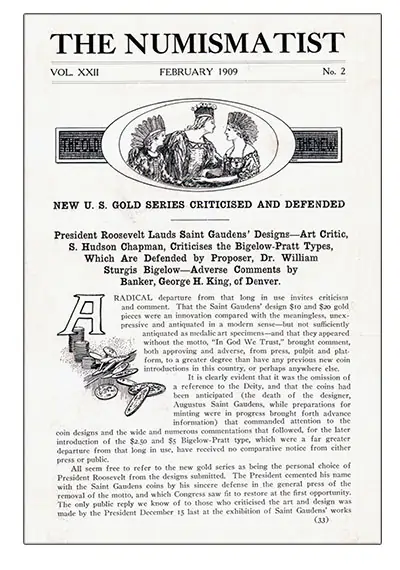 S.H. Chapman responded sharply in the same issue. He dismissed the Pratt portrait as “without artistic merit,” and complained that the portrait showed an “emaciated” Indian “totally unlike” “big, strong Indian chiefs.”
He called the coins a “disgrace” and hoped officials would recall and remelt them,[49] then argued that recessed designs would trap dirt and disease, calling them “the most unhygienic [coins] ever issued.”[50] He advocated a committee to review designs and warned that bad designs would “degrade” public taste.[51]
William Sturgis Bigelow replied. Bigelow advised Roosevelt and supported Pratt. Bigelow said a “recent photograph” provided the portrait and claimed the subject enjoyed excellent health. He suggested Chapman preferred a “fatter but less characteristic type” sometimes seen on reservations.[52] Bigelow also dismissed the hygiene critique by claiming hygiene related more to silver than gold, since silver circulated “into dirtier pockets.”[53]
Hollow Horn Bear and the Persistent Misidentification Myth
The gold coin debate produced a new misidentification of Running Antelope. In February 1909, The Numismatist published “Living Indians Portrayed on Money.” Edgar H. Adams claimed the Series 1899 $5 portrait “is said to be” Hollow Horn Bear, a “well-known Sioux chief” who spoke in Congress in 1889.[54]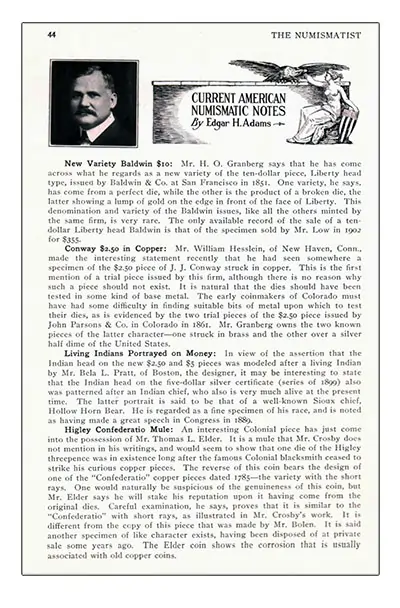
Hollow Horn Bear did address Congress in 1889. However, he did not appear on the 1899 $5 Silver Certificate.
Hollow Horn Bear’s life paralleled Running Antelope’s in notable ways. He entered the world in the early 1850s. He served as a U.S. Army scout around 1874. A 1962 South Dakota historical marker stated that he had once “fought the whiteman wherever he could find them in Wyoming and Montana.”[55]
He served as a “Police Captain” on the Rosebud Reservation beginning around 1881.[56] He arrested Crow Dog after Crow Dog killed Spotted Tail, an episode tied to Ex parte Crow Dog. He served as a leading orator and negotiator during the Sioux Land Commission in 1889.
An 1895 New York Times article praised his “excellent record” of service. He rode in Theodore Roosevelt’s inaugural parade in 1905 and Woodrow Wilson’s in 1913.[57]
Other Publications Also Got It Wrong
Other publications repeated the error. The Aberdeen Democrat reported on February 5, 1909, about an annuity payment supposedly made in Series 1899 $5 Silver Certificates. The paper praised Hollow Horn Bear’s looks and called him “the handsomest and most typical Indian in the country.”[58] It described him as adept at the “white man’s game,” meaning conversation. It also claimed he could talk “a few hundred thousand” out of the Bureau of Indian Affairs.[59]
The article claimed the BIA withheld about $300,000 from his tribe, money the tribe believed should go to minor children. It also claimed Hollow Horn Bear hoped to take home about 50,000 copies of his picture on the $5 certificates.[60]
The annuity’s reality remains unclear in that account. Still, the framing matters. The article cast Hollow Horn Bear as a smooth-talker trying to swindle the government, even though fraud in Indian affairs often flowed the other direction.
The misidentification continued. A 1913 obituary in The National Magazine repeated it.[61] Hollow Horn Bear caught pneumonia during the opening ceremony for the National American Indian Memorial and while riding in Wilson’s inaugural parade. A New York Times announcement described the “tall, bronzed Indians from the west…” who marched in the parade.[62]
Today, the myth persists. Hollow Horn Bear’s Wikipedia page has claimed that “a number of sources report Hollow Horn Bear as the basis for a US five-dollar bill,” citing The Numismatist.[63]
Hollow Horn Bear did appear on stamps and military payment certificates. However, he did not appear on $5 Silver Certificates from 1899 to 1922.
A “Particular Look” and the Logic Behind the Portrait Choice
The language in The Numismatist debate and in regional press coverage reveals racialized expectations about a “proper” Native appearance. Writers demanded a particular “look.” They praised supposed “virility,” while discounted accuracy, and then blurred distinct tribal identities.
That pattern helps explain Running Antelope’s portrait transformation. If the original headdress did not fit, designers substituted another. They prioritized a generalized “Indian” look over cultural specificity.
Running Antelope’s biography also fit federal desires. He embodied the assimilation narrative that politicians and military leaders promoted: settled farming, diplomacy, and accommodation of expansion. He posed no threat as a symbol of indigenous resistance.
Moreover, the medium mattered. Many Americans ranked Silver Certificates below gold-backed money. Therefore, appropriating Running Antelope’s likeness onto silver paper money did not challenge “hard money” assumptions about hierarchy and value. At the same time, the portrait evoked a recent frontier past and offered a “simpler time” fantasy that reinforced racial hierarchy. As Tschachler put it, depicting Native Americans as “exotic people” foregrounded and reinforced white superiority.[64]
1922 Newspaper Storytelling and the Myth-Making Machine
In 1922, newspapers across the country ran a story about Running Antelope titled “Stories of Great Indians – Running Antelope’s Views of Indian Agents.” Elmo Scott Watson, a journalism professor, recounted Running Antelope’s 1874 meeting with Custer.
Watson claimed Running Antelope came to Custer to beg for food and accused Indian agents of dishonesty. Then Watson mocked him at dinner, describing him “gorging” and sweeping food into his robe like a “capricious haversack.”[65]
Next, Watson pivoted. He excused Running Antelope’s lack of table manners, then called him a “first-class fighting man.” Watson described an 1856 war with the Arikara and credited Running Antelope with participation. Watson concluded by admiring a “record of systemic homicide,” which he suggested boosted Running Antelope’s warrior reputation.[66]
Watson’s contradictions illuminate something important. White audiences often wanted Running Antelope to play multiple roles at once: hungry and formidable, crude and noble, threatening and safe. The story ignored the far larger violence committed against indigenous peoples by Custer and the nation he served. Instead,it focused instead on qualities that helped white readers define a “great Indian.”
Philip Sheridan famously voiced the “only good Indian” mindset. Yet the BEP found an Indian “good enough” for Silver Certificates.
Conclusion: Regret, Metaphor, and a Portrait That Outlived Its Subject
Running Antelope seems to have regretted his accommodation later in life.
Forrest W. Daniel’s 1969 account described an 1888 visit by a federal commission to Standing Rock to discuss land purchase under the Dawes Act. Daniel paraphrased Running Antelope’s words. Running Antelope compared the government’s promises to trading for a cow:
He said the government offered a calf for land but never delivered it. Later, it offered a heifer, then a fine cow, and again failed to deliver. Finally, he said the government drove in an old, dried-up animal with a frozen-off tail and broken horns, and the Sioux no longer wanted to trade.[67]
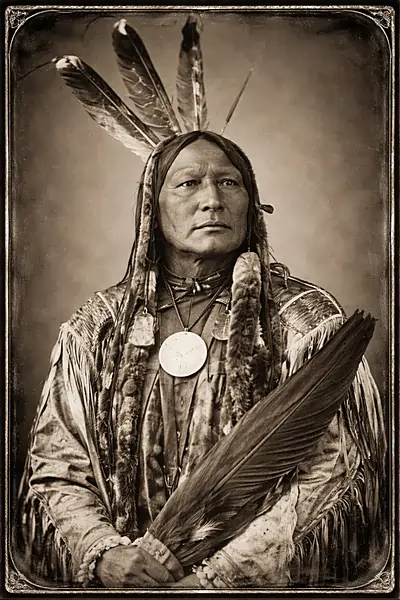
died without knowing that officials would revive his 1872 photograph, alter it to satisfy BEP aesthetics, and place it on a form of currency many Americans distrusted. Americans searching for identity during rapid modernization deployed Native imagery to evoke an imagined past. In that antiquarian frame, Running Antelope became a powerful symbol. The BEP could “play Indian” while avoiding a portrait of resistance.
Collecting the “Chief Note” Today: Demand, Rankings, and Prices
Running Antelope’s likeness still carries symbolic weight, and collectors pay for it. The 100 Greatest American Currency Notes ranked the Series 1899 $5 Silver Certificate at #10.[68]
Collectors pursue the note aggressively. Notes with low serial numbers, unusual serial numbers, replacement status, or major errors often bring strong premiums. Even common circulated examples often sell for hundreds of dollars.
Thomas King, who wondered why other leaders did not appear on currency, admitted that he wanted one for his office wall until he discovered that a nice example can cost thousands.[69] Coin World described the note in 1994 as “one of the most popular notes among collectors of US paper money and consequently is expensive.”[70]
Recent auction results support that claim. Then n January of the year referenced in the original research, a PCGS Gem New 66 PPQ example sold for $6,600, and another note in the same grade sold in April 2018 for the same amount.[71] A PCGS Gem New 67 PPQ example sold in August 2017 for $22,912.50.[72]
Littleton Coin Co. sells the notes and markets them as “beautiful and historic.” The listing calls them “the only series of U.S. notes to feature a Native American as its main theme” and says, “An issue no collector should be without!”
Collectibles followed. In 1977, the BEP issued ANA World’s Fair of Money convention souvenirs featuring the Series 1899 $5 face. Then in 1988, the International Paper Money Show issued a similar card featuring the back. Finally in 2001, the U.S. Mint included a BEP-made replica 1899 $5 Silver Certificate in a set with 2001-D American Buffalo Commemorative silver dollar examples. The set also included a Red Cloud stamp issued in 1987. The sets sold out within a week.[73]
The design even appears on magnets.
In 2013, The Numismatist noted that collectors “do not tire of the dignified image of the chief … even if it is not accurately portrayed.”[74]
Collectors have traded stories about the “handsome” Indian on the note’s face for decades. Auction catalogs continue to praise the note’s beauty and history. Numismatic writers still publish corrections to long-running errors.
Consequently, Running Antelope’s symbolic power, along with the complicated history behind it, continues to live on in collections, publications, and wherever the $5 Silver Certificate appears.
Citations Part 1-10
[1] Coins: The Magazine of Coin Collecting, Oct., 1978, pg. 69-70.
[2] Bill Gibbs, “Running Antelope”, Coin World, Oct., 20, 1997, pg. 86.
[3] Heinz Tschachler, “From ‘Wildman’ to ‘True Native American’”, ANA Journal: Advanced Studies in Numismatics Vol. 2, No. 1 (Spring, 2007), pg. 20.
[4] George Traylor, “A Tenderfoot Tracks Onepapa”, Paper Money, Vol. 6, No. 4, pg. 106.
[5] Ibid.
[6] Thomas King, The Inconvenient Indian (Minneapolis, University of Minnesota Press, 2013), pg. 38.
[7] Forest W. Daniel, “Running Antelope – Misnamed Onepapa”, Paper Money, Vol. 8, No. 1, pg. 4.
[8] Ibid.
[9] David Treuer, The Heartbeat of Wounded Knee: Native America 1890-Present (New York, Riverhead Books, 2019), pg. 88-89.
[10] Treur, 92.
Citations Part 11-20
[11] Treur, 90.
[12] Robert M. Utley, Sitting Bull: The Life and Times of an American Patriot, (New York: Henry Holt and Company, 2014), pg. 251.
[13] “ADVENTURES OF A SCOUT: Interesting Stories of Indian Adventure by One of Custer’s Scount,” The Bossier Banner, March 6, 1879.
[14] Forrest W. Daniel, “Running Antelope – Misnamed Onepapa”, Paper Money, Vol. 8, No. 1, pg. 6, Jan. 1969.
[15] Peter Cozzens, The Earth is Weeping: The Epic Story of the Indian Wars for the American West, (New York: Vintage Books, 2016), pg. 192.
[16] Ibid.
[17] Chester S. Lord, “Coney Island in the Seventies,” The Saturday Evening Post, 1921.
[18] “NUGGETS,” The Bismarck Tribune, August 26, 1874.
[19] Robert M. Utley, Sitting Bull: The Life and Times of an American Patriot, (New York: Henry Holt and Company, 2014), pg. 238.
[20] Robert W. Larson, Gall: Lakota War Chief, (Norman, OK: University of Oklahoma Press, 2012), pg. 182.
Citations Part 21-30
[21] “Official Register of the United States Containing A List of the Officers and Employees in the Civil, Military, and Naval Service on the First of July, 1889; Together with List of Vessels Belonging to the United States,” Government Printing Office, Washington, D.C., 1889.
[22] “FURTHER ALLEGED IRREGULARITIES: Investigation at Standing Rock of General Carlin’s Charges Against Agent Hughes,” Daily Press and Dakotaian, July 27, 1878.
[23] “WHY IS THIS THUS?: An Investigation at Standing Rock Agency Wanted,” The Bismarck Tribune, July 9, 1880.
[24] Forrest W. Daniel, “Running Antelope – Misnamed Onepapa”, Paper Money, Vol. 8, No. 1, pg. 9, Jan. 1969.
[25] “THE SIOUX VISITORS: An Interview with Running Antelope, the Orator,” The Bismarck Tribune, February 16, 1883.
[26] Ibid.
[27] David Treuer, The Heartbeat of Wounded Knee: Native America 1890-Present (New York, Riverhead Books, 2019), pg. 145.
[28] Treuer, 96.
[29] “THE SIOUX VISITORS: An Interview with Running Antelope, the Orator,” The Bismarck Tribune, February 16, 1883.
[30] Peter Cozzens, The Earth is Weeping: The Epic Story of the Indian Wars for the American West, (New York: Vintage Books, 2016), pg. 84.
Citations Part 31-40
[31] Ibid.
[32] Roy Morris Jr., Sheridan: The Life and Wars of General Phil Sheridan, (New York: Crown Publishing Group, 1992), pg. 342-343.
[33] Philip J. Deloria, Playing Indian, (New Haven, Yale University Press, 1998), p. 5.
[34] Heinz Tschachler, “The Wildman in the New World,” The Numismatist, September, 2019, pg. 39.
[35] Tschachler, 41.
[36] Tschachler, 42-43.
[37] Heinz Tschachler, “From ‘Wildman’ to ‘True Native American’: Images of American Indians on paper money,” ANA Journal, 2, No. 1, (Spring, 2007), pg. 9-10.
[38] Philip J. Deloria, Playing Indian, (New Haven: Yale University Press, 1998), p. 100.
[39] Michael O’Malley, Face Value: The Entwined Histories of Money and Race in America, (Chicago: The University of Chicago Press, 2012), pg. 151-159.
[40] O’Malley, 84.
Citations Part 41-50
[41] Ibid.
[42] “New Silver Certificates,” The New York Times, June 26, 1900, pg. 11.
[43] Philip J. Deloria, Playing Indian, (New Haven: Yale University Press, 1998), p. 68.
[44] Deloria, 187.
[45] R.S. Yeoman, A Guide Book of United States Coins 2011, (Atlanta: Whitman Publishing, 2010), pg. 242.
[46] Howland Wood, “The Bigelow-Pratt Gold Pieces – New $2.50 and $5.00,” The Numismatist, December, 1908, pg. 375.
[47] Theodore Roosevelt, “President Roosevelt Lauds St. Gaudens’ Design,” The Numismatist, February, 1909, pg. 34-35.
[48] Ibid.
[49] S.H. Chapman, “Numismatist S.H. Chapman Criticizes Bigelow-Pratt Types,” The Numismatist, February, 1909, pg. 36-37.
[50] Ibid.
Citations Part 51-60
[51] Ibid.
[52] William Sturgis Bigelow, “Dr. Wm. Sturgis Bigelow Answers Mr. Chapman,” The Numismatist, February, 1909, pg. 37-38.
[53] Ibid.
[54] Edgar H. Adams, “Living Indians Portrayed on Money,” The Numismatist, February, 1909, pg. 44.
[55] C.B. Nelson, “South Dakota State Historical Markers,” South Dakota State Historical Society, April 2017.
[56] Dan L. Thrapp, The Encyclopedia of Frontier Biography, (Lincoln, NE: University of Nebraska Press, 1991), pg. 671.
[57] Joe Mitchell Chapple, “Affairs at Washington,” The National Magazine, September, 1913, pg. 11.
[58] “Hollow Horn Bear at Indian Bureau,” The Aberdeen Democrat, February 5, 1909, pg. 1.
[59] Ibid.
[60] Ibid.
Citations Part 61-70
[61] Joe Mitchell Chapple, “Affairs at Washington,” The National Magazine, September, 1913, pg. 11.
[62] “Indian to be Orator,” The New York Times, February 20, 1913, pg. 5.
[63] https://en.wikipedia.org/wiki/Hollow_Horn_Bear
[64] Heinz Tschachler, “From ‘Wildman’ to ‘True Native American’”, ANA Journal: Advanced Studies in Numismatics Vol. 2, No. 1 (Spring, 2007), pg. 20.
[65] Watson, Elmo Scott. “Stories of Great Indians: Running Antelope’s Views of the Honesty of Agents.” The Bolivar Democrat. June 24, 1922.
[66] Ibid.
[67] Forrest W. Daniel, “Running Antelope – Misnamed Onepapa.” Paper Money, 1969.
[68] Q. David Bowers and David Sundman, The 100 Greatest American Currency Notes, (Atlanta: Whitman Publishing, 2006), pg. 38.
[69] Thomas King, The Inconvenient Indian (Minneapolis, University of Minnesota Press, 2013), pg. 38.
[70] Gene Hessler, “Design features of MPCs appear on other notes,” Coin World, March 28, 1994, pg. 38.
Final Citations
[73] Paul Gilkes, “American Buffalo set sells out,” Coin World, July 2, 2001, pg. 1.
[73] Andy Smith, “Artistic License,” The Numismatist, September, 2013, pg. 23.
Resources and Bibilography
- “ADVENTURES OF A SCOUT: Interesting Stories of Indian Adventure by One of Custer’s Scouts.” The Bossier Banner. March 6, 1879. LINK.
- Bowers, Q. David, and David Sundman. The 100 Greatest American Currency Notes. 1. First ed. Vol. 1. Atlanta, GA: Whitman Publishing, 2006.
- Cozzens, Peter. The Earth Is Weeping: The Epic Story of the Indian Wars for the American West. 1. 1st ed. Vol. 1. New York, NY: Vintage Books, 2016.
- Daniel, Forrest W. “Running Antelope – Misnamed Onepapa.” Paper Money 8, no. 1, 1969.
- Deloria, Philip J. Playing Indian. New Haven and London, CT: Yale University Press, 1998.
Additional Resources
- ———. “From ‘Wildman’ to ‘True Native American’: Images of American Indians on Paper Money.” ANA Journal 2, no. 1 (2007): 9–21.
- “FURTHER ALLEGED IRREGULARITIES: Investigation at Standing Rock of General Carlin’s Charges Against Agent Hughes.” Daily Press and Dakotaian . July 27, 1878. LINK.
- Gibbs, Bill. “Hunkpapa Sioux Leader’s Image on Silver Certificate.” Coin World, December
19, 2016. https://www.coinworld.com/news/precious-metals/hunkpapa-sioux-leaders-portrait-on-silver-certificate.html. - Gilkes, Paul. “American Buffalo Set Sells Out.” Coin World 42, no. 2151, July 2, 2001.
- Government Printing Office, 1 Official Register of the United States Containing A List of the
Officers and Employees in the Civil, Military, and Naval Service on the First of July,
1889; Together with List of Vessels Belonging to the United States § (1889). LINK. - Hessler, Gene. “Design Features of MPCs Appear on Other Notes.” Coin World 35, no. 1772, March 28, 1994.
- “Hollow Horn Bear at Indian Bureau.” The Aberdeen Democrat. February 5, 1909. LINK.
- “Indian to Be Orator.” The New York Times. February 20, 1913, LXII, No. 20,116 edition.
- Larson, Robert W. Gall: Lakota War Chief. Norman, OK: University of Oklahoma Press, 2012.
- Lord, Chester S. “Coney Island in the Seventies.” Saturday Evening Post. 1921, Vol. 194
edition. LINK. - Morris, Roy. Sheridan: The Life and Wars of General Phil Sheridan. New York, NY: Crown Publishing Group, 1992.
- Nelson, C.B. “South Dakota State Historical Markers.” history.sd.gov. South Dakota State
Historical Society, April 2017. LINK. - The New York Times. June 26, 1900, Vol. XLIX, No. 15,745 edition.
- “NUGGETS.” The Bismarck Tribune. August 26, 1874. LINK.
- O’Malley, Michael. Face Value: The Entwined Histories of Money and Race in America. Chicago and London, IL: The University of Chicago Press, 2012.
- Roosevelt, Theodore, Samuel Hudson Chapman, William Sturgis Bigelow, and George H King. “New U.S. Gold Series Criticized and Defended.” The Numismatist 22, no. 2, February 1909. https://archive.org/details/TheNumismatist1909Vol22/page/n49/mode/2up.
More Resources
- “THE SIOUX VISITORS: An Interview with Running Antelope, the Orator.” The Bismarck Tribune. February 16, 1883. LINK.
- Smith, Andy. “Artistic License.” The Numismatist 126, no. 9, September 2013.
- Thrapp, Dan L. Encyclopedia of Frontier Biography. Lincoln, NE: University of Nebraska Press, 1991.
- Traylor, George. “A Tenderfoot Tracks Onepapa.” Paper Money 6, no. 4, 1967.
- Treuer, David. The Heartbeat of Wounded Knee: Native America from 1890 to the Present. New York, NY: Riverhead Books, 2019.
- Tschachler, Heinz. The Numismatist 132, no. 9, September 2019.
- Utley, Robert M. Sitting Bull: The Life and Times of an American Patriot. New York, NY: Henry Holt and Company, 2014.
- Watson, Elmo Scott. “Stories of Great Indians: Running Antelope’s Views of the Honesty of Agents.” The Bolivar Democrat. June 24, 1922.
- https://chroniclingamerica.loc.gov/lccn/sn87065645/1922-06-24/ed-1/seq-6/.
- “WHY IS THIS THUS?: An Investigation at Standing Rock Agency Wanted.” Bismarck Tribune. July 9, 1880. LINK.
- Wood, Howland. “The Bigelow-Pratt Gold Pieces – New $2.50 and $5.00.” The Numismatist 21,
no. 12, December 1908. - Yeoman, R.S. A Guide Book of United States Coins 2011. 1. 64th ed. Vol. 1. Atlanta, GA:
Whitman Publishing, 2010. - Zerbe, Farran. “A Consideration of Our New Gold Coins.” The Numismatist 21, no. 1, January 1908.







Very good article…consider the Calhoun notes with images of slaves in the fields working crops…
This article is an amazing product. Kudos to Mr. Bulfinch for such extensive research and pulling together the information in a thoughtful and comprehensive manner. Our government policy writers should be so professional. Thank you.
Thank you for this article on Running Antelope and the $5 dollar silver certificate.
I’ve been cleaning out some of my old boxes. I have a copy an an engraving, from a plate prepared from the original master die, it’s a replica of the obverse $5 Silver Certificate, Series 1899.
I was wondering if there might be a value to this as a collectible. If so, please point me the right direction.
I am the former Executive Director, Southern California Indian Center, Inc.; I am retired and cleaning out my boxes. I am a member of the Cheyenne and Arapaho tribes in Oklahoma.
Walk in Balance,
Paula Starr
Wow – great article. Bullfinch is fantastic. Thanks for reposting it.
I’ve never seen this one before.
I love the artwork on the old currency
Good luck on the coin giveaway everybody!
I love the old currency. So much color and different designs.
The history of this 1899 5 dollar silver certificate was very interesting. I love this currency because they were so beautiful design I always wanted one for my collection. For back then USA really took design showing history of America so everyone could have a work of art in there pockets.
Old currency is such a wonderful example of the importance of beauty.
Great research and information. Interesting why Running Antelope was chosen over others.