


Series 1976 $2 Bill: History, Value, and Collectability
In the mid-1970s, the United States celebrated 200 years of independence from Great Britain. As a result, the nation released a wide range of patriotic and numismatic items. Among them, one issue stands out: the Series 1976 $2 Federal Reserve Note.
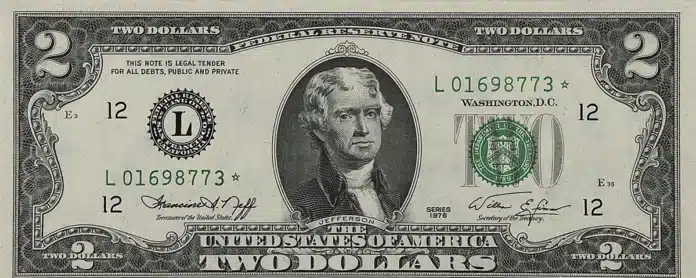 Collectors recognize this note as the first $2 Federal Reserve Note (FRN). Moreover, it introduced the reverse design that remains in use today. Best of all, most examples remain accessible and affordable.
The Bicentennial and U.S. Currency Redesign
The Bicentennial inspired numerous numismatic releases.
First, the United States Mint began striking Bicentennial medals in 1972. Then, in 1973, President Richard M. Nixon signed legislation authorizing commemorative reverse designs for the quarter, half dollar, and dollar coin. The law also mandated the dual date “1776–1976” for coins struck in 1975 and 1976.
Today, collectors can still find Bicentennial coinage in circulation, although locating high-grade examples has become more difficult.
At the same time, officials approved a redesign of the $2 note. In late 1975, the Treasury authorized production of a new $2 Federal Reserve Note to coincide with the Bicentennial celebration.
Treasury Approval and Official Announcement
On November 3, 1975, Treasury Secretary William E. Simon announced that the Bureau of Engraving and Printing (BEP) would produce $2 Federal Reserve Notes for the first time.
Although the Bicentennial inspired the new design, the government did not classify the Series 1976 $2 note as a commemorative issue. The New York Times clarified this point on November 9, 1975:
“[T]he bill is not a ‘special’ Bicentennial‐year issue; it will continue on as a permanent part of the nation’s circulating paper currency.”
Therefore, the note entered circulation as a regular-issue Federal Reserve Note.
How the Series 1976 $2 Bill Differs from Earlier Issues
The Series 1976 note marked an important transition.
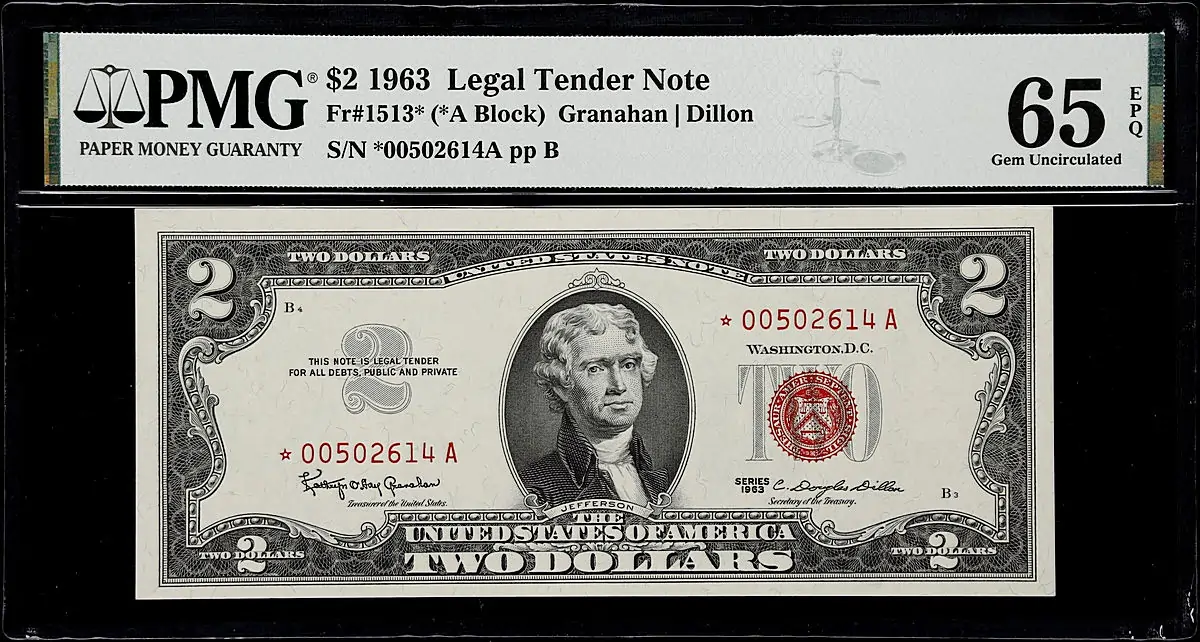
Previously, the government issued $2 notes in the 1960s as Legal Tender Notes. Those notes carried red Treasury seals and red serial numbers. Since the 1860s, the denomination had also appeared as National Bank Notes, Silver Certificates, Treasury Notes, and Federal Reserve Bank Notes.
However, the Series 1976 issue became the first $2 Federal Reserve Note. As expected, it featured a green Treasury seal and green serial numbers.
The obverse retained the familiar portrait of President Thomas Jefferson. In contrast, the reverse underwent a complete redesign.
The Declaration of Independence Reverse
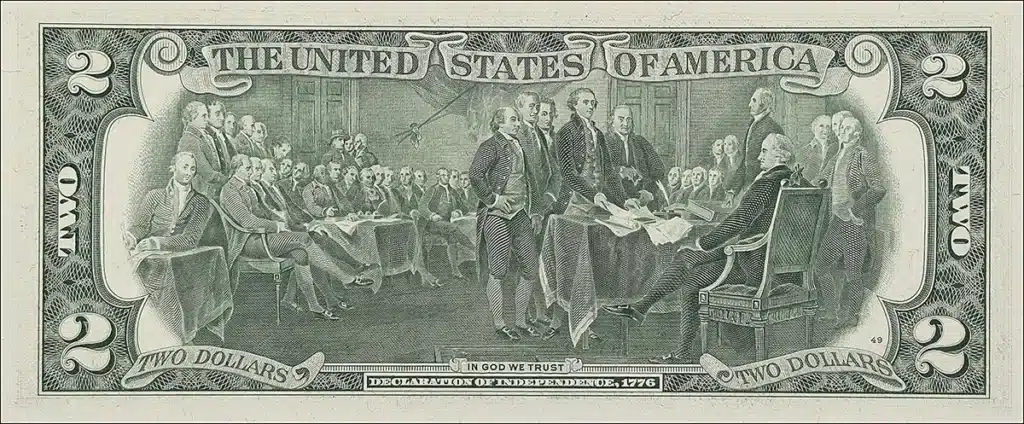
The BEP replaced Jefferson’s Monticello with a vignette based on John Trumbull’s 1817 painting, Declaration of Independence. BEP engraver Peter Cocci adapted the artwork for the note.
Importantly, this marked the first appearance of the Trumbull design on the $2 denomination. However, it did not represent the painting’s debut on U.S. paper money. The image had previously appeared on the back of $100 National Bank Notes in 1863.
The reverse displays the denomination as numerals in each corner. Scrollwork frames the written denomination at the bottom. Additionally, the words “TWO DOLLARS” appear vertically on both sides of the central vignette.
Trumbull’s painting also appeared on Bicentennial commemorative postage stamps, issued in four sections.
Production Figures and Signatures
The Bureau of Engraving and Printing produced 590,720,000 Series 1976 $2 bills between 1976 and 1978.
Each note bears the signatures of:
- Treasury Secretary William E. Simon
- Treasurer of the United States Francine Irving Neff
Officials released the notes on April 13, 1976, Thomas Jefferson’s birthday.
Star Notes – Scarcity – Error Notes
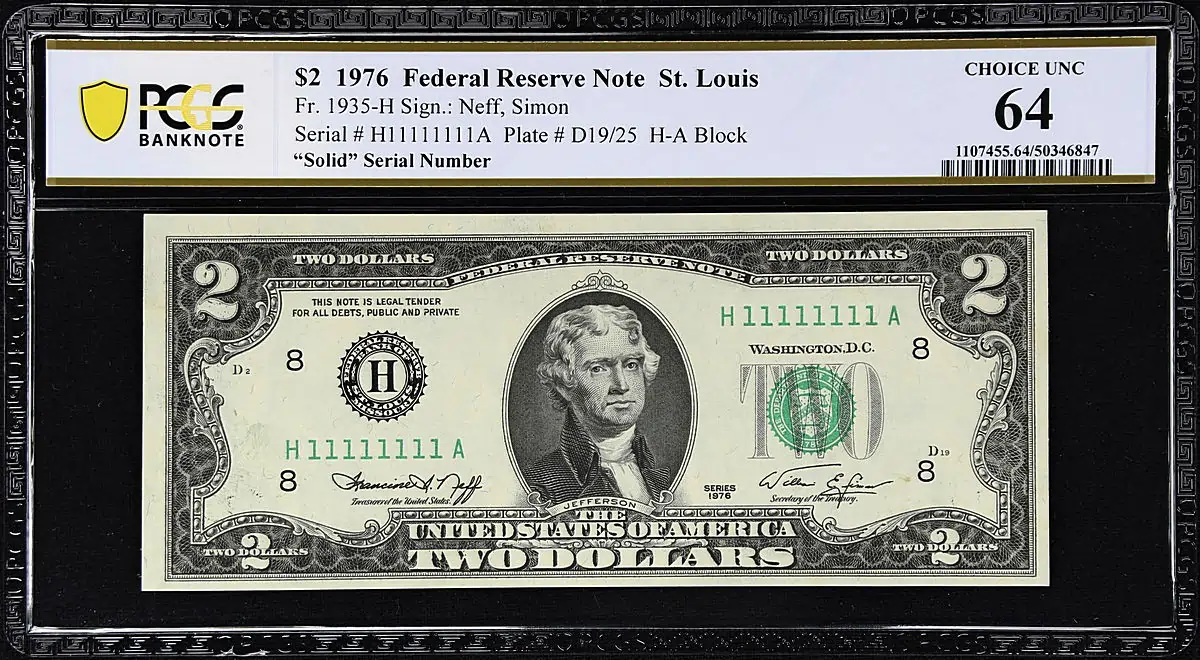
Most Series 1976 $2 notes remain common. Nevertheless, certain varieties command attention.
The scarcest Star note in the series carries the Friedberg catalog number F-1935-J* (Fr. 1935-J*). Minneapolis Star notes also rank among the more elusive issues.
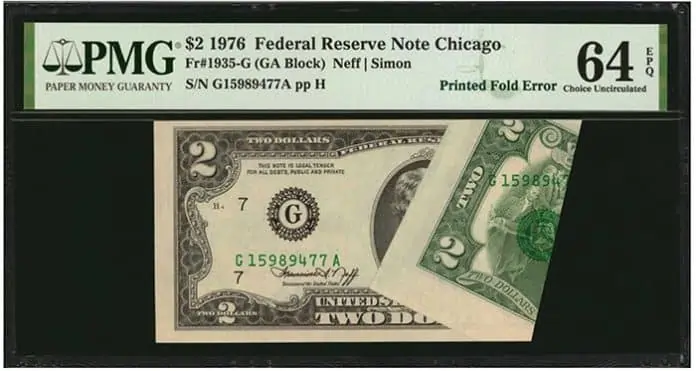
Collectors seek Star notes because the BEP used them as replacements for misprinted notes. Consequently, they appear in smaller quantities.
Public Reception and Circulation
Before release, some observers predicted strong commercial acceptance. An April 11, 1976, New York Times article projected that the $2 note could replace half of the $1 bills in circulation. Officials estimated annual printing savings between $4 million and $7 million.
However, widespread circulation never materialized. In fact, many Americans treated the denomination as unusual or even suspicious. Over the years, some retailers have questioned the legitimacy of $2 notes. In rare instances, authorities even arrested individuals attempting to spend them.
As a result, the denomination remains uncommon in daily commerce.
Stamped First-Day Issues: A Bicentennial Collectible
Release day created a unique collecting opportunity.
On April 13, 1976, many Americans brought newly issued $2 bills to local post offices. They affixed Bicentennial commemorative stamps directly to the notes. Then, postal clerks canceled the stamps with official postmarks.
This crossover collectible appeals to both notaphilists and philatelists. Although most stamped notes trade near face value, collectors sometimes pursue examples from specific hometowns or meaningful locations.
Art Friedberg, co-author of Paper Money of the United States (22nd edition, 2021), recalled strong demand at the time:
“It was different, it was collectible, people loved it. We made a lot of money.”
Robert Azpiazu, owner of First City Coins and Collectibles and author of Collector’s Guide to Modern Federal Reserve Notes: Series 1963–2009 (2011), noted:
“There are some cancellations that are very valuable but only to a small group of eclectic collectors.”
Appearances in U.S. Mint Products
The Series 1976 $2 note also appears in official U.S. Mint products. Notably, the 1994 Thomas Jefferson 250th Anniversary Coinage and Currency Set includes a Series 1976 $2 bill paired with a Satin Finish Jefferson Nickel.
Grading Population and Market Values
As of July 10, 2024, Paper Money Guaranty (PMG) reports 18,830 total grading events for Series 1976 $2 notes across all 12 Federal Reserve districts. Of those, 6,040 represent Star notes.
In today’s market:
- Circulated examples typically trade at or near face value.
- Uncirculated notes often sell for $3 to $4.
- Star notes command higher premiums.
- High-grade examples and collectible serial numbers bring stronger prices.
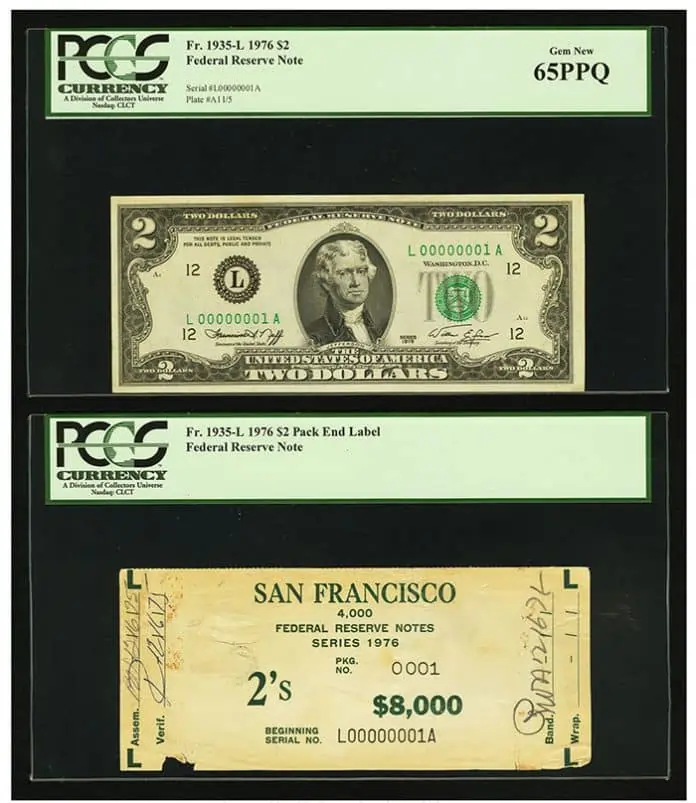
For example, Friedberg 1935-L with serial number 1 realized $21,150 at a Heritage auction on January 8, 2016. The note retained its original BEP brick label.
Why Collectors Still Pursue the Series 1976 $2 Bill
The Series 1976 $2 Federal Reserve Note holds lasting appeal.
- First, it represents the first $2 FRN in U.S. history.
- Second, it introduced the Declaration of Independence reverse that remains in use today.
Finally, collectors can acquire most examples for little more than face value.
Therefore, the Bicentennial $2 bill offers history, artistry, and affordability in one iconic American note.






1928-1963 $2 bills displayed the phrase “United States Note” rather than “Legal Tender Note” at the top of their obverse. The wording “this note is legal tender” appears on both US Notes and Federal Reserve Notes.
some artifacts are meant to be a secret. for the sake of adventure and to kept preserved
LEGAL TENDER NOTES is another commonly used name (more common actually) for United States Notes.
A United States Note, also known as a Legal Tender Note, is a type of paper money that was issued from 1862 to 1971 in the U.S. Having been current for 109 years, they were issued for longer than any other form of U.S. paper money. They were known popularly as “greenbacks”, a name inherited from the earlier greenbacks, the Demand Notes, that they replaced in 1862. Often termed Legal Tender Notes, they were named United States Notes by the First Legal Tender Act, which authorized them as a form of fiat currency.
I spent time overseas while in the Navy from 1969-1972 and “greenbacks” were not only accepted everywhere, but were preferred to their local currencies and were respected like gold.
The vignette of the signing of the Declaration of Independence also appears on the $1 food stamp issued until 2000.
How can I tell if my 1976 $2 bill is worth anything
Try and spend it
It’s legal tender. Just like any of the big bills. Theoretically I could walk into a bank with a $10,000 bill and they have to accept it. I’d never do that since it’s worth way more than face value, but you get my point.
@Jacob McCombs: Over half a billion Series 1976 $2 bills were printed. Unless it’s uncirculated or has a “fancy” serial number, it’s only worth face value. $2 bills are uncommon but hardly rare.
I have a 2 dollar bill is it worth anything from 1976 the serial numbers are k 09345139 A thank you
Yes,two dollars!
My two dollar bill is from 1976, serial number F31432384A is it worth anything.thank you
As the story notes, it’s only worth face value. In most cases serial numbers don’t affect a bill’s value. Some “fancy” patterns like 12344321, 57575757, etc. or very high/low numbers are of interest to collectors though.
Yes,two dollars!
My 1976 2 dollar bill on the backside when looking at it, it shows an extra head that should not be there.
No keep it or contact heritage auctions
I keep two dollar bills in my wallet, and I spend them.
LoL L.m.a.o.r.o.t.f.L.
Augustus Samuel got a $2 dollar bill dated 1976 with serial number g52664273a with a green stamp on it how much is it worth
As the story states, in average condition it’s only worth face value.
In most cases serial numbers don’t affect a bill’s value. Some “fancy” patterns like 12344321, 57575757, etc. or very high/low numbers are of interest to collectors though.
Yes I actually have the bill and the stamps with the postmark on the day they were both issued. I believe I have something of value . Both Bill and stamps are on same page and are in mint condition. Curious what it may be worth.
Hey I wonder if my $2 dollar bills are worth anything, got quite a few of those from numbers 1 to 12
I have a $2 dollar bills dated 1976 with serial # E37924403 A is worth any thing
Two dollars!
I have three $2 bills and numeral order with the 1976 bicentennial stamp 0 postmarked in Kansas City Missouri on July 4th 1976 is this worth anything I have three in order all withstands all stamped at the Kansas City Missouri post office
All of these bills are in super good condition they have been kept in wax paper please reply if these are worth anything thank you
All of these bills are in super good condition they have been kept in wax paper please reply if these are worth anything thank you
Hello do you still have these
YES
I have. 8 bill Three 2003 one. 2013 one. 1976 and. 2009
@Geoffrey Miller Unless the bills are uncirculated, they’re only worth face value.
Might want to do some homework brother……. Lol.
I have 16 $2 bills(3) 1976, (9) series 2017 A, (3) series 2013/A, (1) series 2009 and I got them from my bank
I have this 2 dollar bill and more stuff can somebody contact me.
I have $60.00 $2.00 Dollar bills a $100.00 bill that is 40 years old and other coins half a dollar and quarters like to know how much are they worth
I have 2 $2.00 star notes,in numerical order,that have *s on both notes!
I thought the stars denote start up?
Those may be worth a few bucks to much more, bring them to as many different coin stores as you can because people will scam you, and tell them all you’ve gone to multiple places but DO NOT tell them what the other stores said the value was…
Star notes like you have are normally called replacement notes and are inserted into currency by mint personnel to replace damaged or destroyed or obvious error notes. They can be worth more but it depends on things like condition, serial numbers, etc. I have searched for many years to find a Star note that contains an error itself but have not found any as yet. You can also take a pic of these front and back and submit to dealers out there to find out if they have any interest in them. As the prior response noted, checking with several different sources is always a good idea.
I have 6 1 c from 1935 year and I have 4 2 dollar bill do you know if they are worth some money? Send me a response
How much is a red letter 1957
@Timmy Mahon Please check that date and denomination again. The only Series 1957 bills were $1 silver certificates and they had blue seals. The last red-seal $2 bills were 1963.
Hi I have a few 2 dollars bills let me know if they are worth anything.
Two dollars each! Didn’t you read the article?
I would like to purchase those 2dollars Bills as soon as possible
I have old two dollar bills and half a dollar coins please contact me let me know if they’re worth something I would like to sell them.
I have 3 two dollar bills from 2003 series one of them has low serial number
00870097A ! Is it worth more than $2 ?
I have a 2017 $2 bill.
@Rick B Unless the bill is uncirculated, it’s only worth $2.
Crazy cause I went to the store earlier today ,the dickman gave me a 2 dollar bill . I put it I. My saving bank along with the dollar he gave me back for change . 3 bucks altogether but I took it at 2&1 as a number .
Wockesha
I have a 2 dollar bill from 1928 series
I have $2 bills with the red seal and blue..
US 2 dollar l7193525A US 2 dollar l7768389A 17761776
I have $2. Money
I have two of these and would like to talk to someone about them
@Lesa Reagan: if you check the article again, they’re unlikely to be worth more than face value.
Had a gas station attendant tell me my 1976 $2 bill was fake the other day cause it was a rip on it and the money machine wouldn’t recognize it. Lol.
What are you babbling about?
What are the chance that the further we get from 1976, the likelyhood that the $2 will increase in value?
@Eric Scott Reynolds As the story mentions, over half a _B_illion 1976 $2 FRNs were printed and a lot were saved as Bicentennial keepsakes. It’s highly unlikely most of them will see significant appreciation.
The same thing happened with Series 1957 $1 silver certificates. Mountains were printed and more than a few were saved after silver certificates were discontinued. Even today a typical circulated one only retails for $1.50 to $2.
I have 2 $2 bills from 1926 red . Seal How much does it work?
Oh wow you should get them looked at seriously
@Vision: Could you check that date again? There are no 1926 $2 bills. If they’re 1928 series, you need to know the letter if any that’s near the date. If there’s a letter it could be anything from A through G. There are multiple sites that will give you an idea of how much each type may be worth – if they’re common (F or G) they’re only worth 4-5 dollars, but an A or B letter could bring $50 or more.
I have the same bill how much does it Worth
I have 3 $2 notes 1953 red series , and 4 red seal1928 series
I have a lot of 1976 two dollar bills and coins how do I find out what they are worth
What about the 1776 of 2013 and 1776 of 2003 good condition
@Crystal Quiroga Unless your bills are uncirculated, they’re only worth face value.
[FWIW “1776” isn’t part of the date or series, just part of the design]
I have two of 2 $2bill thay the year 1976 and not sure how much there worth .
@Jeffrey Johnson As the article explains, unless the bills are in uncirculated condition or have special serial numbers they’re* only worth face value.
(*) rather than “there” :)
I have about 600…. $2 bills … I wonder if there are any collectable once worth good money?
I have 5 , two dollar bills all bicentennial all in sequence w serial numbers and all post stamped on first day of issue….in uncirculated condition …are these worth anything …
One way to find out is to send them to a reputable auction house like Heritage, and have them sell them to the highest bidder. The article states that these are normally worth around $4 each, but with 5 sequential, they likely would get more each if sold in the same small sequential group.
I have a 2 $ bill with yellow / gold seal an serial numbers. Can anyone give any info about this cause I can’t find anything about it.
@Shane Alderton: Without knowing a date and series letter it’s not possible to say anything specific, but it’s likely the bill’s undergone some type of damage (chemical exposure, being washed, etc.) that affected the seal color.
FWIW, many years ago there were superstitions that the denomination was somehow “tainted”, perhaps due to it getting the obvious nickname “deuce” which was an old euphemism for the devil. It was common for gullible types to actually wash the bills in an effort to remove the “taint”. Yes, really.
I have about 600 sequential uncirculated 1976 $2 bills. Do they have any value? Beyond face value.
I have a few 1976 2 dollars bills plus I have 2 dollar bill with the red seal from 1963 do they worth anything
2$ note with what seems to me to be an interesting number G 29018181 A 1976 – any idea of value over 2 dollars?
I have 2 2dollar bills 1976 gem condition never folded prestine condition uncirculated sequeintal green star note error cut stamped april 13 pm 1976 atlanta georgia serial# F 00128416 and F 00128417. What are they worth 20k each the 2 togeather in sequiental prestine condition im thinking 100k or more in auction
I have one , with G 69201143 A . Can someone tell me if it’s really valuable
@Frederick Brown Please re-read the article. Unless the billl’s in uncirculated condition, it’s very unlikely to be worth more than face value.
Also, serial numbers generally don’t affect a bill’s value unless they’re unusual in some way. E.g a pattern like 23232323 or a repeating digit such as 55555555 might fetch a few extra dollars.
I enjoy all your articles. I especially enjoyed this one. I have several very old $2 bills but prefer to keep them for my granddaughter.
Heard about the coming $2.50 Coin for America’s 250th Act Passed by the House Last Month?
I always go out of my way to acquire $2 bills. They are fun to leave as tips in a restaurant, pay bills, hand out to kids, stocking stuffers and so many other things.
My favorite true story is going to the bank one day I ask for any $2 bills. I received about 13. They were all star notes and all looked uncirculated. They were also mostly in sequence except that some were missing. But I saved them.
Two weeks later at the same bank I asked for more. I received about 15 more. They were, again, all star notes and in sequence AND all the ones missing from the first trip.
I still have them.
i can’t remember the last time i got a $2 bill in change.
I have 5 crisp 2 dollar bills, series 1976 signed by treasury secretary William Simon. Worth anything?
@Ron Porcelli: As the article notes, huge numbers of 1976 $2 bills were printed. If yours are crisp and uncirculated they might bring $4 or so at retail; otherwise they’re only face value.
Thank you for the history on the currencies. I love to read the comments too!
Now where did I put mine?
Although the $2 bill/ note is not hard to get, generally from any bank/ credit union, a few years ago I had read a news article that a middle school student was paying for his lunch with a $2 bill. the principal and lunch lady thought it was fake, called the NYPD on this poor kid. Tried to get him arrested but the officer knew it was real and had to teach the lunch lady and the principal a bit of history…