


Empires fall. Governments fracture. However, silver endures.
Few coins capture that truth better than the Central American Republic 8 Reales. Struck in Guatemala beginning in 1824, this coin represents a bold political experiment that lasted less than two decades. Yet remarkably, the coin itself survived the collapse of the very nation it was meant to symbolize.
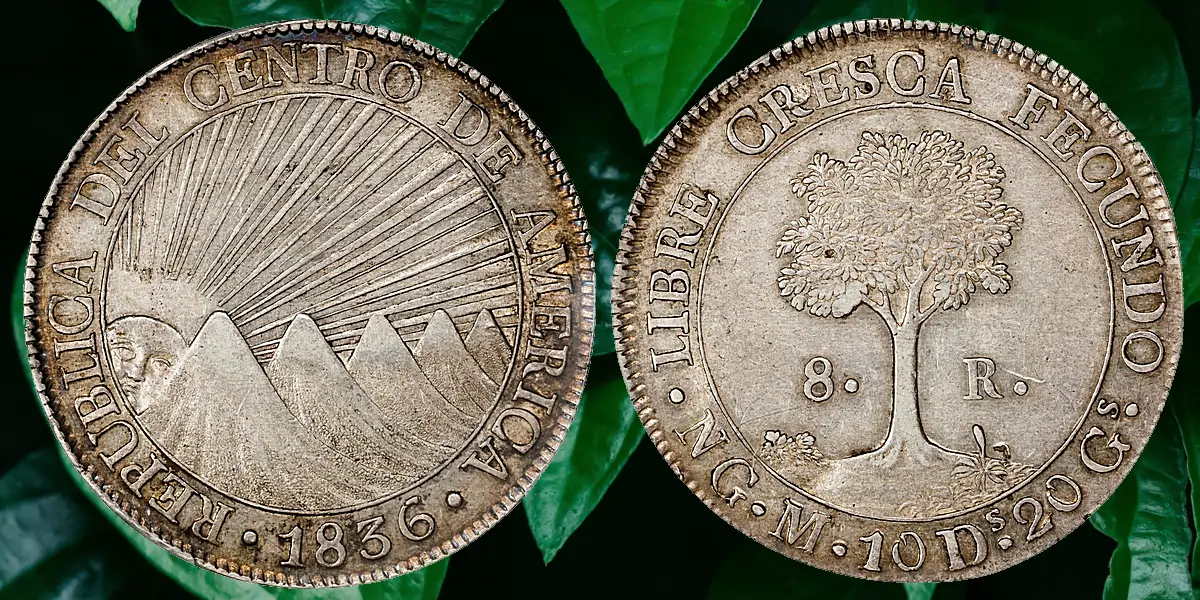
For collectors, the story behind the 8 Reales delivers both historic drama and surprising affordability. At the same time, high-grade examples command serious respect in today’s market.
Let’s explore why.
A Nation Forged in Revolution
The Federal Republic of Central America was formed in 1823. It united five former Spanish colonial provinces: Guatemala, El Salvador, Honduras, Nicaragua, and Costa Rica.
The capital began in Guatemala City. Then, in 1834, the government moved it to San Salvador. Political instability followed almost immediately. Internal conflict weakened the federation. By roughly 1838 to 1840, the union effectively dissolved.
However, coin production continued.
The Guatemalan mint, officially Nueva Guatemala, struck 8 Reales pieces from 1824 through 1841 under the Federal Republic. Even after the federation collapsed, the Republic design remained in use until about 1847/1851.
That continuation makes this issue unique. The coin outlived the country.
The Economic Backbone: A One-Ounce Trade Coin
The 8 Reales served as the standard silver trade coin in the region. Its weight equaled approximately one troy ounce. Its silver fineness stood at roughly 90.27%.
This specification aligned closely with earlier Spanish colonial 8 Reales pieces. As a result, the coin maintained trust in international trade.
Merchants recognized the weight. They trusted the silver. Therefore, circulation remained strong even during political upheaval.
Because of that heavy use, most surviving examples show moderate wear. Nevertheless, the coin remains widely available today.
Design of the Guatemala 8 Reales (KM#4)
The Central American Republic 8 Reales features one of the most symbolic designs in 19th-century Latin American coinage.
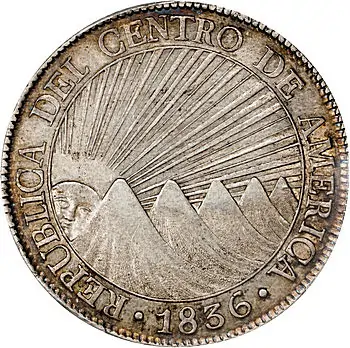 Obverse: The Sun of Libert
The obverse displays a radiant sun with a face. The sun shines over five volcanoes. Those volcanoes represent the five member states of the federation.
The surrounding legend reads:
“REPUBLICA DEL CENTRO DE AMERICA.”
The sun symbolizes liberty. The volcanoes symbolize unity. Together, they present a powerful message of republican identity.
Reverse: The Ceiba Tree
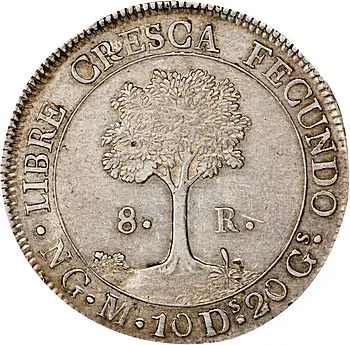 The reverse features a Ceiba tree. In Central American culture, the Ceiba represents strength and fertility.
The denomination “8 R” appears divided by the tree. Around the border, the inscription reads:
“LIBRE CRESCO EN FERTILE.”
Translated, it means: “I grow free in fertile soil.”
The symbolism feels almost prophetic. The republic did not survive. Yet the coin, and its ideals, endured.
Mint Marks and Assayers
The coins carry the mint mark “NG” for Nueva Guatemala. In addition, they display assayer initials.
One well-known assayer is Miguel Muñoz, whose initial “M” appears on early issues such as the 1824-M NG pieces.
Examples certified in Mint State can be visually impressive. For instance, an 1824-M NG 8 Reales graded MS63 by NGC has appeared in major auctions, described as bright and sharply detailed.
Availability and Market Value
Despite the short lifespan of the Federal Republic, production volumes were substantial. Therefore, the 8 Reales remains generally available today.
Most examples in Fine to Extremely Fine condition trade for under $200. Some lower-grade pieces even sell for under $100.
However, condition matters.
Mint State examples remain scarce. As a result, high-grade pieces can exceed $5,000. Eye appeal, strike quality, and originality drive strong premiums.
Because many coins circulated heavily, attractive uncirculated pieces stand out dramatically.
Countermarks and Later Use
Some 8 Reales coins show post-1838 countermarks. These often feature a sun behind a mountain motif.
These countermarks reflect continued circulation after the federation dissolved. Governments revalidated existing coins rather than withdraw them.
Once again, silver proved more durable than politics.
 Why the Central American Republic 8 Reales Matters
This coin tells a larger story.
First, it represents an ambitious attempt at regional unity in post-colonial Latin America. Second, it demonstrates how economic necessity can outlast political structures. Finally, it remains accessible to collectors at many budget levels.
In other words, it combines history, symbolism, and affordability.
For advanced collectors, high-grade examples offer rarity and investment-grade potential. Meanwhile, newer collectors can acquire a tangible piece of 19th-century geopolitical drama without spending a fortune.
Few coins deliver that combination.
A Silver Republic That Refused to Die
The Federal Republic of Central America lasted less than twenty years. Internal divisions fractured the dream of unity.
Yet the 8 Reales coin continued to circulate into the late 1840s and possibly as late as 1851 under the same basic design.
The nation did not grow as intended. However, its coinage became a lasting symbol of independence, resilience, and silver-backed trust.
That enduring legacy gives the Central American Republic 8 Reales its true power, and its lasting appeal in the numismatic marketplace.
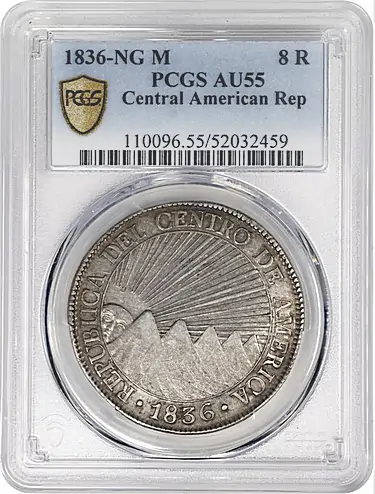
A beautiful example of the GUATEMALA. Central American Republic. 8 Reales, 1836-NG M. Nueva Guatemala Mint. PCGS AU-55. will be in the Stack’s Bowers Auction on Feb 25, 2026 as Lot #77220






History always makes coin collecting that much more fun. I knew nothing about the centralized federal Republic that only exist existed for 20 years. You learned something new every day.