By Dr. Steve Benner for CoinWeek …..
When I began researching this article, I was aware of Sardinia’s rich 8,000-year history, but I hadn’t realized how limited the information on its coinage was. I’ve compiled all the available material to write this article, and I hope readers find it enlightening.
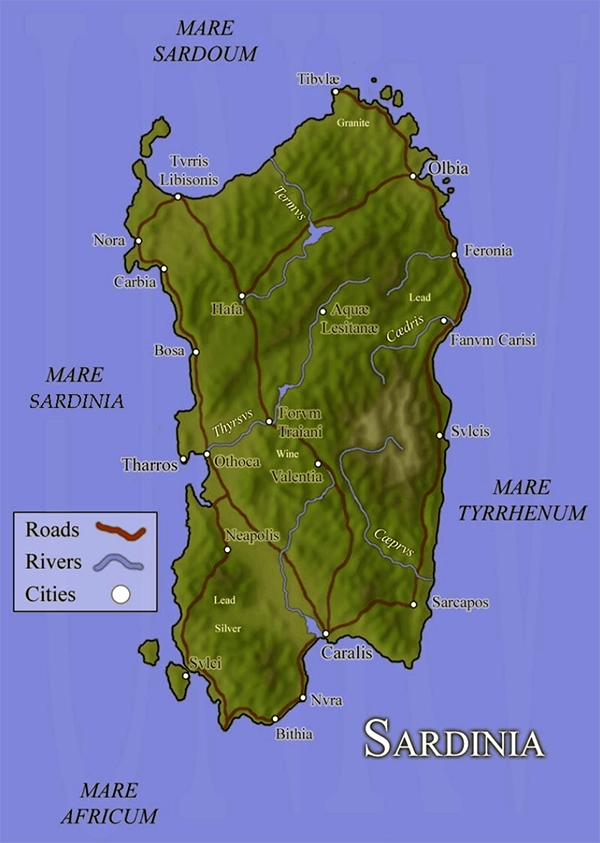
Sardinia, the second-largest island in the Mediterranean after Sicily, lies approximately 120 miles (200 km) off Italy’s west coast, north of Tunisia. It covers an area of 24,100 km² (9,305 sq mi). To its west is the Sea of Sardinia (part of the Mediterranean Sea), and to its east is the Tyrrhenian Sea. To the north, the island of Corsica is separated by the Strait of Bonifacio (Fretum Gallicum). Sardinia is a predominantly mountainous island with a generally high and rocky coastline featuring numerous small islands. Its highest peak, Punta La Marmora, stands at 6,017 feet in the island’s center. The mountain ranges are interspersed with wide alluvial valleys and flatlands in the southwest and northeast. The island is divided by a few major rivers, including the Tirso, Coghinas, and Flumendosa. Most of the arable land was historically used for growing cereals and fruit.
History
Sardinia was home to Neolithic civilizations as early as the 6th millennium BCE. During the Bronze Age, the local population, known as the Nuragic people, constructed thousands of stone structures called nuraghes. The island was rich in metals such as lead and zinc and maintained trading contacts with the Mycenaean civilization. In the 8th century BCE, the Phoenicians established cities and strongholds in the south and west of the island, typically near estuaries and harbors. Notable settlements included Tharros, Bithia, Sulci, Nora, and Caralis, though the Punic population remained small compared to the indigenous people.
The Greeks established a colony at Olbia in the north, though the Carthaginians eventually conquered it. In the 6th century BCE, the Carthaginians gained control of the western Mediterranean Sea and expanded their Punic settlements in Sardinia, overseeing them through plenipotentiaries known as suffetes. While they failed to conquer the entire island in 540 BCE, they succeeded by 510 BCE, establishing or expanding cities like Olbia and Neapolis. Tharros became the nominal capital, with cereals, fruits, and metals as the main exports.
The First Punic War between Rome and Carthage began in 264 BCE and lasted until 241 BCE. At its conclusion, Carthaginian mercenaries rebelled against Carthage in what became known as the Libyan or Mercenary War. This uprising presented Rome with an opportunity to seize Sardinia, which it did in 238 BCE, a move that violated the existing peace treaty with Carthage. The Romans incorporated the island’s existing infrastructure and combined it with Corsica, just to the north, to form the province of Corsica et Sardinia under the governance of a praetor. This new province, along with Sicily, supplied the majority of the grain required by Rome until the conquest of Egypt.
Revolts broke out in 235 and 233 BCE, both of which were suppressed by the Romans. After the Roman defeat at Cannae in 216 BCE, the island’s Punic nobles revolted against the Romans, controlling the island for a very short time. The Romans responded by sending 22,000 infantry and 1,200 cavalry under Titus Manlius Torquatus, who defeated the rebels at the Battle of Decimomannu in 215 BCE. The Romans defeated another rebel army in the south, reportedly killing 12,000.
There were other revolts in 181 BCE and between 177-176 BCE. In the latter instance, the Balares and Ilienses tribes revolted, but Tiberius Gracchus suppressed them, reportedly killing or enslaving 80,000 rebels. A commemorative plaque was placed in Rome, and Gracchus celebrated a triumph. The organized revolts by the coastal and highland Sardinians finally ended in 111 BCE. However, several tribes, known as civitates Barbariae, continued to resist Roman rule into Imperial times by retreating into the mountains. Enslaved Sardinians were notorious for being untrustworthy and for killing their masters. The frequent revolts demonstrated a deep-seated hatred for Rome among some segments of the Sardinian population.
Julius Caesar captured Sardinia from Pompey the Great in 49 BCE, securing its grain supply during the Civil War. Octavian later received the island as his share from the Second Triumvirate. Sextus Pompey, son of Pompey, terrorized the island from 40 to 38 BCE until the Pact of Misenum awarded him Sardinia in 39 BCE, which Pompey quickly violated. A fleet led by Marcus Agrippa eventually defeated Pompey and regained Sicily, Sardinia, and Corsica.
Under Augustus, Sardinia and Corsica became a senatorial province ruled by a proconsul with the rank of praetor. In 6 CE, Corsica became a separate senatorial province, but Augustus appropriated Sardinia as a personal province until the Roman Emperor Nero returned it to the Senate in 67 CE. The Romans ruled the islands for 694 years. Sardinia became a place of exile for political prisoners, and, during the reign of Tiberius, Jews and Christians were arrested and put to work in the mines and quarries. Sardinia supplied the most sailors to the Roman navy and was a major supplier of metals such as lead, copper, and silver, ranking third in overall metal production.
The largest Roman city on the island was Caralis, with a population of around 30,000. Another significant city was Sulci, a wealthy settlement that had to pay Caesar 10 million sestertii for siding with Pompey during the Civil War. Other large and prosperous cities included Nora, Tharros, Olbia, Othoca, Neapolis, Bithia, and Cornus. Rome also founded colonies at Turris Libisonis and Forum Traiani.
Punic coins
Carthage began minting bronze coins on Sardinia in the late 4th century BCE, shortly before the First Punic War. The precise location of these mints remains unknown, though Caralis—the island’s largest city and an early Carthaginian conquest—is the most probable site. Tharros presents another strong possibility.
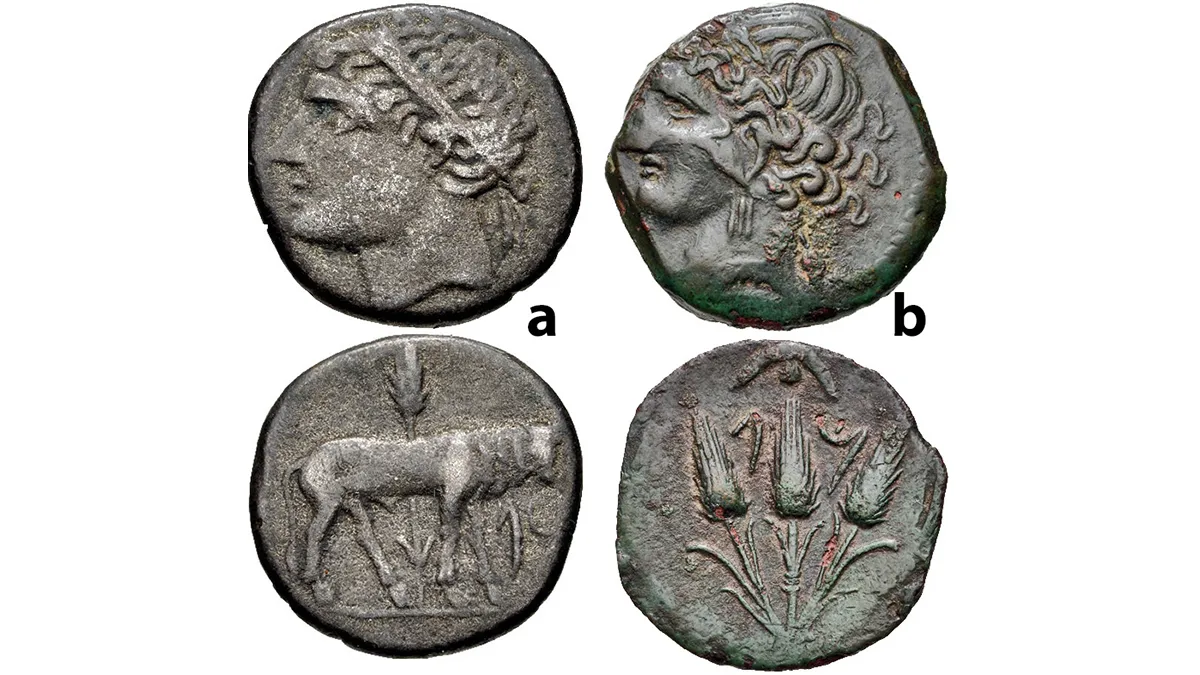
Figure 2 displays two bronze coins, chosen for their historical significance. The first (Figure 2a) is among the oldest coins minted in Sardinia, while the second (Figure 2b) was produced during the First Punic War (264–241 BCE).
Coin 2a features Tanit on the obverse and a horse’s head on the reverse, accompanied by a palm tree and a pellet. Tanit, Carthage’s principal goddess, was revered as a mother goddess, goddess of fertility, and sky goddess. The horse’s head could symbolize Carthage’s formidable cavalry and military might. Alternatively, it might allude to the myth of Dido’s companions discovering a horse’s head at the site Juno designated for Carthage’s founding. A third explanation is that “KAKKABH”—Punic for “horse’s head”—was an ancient name for Carthage. This design was the most prevalent type of Carthaginian coin.
Coin 2b also depicts Tanit on the obverse, with a standing horse on the reverse, a pellet, and the Punic letter “G.” This letter may represent a magistrate or minter. Both coins exhibit excellent artistry, particularly Coin 2a.
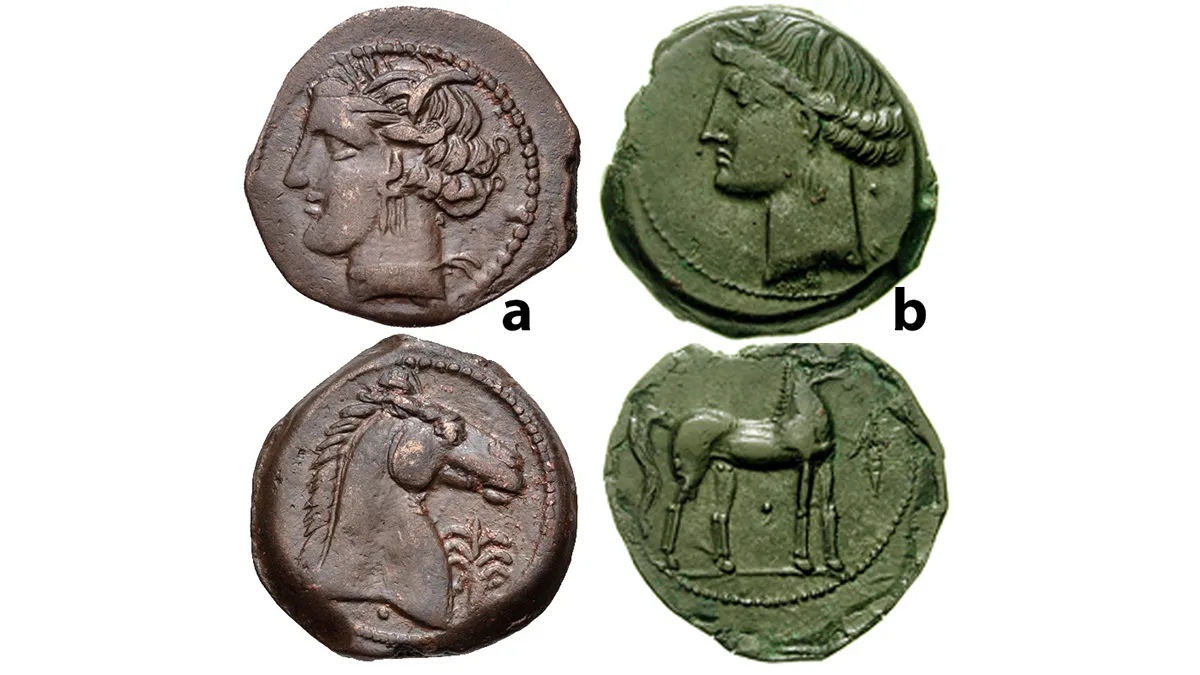
Figure 3 displays two coins minted by the Carthaginians after the First Punic War, during the mercenary revolt.
Coin 3a is a bimetallic stater, composed of copper and silver. Its obverse features a male head, while the reverse shows a standing bull with a grain ear behind it and the Punic letters “MG” to the right. The grain ear symbolizes Sardinia’s grain production, and the bull represents strength, fertility, and power. The “MG” likely refers to a magistrate. An identical coin found elsewhere was attributed to the Second Punic War occupation; therefore, this coin may either have been misattributed or its design revived during that later period (see Figure 4 discussion).
Coin 3b depicts Tanit on the obverse. The reverse features three grain ears and a pellet within a crescent above. The pellet on these coins may indicate the coin’s denomination, similar to its function on Roman Republic coins (see below).
During the Second Punic War (218–201 BCE), the Romans suffered a significant defeat at Cannae in 216 BCE. As a result, the Sardinians revolted and briefly regained control of the island, though this re-occupation lasted less than a year. Surprisingly, some Punic Sardinian coins are attributed to this specific period of the Second Punic War.
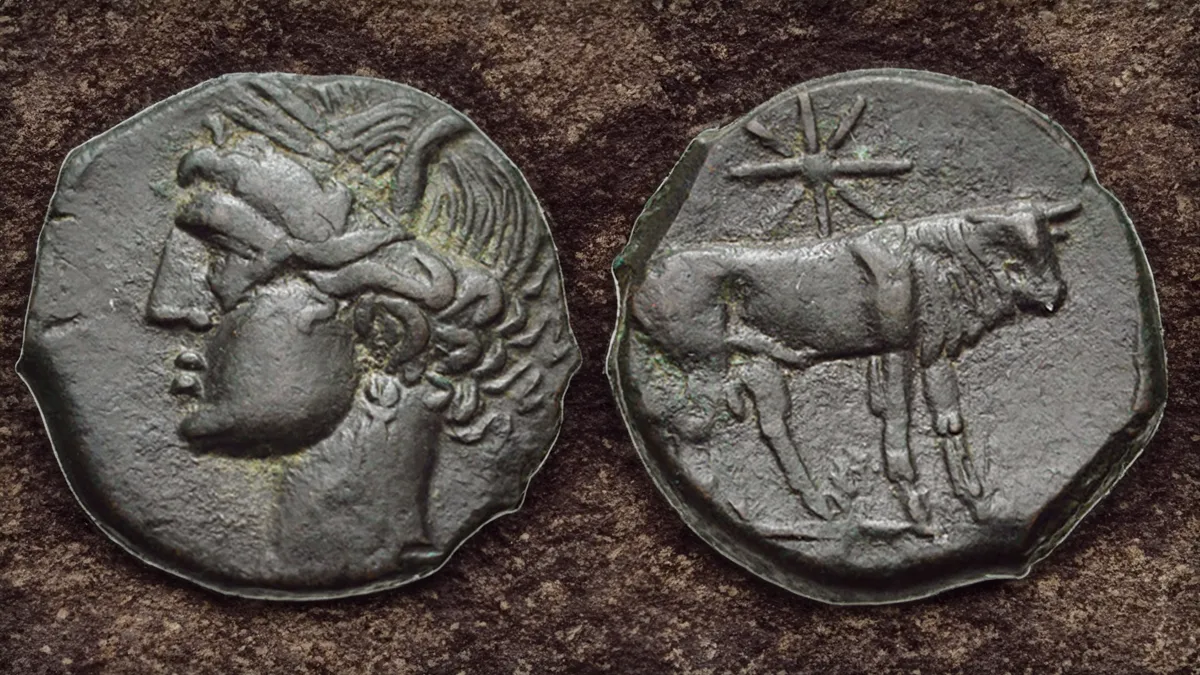
Figure 4 displays the most common coin from this period, and it may have been the only type struck, as another coin I found was suspect. It features Tanit on the obverse and a cow with a star above on the reverse. The star could symbolize eternity, glory, or function as a mintmark. These were the last Carthaginian coins minted in Sardinia.
Roman coins
Information on Sardinian coinage is scarce and often confusing. I have, therefore, synthesized a coherent account of Roman coinage on the island.
The Romans began minting coins on Sardinia after recapturing the island from the rebels, likely around 211 BCE, while the Second Punic War was still ongoing. The mints were probably the same ones previously used by the Carthaginians in Caralis and/or Tharros. Due to the war, the weight of the as was significantly reduced from 324 grams to 54 grams. The bronze as was initially valued at one-tenth of the newly introduced denarius (this ratio was later adjusted to one-sixteenth in the mid-2nd century BCE).
The following fractions of the as were produced on Sardinia: the triens (one-third) weighing 18g, the quadrans (one-quarter) at 13.5g, and the sextans (one-sixth) at 9g. These are illustrated in Figure 4.
Figure 4a displays a coin with the head of Minerva on the obverse, accompanied by four pellets above. The reverse features the prow of a ship with “ROMA” above and four pellets below. Minerva (Athena in Greek religion) was a prominent Roman goddess. The ship’s prow symbolizes Rome’s naval dominance after defeating Carthage. The four pellets indicate the coin’s value as one-third of an as.
Figure 4b features the head of Hercules on the obverse with three pellets, and the same reverse design but with only three pellets below. The number of pellets signifies that this coin is a quadrans, or one-quarter of an as.
Finally, Figure 4c shows the head of Mercury on the obverse with two pellets above, and the same reverse design with two pellets below, indicating it is a sextans, worth one-sixth of an as.
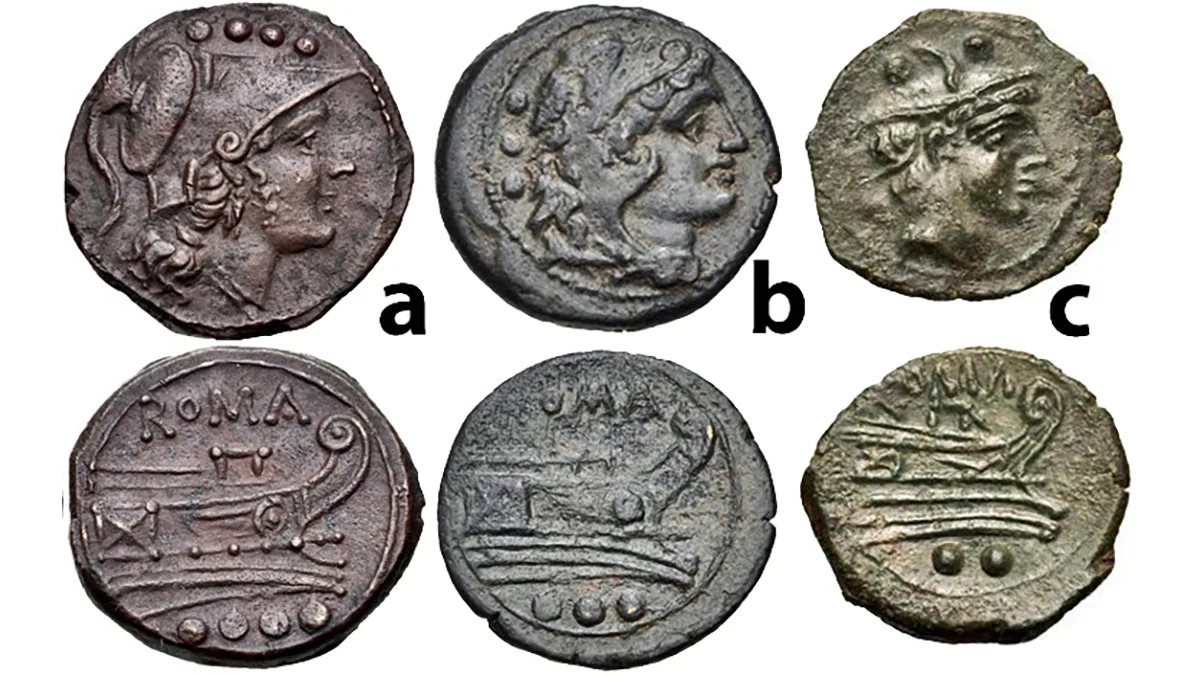
One unusual characteristic of Roman coins minted in Sardinia is their frequent underweight status, as shown in Figure 4. This is believed to be due to Roman minters utilizing a surplus of bronze planchets (blank coins) and/or Punic coins left over from the Carthaginian occupation. By overstriking these existing coins, the minters often produced coins lighter than the required denominations.
As far as I could determine, Rome ceased using Sardinia as an imperial mint early in the 2nd century BCE, as I found no later examples. However, I did locate some rather unappealing Roman colonial coins from the mid-1st century BCE that have been attributed to Sulcis, Caralis, and Uselis (an Augustan colony established in the island’s interior).
Comments
Carthaginian coins minted in Sardinia do not appear particularly rare or expensive, though their authenticity can sometimes be questionable (as seen in Figure 3a). However, Roman coins present challenges regarding their attribution to Sardinia, often ascribed to southern Italy or Sicily instead. While their lighter weight might suggest a Sardinian origin, even this indicator is disputed by some experts.