


By Mike Markowitz for CoinWeek …..
THE DREAM OF flight has always held a powerful grip on the human imagination. Pegasus, the flying horse of Greek mythology, symbolizes that dream, and this winged white stallion appears on many ancient coins. A recent search for the term “Pegasus” in the CoinArchivesPro database (which documents over 2 million auction records over the past 2 decades) produced 25,155 hits! There are hundreds of different types, extending over eight centuries. In what follows, I describe a selection that I hope will be most interesting to CoinWeek readers.
Earliest Pegasus
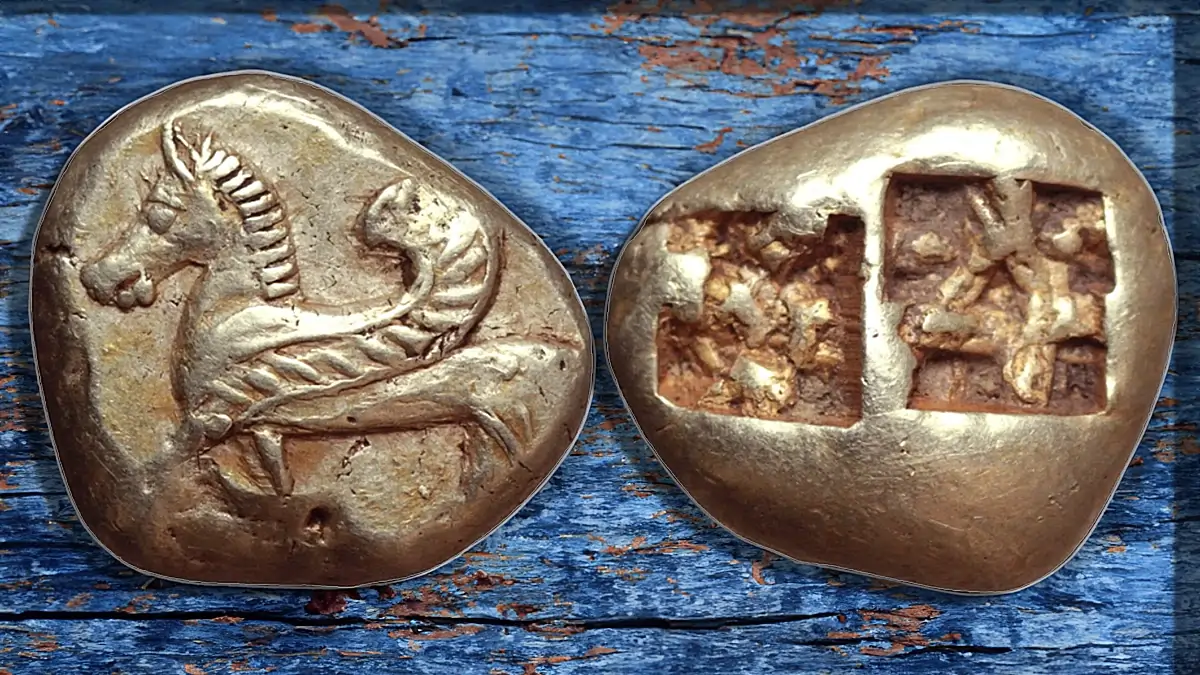
The first reference to Pegasus in literature is Hesiod’s Theogony, dated to the late eighth or early seventh century BCE. The magical flying horse and his brother Chrysaor, a flying boar, were born from the blood of the monster Medusa when the hero Perseus cut off her head:
Pegasus flew away, leaving the earth that feeds the sheep, and joined the gods; now he lives in the halls of Zeus and carries the thunder and lightning bolts for the almighty lord of wisdom (Brown, 61)[1].
Pegasus appears at the very dawn of ancient coinage on an electrum trite (one-third stater, 4.75 grams) from an uncertain mint in Ionia on the eastern shore of the Aegean Sea. A cataloguer explains:
Pegasos is here shown with the characteristic curved wings of his depictions in the archaic period. In mainland Greece, the transition from curved to straight wings on earthenware appears to have started around the middle of the sixth century, and on coinage from the start of the fourth century, though curved wing depictions persisted in deliberately archaized forms until much later[2].
Archaic Corinth
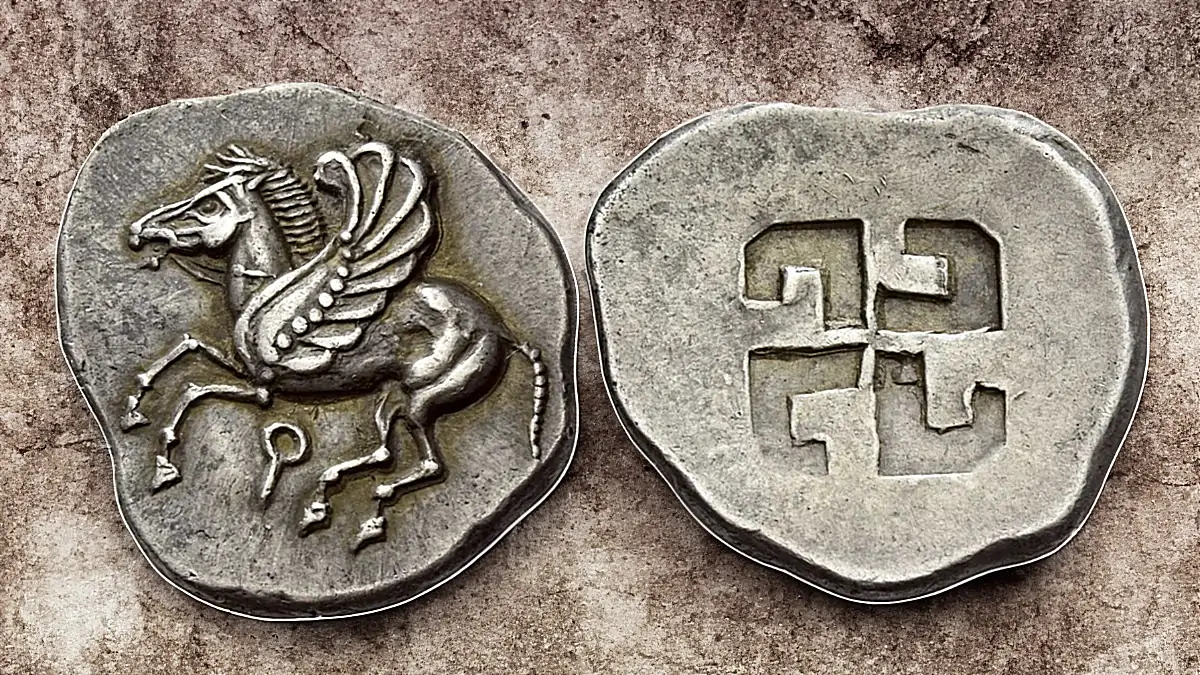
Strategically located at the narrow isthmus joining the Peloponessus to mainland Greece, Corinth[3] grew prosperous on trade. The earliest coinage of Corinth adopted Pegasus as the city’s emblem, and this continued for centuries. The coins usually bear the obsolete letter qoppa (Ϙ), which was the initial of Corinth’s Greek name. The silver stater or didrachm of Corinth weighed exactly half as much as the Athenian tetradrachm and the two coinages circulated together. The coins were nicknamed πωλοι (poloi, meaning “colts”). A magnificent example dated to c. 550-500 BCE brought over $85,000 in a recent European auction[4]. The prolific Corinthians planted many colonies throughout the Mediterranean, and most of these cities put Pegasus on their coins as a token of connection to the mother city.
Cyzicus
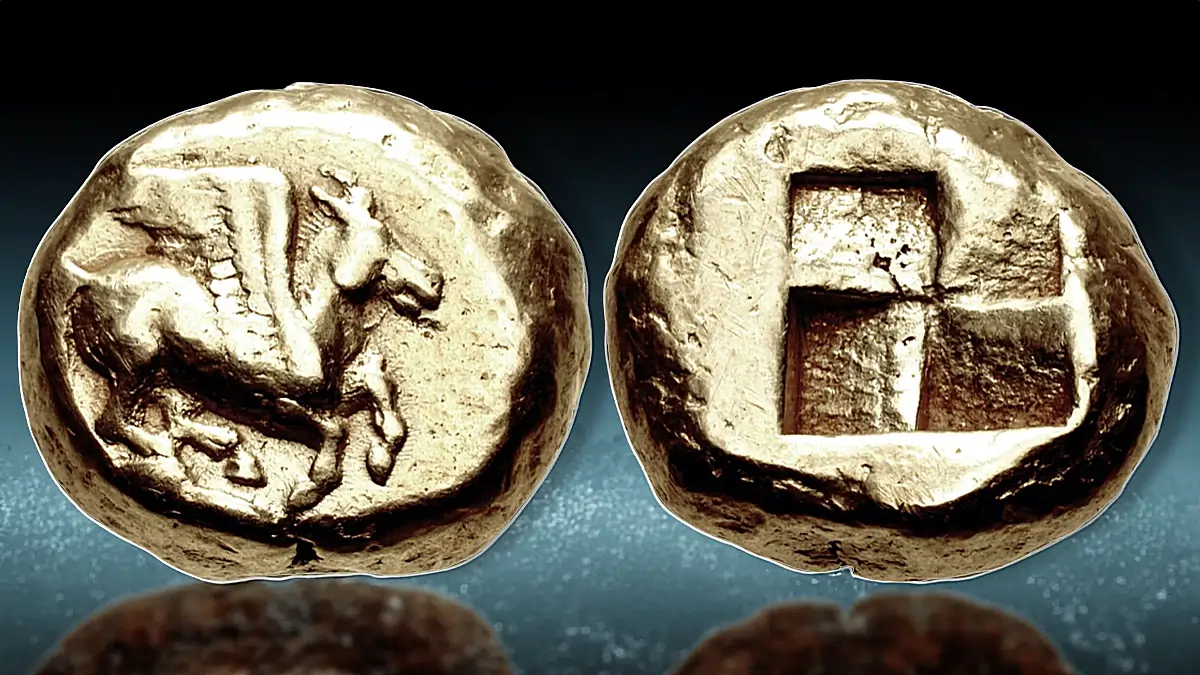
The city of Cyzicus[5] (or Kyzikos) issued coins in electrum (an alloy of gold and silver) long after most other Greeks had switched to pure silver and pure gold. The city’s emblem was a tuna fish, which sometimes falls off the edge of poorly centered coins. The designs changed every year, so there is a tremendous variety of types. Pegasus adorns a crudely struck archaic Cyzicene stater[6], c. 450-330 BCE.
Kelenderis
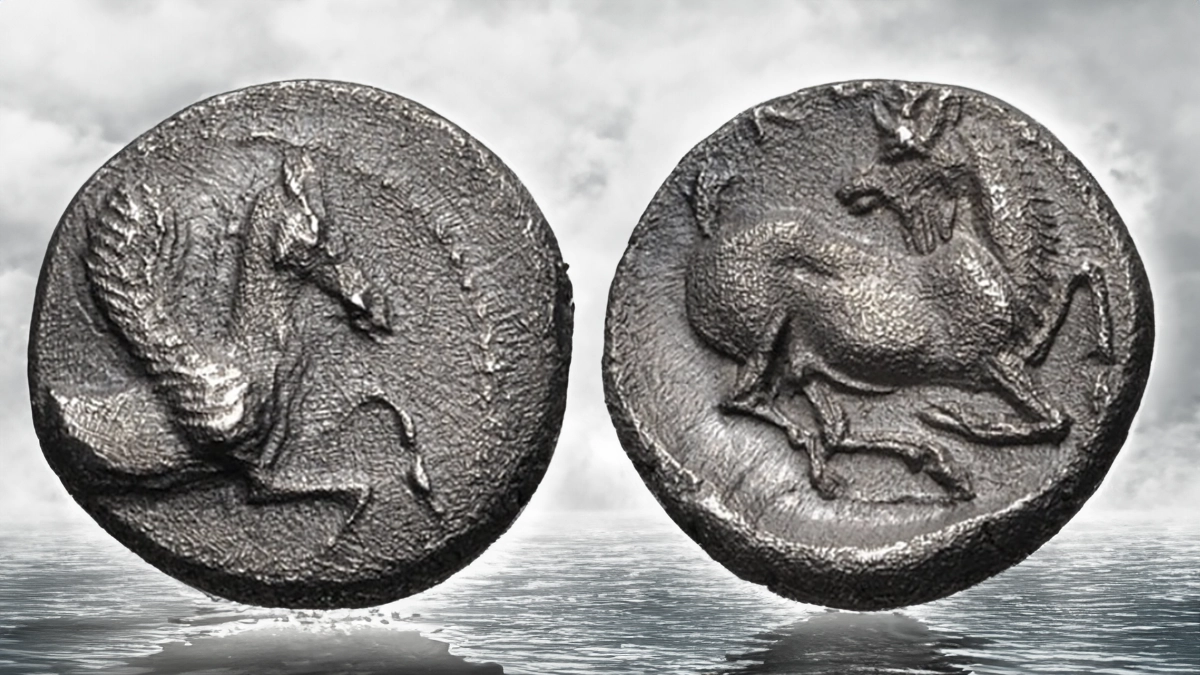
The town of Kelenderis (today Aydıncık, Türkiye) had one of the best ports on the southern coast of Anatolia. On an extensive silver coinage beginning in the fifth century BCE, the city emblem was a billy goat turning his head to look backward. The front half (“protome”) of Pegasus often decorates the obverse of small denominations.
At first, I was baffled by the frequent appearance of only half the flying horse until I saw the star chart for the constellation of Pegasus[7], which represents only the front of the creature. In Greek mythology, Zeus placed Pegasus among the stars to reward his courage.
Tarsus
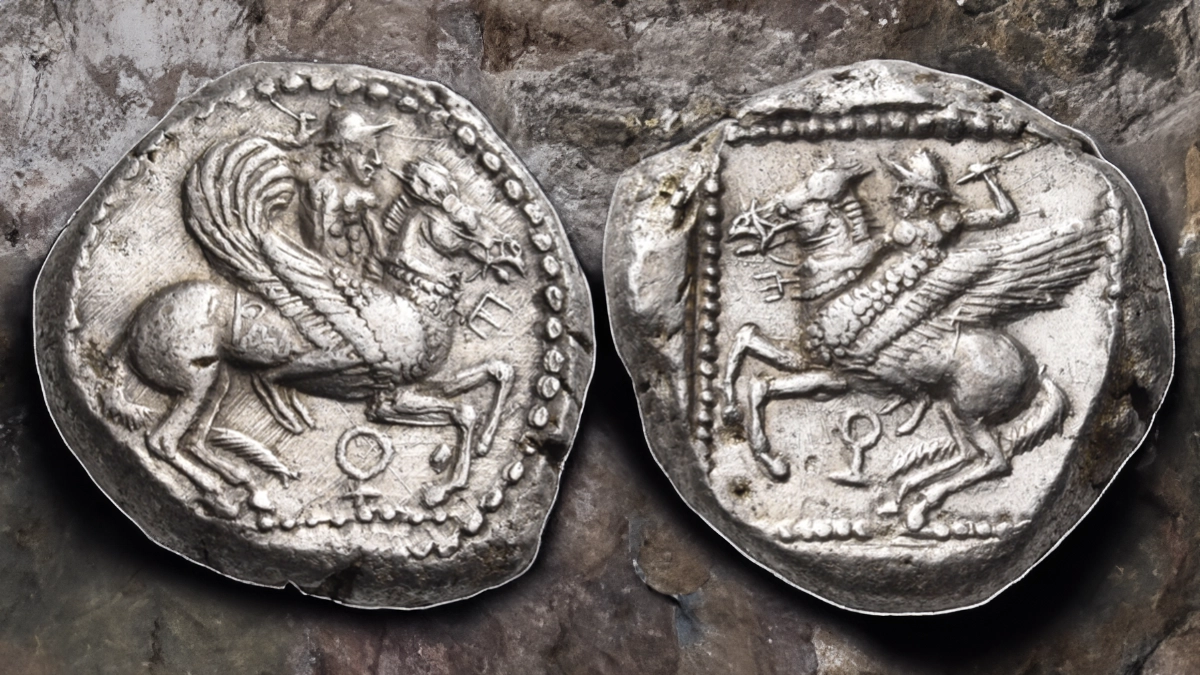
In mythology, the hero Bellerophon rode Pegasus to defeat the monstrous Chimera (Khimaira). Flying horse and rider appear on both sides of a remarkable silver stater of Tarsus dated to c. 425-400 BCE. Of this coin, of which only three examples are known[8], a cataloguer wrote:
The myths tell us that as Bellerophon’s fame grew, so did his hubris. He felt that because of his victory over the Chimera, and because he thought he was a god he deserved to fly to Mount Olympus, the realm of the gods. This presumption angered Zeus and he sent a gadfly to sting Bellerophon’s mount, Pegasos, causing Pegasos to accidentally throw Bellerophon to the ground. The story as it pertains to Tarsos is that it was on the site of the future city that Bellerophon landed, hurting his foot, thus leading the city to be named tar-sos (the sole of the foot)[9].
Leukas
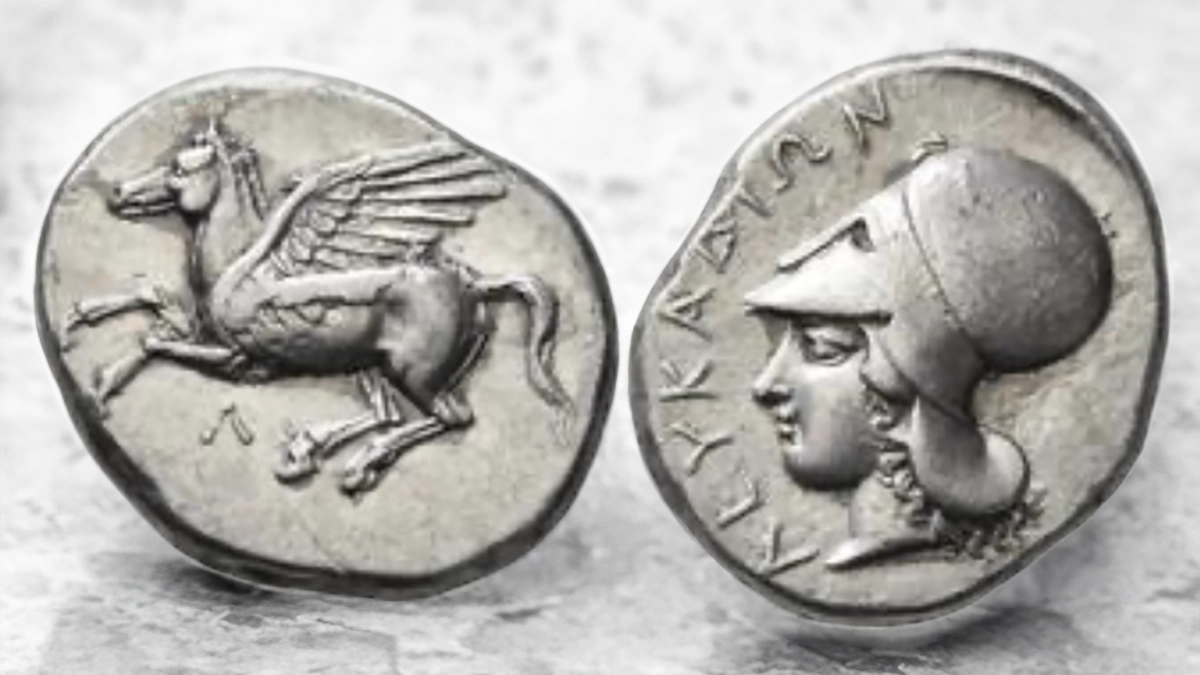
After Corinth itself, Leukas was the most prolific mint for Pegasos staters (Sear 1978, 215).
Leukas (now Lefkada, an island on the western coast of Greece) was a colony of Corinth. A silver stater “of lovely late Classical style,”[10] dated to c. 375-350 BCE, bears an elegant Pegasus flying to the left, above the Greek letter lambda (Λ) to indicate the city’s name.
Lampsakos
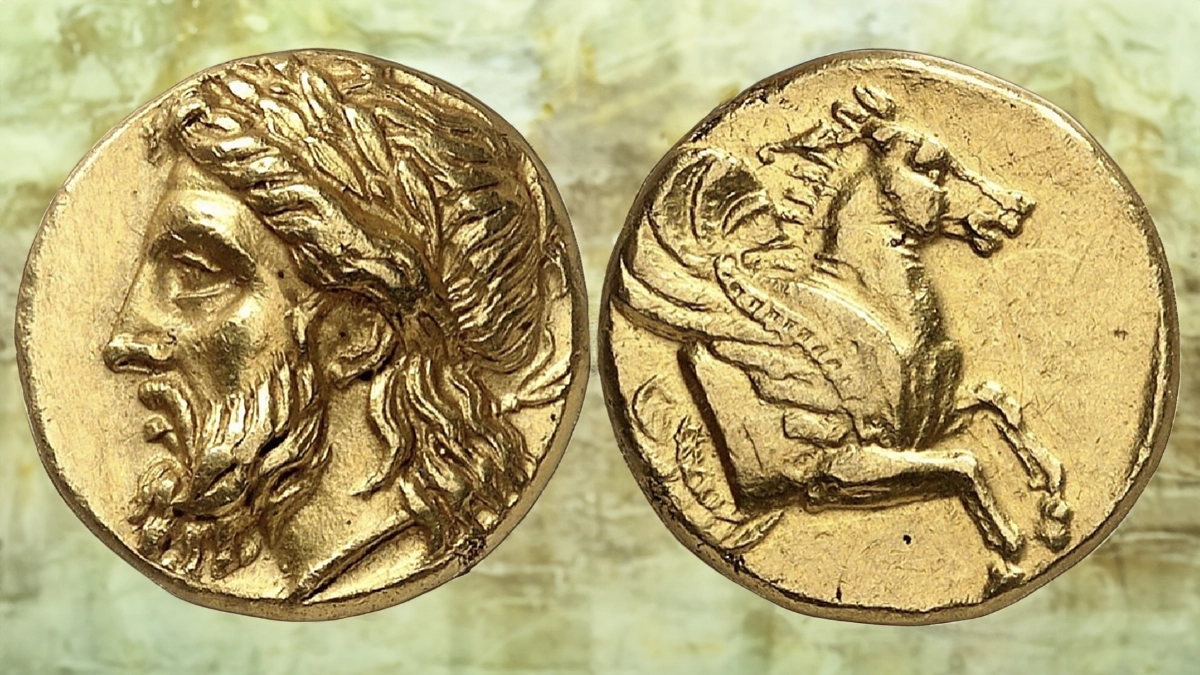
Located on the Hellespont (the narrow strait separating Asia Minor from Europe), Lampsakos[11] grew to be a major city with a substantial gold coinage. Lampsakos adopted the forepart of Pegasus as its emblem. A magnificent gold stater[12] dated to c. 350 BCE realized over $262,000 in a recent European auction — possibly a record price for any Pegasus coin.
Carthage
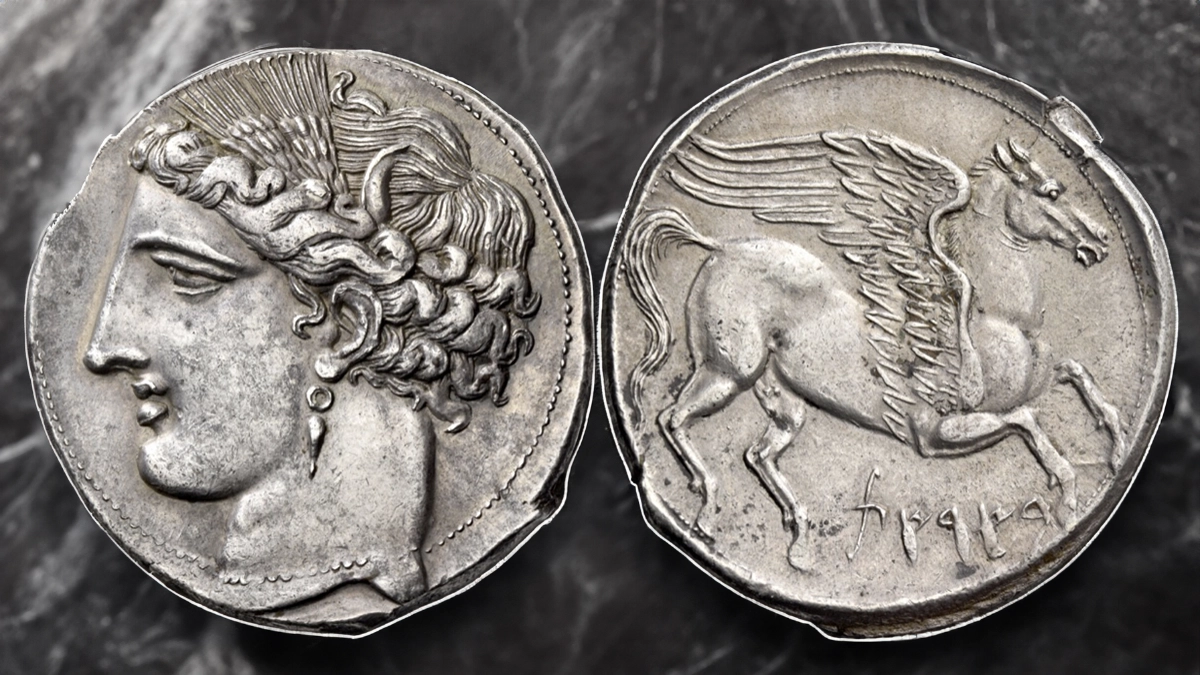
One of the largest and heaviest ancient coins depicting Pegasus is a silver dekadrachm (or “five-shekel piece”) of 38 grams (more than the 31-gram troy ounce!) issued by the Carthaginians in Sicily, probably to pay mercenaries during the First Punic War. The cryptic Punic inscription is b’rst (“in the land”). This muscular Pegasus may be copied from a stater of Agathocles, King of Syracuse (317-289 BCE).
An example described as “rare and possibly the finest specimen in private hands of this desirable and prestigious issue” brought over $157,000 in a 2019 European auction[13].
Syracuse
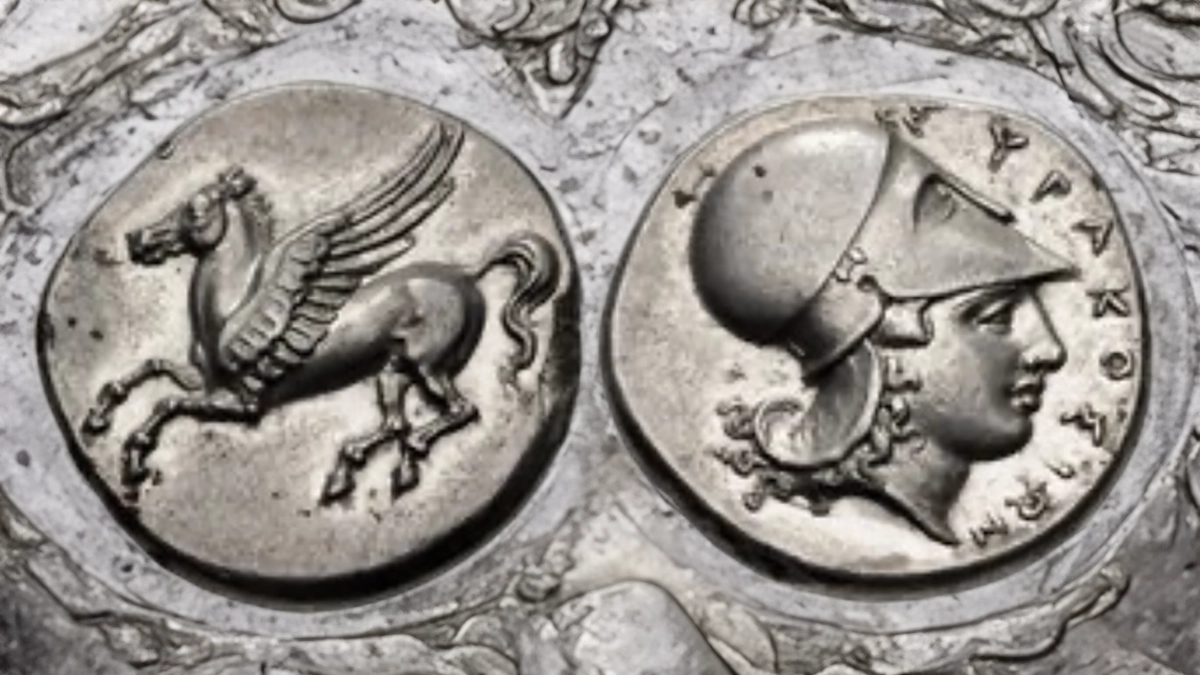
Founded as a colony of Corinth circa 734 BCE, Syracuse became the most important Greek city of Sicily thanks to its fertile hinterland, magnificent natural harbor, and reliable spring of fresh water. The turbulent political history of Syracuse saw alternating periods of monarchy, tyranny, and democracy. A Corinthian aristocrat, Timoleon[14] (c. 411-337 BCE), restored limited democratic rule at Syracuse. Silver staters of this period (the “Third Democracy”) follow the Corinthian weight standard (~8.6 grams) and design, with the city name spelled out around the helmeted head of Athena on the reverse[15].
Alabanda
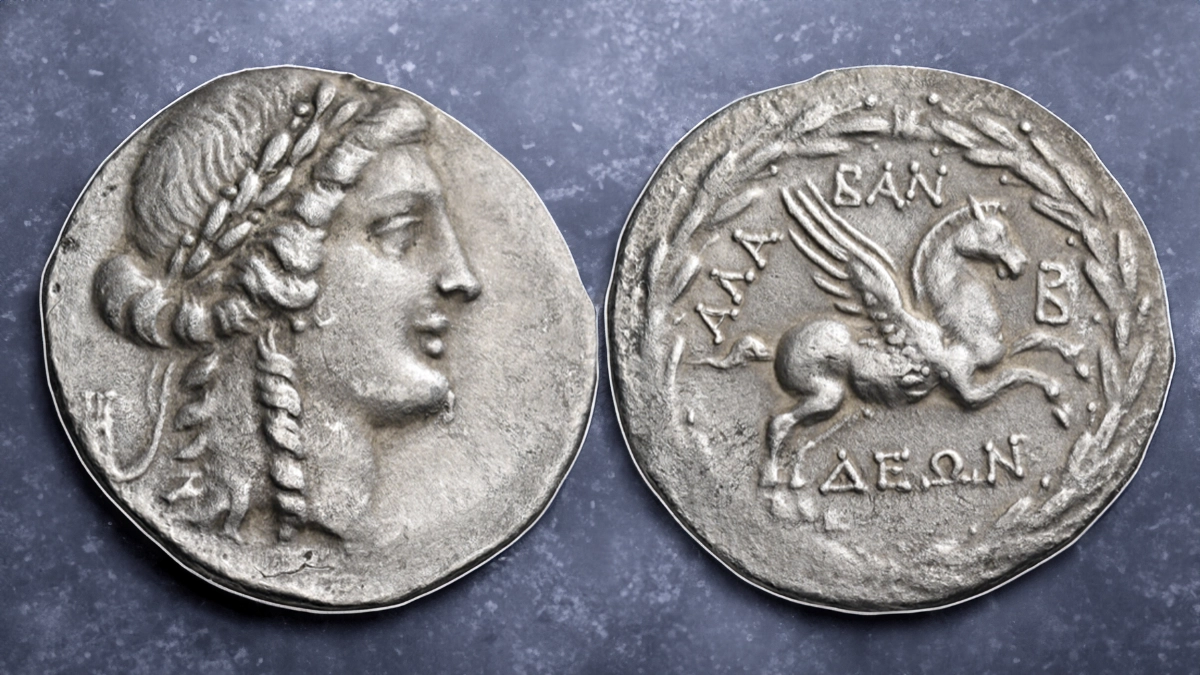
Alabanda was a prosperous place, with a population reputed to be one of the most dissolute in the whole of Asia Minor (Sear 1979, 435).
A town in the province of Caria, Alabanda issued handsome silver tridrachms (a three-drachma piece of 11-12 grams) in the second century BCE. These bear the head of Apollo on the obverse and Pegasus within a laurel wreath on the reverse[16].
Mithradates
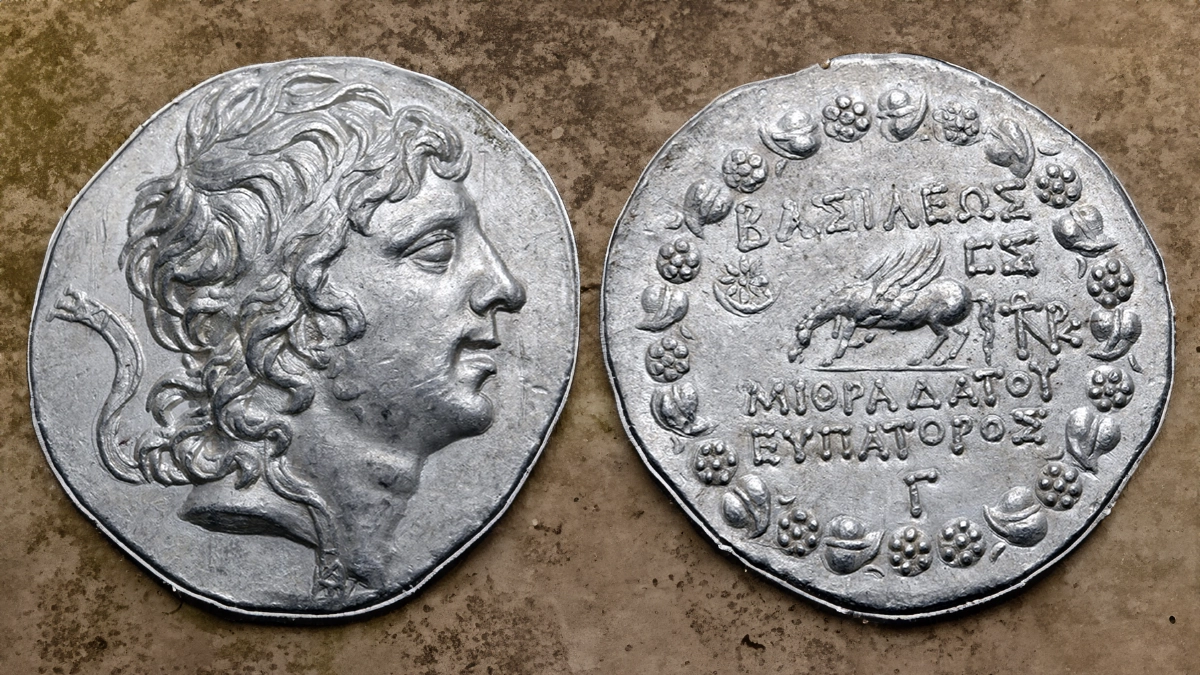
Like Hannibal a hundred years before he tried valiantly to stem the relentless advance of Roman power. But after three wars he was eventually defeated by Pompey the Great and later committed suicide, in his sixty-ninth year (Sear 1979, 680).
Mithradates VI “the Great”, King of Pontus (120 – 63 BCE), was one of Rome’s most determined enemies. He carved out an extensive empire in Asia Minor, issuing handsome gold staters and silver tetradrachms bearing his portrait, with a variety of animals on the reverse. The coin image of Pegasus appears to be kneeling as if to drink[17]. One of the magical powers ascribed to Pegasus is that springs of fresh water would emerge from the ground where his hoof struck.
Aes Grave
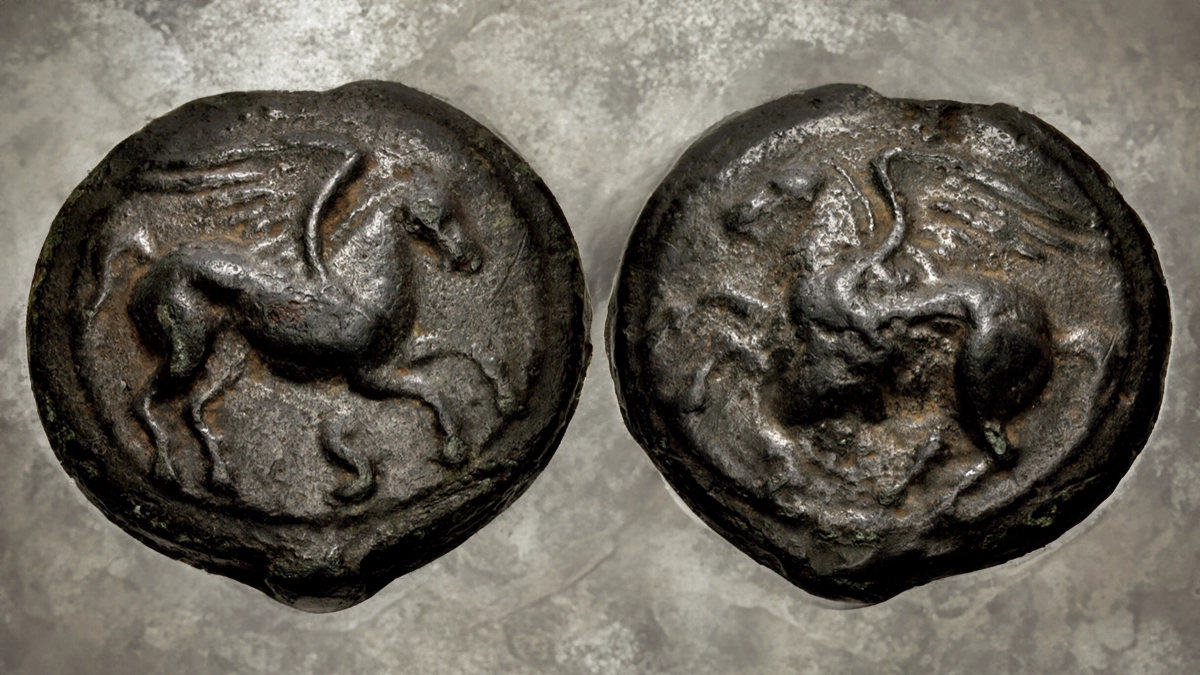
Like so many things Rome borrowed from the Greeks, Pegasus makes an appearance very early in the history of Roman coinage. Lacking a domestic supply of silver, in the third century BCE Rome experimented with enormous cast coins known to numismatists as aes grave (Latin for “heavy bronze”). Pegasus appears on both sides of a semis coin, weighing one-half of the 12-ounce Roman pound, dated to c. 270 BCE[18].
Quintus Titius Mutto
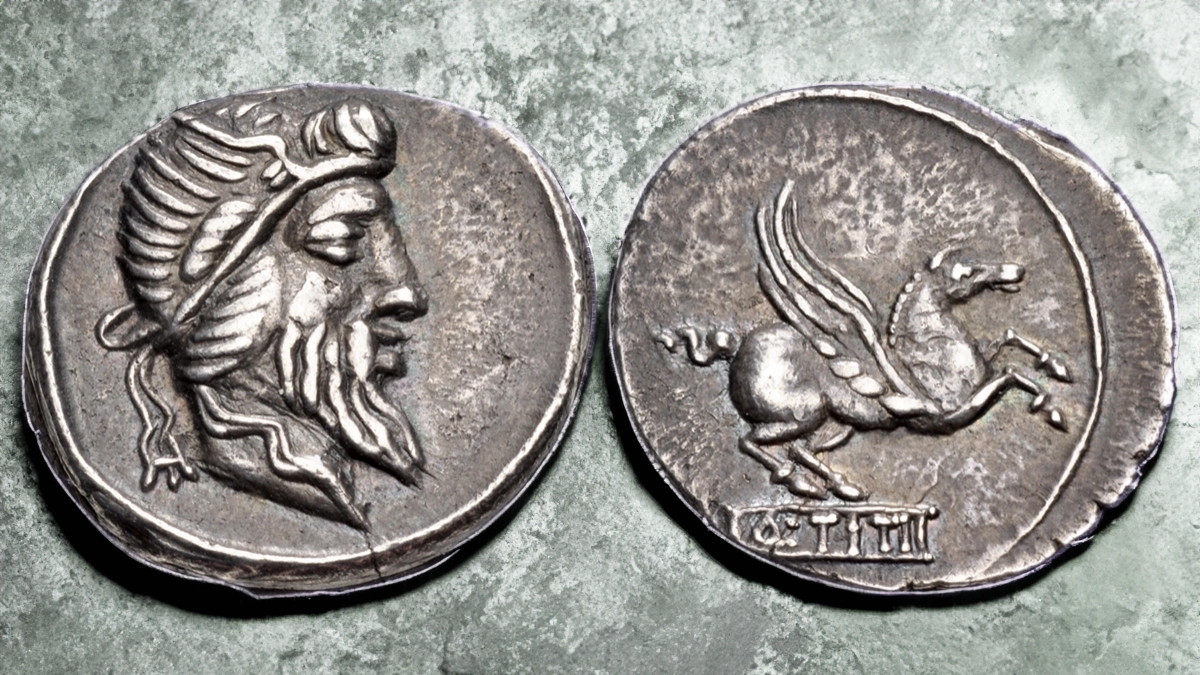
Like many Roman mint officials[19], Quintus Titius Mutto is known to history only from the fairly common denarius issued in 90 BCE that bears his name. The obverse bears the head of Mutinus Titinus[20], an obscure Roman sex god, possibly a sly pun on the official’s name. The reverse shows Pegasus leaping into flight with gracefully upswept wings[21].
Lucius Cossutius
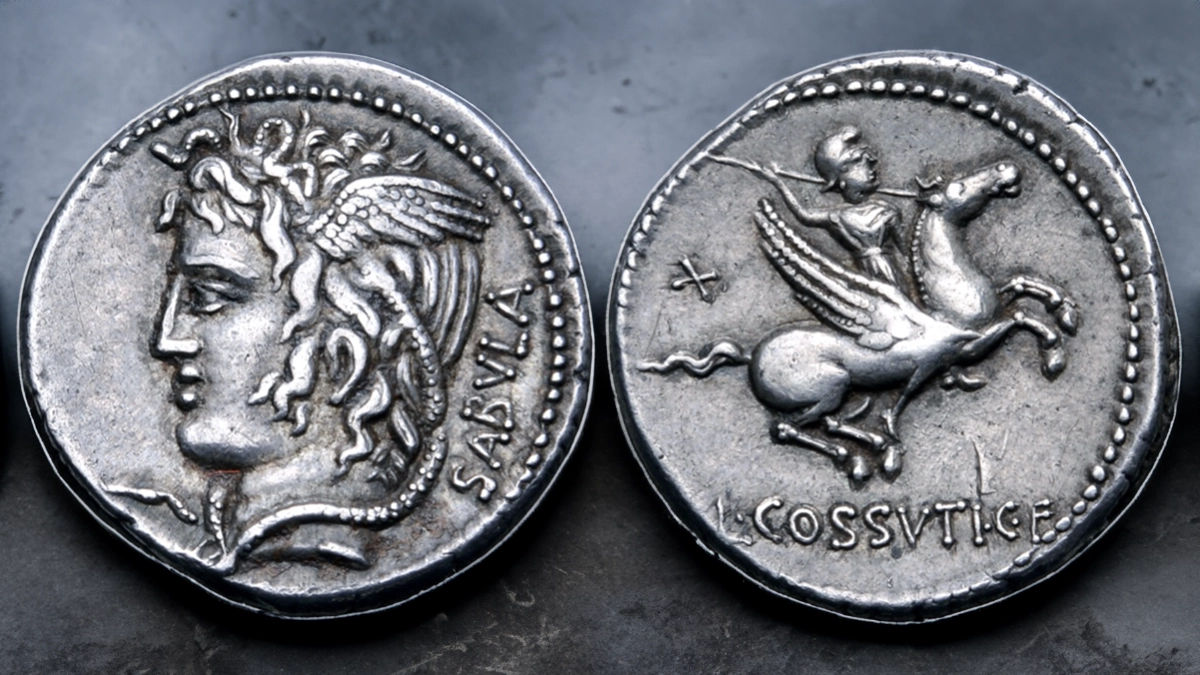
Lucius Cossutius was a mint official of the Roman Republic in 74 BCE. His denarius bears an elegant head of Medusa on the obverse and Bellerophon riding Pegasus and hurling a spear on the reverse. An outstanding example of this coin brought nearly $15,000 in a recent London auction[22].
Augustus
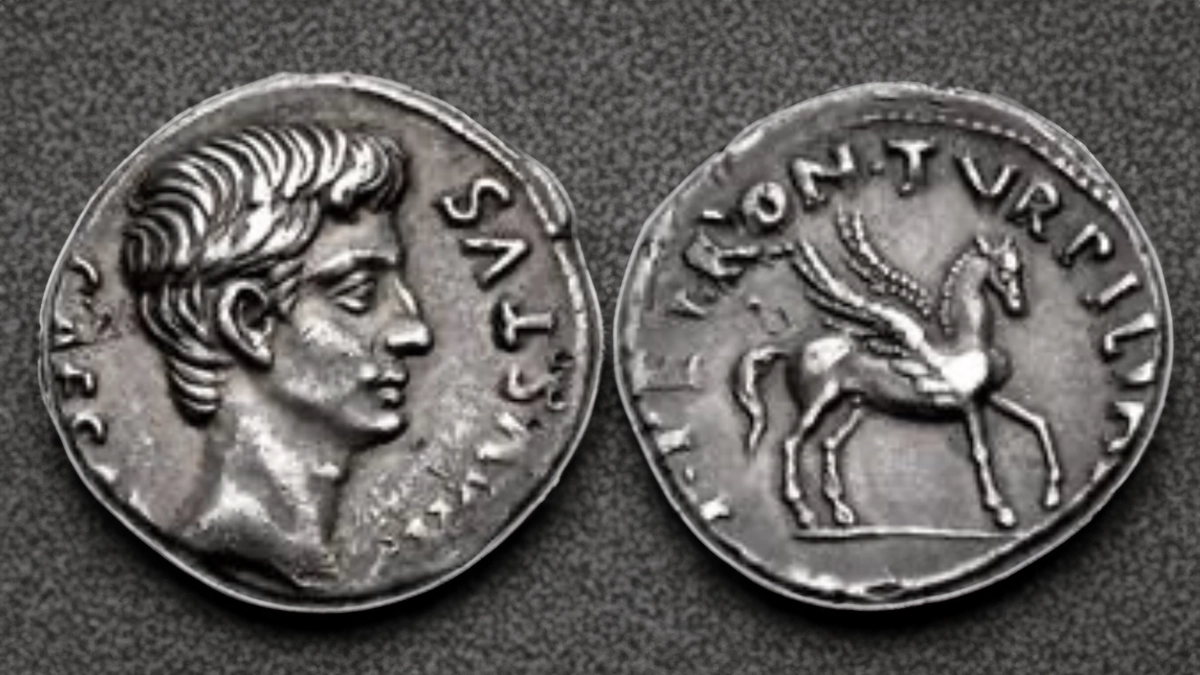
A delicate Pegasus with rather spindly legs stands on a ground line on the reverse of a Rome mint denarius of the emperor Augustus dated 19/18 BCE[23]. The responsible mint official, Publius Petronius Turpilianus, came from a distinguished Senatorial family[24], that produced several provincial governors and consuls in later years.
Domitian
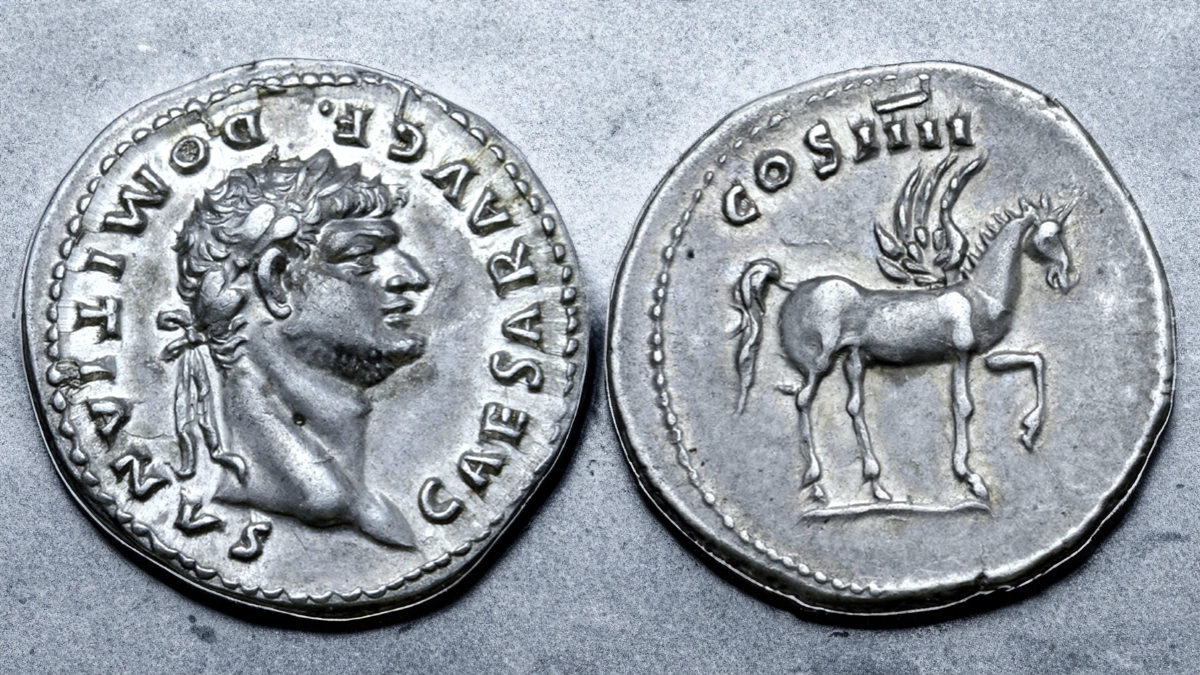
Born in 51 CE, Domitian was the younger son of the emperor Vespasian. He was given the honorary title of “Caesar” in 69 and became emperor on the death of his elder brother Titus in 81. One of the most common Roman imperial coins depicting Pegasus is this issue of Domitian as Caesar (junior co-emperor) dated to 76/77 CE. An exceptional example realized nearly $1,000 in a 2019 London auction[25].
Since horses are not designed for flight, ancient artists were unsure about how to attach eagle wings to Pegasus. Sometimes the wings spring from the chest (the muscles that power birds’ wings are anchored to the “keel” or breast bone), but other times they are rather impractically tacked onto the animal’s back, as on this coin.
Gallienus
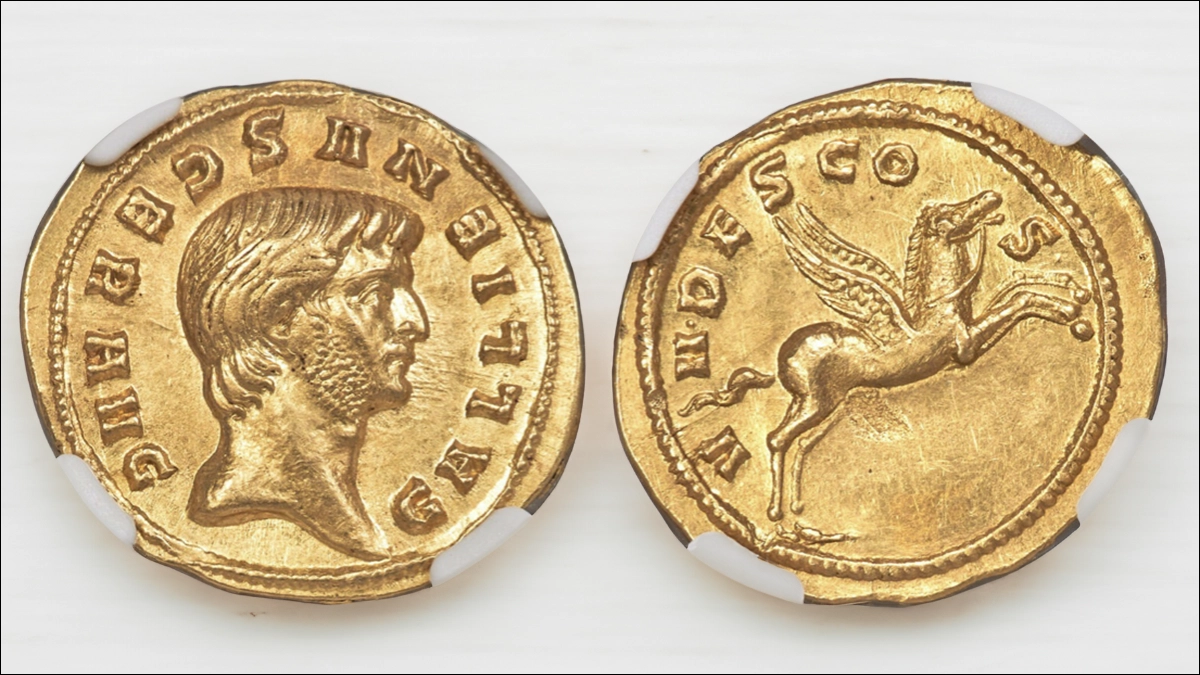
The last appearance of Pegasus on an ancient Roman coin may be this rare gold aureus[26] of the emperor Gallienus (reigned 253-268 CE) dated to his seventh consulship in 264/265. At least four different Roman legions adopted Pegasus as their emblems, and one of these, Legion II Adiutrix, was a favorite of Gallienus.
Cellini
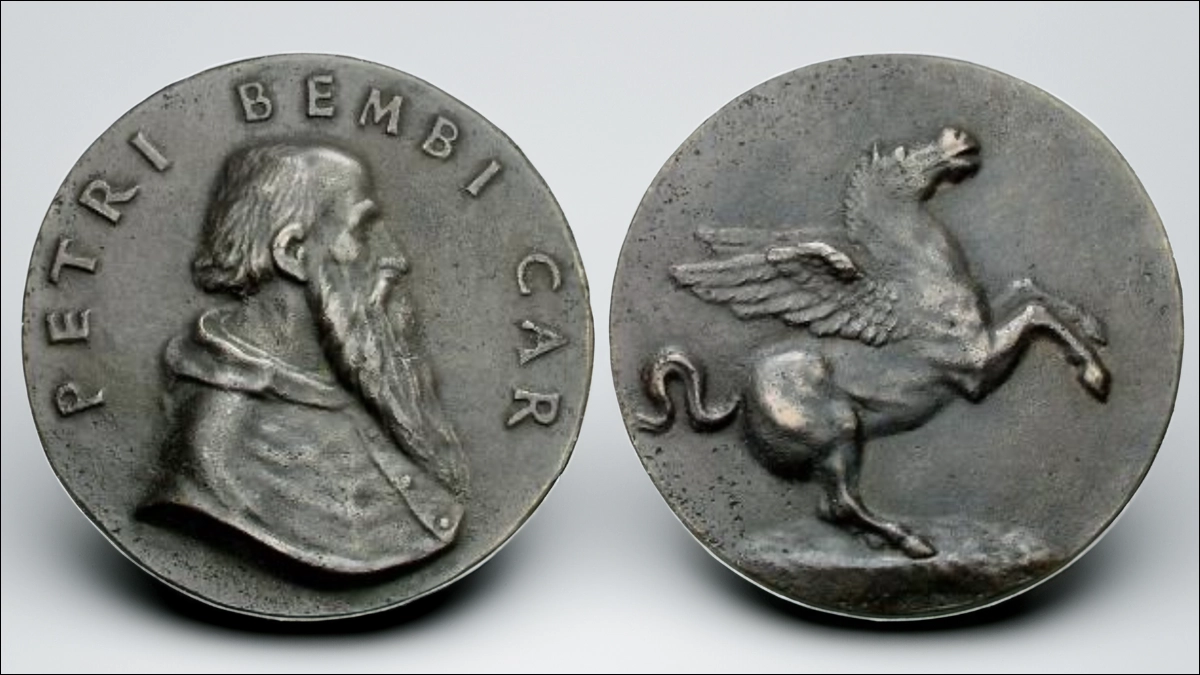
As an animal companion of the Muses, Pegasus became a popular symbol for poets and poetry[27]. When the Italian Renaissance poet Cardinal Pietro Bembo (1470-1547) commissioned famous goldsmith Benvenuto Cellini to create his portrait medallion[28], a magnificent classic Pegasus featured prominently on the reverse. Renaissance celebrities handed out these medallions to friends as keepsakes. When the Italian province of Tuscany (Toscana) created its modern flag[29], Cellini’s Pegasus was chosen for the design.
* * *
Pegasus on Ancient Coins: Notes
[1] The brilliant classical scholar Norman O. Brown, who translated Hesiod, was one of my teachers at the University of Rochester, NY.
[2] Roma Numismatics Auction 8, September 28, 2014, Lot 518. Realized £9,000 (about $14,620 USD; estimate £7,500).
[3] https://en.wikipedia.org/wiki/Ancient_Corinth
[4] NAC Auction 116, October 1, 2019, Lot 143. Realized CHF 85,000 (about $85,222 USD; estimate CHF 60,000).
[5] https://en.wikipedia.org/wiki/Cyzicus
[6] CNG Triton XXIV January 19, 2021, Lot 637. Realized $4,250 USD (estimate $3,000).
[7] https://en.wikipedia.org/wiki/Pegasus_(constellation)
[8] Nomos Auction 18, May 5, 2019, Lot 203. Realized CHF 20,000 (about $19,623 USD; estimate CHF 6,000).
[9] Roma Numismatics Auction XVI, September 26, 2018, Lot 331. Realized £4,200 (about $5,528 USD; estimate £5,000).
[10] Leu Web Auction 20, July 16, 2022, Lot 694. Realized CHF 5,100 (about $5,210 USD; estimate CHF 150).
[11] https://en.wikipedia.org/wiki/Lampsacus
[12] Maison Palombo Auction 20, January 22, 2022, Lot 16. Realized CHF 240,000 (about $262,467 USD; estimate CHF 100,000).
[13] NAC Auction 114, May 6, 2019, Lot 109. Realized CHF 160,000 (about $157,217 USD).
[14] https://en.wikipedia.org/wiki/Timoleon
[15] CNG Auction 120, May 11, 2022, Lot 74. Realized $6,000 USD (estimate $2,000).
[16] Nomos Auction 21, November 21, 2020, Lot 200. Realized CHF 2,800 (about $3,069 USD; estimate CHF 750).
[17] Roma Numismatics Auction XXIII, March 24, 2002, Lot 254. Realized £3,000 (about $3,955 USD; estimate £3,000).
[18] CNG Auction 112, September 11, 2019, Lot 468. Realized $2,100 USD (estimate $1,000).
[19] https://en.wikipedia.org/wiki/Triumvir_monetalis
[20] https://en.wikipedia.org/wiki/Mutunus_Tutunus
[21] CNG E-Auction 507, January 5, 2022, Lot 412. Realized $900 USD (estimate $300).
[22] Roma Numismatics Auction XXII, October 7, 2021 Lot 601. Realized £11,000 (about $14,984 USD; estimate: £3,000).
[23] CNG Auction 115, September 16, 2020, Lot 613. Realized $1,100 USD (estimate $750).
[24] https://en.wikipedia.org/wiki/Petronia_gens
[25] Roma Numismatics Auction XVIII, September 29, 2019, Lot 1127. Realized £800 (about $987 USD; estimate £1,000).
[26] Heritage Sale 3904, August 19, 2021, Lot 33098. Realized $13,500 USD (estimate $8,000-$10,000).
[27] The magazine Poetry uses an icon of Pegasus as its logo.
[28] Astarte Auction XIX, May 6, 2006. Realized CHF 650 (about $531 USD; estimate CHF 500).
[29] https://en.wikipedia.org/wiki/Flag_of_Tuscany
References
Brown, Norman O. (translator). Hesiod: Theogony. Indianapolis (1953)
Cammann, Jean B. Numismatic Mythology. New York (1936)
Kraay, Colin. Archaic and Classical Greek Coins. New York (1976 reprint)
Sear, David. Greek Coins and Their Values. Vol 1: Europe. London (1978)
–. Greek Coins and Their Values. Vol 2: Asia & Africa. London (1979)
–. Roman Coins and Their Values, Vol 1: The Republic and the Twelve Caesars. London (2000)
Seltman, Charles. Greek Coins. London (1955)
Stevenson, Seth W. A Dictionary of Roman Coins. London (1964 reprint of 1889 edition)
* * *






Well researched article. Beautiful examples of the coinage presented for the cities/kingdoms for visual consideration. Enjoyed the read! Keep up the good work.
Very nice article. I enjoy reading it
The coins, especially the Greek ones, are beautiful. Nice article!
Really interesting read
What an interesting article with so many different representations of Pegasus. I had not heard before about the representation by Kelenderis and others showing the front half of Pegasus as it is represented by the constellation.