


By Mike Markowitz
A Remote Outpost at the Edge of Empire
At the far margins of the Byzantine world, the town of Cherson [1] (near modern Sevastopol, in Crimea on the Black Sea) quietly served the empire in ways few citizens of Constantinople ever considered.
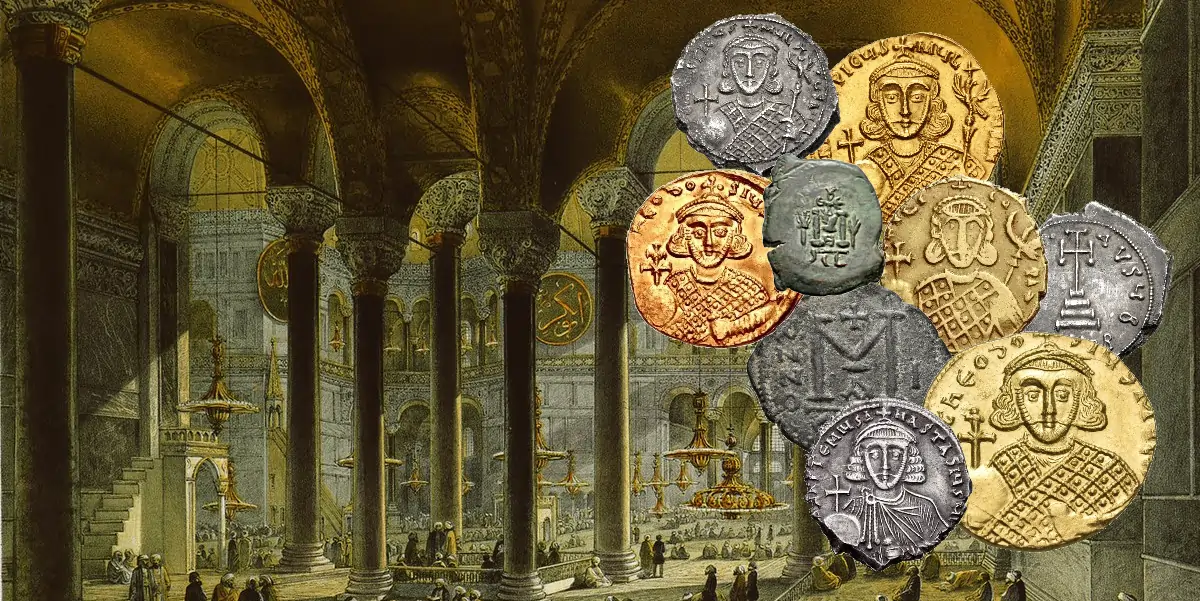
It functioned as an early-warning station against the shifting tribal powers of the Eurasian steppe. At the same time, it doubled as a place of exile, where disgraced emperors and political enemies could be removed from sight but not entirely from memory.
In the year 711, however, Cherson suddenly found itself at the center of imperial drama during a violent interval that some historians call the “Twenty Years’ Anarchy” [2].
Remarkably, the imperial coinage of this chaotic era preserves a detailed and often chilling record of those events through Byzantine coins.
Justinian II: Deposed, Mutilated, and Banished
In 695, the tyrannical emperor Justinian II fell in a palace coup [3]. His enemies mutilated his nose, since Roman tradition held that physical disfigurement rendered a man unfit to rule.
At the time, mutilation was considered more merciful than execution. Accordingly, Justinian went into exile at Cherson. There he waited, plotted, and patiently prepared his return. According to one account, an itinerant surgeon repaired his injury. Another version claims that he wore a golden prosthetic nose instead.
Eventually, Justinian secured an alliance with the powerful Khazars by marrying the khan’s sister, who bore him a son. Later, he escaped from Cherson with a small band of followers in a boat scarcely suited for the open sea. After surviving a violent storm, he landed on the Bulgarian coast. There, he gained the support of Tervel, the Bulgar khan.
By slipping into Constantinople through an abandoned aqueduct tunnel, Justinian seized control of the capital in August 705.
Terror Restored
Once restored to power, Justinian unleashed six years of ruthless vengeance. He executed anyone who had ever offended him. In particular, he harbored a deep hatred for Cherson and ordered an expedition to destroy the city that had once confined him.
Bardanes Rebrands Himself as Philippikos
Bardanes was born at an unknown date into an elite family that may, or may not, have been of Armenian ancestry. Historians still debate the matter. “Vardanes” is a Persian name, while “Vardan” remains a common Armenian personal name.
Around 702, during the reign of the usurper Tiberius II Apsimar, Bardanes became entangled in court intrigue and suffered exile on the island of Kephallenia. When Justinian II returned to power, he recalled Bardanes and placed him in command of the punitive expedition against Cherson. Nevertheless, Bardanes had no intention of carrying out the emperor’s orders.
“He seems to have been an easy-going popular officer with a reputation for mildness. He was a Monothelete heretic, but this apparently did not bother anyone at the time. Assuming the properly classical name Philippikos, which he felt more suited to the dignity of the Empire than the Armenian Vardan, he was proclaimed basileus [emperor].” , Head (1972) page 146
Theology, Heresy, and Imperial Politics
Throughout their history, Byzantines obsessed over theological disputes. At times, these arguments escalated into bitter conflicts that threatened the unity of the empire itself.
Monotheletes [4] argued that Christ possessed a single will. In contrast, Orthodox doctrine held that He had distinct human and divine wills.
In 711, Philippikos captured Constantinople. The population, exhausted by Justinian’s reign of terror, welcomed him.
Soon afterward, soldiers hunted down Justinian and beheaded him. His young son, who had taken sanctuary with his grandmother in a church, was dragged from the altar and murdered.
Coinage as a Claim to Legitimacy
One of the first acts of any new emperor was to place his name and portrait on the coinage. For this reason, Byzantine coins conveyed legitimacy more effectively than proclamations or ceremonies.
During this period, the Constantinople mint employed a remarkable group of engravers. In particular, they produced realistic and detailed portraits on gold issues.
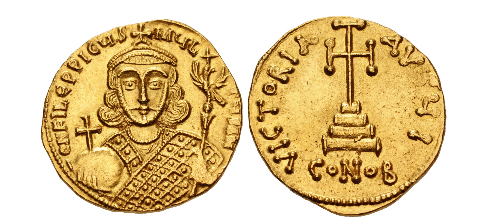
The gold solidus of Philippikos [5] shows a frontal portrait of the emperor wearing a crown and the jeweled loros. He holds a cross-topped orb and a scepter tipped with an eagle. It ranks among the most revealing Byzantine coins of the period.
Although Greek was the empire’s spoken language, coin inscriptions of this period remained in Latin: D N FILEPPICUS MULTUS AN (“Our Lord, Philippicus, Many Years”)
Spelling lacked standardization. Some dies spell the name with two P’s; however, most read FILEPICUS.
The reverse shows a cross on three steps surrounded by the optimistic inscription VICTORIA AUG (“Victory of the Emperor”), above the mint mark CONOB (Constantinopolis Obryzum, “Constantinople, refined gold”).
Despite political chaos and rapid regime changes, the mint maintained the weight, purity, and workmanship of the gold coinage with remarkable consistency.
Fractional Gold Issues
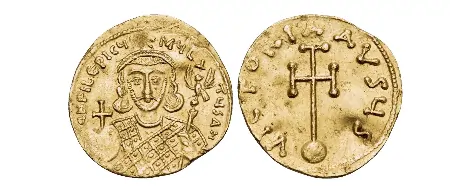
The gold semissis, struck in small quantities, carried a value of one-half solidus and a theoretical weight of 2.25 grams [6]. Well-preserved examples, however, usually weigh closer to 2.17 grams.
The obverse mirrors that of the solidus. On the reverse, a cross on a globe marks the denomination. Because of the small flan, the engraver had no room for a mint mark.
These fractional gold issues form an important subset of surviving Byzantine coins.
![Philippicus Bardanes, 4 November 711 – 3 June 713 Tremissis 711-713, AV 1.38 g. DN PHILEPICYS – MYL – [TYS AN] Facing bust with short beard, wearing loros and crown with cross on circlet, holding globus cruciger in r. hand and eagle-tipped sceptre with cross above in l. Rev. VI[CTORI]A AVGYS ?? Cross potent on base; in exergue, CONOB. DO 6. MIB 6. Sear 1452.](webp/fig3-3.webp)
These thin coins were often poorly struck and badly centered. As a result, they circulated heavily and rarely survive in high grade [7].
Provincial Gold Coinage in Italy
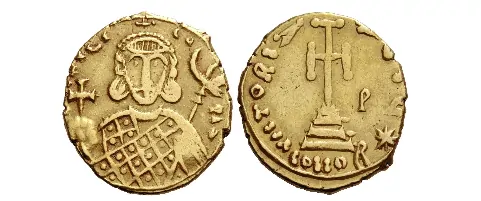
Several provincial mints in Italy also struck gold for Philippikos, probably to pay troops. However, these mints lacked the skilled artisans of Constantinople. Consequently, workshops at Rome, Ravenna, and Syracuse produced crudely executed coins with garbled inscriptions, often in debased metal [8].
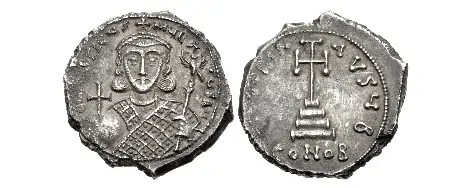
Silver and the Mysterious Hexagram
Heraclius originally introduced the silver hexagram around 615 during the Persian wars. Later, the denomination survived as a “ceremonial” coinage of uncertain purpose.
(When numismatists cannot determine a coin’s function, they usually label it “ceremonial.”)
The extremely rare hexagram of Philippikos was struck with solidus dies on ragged silver blanks [9].
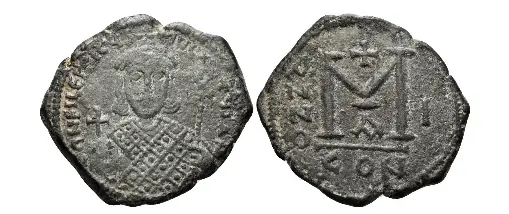
Copper Coinage and Everyday Life
Copper coins met the needs of the urban economy, where daily transactions required small change.
As emperors rose and fell, officials frequently overstruck copper coinage. The follis of this period ranged from 3 to 6 grams and rarely displayed clear images or complete inscriptions. Officially, 180 folles equaled one gold solidus. In reality, the exchange rate fluctuated and usually ran higher. The reverse carried a large M as the mark of value [10].
In daily life, Byzantine coins of copper dominated economic exchange.
Half folles, marked with a bold K, also circulated.
Philippikos “quickly proved himself a hopeless hedonist who spent vast sums on his own amusement, and in his serious moments seemed interested only in reviving the old theological disputes…” [Norwich (1989) page 347]
As a result, he neglected the empire’s defenses. Consequently, Bulgar invaders devastated territory nearly to the walls of Constantinople.
In the summer of 715, the army revolted. A group of officers stormed the palace, blinded and deposed the emperor, and sent him to die in a remote monastery.
His reign lasted just 19 months.
Anastasius II and a Brief Hope of Stability
A palace official, the protoaseketris, or “chief of staff”, named Artemius was proclaimed emperor on June 3, 715, taking the name Anastasius II [11].
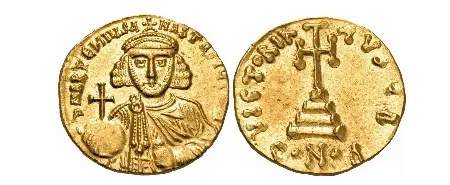
Artemius proved a capable administrator. He restored relations with the pope in Rome and strengthened the defenses of Constantinople. At the same time, he prepared for the expected assault by the Umayyad Caliphate. Nevertheless, he failed to secure the loyalty of the chronically mutinous army.
On his scarce gold solidus [12], Artemius wears the chlamys, a pleated robe fastened at the shoulder by a clasp adorned with three strings of pearls. He holds a cross-topped orb and an akakia, a hollow tube filled with ashes meant to remind the emperor of his mortality.
The usual inscription reads: dN ARTЄMIЧS ANASTASIЧS MЧL (“Our Lord Artemius Anastasius Many Years”)
The word ANNOS (“years”) was probably omitted for lack of space.
One of the favorite coins in my own collection is a gold semissis of Anastasius II described as “extremely fine and rare” from the famous William Herbert Hunt collection [13].
The obverse matches the solidus. Meanwhile, the reverse shows the standard cross on globe with the inscription VICTORIA AUGUS. Examples appear occasionally at auction and usually sell for $2,200 and up [14].
During the earliest days of the reign, a handful of tremisses appeared bearing only the name “Anastasius.” Only about four examples are known. One sold for the extraordinary price of $11,000 at a U.S. auction in 2018 [15].
Tremisses with the full name “Artemius Anastasius”, almost never fully legible, are scarce and typically bring $800 to $1,600 at auction.[16]
Theodosius III and the End of the Anarchy
In 715, Artemius placed his finance minister, John the Logothete, in command of the forces assembled at Rhodes for an offensive against the Caliphate. Unfortunately, the troops had developed a taste for rebellion. Consequently, they turned on John and clubbed him to death.
They then marched on Constantinople, selecting along the way an unassuming tax collector named Theodosius, whom they inexplicably proclaimed emperor [Norwich (1989) page 349].
Forced at sword point to accept the crown, Theodosius replaced Artemius, who retired intact to a monastery. He later escaped and was executed in 719 after a failed attempt to regain power.
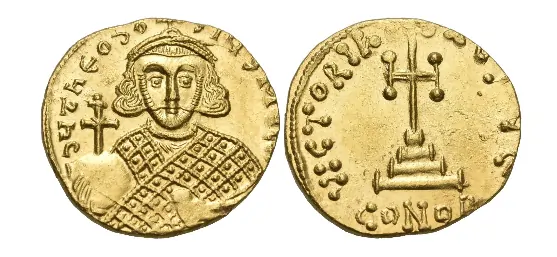
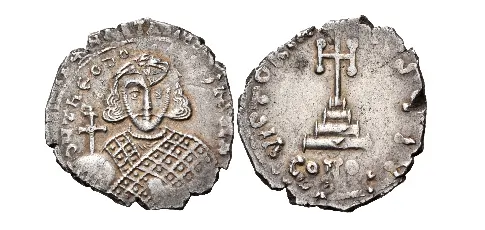
Known as “Theodosius of Adramyttium,” after his hometown near modern Burhaniye, Türkiye, Theodosius III [17] was widely regarded as a puppet of the troops. Powerful generals Leo and Artavasdus refused to recognize him.
Still, by controlling Constantinople and the mint, By controlling the mint, Theodosius ensured that Byzantine coins carried his image to assert legitimacy. On the rare solidus, he wears the loros and holds an orb topped with a double-barred patriarchal cross [18].
Collecting the Chaos
Despite political instability, the Constantinople mint preserved the weight, purity, and workmanship of the gold coinage.
Silver issues appeared only sporadically for ceremonial purposes that remain poorly understood. Meanwhile, copper small change was generally crude, heavily overstruck, and visually unappealing.
For collectors today, Byzantine coins from this era range from scarce to extremely rare. Among them, the issues of Theodosius III pose the greatest challenge for collectors.
The standard reference for the coinage of this period remains the Dumbarton Oaks Catalogue (Grierson, 1968), although many auction listings still cite the more accessible, but outdated, second edition of Byzantine Coins and Their Values (Sear, 1987).
Citations
[2] https://en.wikipedia.org/wiki/Twenty_Years%27_Anarchy
[3] https://coinweek.com/coins-of-justinian-ii-the-emperor-who-lost-his-nose/
[4] https://en.wikipedia.org/wiki/Monothelitism
[5] CNG Auction 123, May 23, 2023, Lot 744, realized $4,500
[6] Nomos obolos 27, March 19, 2023, Lot 758, realized $3,231
[7] NAC Auction 75, November 18, 2013, Lot 662, realized $713
[8] NAC Auction 100, May 29, 2017, Lot 2053, realized $1,130
[9] CNG Triton XXIV, January 19, 2021, Lot 1176, realized $8,500
[10] Nomos obolos 29, October 8, 2023, Lot 717, realize $1,039
[11] https://en.wikipedia.org/wiki/Anastasius_II_(emperor)
[12] Nomos Auction 37, November 16, 2025, Lot 287, realized $3,910
[13] Sotheby’s, December 5-6, 1990, Lot 547, realized $2,750
[14] Nomos auction 19, November 17, 2019, Lot 426, realized $2,226
[15] CNG Auction 109, September 12, 2018, Lot 769, realized $11,000
[16] CNG Mail Bid Sale, September 19, 2001, Lot 1455, realized $850
[17] https://en.wikipedia.org/wiki/Theodosius_III
[18] Nomos Auction 28, May 22, 2023, Lot 1369, realized $5820
References
- Connell, Christopher T. Byzantine Emperors of Chaos. (Video, American Numismatic Association, 2002)
- Goodacre, Hugh. A Handbook of the Coinage of the Byzantine Empire. London (1960)
- Grierson, Philip. Catalogue of the Byzantine Coins in the Dumbarton Oaks Collection, Volume 2, Part 2. Washington, DC (1968)
- Head, Constance. Justinian II of Byzantium. Madison WI (1972)
- Kaldellis, Anthony. The New Roman Empire: A History of Byzantium. Oxford (2024)
- Kazhdan, Alexander (editor). Oxford Dictionary of Byzantium (3 volumes). Oxford (1991)
- Norwich, John J. Byzantium: The Early Centuries. New York (1989)
- Sayles, Wayne. Ancient Coin Collecting V: The Romaion/Byzantine Culture. Iola, WI (1998)
- Sear, David. Byzantine Coins and Their Values. London (1987)







The intersection of coinage and power struggles is interesting.
nice article
Absolutely amazing. Love history and this article is so full of it! Thank you!
Great article