


In the long history of ancient coinage, innovation usually followed power. Greek city-states expressed civic identity through coin designs, and empires used precious metal to project authority. Egypt, however, resisted coinage for centuries, until one extraordinary exception.
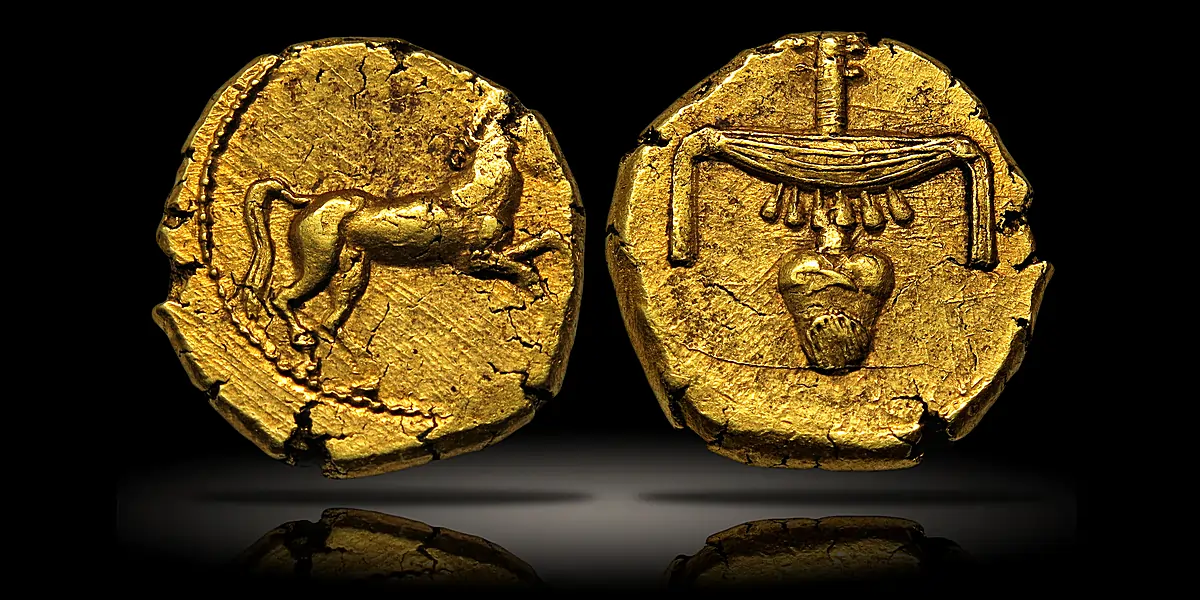
A single gold stater, issued under Nektanebo II, stands apart as the only known coin to feature Egyptian hieroglyphics. More than a numismatic curiosity, it represents a deliberate and symbolic assertion of Egyptian kingship at the very end of native rule.
A Pharaoh at the Edge of History
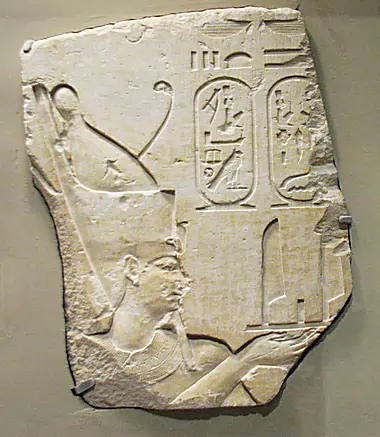
Nektanebo II reigned from 361 to 343 BC, a period defined by instability and external pressure. He came to power by overthrowing his uncle, Pharaoh Takhos, and quickly faced renewed aggression from the Achaemenid Persian Empire.
In 351/0 BC, Nektanebo successfully repelled a Persian invasion, securing Egypt’s independence, temporarily. A second assault followed in 344/3 BC, led by Artaxerxes III, forcing Nektanebo to flee south to Ethiopia. With his defeat, Egypt lost its last native pharaoh and entered a new era of foreign domination.
The gold stater bearing hieroglyphs belongs squarely within this turbulent context.
An Egyptian Coin in a Greek Monetary World
By the 4th century BC, coinage had become the dominant medium of payment across the eastern Mediterranean. Egypt, by contrast, had long relied on weighed bullion and state-controlled redistribution systems. Coinage only began to take root during the late 26th Dynasty, and even then, most coins circulating in Egypt were imported or stylistically Greek.
Nektanebo’s gold staters break decisively from that pattern.
Instead of Greek gods or Persian royal imagery, the coin presents an unmistakably Egyptian visual language. The obverse shows a prancing horse, an image often associated with kingship and elite power. While horses appear frequently on Greek coinage, their appearance here may reflect a conscious adaptation rather than imitation, a visual bridge between Egyptian authority and the expectations of Greek mercenaries.
This interpretation aligns with historical reality. Nektanebo relied heavily on Greek mercenaries to defend his throne, and coinage was the most practical way to pay them. The stater’s form follows Greek monetary standards, but its message is entirely Egyptian.
Hieroglyphs in Gold: Meaning and Message
The reverse is what makes the coin singular in ancient numismatics.
It bears hieroglyphic symbols reading nefer nebew, meaning “good gold.” The design combines a pectoral necklace (nebew, or gold) crossing a windpipe and heart (nefer, or good). These symbols were not decorative flourishes. In Egyptian culture, hieroglyphs carried intrinsic meaning, often tied to cosmic order, legitimacy, and divine favor.
By placing hieroglyphs on a gold coin, Nektanebo made a statement that went beyond commerce. He embedded traditional Egyptian concepts of value and righteousness directly into a medium foreign to Egyptian custom. The result is a coin that functions simultaneously as currency, royal proclamation, and cultural manifesto.
It is worth noting that while the coin was likely intended for circulation among Greek mercenaries, the choice of hieroglyphs suggests that its symbolic audience was Egyptian as well. This duality underscores the pharaoh’s precarious position as a nationalist ruler forced to rely on foreign soldiers.
Minting at Memphis: Power Center of a Fading Kingdom
The coinage of Nektanebo II was produced at Memphis, Egypt’s traditional administrative heart. Alongside the gold staters, the mint issued silver fractions and possibly bronze coinage, though the latter remains uncertain.
The gold staters are exceptionally rare. Only 42 examples are currently known, struck from three die pairs, with approximately 20 pieces held in private collections. Such limited production suggests that these coins were never intended for broad circulation. Instead, they appear to have served a specific, short-term function during the final years of native Egyptian resistance.
The End of Native Rule – and a Numismatic Final Statement
Within a decade of Nektanebo’s flight, Egypt would be conquered by Alexander the Great and absorbed into the Hellenistic world. Under the Ptolemies and later the Romans, Egyptian iconography returned to coinage, but always filtered through Greek and imperial traditions.
No later ruler would strike coins using Egyptian hieroglyphs again.
This fact elevates the Nektanebo stater beyond rarity. It is a historical punctuation mark, the final, defiant expression of pharaonic identity in metal. Where monumental inscriptions once proclaimed divine kingship, this coin condensed that message into 17 millimeters of gold.
A Coin Unlike Any Other
The Nektanebo II gold stater occupies a category of its own. It is not merely rare, nor simply beautiful. It represents a moment when tradition confronted necessity, and when Egypt’s oldest visual language found expression in its newest monetary form.
For collectors and historians alike, it remains one of the most eloquent objects from antiquity, a coin that speaks, quite literally, in hieroglyphs.
Numismatic Description (for Reference)
- EGYPT, Pharaonic Kingdom. Nektanebo II. 361–343 BC. AV Stater (17 mm, 8.23 g, 12h).
- Obverse: Horse prancing right.
- Reverse: Hieroglyphic representation of “good gold”: pectoral necklace (nebew, “gold”) crossing horizontally over a windpipe and heart (nefer, “good”).
- References: FF-BD 2g (D1/R2 – this coin); SNG Berry 1459; SNG Copenhagen 1; ACGC 1064; Adams III 2075; Hunt I 106; Zhuyuetang 121.
- Provenance: Colosseo Collection.








Very neat!
Win!!