


Power, Image, and Dynastic Messaging from Tiberius to Nero
Part 1 Ceaser and Augustus
Roman imperial coinage under the Julio-Claudian emperors did far more than facilitate commerce. These coins projected legitimacy, reinforced family continuity, and communicated authority across the Empire.
From the restrained portraiture of Tiberius to the increasingly personal and political imagery of Nero, imperial coins reveal how Rome’s first dynasty evolved and ultimately collapsed.
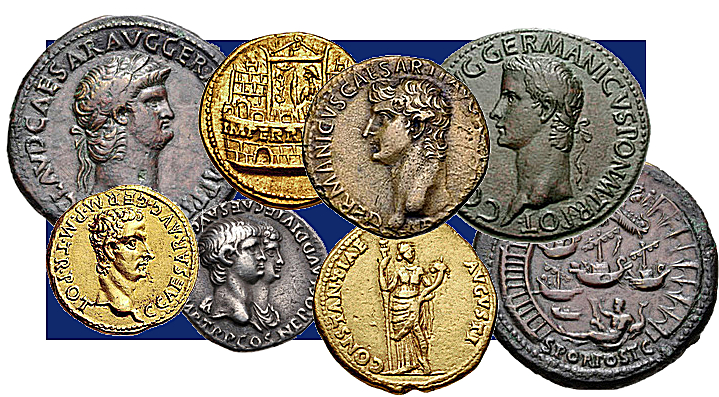
This second installment examines portrait coins issued between 14 and 68 CE, focusing on how emperors and their relatives used numismatic imagery to shape public perception.
Tiberius as Emperor (14 – 37 CE)
Tiberius became Rome’s second emperor in 14 CE following the death of Augustus. Ancient writers consistently describe him as reluctant to accept power. His actions during the early years of his reign support that assessment. Augustus had already removed potential dynastic complications by exiling his daughter Julia, who died shortly after her father.
Despite these measures, Tiberius ruled under the constant presence of his mother, Livia. Ancient sources portray her as forceful and politically assertive, and she reminded Tiberius frequently that his position depended on her influence. Her death in 29 CE finally freed him from that pressure.
Over time, Tiberius grew weary of administration. He withdrew from Rome and settled on Capri, where he governed through trusted officials. Sejanus, prefect of the Praetorian Guard, exercised enormous authority during this period. Hostile ancient sources accuse Tiberius of moral excess on Capri and claim that Caligula participated in these activities. Modern historians treat these allegations cautiously, recognizing their origin in senatorial hostility.
Tiberius died in 37 CE. Roman writers record little public mourning.
Coinage of Tiberius and His Family
An aureus struck in 18 CE shows Tiberius with an idealized, ageless portrait. Like Augustus, he avoided visible aging on coinage. This stylistic consistency extended across the Julio-Claudian family and often makes individual identification difficult without legends.
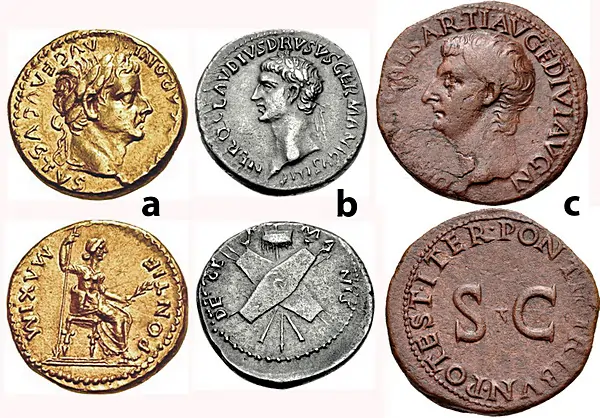
A denarius of Drusus the Elder—Tiberius’ brother—demonstrates this challenge. The obverse shows Drusus, while the reverse displays crossed German shields commemorating his victories in Germania under Augustus. Claudius, Drusus’ son, minted this coin decades later as an act of dynastic commemoration.
A dupondius depicting Drusus the Younger, Tiberius’ son, presents a more individualized portrait. The engraver emphasized facial character rather than idealized symmetry. Together, these coins illustrate how Julio-Claudian mints balanced uniformity with recognizable identity.
Caligula’s Reign (37 – 41 CE)
Gaius Caesar Augustus Germanicus, known to history as Caligula, became emperor at age 25. The Roman public greeted his accession with enthusiasm, largely because it marked the end of Tiberius’ unpopular rule.
Caligula quickly eliminated potential rivals. He ordered the death of his cousin and co-heir, Tiberius Gemellus, the son of Drusus the Younger. Ancient sources report that Caligula initially governed competently. As he consolidated power, however, his behavior grew erratic and increasingly antagonistic toward elites.
Writers such as Suetonius and Cassius Dio accuse Caligula of extreme cruelty and sexual excess, including incest with his sisters Agrippina the Younger, Drusilla, and Livilla. These claims originate from hostile sources, but they reflect a ruler who alienated nearly every power base in Rome.
In 41 CE, members of the Praetorian Guard assassinated Caligula during public performances. They also killed his wife Caesonia and their daughter Julia Drusilla.
Dynastic Coinage under Caligula
Caligula expanded the use of family portraits on imperial coinage. He honored his parents, Germanicus and Agrippina the Elder, and prominently featured his sisters.
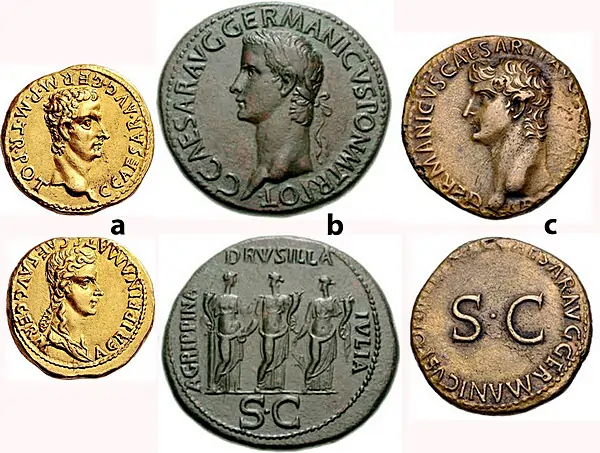
An aureus pairs Caligula on the obverse with Agrippina the Elder on the reverse. Caligula’s portrait appears generic, while Agrippina’s displays careful engraving and strong realism.
A large sestertius shows Caligula on the obverse and his three sisters, Agrippina, Drusilla, and Livilla, on the reverse. This issue represents one of the clearest expressions of dynastic unity in Roman imperial coinage. An as depicting Germanicus reinforces the continued public reverence for Caligula’s father.
Claudius’ Reign (41 – 54 CE)
After Caligula’s assassination, the Praetorian Guard elevated Tiberius Claudius Caesar Augustus Germanicus to the throne. Claudius descended from Rome’s most distinguished military family as the son of Drusus the Elder and brother of Germanicus.
Earlier emperors had overlooked Claudius due to physical disabilities and speech impediments. These traits likely spared him during purges. Once in power, he proved himself an effective administrator and legislator. He immediately rewarded the Praetorians for their support.
Claudius married Messalina, whose behavior ancient sources describe as scandalous and politically reckless. After she participated in a public mock-marriage, Claudius ordered her execution. Their children, Octavia and Britannicus, survived to adulthood.
Claudius later married his niece Agrippina the Younger and adopted her son Nero. In 54 CE, Claudius died after consuming poisoned mushrooms. Ancient writers attribute the act to Agrippina.
Claudius and Imperial Portraiture
An aureus from Claudius’ reign shows a realistic portrait that emphasizes age rather than idealization. The reverse depicts the Praetorian Camp, acknowledging the force that secured his rule.
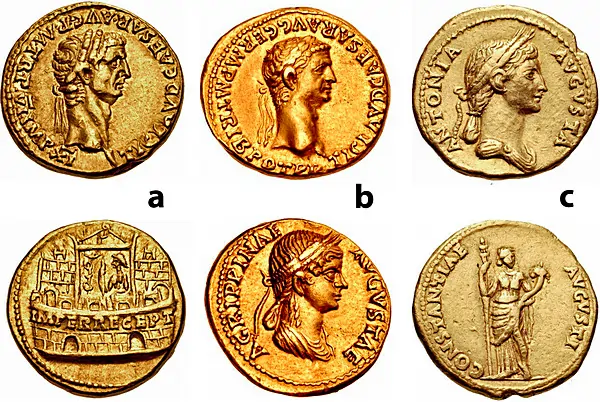
Another aureus presents Claudius alongside Agrippina the Younger. Her named portrait marks a significant departure from Augustan precedent. Augustus never placed Livia on imperial coinage.
A third aureus honors Antonia Minor, Claudius’ mother, identifying her as Antonia Augusta. This issue reinforces dynastic legitimacy through the maternal line.
Imperial mints rarely featured Messalina or Britannicus. Some provincial issues depict them, but Claudius avoided their portraits in central imperial coinage.
Nero as Emperor (54 – 68 CE)
Nero became emperor at 17 years old. His lineage as Augustus’ great-great-grandson secured acceptance despite his lack of experience. He had married Claudius’ daughter Octavia three years earlier and poisoned Britannicus shortly after taking power.
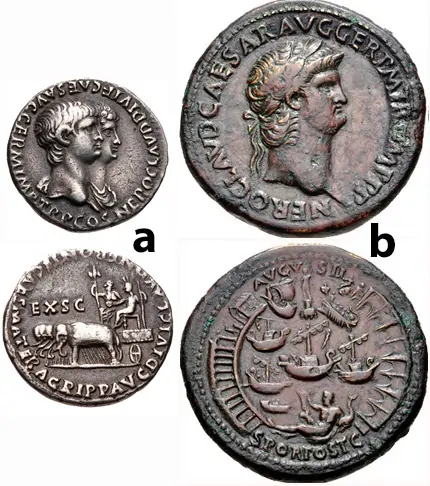
Early success defined Nero’s reign. His advisors, Seneca the Younger, Sextus Afranius Burrus, and Agrippina the Younger, managed administration and policy. Nero acknowledged this shared authority through coinage that paired his portrait with Agrippina’s.
By 59 CE, Nero moved against his mother. He staged a maritime accident that failed to kill her, then ordered her murder. Contemporary observers rejected the official claim of suicide.
After Burrus died in 62 CE and Seneca lost influence, Nero ruled without restraint. He exiled and executed Octavia, then married Poppaea Sabina. Ancient sources accuse Nero of killing Poppaea during pregnancy in 65 CE.
As revolts spread and opposition hardened, the Senate declared Nero a public enemy. He fled Rome and died by suicide in 68 CE.
Nero’s Numismatic Legacy
A denarius shows Nero and Agrippina with jugate portraits, symbolizing shared rule early in his reign.
One of Nero’s most celebrated coins pairs his portrait with a detailed aerial view of the harbor at Ostia. Claudius began the project, and Nero completed it shortly before 64 CE.
The reverse remains one of the most ambitious architectural depictions in Roman coinage.
Availability and Collecting Considerations
Collectors encounter significant challenges when pursuing Julio-Claudian portrait coins. Most examples command high prices and appear infrequently. Even advanced collectors often own only a single representative coin from this group.
References
- Acsearch.info
- Classical Numismatic Group (CNG)
- Wildwinds
- Boardman, Griffin, Murray, The Oxford History of the Classical World
- Hornblower & Spawforth (eds.), The Oxford Classical Dictionary
- Madden, Smith, Stevenson, A Dictionary of Roman Coins
- Sutherland & Carson, The Roman Imperial Coinage








Was fascinated by ancient Roman history in 4th grade.
I have an As of Claudius in my collection. It is very worn from being heavily circulated.
Just curious if there are phone apps for scanning ancient coins and estimating their value?