


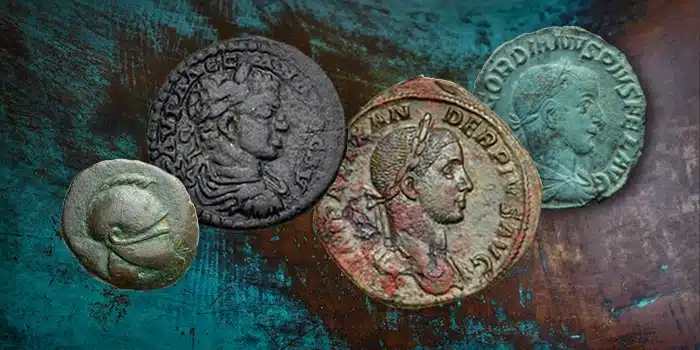
Original By Tyler Rossi for CoinWeek ….. Reformatted and updated by CoinWeek
Understanding Patina on Ancient Coins: Types, Formation, and Collector Value
Unlike modern coins, ancient coins do not conform to the strict condition thresholds of the 70-point Sheldon Grading Scale. Instead, collectors evaluate ancient coins primarily on eye appeal, surface preservation, and historical integrity. One of the most important contributors to eye appeal is patina.
So, what exactly is patina, and why does it matter so much?
What Is Patina on Ancient Coins?
In technical terms, true patina refers to surface oxidation that begins forming on a metal coin almost immediately after striking. On modern copper coins, this same process produces the familiar Red, Red-Brown, and Brown designations.
However, among ancient coin collectors, the term “patina” has a broader meaning. In common usage, it describes any layer of oxidation or mineral deposition that forms over centuries while a coin remains buried. This process depends primarily on two variables:
- The chemical composition of the soil
- The metal alloy of the coin
Because burial environments vary widely, ancient patinas appear in many forms, textures, and colors.
The Two Primary Patina Categories
Most ancient bronze coin patinas fall into two broad color families:
- Green patinas
- Red patinas
Each forms through distinct chemical reactions involving copper and environmental elements.
Green Patina: The Most Common Surface Type
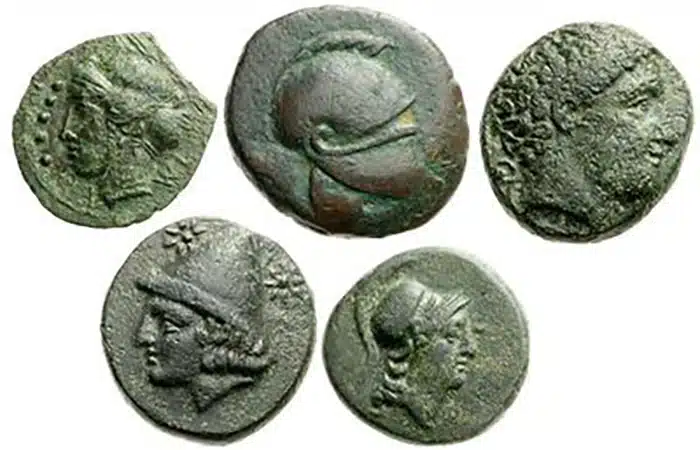
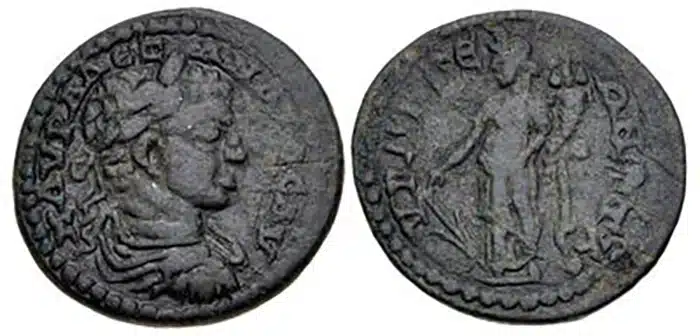
Green patina is the most frequently encountered surface on ancient bronze coins. It forms primarily from copper acetate (Cu(CH₃CO₂)₂), which develops when copper reacts with acetic acid present in air or soil.
Importantly, green patina can vary dramatically in tone. Shades range from nearly black to bright or pale green, depending on environmental exposure and alloy composition.
Desert Patina: A Subtype of Green Patina
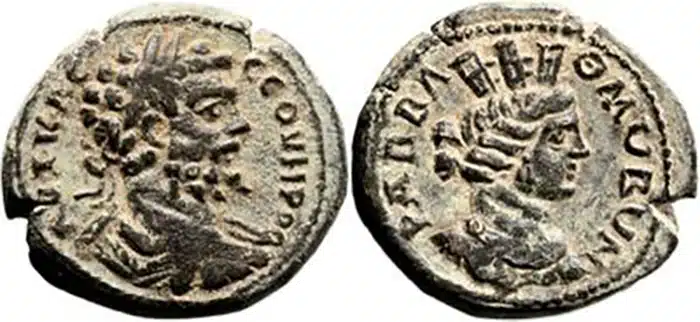
One visually striking variation of green patina is known as desert patina. This surface results from a combined chemical and environmental process.
Desert patinas typically feature:
- A light sandy or tan surface layer
- A darker green or brown patina beneath
These patinas form most often in dry, dusty climates, where fine sand becomes chemically bonded to an already-patinated surface. When conservators partially remove the encrustation, the darker underlying patina creates a dramatic contrast that highlights design details.
Important Note on Authenticity
Desert patinas can be artificially fabricated. In some cases, original surfaces are stripped and sandy material is glued onto the coin. Depending on the adhesive, these forgeries may be removable with water or gentle brushing. As a result, collectors should examine desert patinas carefully.
Red Patina: Rare and Visually Polarizing
Red patina appears far less frequently than green patina. It forms when cuprous oxide (Cu₂O), also called copper(I) oxide, develops from reactions involving cupric oxide (CuO) in the coin or surrounding soil.
This patina can appear bright red or dark crimson. However, coins displaying only red patina are extremely rare. In nearly all cases, red patina forms on top of an existing brown copper surface.
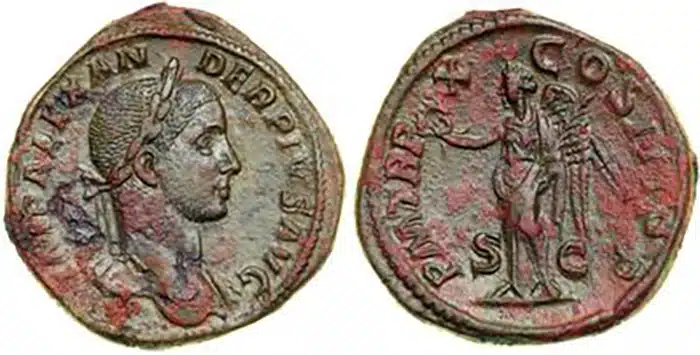
In the example above, uneven red encrustations sit atop a thick reddish-brown base, creating a visually unstable appearance.
By contrast, some red-brown combinations appear more uniform and stable.
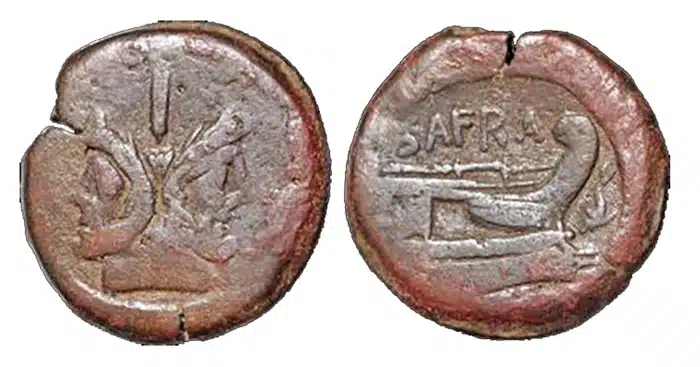
While eye appeal remains subjective, evenly distributed red-brown patinas are generally considered more attractive and chemically stable.
Brown Patina: Thin Oxidation or Mixed Surfaces
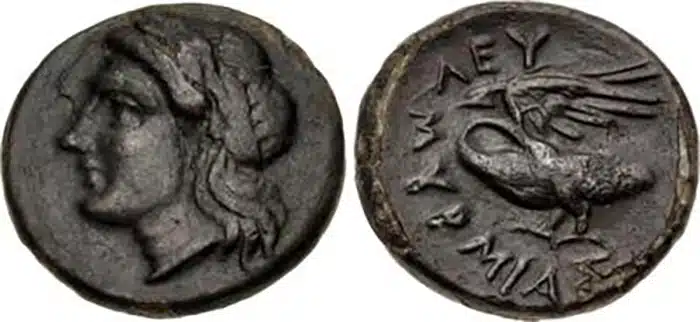
Brown patina forms in two primary ways:
- Through a thin copper oxide film created shortly after striking
- Through a natural blend of green and red patinas
Coins that developed a brown surface before burial often retain especially smooth textures.
Blue Patina vs. Bronze Disease
Blue patina is exceptionally rare, and often misunderstood.
In many cases, blue-green surface growth indicates bronze disease, not patina. Bronze disease occurs when internal chemical reactions produce acid within the coin. This process creates powdery blue-green eruptions and causes active metal loss.
Unlike patina, bronze disease is destructive and subtractive. If removed, it leaves behind pitting and surface damage.
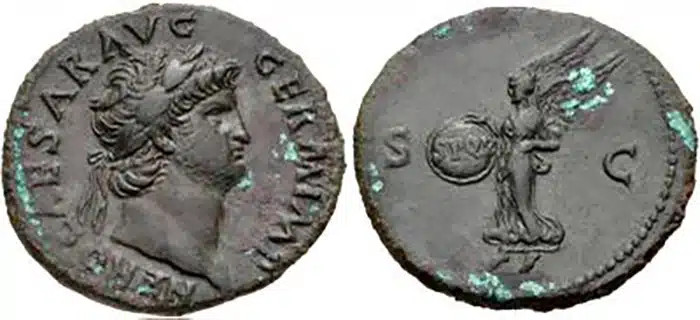
Historically, researchers once believed bronze disease was biological in origin, hence the term “disease.” Modern research has shown it to be chemical. Treatment methods remain complex and fall outside the scope of this article.
True Blue Patina: Rare but Stable
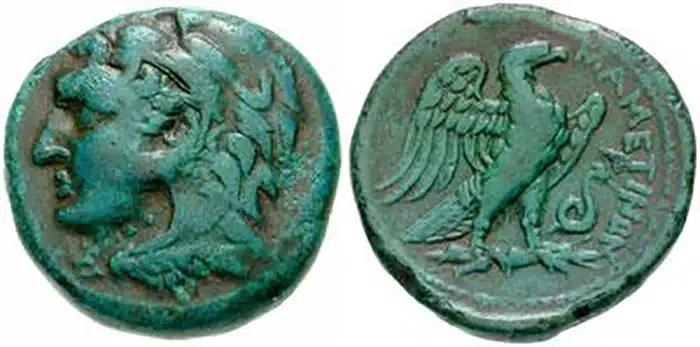
Not all blue patina indicates bronze disease. Some copper oxides form stable blue or blue-green surfaces, similar to those seen on untreated bronze statues.
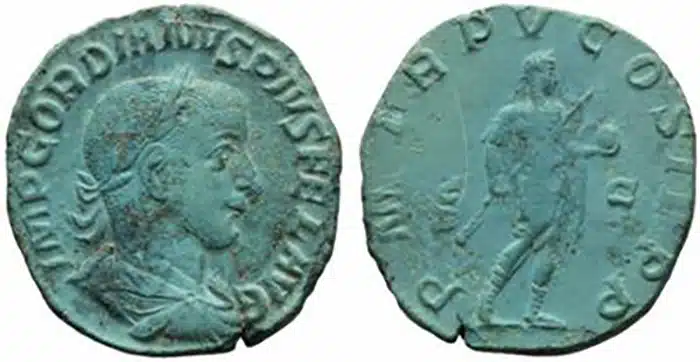
In other cases, blue-green patinas may appear waxy and highly durable.
River (Tiber) Patina and Anaerobic Preservation
River patina, often called Tiber Patina, forms in oxygen-deprived (anaerobic) environments, such as riverbeds or waterlogged clay soils.
Coins with this surface typically display:
- A subtle brass-like color
- Minimal brown oxidation
- Even, fine pitting across the surface
Because clay prevents oxygen exposure, oxidation may slow or even partially reverse. As a result, the coin may appear close to its original struck condition.
Cleaning vs. True River Patina
Not all smooth bronze coins possess river patina. Some have simply been harshly cleaned.
For example, this dupondius of Augustus and Agrippa (10–14 CE) had its patina stripped and sold for $100 in 2015.
A comparable coin with original patina sold for nearly $400 in 2013.
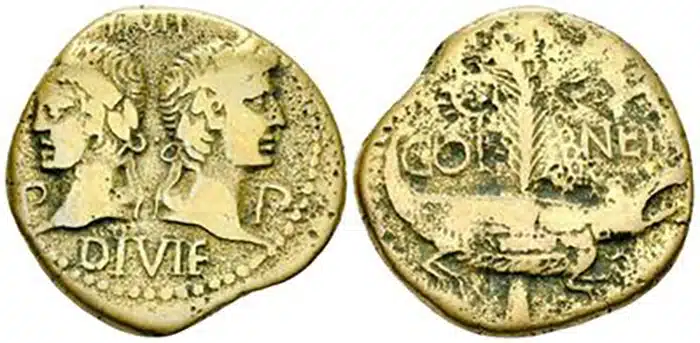
By contrast, authentic river patinas show no tooling or stripping.
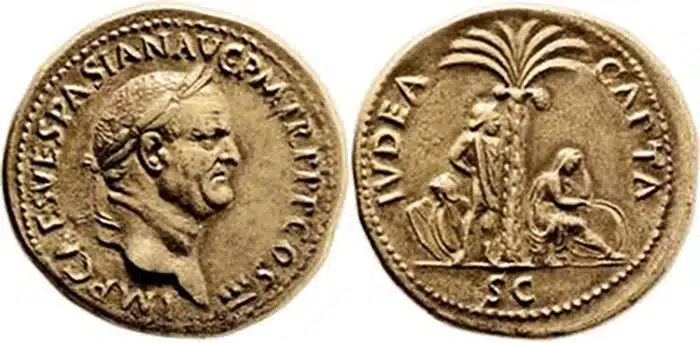
Coins recovered from anaerobic sites, such as the boggy soils near Vindolanda in Britain, often exhibit these same surfaces.
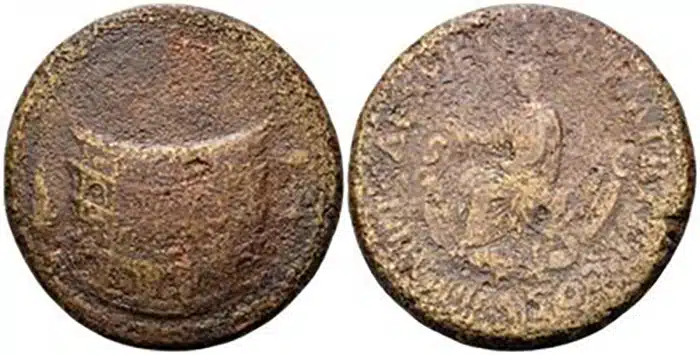
Variations in River Patina Preservation
Not all river-patinated coins appear pristine. Many circulated heavily before deposition.
For example, this sestertius of Titus shows light corrosion but retains an authentic anaerobic surface. Due to its extreme rarity, it sold for £8,000 in 2016 (approximately $10,841 USD, inflation-adjusted).
Why Some Coins Survive, and Others Do Not
Patina is technically a form of corrosion. So why do some coins survive while others deteriorate completely?
Some coins do not survive at all. Highly acidic soil can reduce bronze coins to featureless discs.
Coins that endure typically benefit from:
- Low soluble salt content in surrounding soil
- Chemical equilibrium between corrosion layers and burial environment
When stable and attractive, patina can mask surface flaws and significantly enhance value.
Fake Patinas and Collector Caution
Because patina adds value, some individuals attempt to fake it using chemical treatments. While convincing at first glance, artificial patinas often lack the hardness and integration of genuine surfaces.
Most authentic patinas formed over centuries become extremely difficult to remove without damaging the coin. That said, some genuine patinas—especially rare blue-green types—remain soft.
For this reason, careful examination remains essential.
Final Thoughts
Patina tells a coin’s story. It records chemistry, environment, and time itself. Understanding patina helps collectors distinguish authenticity from alteration—and preservation from decay.
Sources
- Metal Detecting World – Patina Overview
- Powder Diffraction (Cambridge University Press) – Roman Coin Patina Analysis
- Caridi et al., 2014 – Investigation on Ancient Bronze Patina
- Sandu et al., 2006 – Authentication of Archaeological Bronze Coins
* * *








While visiting Turkey a street “vendor” offered to sell me a “genuine” ancient coin worth $1,000 US. His price was $100, but quickly dropped to $20 as I walked away. I’m sure I missed a great bargain!
Very informative yet easy to understand. This is a great article for future reference.