By Steve Benner for CoinWeek
Part I: From Persian Satrapy to Hellenistic Kingdom
Cappadocia occupied the heart of ancient Asia Minor, in what is now central Turkey. Its geography shaped its history, politics, and coinage. High elevation, harsh winters, and limited trade routes encouraged local autonomy. These conditions also influenced how Cappadocian rulers expressed authority through coinage.
This first installment examines the early kings of Cappadocia and their coins, from the late Persian period through the reign of Ariarathes VI.
Geography and Historical Setting
Cappadocia sat on a rugged plateau within the Taurus Mountain system. Mount Erciyes, known in antiquity as Argaeus, rises to 3,916 meters and dominates the region. The Taurus Mountains separate Cappadocia from Cilicia and the Mediterranean coast. Lycaonia borders the region to the southwest, while Galatia lies to the northwest.
The climate remains severe. Summers are hot and dry. Winters bring heavy snow. Several rivers flow through Cappadocia, including the Sarus, the Pyramus, the middle Halys, and tributaries of the Euphrates. None are navigable, which limited commerce and reinforced regional isolation.
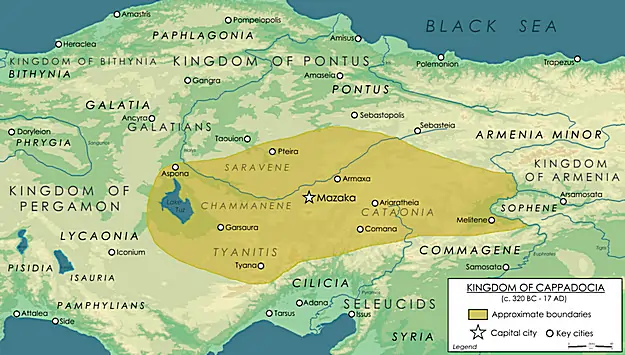
During the Bronze Age, Cappadocia formed the core of the Hittite Empire. After the empire’s collapse around 1200 BCE, the region faded from prominence. That changed with the rise of the Persian Empire.
In 546 BCE, Cyrus the Great defeated Croesus of Lydia and absorbed Asia Minor. Cappadocia became a Persian satrapy, with its capital at Mazaka.
The Early Ariarathid Rulers
Ariarathes I (331/0–322 BCE)
In 334 BCE, Alexander the Great invaded the Persian Empire and defeated its forces at the Granicus River. Within a few years, he controlled all of Asia Minor.
Following Alexander’s conquest, Ariarathes I assumed control of Cappadocia despite Alexander having appointed a governor. He ruled Cappadocia, Pontus, and parts of Paphlagonia as an independent power for a brief period. In 322 BCE, Perdiccas executed Ariarathes I, ending his reign.
Ariarathes I issued silver sigloi, or drachms, struck on the Persian standard of approximately 5.6 grams. Two main types exist. One depicts Baal of Gaziura seated, holding an eagle and scepter. The reverse shows a griffin attacking a stag. The legends appear in Aramaic.
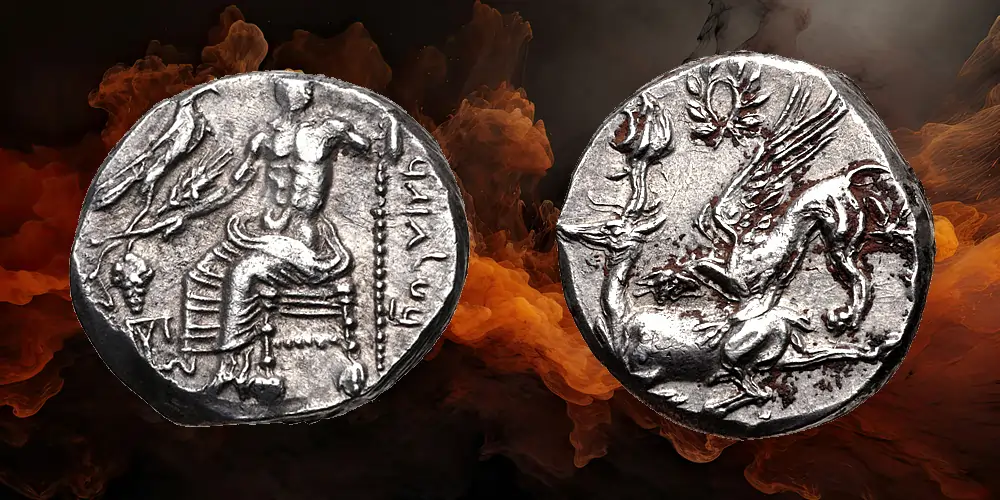
A second silver type features a nymph, an eagle, and a dolphin, closely resembling coinage from Sinope. Ariarathes I also minted small bronze coins. These show the ruler drawing a bow on the obverse and an ibex standing on the reverse.
Ariarathes II (301–280 BCE)
After Ariarathes I’s death, his nephew Ariarathes II fled to Armenia. He returned during the Fourth War of the Diadochi, which lasted from 307 to 301 BCE. He regained control of Cappadocia during this period of instability.
Seleucus I Nicator later appointed Ariarathes II as satrap. After Seleucus’ death in 281 BCE, Ariarathes asserted greater independence and resisted attempts by Antiochus I to restore direct Seleucid control.
Only one coin type is securely associated with Ariarathes II. It is a small bronze issue depicting the king wearing a bashlyk on the obverse. The reverse shows a lioness nursing her cub.
Ariaramnes (280–230 BCE)
Ariaramnes succeeded his father in 280 BCE. Ancient sources record little about his reign. However, his coinage provides valuable evidence.
He struck several bronze denominations. Each shows his portrait wearing a bashlyk on the obverse. Larger coins depict a rider on horseback or a grazing horse. Smaller pieces show a horse grazing or prancing. Importantly, the legends appear in Greek and read ARIARAMNOU, marking a linguistic transition in Cappadocian coinage.
Ariarathes III and the Rise of Kingship
Ariarathes III (255–220 BCE) became sole ruler after his father’s death in 230 BCE. He was the first Cappadocian ruler to formally assume the title of king.
During conflicts among the Seleucids, Ariarathes III supported one faction and expanded his territory at Seleucid expense. He captured Comana, including its important temple of the goddess Ma.
He minted two bronze denominations. The larger type features a mounted horseman or Ma-Kybele on the reverse. The smaller denomination shows an ivy leaf. On the obverse, Ariarathes III wears a bashlyk with a raised peak, a feature reserved for kings.
Coins came from at least three mints: Cybistra, Morima, and Tyana.
Ariarathes IV and the Introduction of Silver
The future King, Ariarathes IV Eusebes (220–163 BCE), ascended the throne while still young. He married Antiochis, daughter of Antiochus III, strengthening ties with the Seleucid Empire.
These ties pulled Cappadocia into war against Rome between 192 and 190 BCE. The Seleucid coalition lost. Rome imposed a heavy indemnity on Cappadocia. Eumenes II later negotiated a reduction.
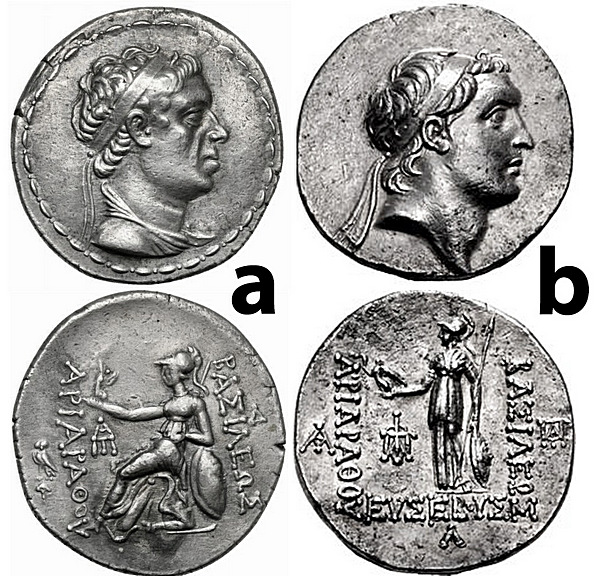
Late in his reign, Ariarathes IV introduced silver tetradrachms struck on the reduced Attic standard. These depict the king on the obverse and Athena seated on the reverse. A fillet border surrounds the portrait.
Evidence suggests these coins were minted at Soloi in Cilicia.
Ariarathes V and a Silver-Based Coinage
Ariarathes V Eusebes Philopator (163–130 BCE)
He emphasized Greek culture and strong ties to Rome. He founded Tyana and refounded Mazaka as Eusebeia.
His silver coinage dominates his reign. He struck tetradrachms and drachms depicting his portrait and Athena standing. The reverse legend identifies him as king and includes the epithet Eusebes.
Ariarathes V died in 130 BCE while supporting Rome during its war against Aristonikos.
Orophernes: Usurper King of Cappadocia (159–157 BCE)
Orophernes was a half-brother of Ariarathes V Eusebes Philopator and a member of the Ariarathid dynasty. Ancient sources identify him as a son of Ariarathes IV, though they do not name his mother. His claim to the throne rested on dynastic legitimacy rather than popular support.
Accession with Seleucid Support
In 159 BCE, Orophernes sought to overthrow Ariarathes V by appealing to Demetrius I Soter, ruler of the Seleucid Empire. Demetrius provided military assistance, enabling Orophernes to seize control of Cappadocia and force Ariarathes V into exile.
Orophernes presented his case to the Roman Senate, arguing that he had a legitimate claim to the Cappadocian throne. The Senate chose not to support either claimant fully. Instead, Rome divided the kingdom between the two brothers. This decision reflects Rome’s broader policy during the period, which favored balance and influence over direct intervention.
Unpopular Rule and Loss of Power
Ancient literary sources portray Orophernes as deeply unpopular among the Cappadocian population. His reliance on foreign troops and Seleucid backing appears to have undermined his legitimacy. Additionally, sources accuse him of heavy taxation and the seizure of temple funds, though these claims come from hostile accounts and cannot be independently verified.
In 157 BCE, Ariarathes V returned with military support from Attalus II. Orophernes was quickly deposed and fled to Seleucid territory.
Final Years and Imprisonment
After his deposition, Orophernes remained in Syria. Ancient sources report that he later became involved in a conspiracy against Demetrius I. As a result, Demetrius imprisoned him. The sources do not record his death date, but they agree that he spent the remainder of his life in captivity.
The Coinage of Orophernes
The only securely attributed coinage of Orophernes consists of silver tetradrachms struck on the reduced Attic standard, weighing approximately 16.7 grams. Numismatic evidence indicates that these coins were minted at Priene, a city under Seleucid influence at the time.
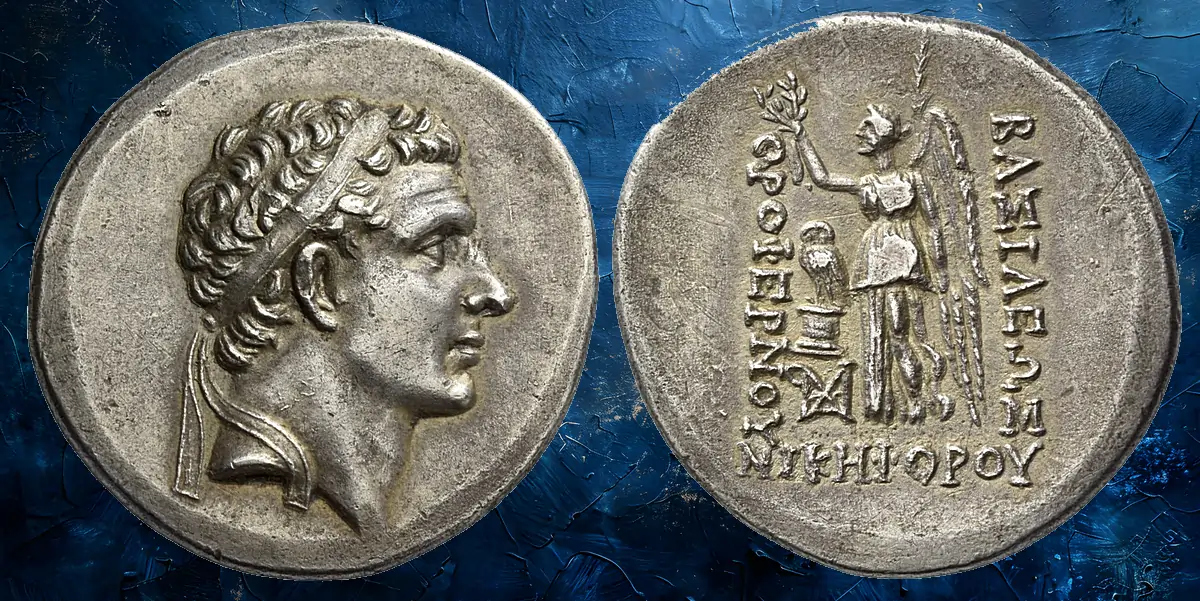
Harlan Berk later ranked this coin among the 100 greatest ancient coins.
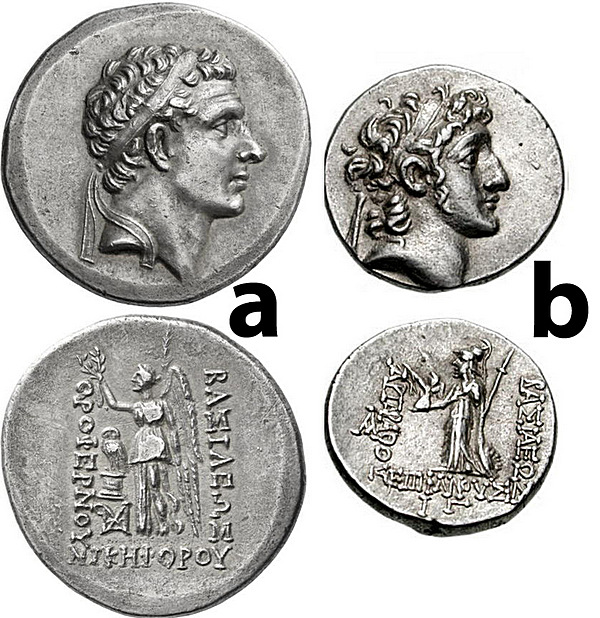
The obverse depicts a finely engraved diademed portrait of Orophernes facing right. The reverse shows Nike standing left, crowning the royal name and holding a palm branch. An owl appears in the field, a civic symbol associated with Priene.
The Greek legend identifies him as BASILEOS OROPHERNOU NIKHΦOPOU, meaning “King Orophernes, Victory Bearer.” The epithet Nikephoros likely served a propagandistic purpose, emphasizing military success at a time when his authority remained contested.
Numismatists widely regard this issue as one of the finest portrait coins of the Hellenistic period. Harlan Berk ranked the Orophernes tetradrachm as number 82 in 100 Greatest Ancient Coins, noting both its artistic quality and extreme rarity. Fewer than a dozen examples are known, most held in institutional collections.
Historical Significance
Orophernes’ reign was brief, but it illustrates several recurring themes in late Hellenistic Anatolia. Dynastic legitimacy alone did not guarantee stability. Foreign intervention, Roman arbitration, and public acceptance all shaped outcomes.
His coinage stands in sharp contrast to his political failure. While his rule collapsed quickly, his tetradrachms remain among the most admired works of Hellenistic numismatic art, preserving his image far more successfully than his reign preserved his power.
Ariarathes VI and Dynastic Instability
Ariarathes VI Epiphanes (130–116 BCE)
Early coinage includes rare jugate drachms showing Ariarathes VI with his mother Nysa. Later issues depict him wearing a diadem.
Political instability continued. Mithridates V arranged his assassination in 116 BCE.
Conclusion
By the mid-second century BCE, Cappadocia had evolved from a Persian satrapy into a Hellenistic kingdom with a sophisticated monetary system.
NOTE a “satrap” is a provincial governor in the ancient Persian empire.
Coinage records these transitions in metal. Part II will examine the later Ariarathids and the shift toward Roman client kingship.