


Ancient Greek Coins by Russell A. Augustin, AU Capital Management, LLC ……
From the Colosseo Collection ……
Akragas and the Art of Sicilian Coinage
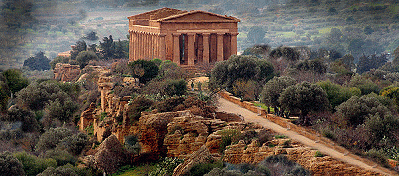
Founded on the southern coast of Sicily, Akragas (modern Agrigento) rose to become one of the wealthiest and most powerful Greek cities in the western Mediterranean, rivaled only by Syracuse. Its prosperity was famously expressed through monumental architecture, including the great Doric temples that still dominate the site today.
For nearly a century, the coinage of Akragas remained remarkably consistent. Early issues typically featured Zeus’ eagle on the obverse and a crab on the reverse, civic types that reflected both divine favor and local identity. Over time, however, the competitive aristocratic culture of Sicily transformed the artistic landscape. Elite rivalry, displayed in equestrian contests, public works, and increasingly in coin design, produced what can only be described as a numismatic arms race.
The Great Artistic Transformation
Around 415 BCE, Akragas undertook a dramatic redesign of its coinage across multiple denominations. The new issues exhibit a leap in complexity, naturalism, and compositional ambition. These coins are widely regarded among the most beautiful products of Greek numismatic art, clearly the work of master engravers active in late fifth-century Sicily.
The silver obol discussed here is among the smallest of Greek denominations, yet it demonstrates extraordinary technical refinement. Despite its diminutive fabric, the engraver achieved remarkable depth, motion, and anatomical realism, a testament to both artistic confidence and technical mastery. The scene is executed with vigor and tension, maximizing the limited surface area of the flan.
Stylistically, this obol shares clear affinities with the celebrated dekadrachms of Akragas and the so-called Skylla tetradrachms. Many scholars attribute these dies to the same workshop, if not the same master engraver responsible for the renowned Agrigentum dekadrachm issues.
Obverse: Eagles and Omen
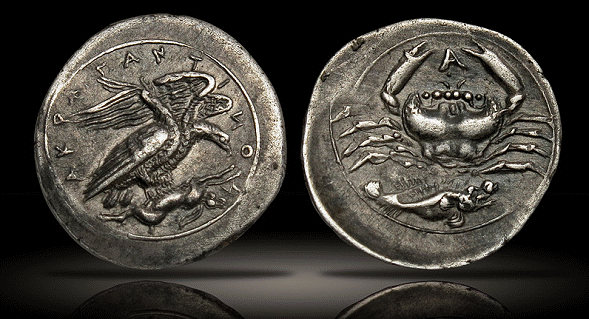
The obverse depicts two eagles tearing apart a hare they have just captured. One bird spreads its wings while bending downward toward the prey; the other raises its head in a triumphant gesture. The composition avoids rigid symmetry, instead embracing naturalistic movement and psychological tension.
The imagery likely references a passage from the Agamemnon of Aeschylus. In the play, two eagles devour a pregnant hare, an omen foretelling the destruction of Troy by Agamemnon and Menelaus. The scene conveys themes of power, conquest, and divine sanction, appropriate symbolism for a city at the height of its wealth and ambition.
Reverse: Civic Identity and Maritime Power
The reverse features a crab, long the civic badge of Akragas, symbolizing both the nearby Akragas River and the city itself. Beneath the crab appears a fish, commonly identified as a sea perch. While earlier issues emphasized freshwater associations, this pairing may signal the city’s expanding maritime interests during the late fifth century BCE.
A Special Issue?
All known specimens of this obol appear to derive from a single pair of dies, suggesting a limited production. The exceptional artistry invested in so small a denomination further supports the theory that this was not a routine circulation piece. It may have been a ceremonial issue, commemorative distribution, or elite presentation piece, intended to advertise both artistic sophistication and civic strength.
Ironically, the triumphant imagery proved short-lived. In 406 BCE, Akragas was sacked by Carthaginian forces, an event that marked the end of its golden age and brought this remarkable period of artistic coinage to an abrupt close.
Today, this obol stands as a miniature masterpiece, evidence that in late Classical Sicily, even the smallest coins could serve as vehicles for monumental artistic expression.
* * *
Akragas. Obol (Silver, 0.79 g), c. 410-406 BCE. Two eagles standing right on dead hare, the one in front with closed wings and its head thrown back screaming in triumph, the one behind with wings open and head turned down, tearing at its prey with its beak. Rev. Crab with between its claws; below, grouper (Polyprium cernium) swimming to right. Basel 263 = SNG Lockett 519 (same dies). Rizzo pl. III, 6 (same dies). SNG Lloyd 829 (same dies). Very rare. Beautifully toned, a superb coin of the finest style. Extremely fine.
Ancient Coin Articles on CoinWeek






What an enchanting coin. Such detail for a small piece!
Interesting coin. I like to see different types of coins and designs.
Ancient coins are so interesting! Thanks for this article.