By Steve Benner
A Forgotten Frontier of Magna Graecia
Ancient Apulia lay along the eastern Adriatic coast of the Italian peninsula, just north of the “heel” of Italy’s boot. The heel itself belonged to Calabria in antiquity, though modern geography treats it as part of Apulia.
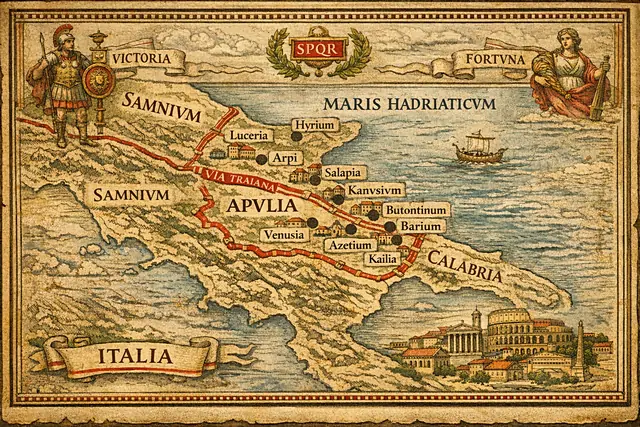
To the east stood Samnium and Lucania. To the north lay Frentani.
Originally, Apulia belonged to the Apuli, a Samnite Oscan tribe living near Mount Garganus. Later, the region included the Daunii and the Messapian-speaking Peucetii.
By the end of the fourth century BCE, Apulia had become thoroughly Hellenized. Greek influence flowed from Tarentum in Calabria. However, unlike the wealthy coastal cities of Magna Graecia, Apulia remained something of a backwater. It developed colonies late. Rome only began to take serious notice in the late fourth century BCE.
Yet beneath this quiet reputation lies a remarkable numismatic story.
Wealth Without Fame
Apulia produced wine and oil across its fertile plains. Rome later relied on the region for cattle and horses. Large-scale sheep farming followed, and Apulian wool earned high praise.
During the Samnite and Punic Wars, Rome tightened its grip. By the third century BCE, Apulian cities incorporated Roman monetary features. Before long, they minted coins in unmistakably Roman styles.
Still, only a few cities struck silver. Most minted bronze alone. The most prosperous mints were:
- Arpi
- Kaelia
- Kanousion
- Rubi
Each tells a different story.
Arpi: Myth, Horses, and War
Ancient tradition credits Arpi’s founding to the Argive King Diomedes. Greek myth says Diomedes stole the white horses of King Rhesus. Appropriately, horses dominate Arpi’s coinage.
![Figure 2: Arpi, Apulia: a) Stater, 270-250, 6.91 g., Head of Demeter with wreath of ears of grain and ear pendant to left, / [ARPANWN] Free horse leaping to left, above a star, below a helmet, SNG ANS 631; b) Circa 325-275 BC. AR Obol, 0.54 g. Horse prancing right; A above horse / Fishhook; L to right. SNG France 1224; c) Circa 215-212 BC. AR triobol, 1.90 g. Helmeted headof Athena left / Three grain ears conjoined at the stem, HN ltaly 646; c)](jpg/fig2_sb.jpg)
Early Silver Coinage
Arpi began minting in the late fourth century BCE on the Campanian standard of approximately 7.3 grams to the didrachm stater.
A stater from 270–250 BCE shows Demeter crowned with grain on the obverse. A free horse leaps on the reverse. The ethnic ARPANWN appears prominently.
Smaller denominations followed:
- Diobols: Athena with horse or Herakles [A diobol is an ancient Greek silver coin worth two Obols, equivalent to 1/3 of a drachma.These small, often sub-10mm coins were used for daily transactions, such as paying for small goods, and were produced by various city-states between the 6th and 3rd centuries BCE]
- Obols: Horse and fishhook; or boar’s head and horse’s head [An obol is an ancient Greek silver coin worth one-sixth of a drachma, typically weighing around 0.72 grams. Originating from iron spits (“obelos”), they were used in daily commerce and funerary rites, where one was placed in the mouth of the deceased to pay Charon to ferry souls to the underworld]
The fishhook forms a visual pun on the Greek word arpe.
Punic Influence
After Cannae, Arpi shifted to the Punic standard. The mint produced triobols (1.8 g), diobols (1.2 g), and obols (0.6 g).
A triobol dated 215–212 BCE shows helmeted Athena. Three conjoined grain ears appear on the reverse. The number of ears indicates denomination:
- One ear = obol
- Two ears = diobol
- Three ears = triobol
This system stands as one of Apulia’s most clever numismatic devices.
Bronze Coinage
Arpi also struck bronze beginning in the late fourth century BCE.
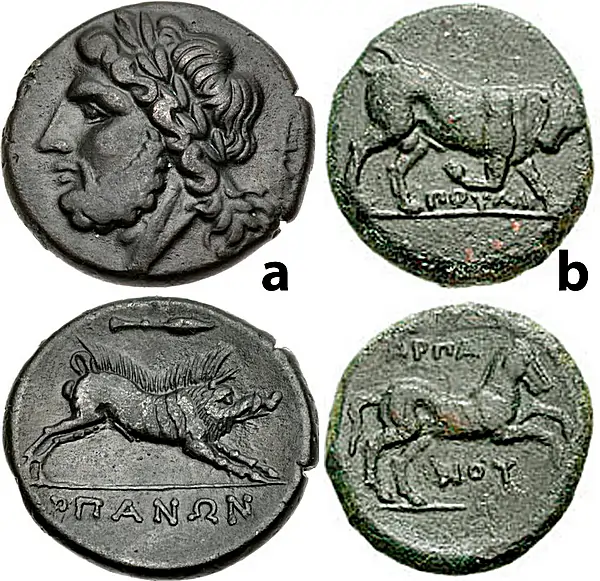
Types include:
- Apollo and lion
- Zeus and boar
- Charging bull and galloping horse
Notably, the boar reverse closely resembles the Aetolian quarter stater reverse. Roman magistrates later appeared on issues, such as POULLI on a mid-third-century bronze.
Arpi’s coinage reflects myth, agriculture, and military turbulence, all in silver and bronze.
Kaelia: A Border City with Greek Roots
Ancient geographers debated whether Kaelia belonged to Apulia or Campania. Its coinage confirms Apulian identity.
Little survives about its history. However, its coinage speaks clearly.
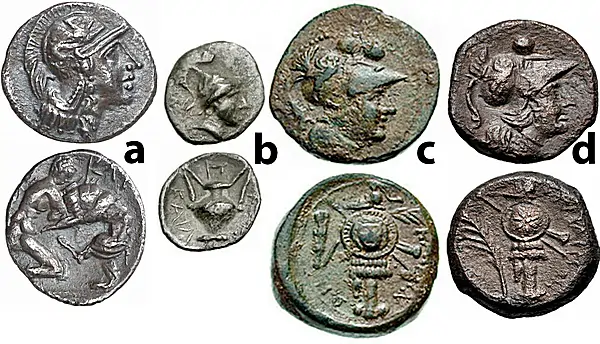
Silver Issues
Kaelia struck silver from the fourth to second century BCE.
The early diobol features Athena and Herakles wrestling the Nemean lion. Obols show a pig on the obverse and KAI within an olive wreath on the reverse.
By the mid-third century BCE, the mint adopted the Tarentine standard. Obols depict:
- Helmeted male head and amphora
- Bull’s head and kithara
- Bull’s head and kantharos
Silver production ended by the mid-third century.
Bronze During the Punic Wars
In the last quarter of the third century BCE, Kaelia issued bronze under the Roman sextantal standard of 54.8 grams to the as.
A sextans shows Athena in Corinthian helmet. Two pellets mark the denomination. The reverse depicts a trophy with KAILINWN.
An uncia shows a single pellet for value. The mint also struck semunciae at half the weight of the uncia. At least three varieties exist for each denomination.
Kaelia’s coinage demonstrates Roman influence during wartime mobilization.
Kanousion: From Rebellion to Roman Citizenship
Like Arpi, Kanousion claimed Diomedes as founder. In reality, Daunians likely settled the city before Hellenization in the fourth century BCE.
During the Samnite Wars, Kanousion sided against Rome. Rome devastated its territory. Thereafter, loyalty shifted.
After Cannae, Kanousion welcomed Roman survivors. The city provided clothing, food, and money. This act likely spared it harsher punishment.
During the Social War (91–87 BCE), the city rebelled again. Rome failed to capture it. In 89 BCE, Kanousion received full Roman citizenship.
Silver Coinage
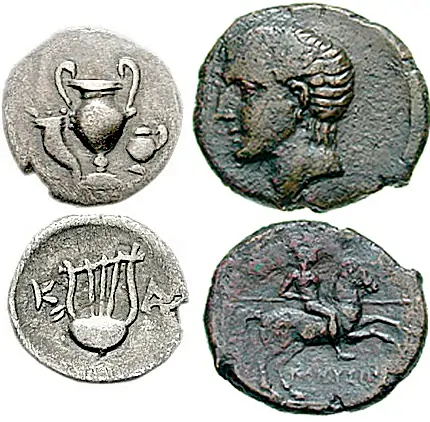
In the early third century BCE, Kanousion minted obols on the Achaian standard of 7.8 grams to the tridrachm.
Types include:
- Amphora and kithara (legend K-A)
- Bare male head and mounted warrior (KANUSINWN)
- Hemiobols depict Helios and crescents, or chelys (a tortoiseshell lyre) within a wreath.
Silver production ceased around 250 BCE.
Bronze and Roman Minting
Subsequently, Kanousion struck bronze denominations: triens, quadrans, sextans, and others weighing roughly 7 and 2 grams.
Later, near the end of the third century BCE, the city functioned as a Roman mint. It produced:
- As
- Semis
- Triens
- Quadrans
- Sextans
- Uncia
- Semuncia
Kanousion transformed from rebel ally to Roman monetary partner.
Rubi: Quiet but Complex
Rubi remains obscure in literary sources. However, its coins provide clarity.
The city gained full Roman citizenship at the end of the Social War in 90 BCE and became a municipium.
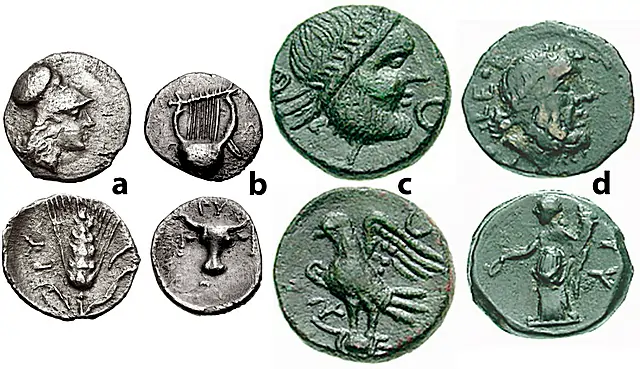
Silver Fractionals
In the late fourth and early third centuries BCE, Rubi struck diobols and obols on the Achaian standard.
Diobols show Athena and either:
- Grain ear
- Herakles and lion
The legend appears as PY, likely representing the Greek letter Rho.
Obols include chelys on the obverse and bucranium on the reverse. Six types exist.
Silver minting stopped by 275 BCE.
Bronze Series
Rubi issued four bronze denominations ranging from 7 to 2 grams.
Types include:
- Zeus and eagle on thunderbolt
- Herakles and club
- Athena and owl or Nike
- Zeus and Tyche with phiale and cornucopia
The PY monogram appears consistently.
Rubi’s modest coinage shows careful iconographic planning.
Why These Coins Matter
At first glance, Apulian coins seem unremarkable. They lack the artistic brilliance of Syracuse or Tarentum.
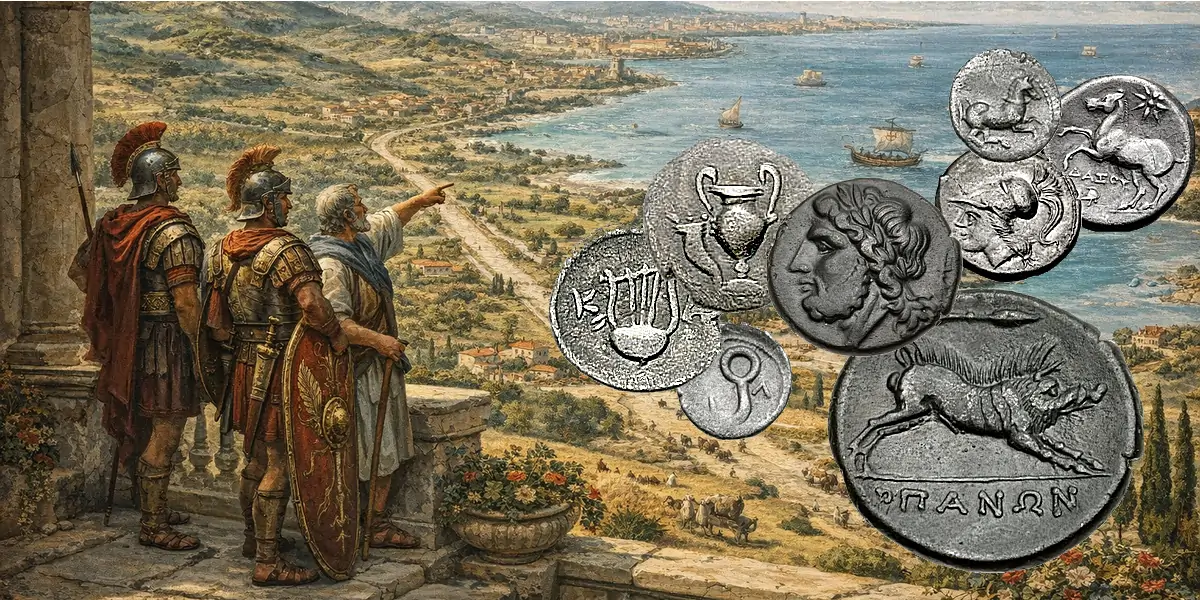
However, here is the overlooked truth.
These coins record a frontier in transition.
Arpi shifts standards after a Punic garrison. Kaelia adopts Roman weight systems during wartime. Kanousion transforms from Samnite ally to Roman mint. Rubi quietly stops silver production decades before full Roman integration.
Each change marks political pressure, and each weight shift reveals allegiance.
Apulia’s coinage captures the precise moment when Greek Italy yielded to Roman Italy.
That transformation shaped Western civilization.
And it happened, quietly, in silver obols and modest bronze sextantes.
Collecting Ancient Apulian Coins Today
Silver examples remain difficult to locate in the marketplace. Bronze pieces appear more frequently.
Despite relative scarcity, prices often remain modest. Therefore, the challenge lies in locating examples rather than affording them.
Collectors who pursue Apulian coinage enter a specialized and rewarding field.
References
- Acsearch.info Auction Database
- Classical Numismatic Group (CNG)
- Grant, Michael. A Guide to the Ancient World (1986).
- Head, Barclay V. Historia Numorum (1887).
- Hoover, Oliver. Handbook of Coins of Italy and Magna Graecia, Vol. 1 (2018).
- Hornblower & Spawforth. Oxford Classical Dictionary (1996).
- Sear, David. Greek Coins and Their Values, Vol. 2 (1979).
- Steve Benner writes for CoinWeek with a focus on ancient numismatics and the intersection of history and coinage.