


By Charles Morgan and Hubert Walker for CoinWeek Notes …..
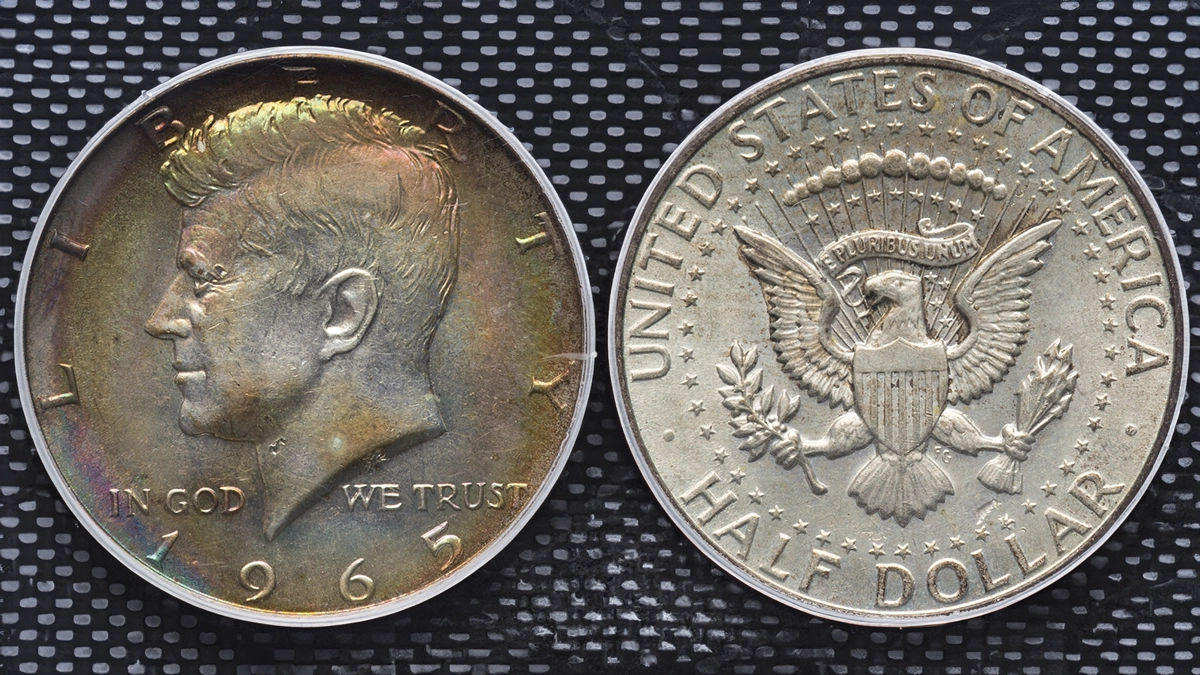
The silver Kennedy Half Dollar was first issued in 1964 as a memorial to President John F. Kennedy just months after his shocking assassination in Dallas. But this desire to commemorate the beloved young President in silver ran contrary to the evolving realities of the market for the precious metal.
In 1965, when Congress acted to change the composition of America’s silver coins to base-metal clad, it made an exception for the half dollar, which merely saw a reduction to 40% silver (the remainder being a copper-nickel alloy). It’s not solely because of this carve out that the half dollar denomination fell out of daily use, but it certainly didn’t help matters that Congress did not see fit to work with the vending machine industry to find a solution for the cumbersome coin now that it’s size and weight was no longer based on the coin’s intrinsic value.
Collecting the Silver-Clad Kennedy Half Dollar
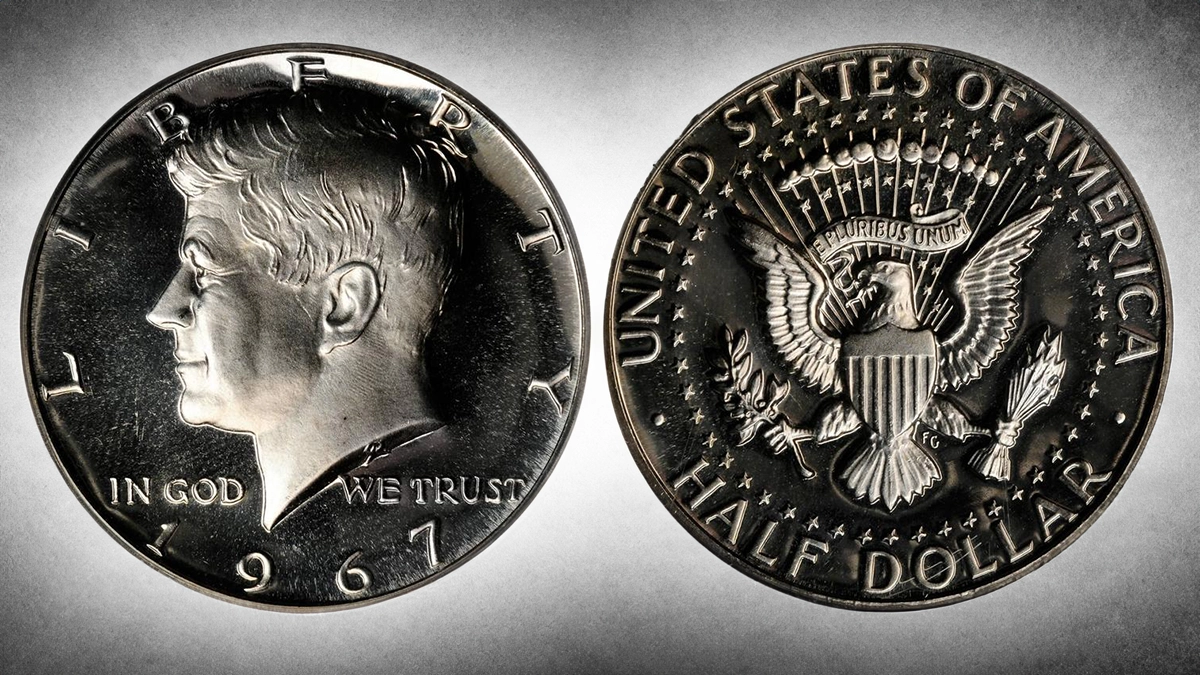
The Silver Clad-Kennedy Half Dollar type is an affordable and easily completable subset of the Kennedy Half Dollar series. The set consists of six business strikes, three Special Mint Set coins, and three Proof issues.
Kennedy Half Dollars, Silver-Clad Type (1965-1970) |
||
| Business Strikes | Special Mint Set Coins | Proof Coins |
| 1965 | 1965 | |
| 1966 | 1966 | |
| 1967 | 1967 | |
| 1968-D | 1968-S | |
| 1969-D | 1969-S | |
| 1970-D | 1970-S | |
Business strikes were produced for all six years, although all business strikes produced from 1968-1970 carry the “D” mintmark of the Denver Mint. Uncirculated examples of these coins can be acquired in the United States Mint’s annual Uncirculated Coin Sets, which resumed production in 1968.
Special Mint Set coins were produced for sale as a replacement for the Mint’s annual Uncirculated Sets and Proof Sets. The coins are quasi-Proofs, but not made to the same specifications. These sets were produced at the San Francisco Assay Office but do not carry a mintmark. They were sold at an issue price of $4 and included each of the five coins struck that year. The 1965 Special Mint Set was produced in 1966, while production of the 1966 Special Mint Set coins began in August of that year. These sets can be obtained today for less than $15 each.
Proof Set production resumed in 1968. As with the Special Mint Sets, Proofs were struck in San Francisco, but this time carried the “S” mintmark. Between 2.6 and 3 million sets were produced each of the three years that silver-clad Kennedy Half Dollars were struck, so collectors will have little trouble acquiring a set for a reasonable price.
In-Depth Date Analysis by CoinWeek Notes
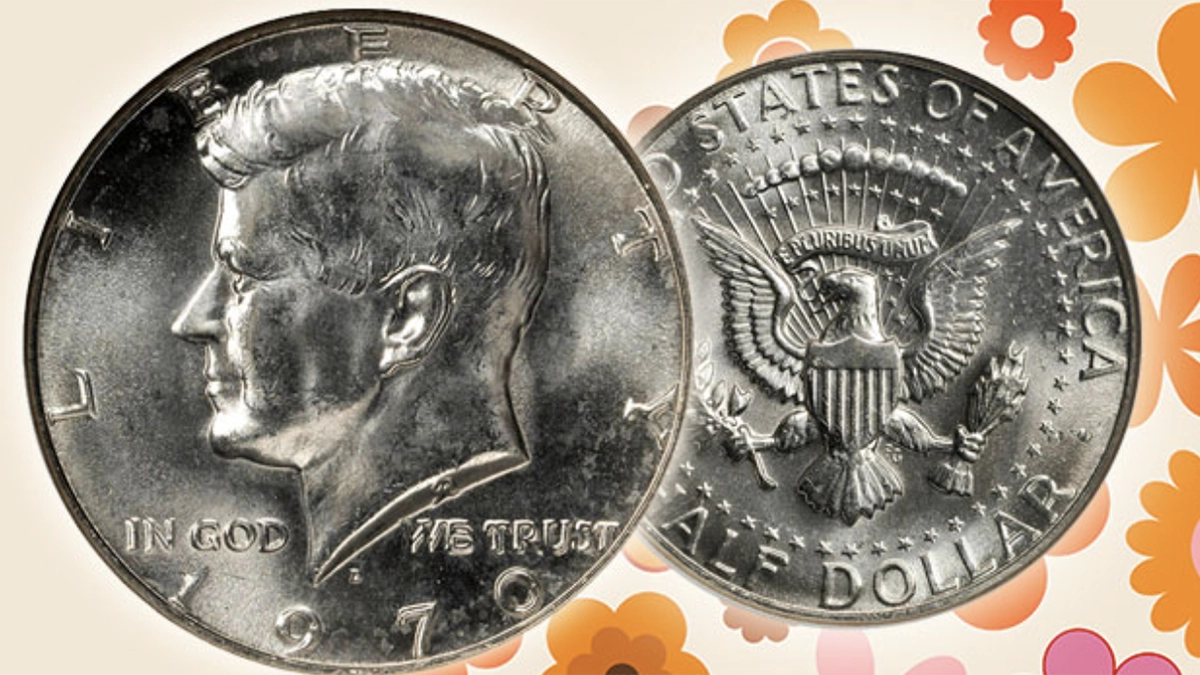
Kennedy Half Dollar, Silver-Clad Design
Obverse:
Chief Engraver Gilroy Roberts adapted the Kennedy Half Dollar obverse from his work on the Kennedy Inaugural Medal. President Kennedy’s left-facing portrait is the design’s central motif. Wrapping around the upper portion of the rim is the word LIBERTY. The national motto IN GOD WE TRUST is inscribed in a straight line that extends from the left edge to the right edge of the coin, with “GOD” and “WE” separated by the truncation of Kennedy’s neck. The date 1964 wraps around the bottom of the design. Roberts’ initials appear on the truncation of Kennedy’s neck above the word “WE”.
Reverse:
Roberts’ assistant Frank Gasparro adapted the Kennedy Half Dollar reverse design from the Seal of the President of the United States. A heraldic eagle is splayed, its chest protected by the Union shield. Clutched in its beak is a ribbon emblazoned with the motto E PLURIBUS UNUM. A glory of rays, clouds, and stars fans out from behind the eagle. The 13 stars represent the original British American colonies, while the rays and clouds signify heaven and the divine providence the founders believed inspired the formation of the United States. The eagle’s talons grip an olive branch in its dexter and a spray of arrows in its sinister. Fifty stars surround this central motif.
The legend UNITED STATES OF AMERICA wraps around the top of the design. The denomination HALF DOLLAR wraps around the bottom. Gasparro’s initials FG appear between the eagle’s left leg and tail feathers.
Edge:
The edge of the Kennedy Half Dollar is reeded.
Coin Specifications
| Kennedy Half Dollar | Silver-Clad Type |
| Years of Issue: | 1965-70 |
| Mintage (Circulation): | High: 295,046,978 (1967); Low: 2,150,000 (1970-D) |
| Mintage (Proof): | High: 3,041,506 (1968-S); Low: 2,632,810 (1970-S) |
| Alloy: | .400 Silver, .600 Copper (Outer layers of .800 Silver, .200 Copper bonded to an inner core of .209 Silver, .791 Copper) |
| Weight: | 11.5 g |
| Diameter: | 30.6 mm |
| Edge: | Reeded |
| OBV Designer: | Gilroy Roberts |
| REV Designer: | Frank Gasparro |
| Quality: | Business Strike, Specimen, Proof |
* * *
Additional References
Bowers, Q. David. The Experts Guide to Collecting and Investing in Rare Coins. Whitman Publishing.
–. A Guide Book of United States Type Coins. Whitman Publishing.
Breen, Walter. Walter Breen’s Encyclopedia of U.S. Coins. Doubleday.
Guth, Ron, and Jeff Garrett. United States Coinage: A Study by Type. Whitman Publishing.
Taxay, Don. The U.S. Mint and Coinage. Arco Publishing.
Yeoman, R.S., and Jeff Garrett (editor). The Official Red Book: A Guide Book of United States Coins. Whitman Publishing.
* * *






Hello. I have inherited an assortment of coins of various monetary value; silver dollars, half dollars, quarters, etc. How would I go about finding a trustworthy appraiser with the intent of selling them?
I have a Kenny Half Dollar coin mint in the year 1964. How do I get the coin check for it value.
Yes, I like to know where I can purchase these special men sets actually all the ones that were mentioned that can only be received by the men sets and the San Francisco on the Denver and which ever other ones that were issued during the 68 to 70 and the 66 special sets as well
I have a Kennedy half dollar in a mint set I took it to a coin dealer and he also confirmed that it has no copper in it .it’s a 1965 no mint mark. its never been out of the plastic would like to know the value. It’s not the only thing I have. I have more mint sets. I would sell for the right price.
@Richard Trzebiatowski Thanks to Congress, no 1965-67 US coins carried mint marks so the lack of a letter on your coin is neither an error nor any help determining where it was made. It sounds like you have an ordinary 40% silver* half which would be worth its melt value at a minimum. The fact that it’s in a mint set would add more value because thee coin hasn’t been in circulation.
Y’all just get ready what about those silver half dollars that came before Kennedy death in 1965,aren’t they worth more than what they are,I’ve got a few 1958 silver half dollars and dollars in silver.
Can a John F. Kennedy 1973 be silver clad, J am going to double check. It has the raised edge on front and back. The color is not the bright silver, but a silver tone..Just saw you article will double check. I have lots of coins.
@Loucinda Brown One of the first tests is to look at the coin’s edge. If its color is coppery or brown like the edges of quarters and dimes, you have a standard cupronickel coin that’s unlikely to be worth more than face value unless it’s in superb condition. If the edge is gray, that would likely indicate the coin was somehow struck on a 40% silver blank.
HOWEVER … while some 1971 silver halves have been reported, the chances of a 40% blank surfacing three years later are quite slim. If you’re still not sure, try showing it around at a local coin show or club meeting where people are likely to have additional experience.
In restrospect the Treasury couldn’t have done a worse job with the half following 1964.
> Several numismatic writers have suggested that the 1964 issue should have been declared a one-year memorial coin. If the Franklin design had been resumed, perhaps far fewer halves would have been saved as mementos.
> Mint director Brooks, who wanted to convert the half to cupronickel immediately, was opposed by the silver lobby that wanted the denomination to be a “circulating prestige” piece (whatever that meant) with a much higher silver content. The 40% figure was a compromise intended to keep some silver but debase the coin enough to prevent melting … until it wasn’t. By 1968 speculators had driven up silver prices to the point where even debased halves were worth more than face value.
> The Mint waited *6* years to change the coin’s composition again, during which time nearly every 40% silver half vanished from circulation. By 1971 people had become accustomed to using multiple quarters and cash-register drawers were gradually reconfigured to have only four usable coin slots. By contrast, when a similar situation happened in Australia, within three years their Mint recalled all 80% silver halves and replaced them with a multi-sided cupronickel coin.
[An “oops”: In the story’s second paragraph, “it’s size” should of course be “its size”.]