


By Charles Morgan and Hubert Walker for CoinWeek Notes …..
In 1916, United States Mint Chief Engraver Charles E. Barber’s uniform designs for the dime, quarter, and half dollar were set aside, replaced by Adolph A. Weinman’s designs for the dime (Mercury, or Winged Liberty Head) and half dollar (Walking Liberty) – as well as Hermon A. MacNeil’s design for the quarter.
MacNeil, a noted sculptor for public works projects, placed Liberty standing on the obverse of the quarter and a soaring eagle on the reverse. His models for Liberty have been attributed to silent film actress, practicing nurse, and artist’s model Dora Doscher (also known as Doris Doree) and Broadway actress Irene MacDowell. Coin dealer J.H. Cline, a noted specialist in the series, believed it was MacDowell. Numismatist Roger Burdette, in his landmark work Renaissance of American Coinage, 1916-1921 (2005), doubts the MacDowell story and suggests that the Liberty portrait was most likely drawn from a composite of models. Both women did model for MacNeil, however.
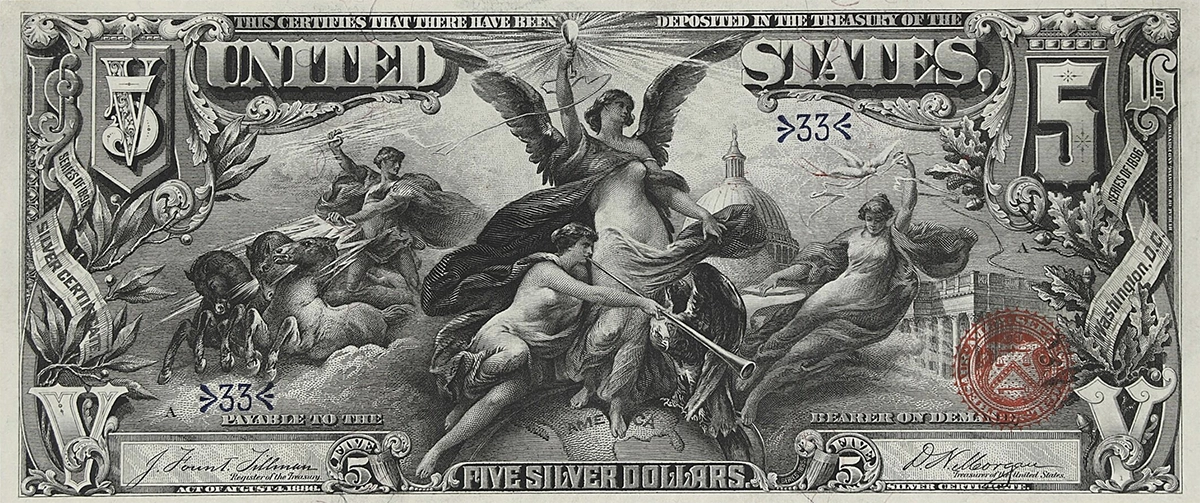
The first version of MacNeil’s design released in 1916 depicted Liberty in a classic semi-nude pose. This design was in line with the Beaux-Arts, a popular artistic style of the period. Liberty’s exposed breast was a novel concept for a United States coin, but not so for period art. The 1896 $5 Silver Certificate similarly depicted a partially nude female figure, reportedly to the dismay of the ladies of Boston high society, which resulted in some banks refusing to handle the notes.
The Opaque Design Change of 1917
An oft-repeated myth popularized by numismatist Walter Breen suggests that a groundswell of criticism regarding the semi-nude portrait of Liberty necessitated a change to the design in 1917. We have yet to read a convincing case for this assertion and Burdette claims to have found nothing in the Mint’s records to suggest that officials were concerned about this issue.
Instead, it is clear that MacNeil, like other notable outside artists before him, found it difficult working with the Mint’s engraving department and bureaucracy. The Mint had made several revisions to the artist’s design without his input. In fact, the Mint had made changes to the design between strikings of 1916 and 1917-dated Type 1 coins, which were struck starting in late 1916.
MacNeil received 20 (probably 1917-dated) Standing Liberty Quarters on January 10 and was surprised to learn about the changes. He wrote a detailed letter to Mint Director Friedrich Johannes Hugo von Engelken the next day, explaining his thoughts on the design changes and offering improvements:
- To lower Liberty’s head on the obverse;
- To modify Liberty’s legs to prevent her from appearing “bowlegged”;
- To minimize the sagging of the drapery covering the shield by pulling it tighter;
- To reduce the size of the lettering of LIBERTY; and
- To reduce the size of the word OF in the legend on the reverse
MacNeil did not mention Liberty’s chest, nor the change in the placement of the stars on the reverse.
Von Engelken–recognizing that he had a hand in the disconnect between the design now in production and MacNeil’s submitted and approved artwork–sought a compromise and wrote a letter to Treasury Secretary William Gibbs McAdoo on January 17 asking him to authorize a conference in Washington, D.C. with the Secretary and the Mint. McAdoo agreed and the three met on January 22. Afterward, MacNeil returned to his New York studio and began work on the agreed-upon improvements.
At the same time, tensions between the United States and the German Empire were reaching an inflection point. As Burdette points out, MacNeil’s art in the later part of 1916 reflected a sense that Liberty would meet the times “resolute, determined, and ready to fight.” MacNeil’s revised obverse design, completed in mid-February 1917, depicted Liberty wearing chain mail.
With America’s entry into World War I, MacNeil voiced the opinion that his Liberty portrait should be changed to reflect the times and so, with the approval of the Treasury Department, a revised design was submitted. Now Liberty wore armor over her chest. The reverse also saw major design modifications involving the position of the eagle and the placement of stars.
The Problem with the Date
While beautiful, the Standing Liberty Quarter, as was the case with the Buffalo Nickel, became dateless with wear. To address this issue, the date was recessed in 1925 – a change sometimes considered a third type of the series.
Full Head Designation
Standing Liberty Quarters also include a popular sub-type, that of quarters with a “Full Head” classification referring to the presence of details in Liberty’s head. Those details include distinguishable leaves in Liberty’s hair, a distinct hairline, and evident ear detail. Some authorities suggest that the complete presence of all the rivets in the shield held by Liberty is an alternative, perhaps better, indicator of a full strike. However, both head and rivet detail may not be present in the same coin, but only the presence of head detail defines the strike quality designation.
How Much Are Type 2 Standing Liberty Quarters Worth?
At least 3,000 to 4,000 business strike Type 2 Standing Liberty Quarters have been certified for each date and mintmark, more for the 1920s and ’30s coins. Several hundred to a thousand Full Head examples are listed for many issues. Prices are modest for most dates through MS63 and increase in Gem Mint State and finer. Higher priced coins are the 1918-S 8 Over 7, the 1923-S, the 1927-S, and Full Head examples. Some Full Head pieces are extremely expensive as MS64 and finer.
No official Standing Liberty Type 2 Proofs were made.
In-Depth Date Analysis from CoinWeek Notes
Extended Standing Liberty Quarter, Type 2 Coverage on CoinWeek
CoinWeek contributor Greg Reynolds discusses the Type 2 Standing Liberty Quarter in this installment of his Classic U.S. Coins for Less Than $500 Each series.
Tips for Detecting Counterfeit Standing Liberty Quarters
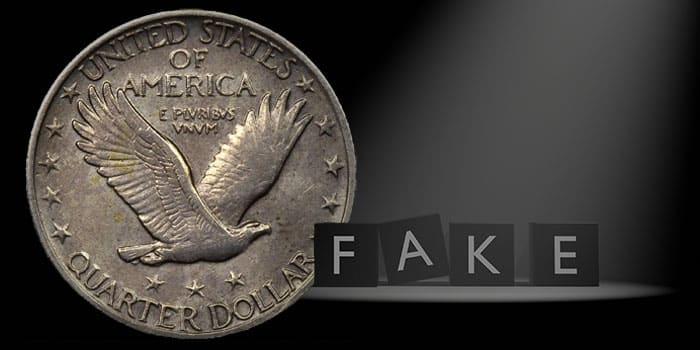
- From the Dark Corner: An “Authenticated” Counterfeit 1927-S Standing Liberty Quarter
- Struck Counterfeit Coin of the Week: 1927-S Standing Liberty Quarter + 1-Page Attribution Guide
Jack Young and the “Dark Side” group discuss a variety of fake 1927-S Standing Liberty Quarters.
Graders at NGC write about their encounter with a counterfeit 1924-S.
Design
Obverse:
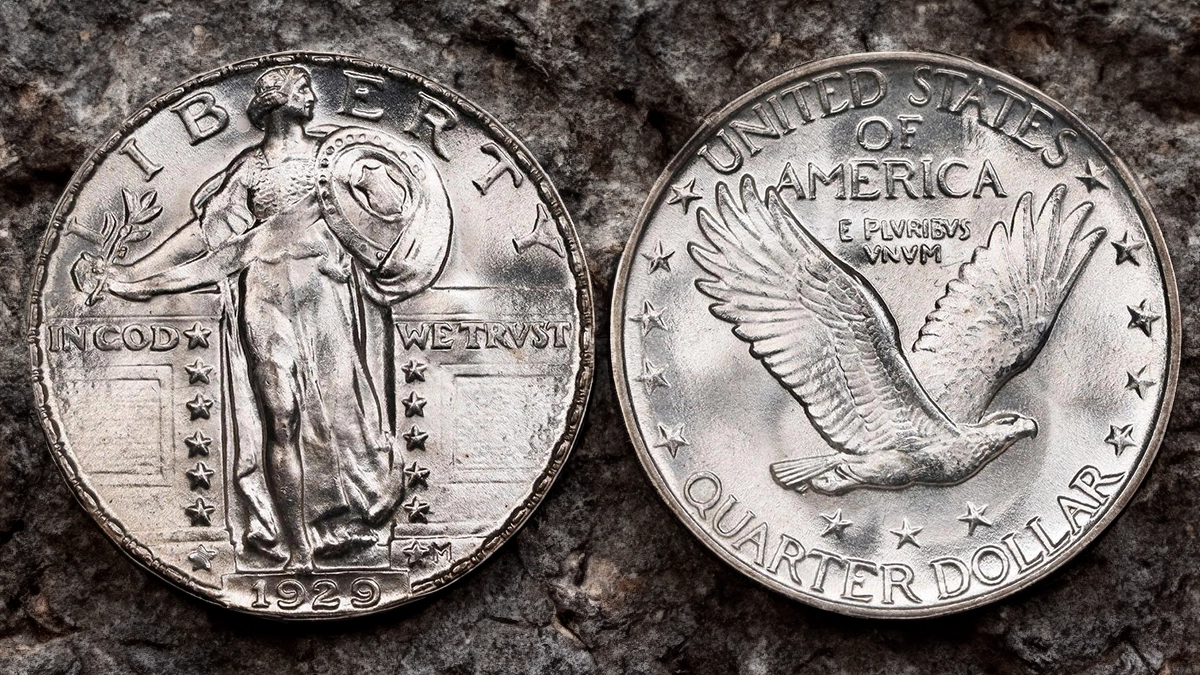
Lady Liberty stands in the opening of a wall or parapet, her right leg resting on the base and her left foot raised as if she is walking forward. Her long flowing gown, draped loosely and wrapped around her right arm, falls off the shoulders to reveal a chain mail armor vest. Her left arm holds a circular shield as if in a defensive posture; the shield displays the Union shield and several concentric rings, including a circle of raised dots or rivets near the edge. Liberty’s right arm is extended outward, resting on a portion of the wall, and her hand holds an olive branch. More loose drapery covers the bottom part of the shield, extends across the front of Liberty, and ends beneath the arm on the top of the wall.
The word LIBERTY arcs across the top of the coin, the “L” partially covered by the olive branch and “B” and “E” separated by Liberty’s head. Both wall sections display a rectangular panel of horizontal stripes, with IN GOD at the top of the left wall and WE TRVST similarly located on the right wall. Thirteen five-pointed stars form two columns along the wall edges next to the opening: seven to the left and six to the right (the top left star follows the “D” in GOD). The step upon which Liberty stands displays the date in raised numerals. The designer’s initial M is to the right of the bottom star in the right column, and for quarters minted in Denver or San Francisco, the D or S mintmark is located to the right of the bottom star in the left column. Inside the flat rim is a concentric ornamental ring consisting of two raised angular dots alternating with a short raised bar; the ring is broken by the step that displays the date.
Reverse:
The center of the reverse shows an eagle in flight, headed to the right, wings outstretched and raised. Inside the flat rim is a concentric ring of UNITED STATES at the top and QUARTER DOLLAR at the bottom, with five five-pointed stars separating UNITED and QUARTER on the left and five five-pointed stars separating STATES and DOLLAR on the right. Three additional five-pointed stars are below the eagle, above QUARTER DOLLAR. OF AMERICA, in two lines and of smaller-sized letters, lies below UNITED STATES; below that text in even smaller letters is the motto E PLVRIBVS VNVM on two lines.
Edge:
The edge of the Type 2 Standing Liberty Quarter is reeded.
Varieties
A few varieties have been identified, including the 1918-S 8 Over 7; the 1928-S Large S and Small S; and other, more minor die variations.
Standing Liberty Quarter, Type 2 Coin Specifications
| Standing Liberty Quarter, Type 2 | |
| Years of Issue: | 1917-30 |
| Mintage (Circulation): | High: 27,860,000 (1920); Low: 396,000 (1927-S) |
| Mintage (Proof): | None officially known |
| Alloy: | .900 silver, .100 copper |
| Weight: | 6.25 g |
| Diameter: | 24.30 mm |
| Edge: | Reeded |
| OBV Designer: | Hermon A. MacNeil |
| REV Designer: | Hermon A. MacNeil |
* * *
Additional References
Bowers, Q. David. The Experts Guide to Collecting and Investing in Rare Coins. Whitman Publishing.
–. A Guide Book of United States Type Coins. Whitman Publishing.
Breen, Walter. Walter Breen’s Encyclopedia of U.S. Coins. Doubleday.
Cline, J.H. Standing Liberty Quarters. Zyrus Press.
Guth, Ron, and Jeff Garrett. United States Coinage: A Study by Type. Whitman Publishing.
Taxay, Don. The U.S. Mint and Coinage. Arco Publishing.
Yeoman, R.S., and Jeff Garrett (editor). The Official Red Book: A Guide Book of United States Coins. Whitman Publishing.
* * *








During the ‘teens and twenties of the last century it was very common for artists to use the 24-character Roman alphabet rather than the modern English alphabet when lettering classically-themed designs. Like the letter Y that acts as both a vowel and a consonant in modern English, V and I also did double duty for the Romans – TRIPLE if you count their use as numerals! The letters U and J for the respective vowel sounds didn’t come into use until the Middle Ages.
I grew up near a city where many buildings from that era follow the same convention. My favorite has the bold inscription “AQVARIVM” over its entrance, no doubt because they once displayed tvna, halibvt, and gvppies.
I have been trying to find out what percent of the1917 standing liberty quarters have the 100% full head versus the minimum full head requirements as described by pcs and ngc.