


By Jack D. Young, Early American Coppers (EAC), and the Dark Side Group …… Updated Dec 11, 2025
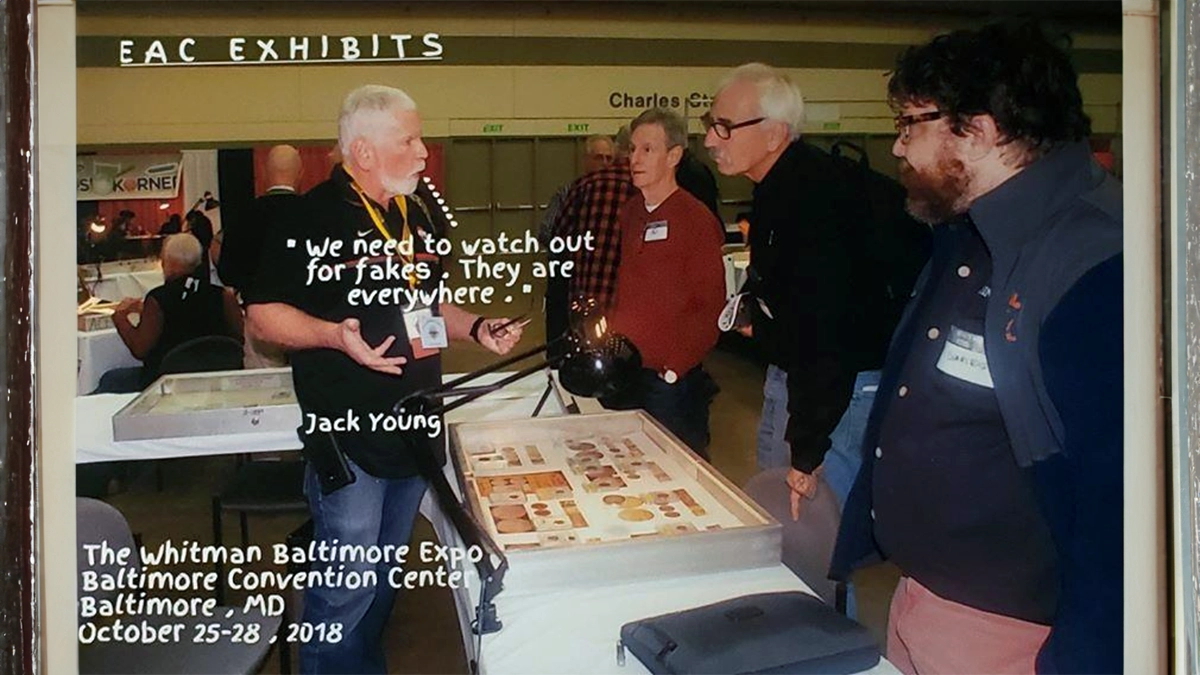
After submitting my 50th exclusive CoinWeek article on counterfeits, CoinWeek sent me a note asking whether I’d considered doing one on the five or 10 most deceptive counterfeits I’d ever seen and what had tipped me off about them. I responded that I thought that was a great idea!
But writing more articles on all of the fakes appearing in many different selling venues got in the way, and now, after 65+ articles published on CoinWeek, I found myself revisiting the idea!
And I wrote it under my “Dark Corner” brand instead of my current “Fun with Fakes (FwF)” because every one of the following has had one or multiple examples certified and slabbed as genuine by a major third-party grading service (TPG) or two.
These are the ones that keep me up at night, and certainly are not “Fun”…
Brief History of this “Ring” of Counterfeiters
All of these and approximately 20 other examples can be traced back to one counterfeit “ring”.
The moneyman was in China; he purchased genuine examples, many from good dealers on eBay (the “Bay”), and then shipped them to the “den” in College Station, Texas, where various seller IDs sold the clones on the Bay.
I am not aware if anyone knows where the counterfeits were actually “coined”.
I had the opportunity to present my findings on these at the time to the U.S. Secret Service in a face-to-face meeting, compliments of my friend and anti-counterfeiting activist Beth Deisher back in 2018.
As a result of that meeting, I had follow-up phone meetings with both a Texas Customs and Border Patrol (CBP) agent (who was aware of the location I had identified to the Secret Service) as well as a Treasury Department agent on the same subject.
Although I never heard what happened (I was told I would most likely not), the group disappeared, including all seller IDs on eBay, and I didn’t see any other new varieties from them again.
So, Here is My List
For each entry on this list, I will include the best images available–including full slab images if the example has been reported and the cert number dealt with–but I will redact the cert numbers of any still open.
The top five most deceptive counterfeits that I’ve encountered since we saw the first one back in the fall of 2015, in ascending order:
- 1796 S-85 Large Cent
- 1872-S Seated Half Dollar
- 1798 S-158 Large Cent
- 1836 Gobrecht Dollar
- 1797 S-139 Large Cent
Detailed attribution information on each can be found at the links above.
#5) 1796 S-85 Large Cent
This one was identified as a fake by a friend and colleague from Early American Coppers (EAC) for reasons apparent when compared to a genuine example. My initial thought was it could have been tooled but would not dispute the evidence.
Interestingly, I found another example with matching major attribution marks but some apparently enhanced details, leading me to believe that the counterfeiters tooled the original dies.
Further research resulted in finding the original holed example, and we realized they were actually repairing damaged genuine coins to make the dies.
Subsequently, this one was certified by a major TPG, and images taken highlighted the apparent “star” in front of the face and doubled ONE CENT, leading to more and deeper research.


As a result, this example was proven to have been struck over a later date Large Cent cull (another of my initial suspicions); the main buyer had purchased cull Large Cents from a couple of Bay sellers during the time we were researching these.

The total population includes two TPG-certified specimens, a couple of raw examples, and the known damaged genuine source coin.
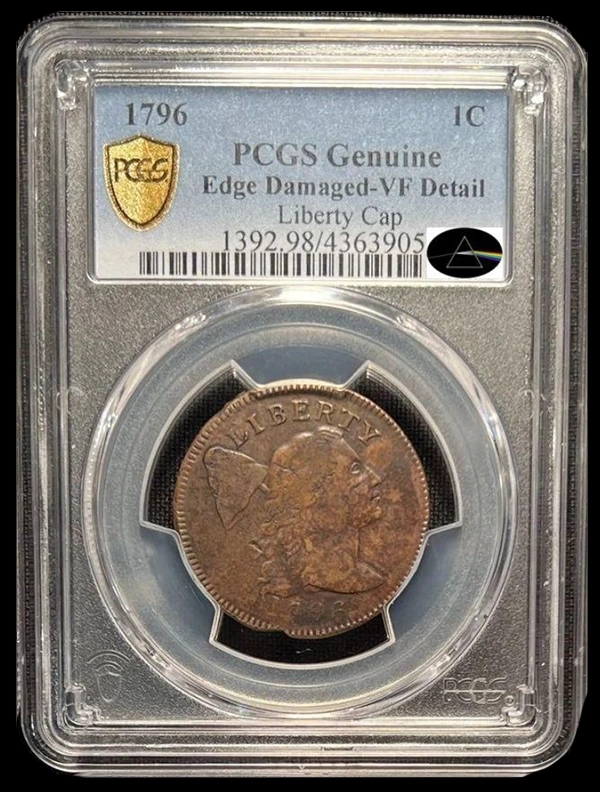
The main repeating attribution points are as follows:

This is the only example I have been able to document struck over another later date coin!
#4) 1872-S Liberty Seated Half Dollar
This was the “coin” that got me introduced to the Liberty Seated Collectors Club (LSCC) after finding a raw example listed on eBay by one of the known connected bad sellers.
Like the 1796 S-85, the 1872-S Half Dollar was initially “suspicious” due to the seller that was offering it, and after further review, the coin was not attributable to a genuine known variety for the date and mint.
I reached out to the LSCC, and a member responded that they had also found an example–this one in a TPG holder–and described what was wrong with them.
It actually took experts to figure it out, and as several articles have explained, the reverse was wrong for an 1872-S, although I found another in the same TPG’s holder as genuine.
More specifically, the obverse was reportedly from an 1872-P by mint state, the reverse with this unique (for an 1872-S) sized mintmark and location is from an 1875-S, and the reed count (yes, experts count edge reeds) was from an 1876!
I referred to it as a sort of “Frankenstein’s Monster” coin, with a couple of certified examples and a couple of raw ones but no documented genuine source coin, the only one we did not find for this group.
One image of this one is courtesy of my friends at NGC (who have not authenticated one), as well as in-hand images taken of the two slabbed examples.
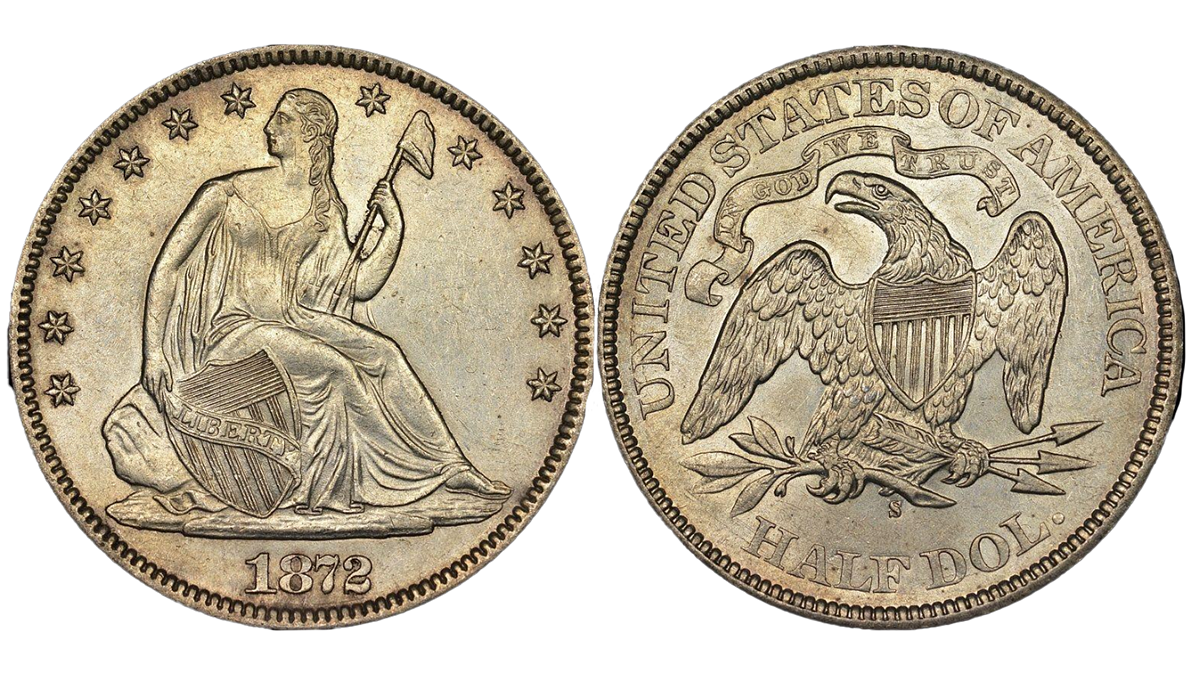

And the main repeating major attribution points as follows:

#3) 1798 ”S-158” Large Cent
The 1798 ”S-158” Large Cent is one of my favorites, having handled several fake examples from different venues, and it is actually the variety that started me down this rabbit hole in late 2015. It was also the subject for my meeting and presentation to the United States Secret Service in Washington, D.C..
The first one reported was initially investigated as a new unknown variety of 1798 Large Cent, but several more were almost immediately found after its discovery, with all having matching attribution marks.
The following images include the “discovery coin” (found by someone else), the first one I discovered, and another counterfeit from the same group of known eBay bad sellers.

Interestingly, all three of the imaged examples were listed and sold by three different seller IDs, but all linked back to one listed “Company” and corresponding location in Texas.
The following image, courtesy of a friend and fellow EAC (Early American Coppers) member, was also used for one of my Facebook Group pages.

It shows marks and repaired areas common to all known examples, with a genuine coin on top.
Another certified example, this one initially considered a die state of S-158:

One of the interesting things to note is that we’ve documented nine of these, including the presumed genuine source example, all found in the late 2015 to early 2016 timeframe.
We have not seen another, which makes me wonder how many more are out there in folks’ collections.
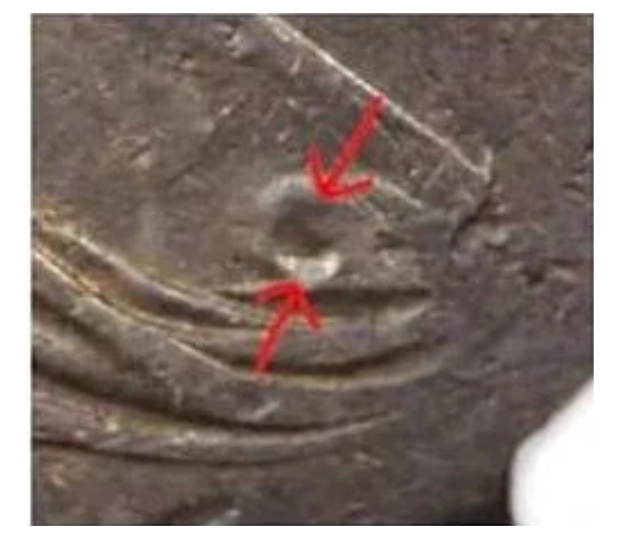
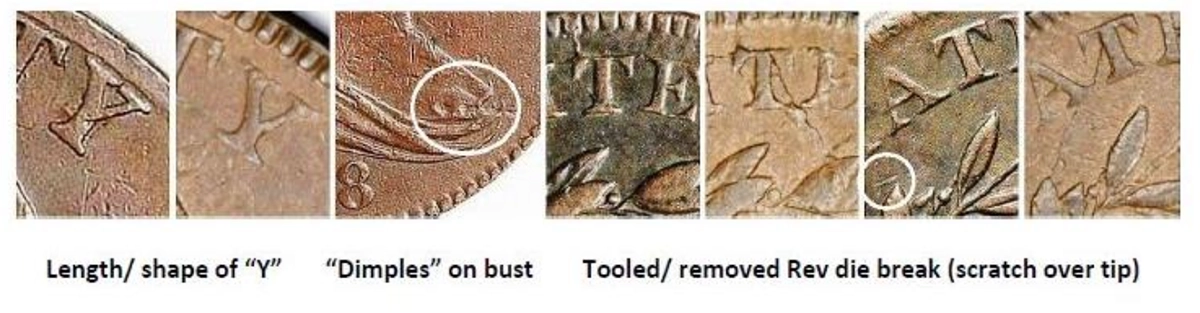
The main repeating attribution points are in the image below.
#2) 1836 Gobrecht Dollar
The 1836 Gobrecht Dollar coming in at number two is a prolific TPG-certified counterfeit found in a major auction venue along with the ‘Bay. I’ve written a couple of articles on these.

As in many of the deceptive certified counterfeits, the genuine source example for the dies was damaged and repaired to make the false dies.
The hole in this example was small and mainly affected the “OF” on the reverse, requiring tooling in that spot after plugging the hole. The most obvious result of the tooling was the tail of the “F”.
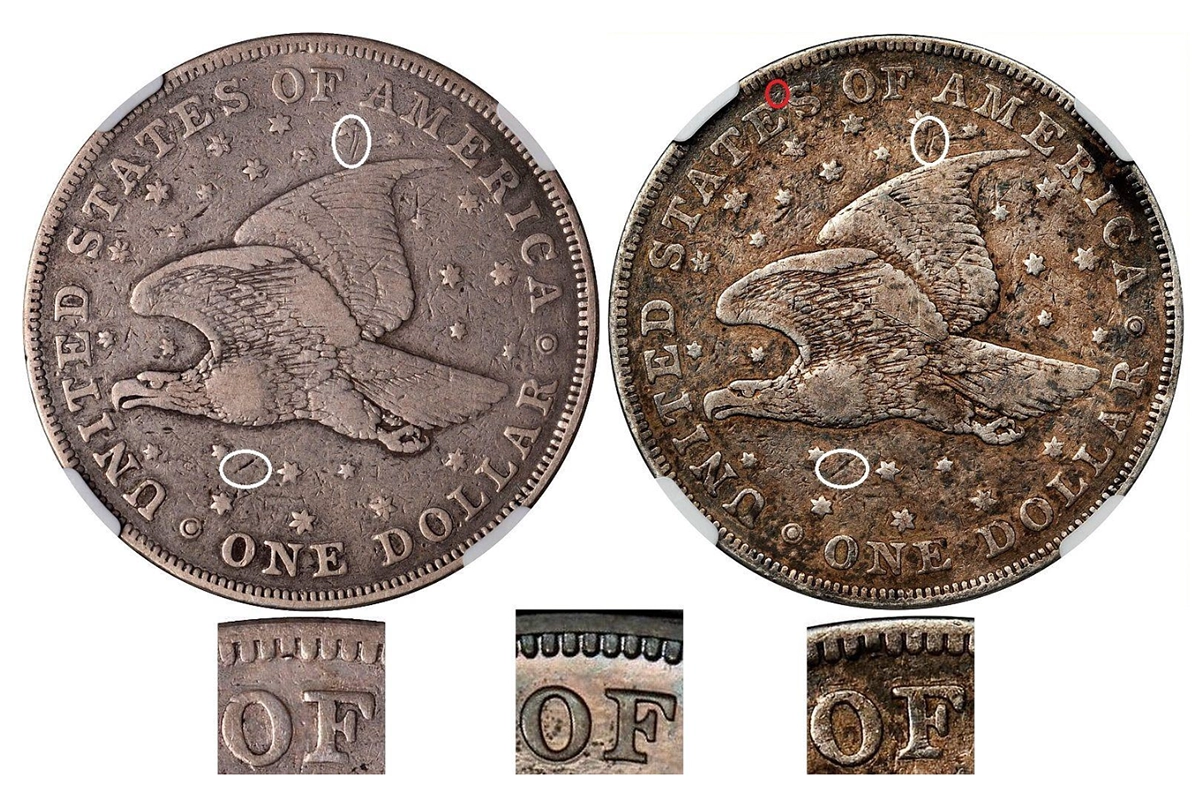
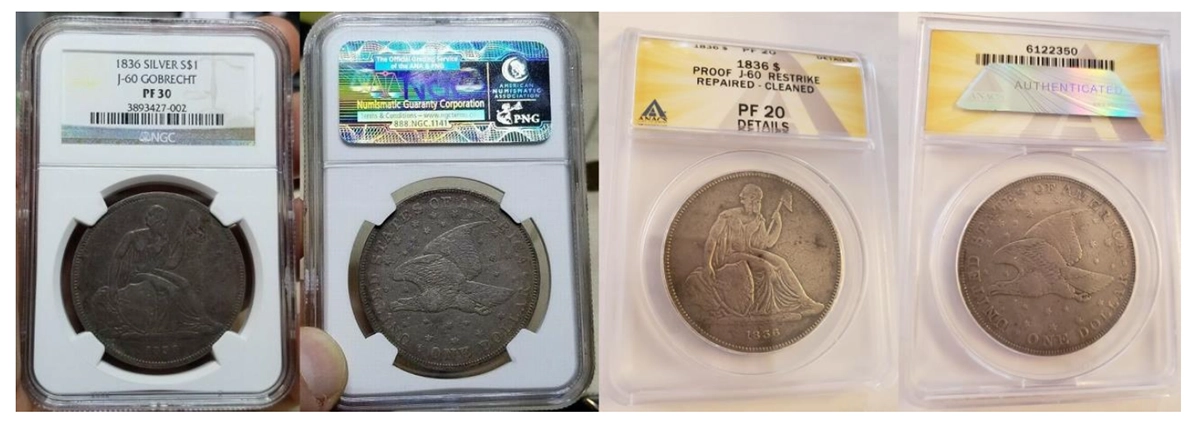
Since reporting these, one turned up a few years ago in a dealer’s inventory, also TPG-certified. I understand it was returned to the third-party grading service that “authenticated” it.
The main repeating attribution points are as follows:

#1) 1797 S-139 Large Cent
So, here we are at NUMERO UNO, the 1797 “S-139” Large Cent, the one that a friend and big-time Early American Copper dealer said kept him up at night, and another was convinced only when I showed him the evidence.
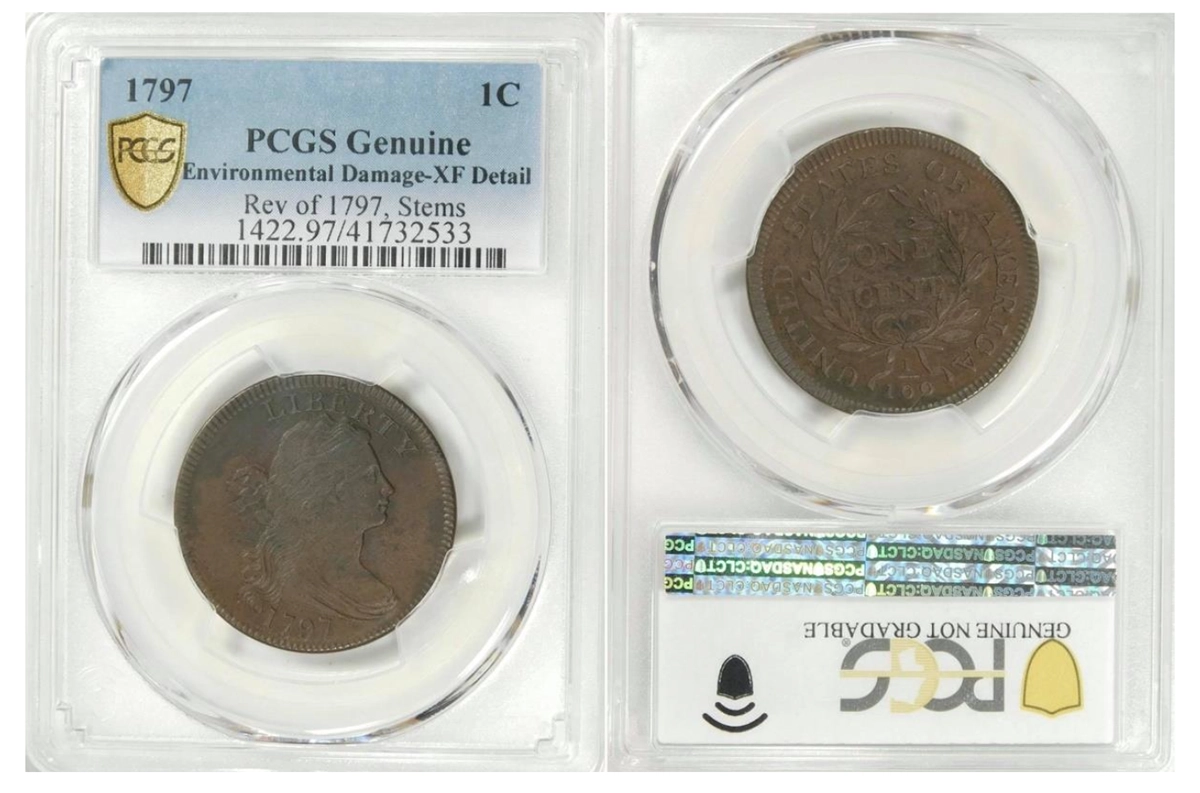
Possibly only one certified, this example was authenticated by two of the top TPGs. The other certified example is likely the repaired genuine source coin. There were a couple of raw examples found and documented, as well.

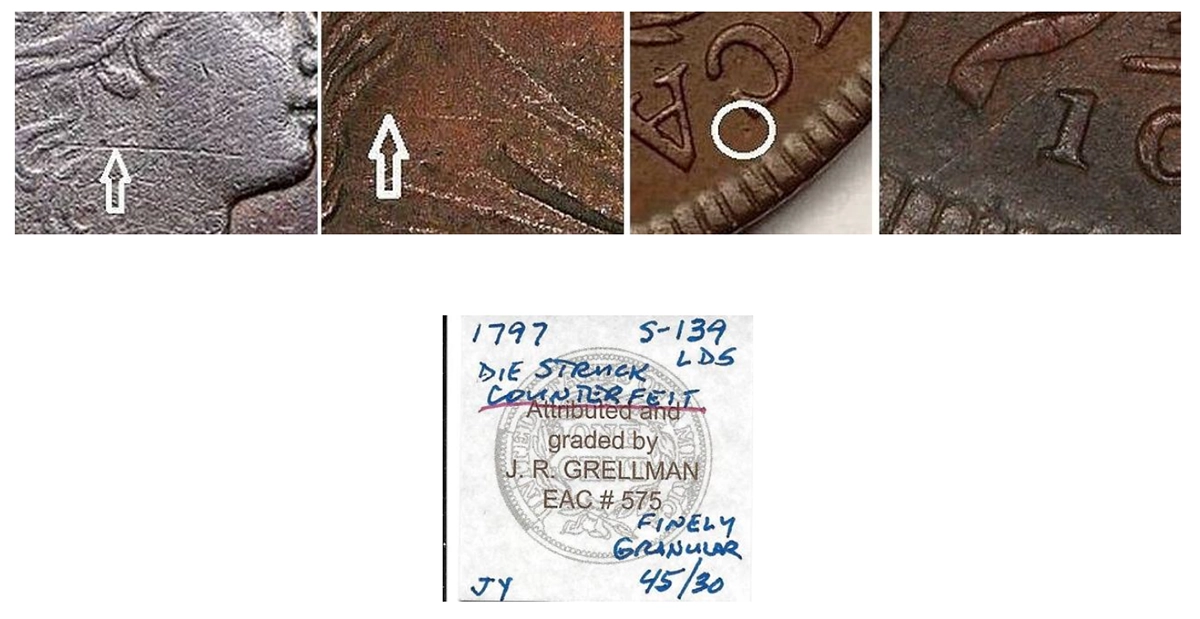
The genuine example had a series of deep scratches that were mostly smoothed out on the coin before making these false dies, leaving an obvious streak on the doctored coin and remnants on the struck fakes, which serve as attribution points.
This one is so good that it was included as #18 for the variety in the Early Copper condition census for large cents (“CC”).
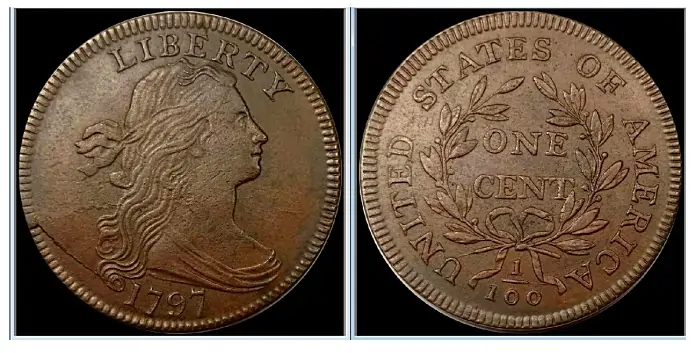
Supposed 1797 S-139 CC 18, net graded VF30
While researching this one, I asked a friend to do an image analysis. He “maps” a genuine coin in CAD/CAM and then maps the subject examples. His overlay includes two known bad examples; the “red” features are common only to the fakes.

These also match the “atts” that I had previously developed:
So there you have it, the top five deceptive counterfeits that keep me and plenty of others up at night!
Best, as Always,
—Jack
MORE Articles on Counterfeit Coins by Jack D. Young
* * *






Glad we have the experts to find these coins. I would be very easily fooled by them.
Extremely interesting! One must have any eye for detail as well as patience.