


By Jack D. Young – Special to CoinWeek
Counterfeit U.S. coins are nothing new. But in today’s market, modern Chinese-made fakes, often housed in convincing counterfeit holders, are pushing the boundaries, and threatening unsuspecting collectors at every level.
This article highlights just a few of the Carson City (CC) dollar counterfeits currently circulating, many of which were reviewed during a FrostByte “Chit Chat” session on December 7th. These fakes aren’t just poor reproductions; they’re often sophisticated deceptions that exploit gaps in collector knowledge and marketplace oversight.
Let’s dig into some examples, and more importantly, how to spot the red flags.
The “Impossible” Seated Liberty Dollars
Among the most glaring examples are Seated Liberty dollars allegedly from Carson City, but dated before CC coins were ever struck.
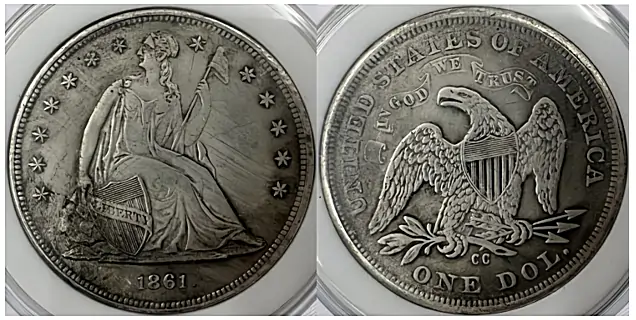
This is a historical impossibility. The “CC” mintmark wasn’t introduced until 1870, and the “In God We Trust” motto wasn’t added until 1866. Yet here we are, with afantasy coin boldly sporting both the wrong dates and design elements.

These fakes often feature what’s known as the “Dotted N” in “UNITED”, a telltale marker I previously discussed in a CoinWeek article on counterfeit diagnostics. Additionally, the reverse dies don’t match any known genuine Trade dollar varieties, but they do match each other, suggesting a shared counterfeit origin.
The “Common Reverse” Trick
A deeper dive reveals that many of these fakes, whether Seated Liberty or Morgan dollars, share identical reverse dies, especially around the “CC” mintmark area. That’s a major giveaway.
This tactic of using a generic counterfeit reverse across many dates is common in these modern fakes. Once you’ve identified the reverse as bad, you can often dismiss any coin using it.
Here’s one from my own collection:

And why stop at 1874? I’ve seen “CC” dollars as early as 1791, a date that never existed for any U.S. dollar, let alone from Carson City.
The “Notched R” and More Fake Varieties
Another family of fakes uses what I call the “Notched R”, found in Liberty Seated fakes like the 1875-CC dollar Trade Dollar. I covered this in detail for the Gobrecht Journal, published by the Liberty Seated Collectors Club.
These fakes again feature the same bad reverse die, making the shared traits easy to track once you know what to look for.

The Morgan Dollar Epidemic
The Morgan dollar series, especially Carson City issues, is rife with counterfeits. The 1881-CC has become one of the most commonly faked dates, though all CC dates have been targeted.
In fact, during an earlier investigation, I tracked at least 13 different sellers offering fake 1881-CC Morgans, all using the same counterfeit PCGS certification number: 27886283. The labels were high-quality forgeries, but the coins, once compared, all showed the same incorrect reverse for the date.
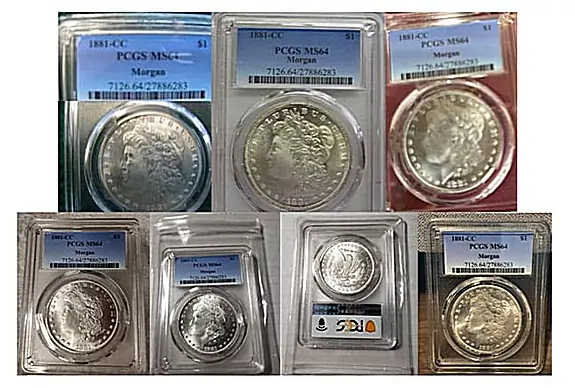
This eventually connected with a Coin Community forum thread from 2018, which discussed raw fake 1881-CC Morgans, again using the same bad reverse.
IMAGE
Caption: Counterfeit 1881-CC Morgans using shared die characteristics and forged holders
Know Your VAMs — They Can Save You
When vetting a Morgan dollar, I always start with the reverse design and the mintmark placement. For Carson City coins, the size and position of the “CC” is often the easiest way to rule out a fake.
One of the most valuable tools I use is VAMWorld, an online database of known die varieties (VAMs). I’ve even created crib sheets for myself that show what legitimate Carson City reverses should look like.

By comparing the fake’s reverse to genuine examples, the differences become obvious. However, I’ll refrain from detailing all of them here. The purpose of this article is to protect collectors, not help counterfeiters improve their product.
1921 Morgans: Genuine Certs, Fake Coins
One of the most deceptive examples I’ve seen is a 1921-P Morgan dollar, graded MS64 by PCGS.
The genuine coin’s label reads “1921 Morgan” to distinguish it from 1921 Peace dollars. However, counterfeiters cloned this label and used it to house their fakes—complete with forged coins inside.
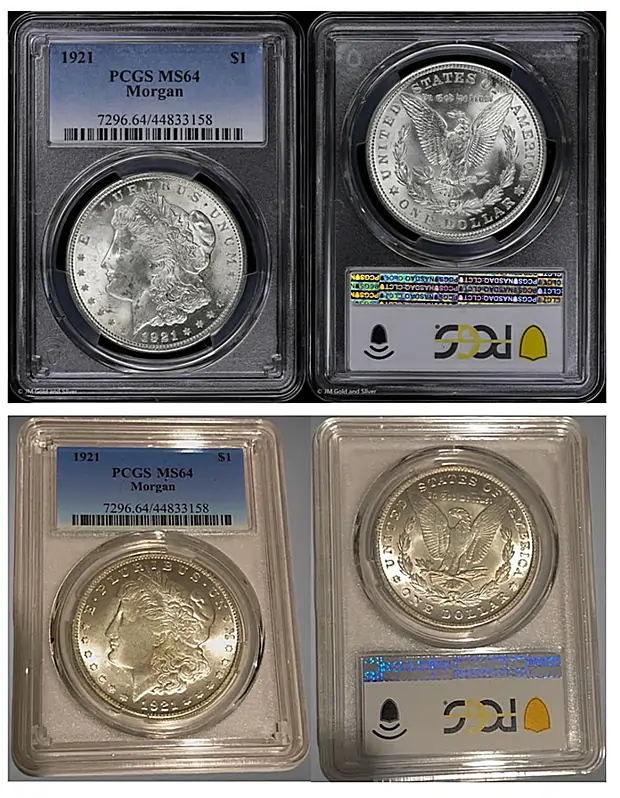
Eventually, counterfeiters adapted, and newer versions of these fakes began appearing without the “Morgan” label, trying to stay ahead of the hobby’s scrutiny.
Recent Listings: Spotted and Flagged
Counterfeit Carson City dollars continue to surface in online auctions. Just recently, an example of a fake 1879-CC dollar was listed on HiBid, complete with counterfeit certification and packaging.
Thanks to vigilance from collectors and the Anti-Counterfeiting Educational Foundation (ACEF), the listing was flagged and pulled.
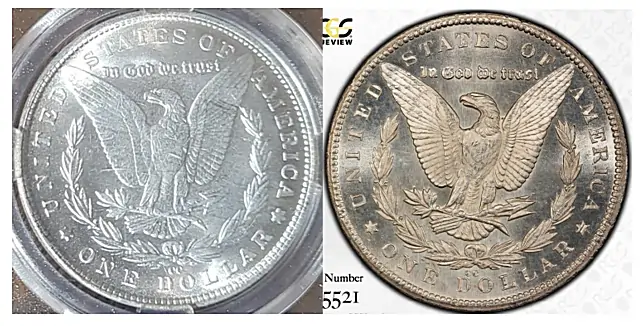
This is the reality we live in. These coins look legitimate at a glance and are often sold through high-traffic platforms to reach unaware buyers.
Final Thoughts: Knowledge Is Your Best Defense
The counterfeiters aren’t slowing down. They’re getting better, faster, and more coordinated. As they refine their dies and fake slabs, it’s up to us, the collectors, dealers, and researchers, to stay ahead.
If you’re buying a Carson City coin:
- Verify the reverse die details
- Use tools like VAMWorld
- Double-check certification numbers using the grading service’s online tools
- Buy from trusted sellers
- And most of all: ask questions. A coin that looks too perfect—or too good to be true, deserves a second look.
I’ll continue publishing updates and discoveries as new fakes emerge. Until then, stay sharp, and stay skeptical.
Best as Always,
Jack





Now I have to recheck my collection! Thanks for sharing so much knowledge!
Thank you for the comment!
Yep, off to check my very small stack of these coins. Valuable insight.
I also have to give a shout out to a previous CoinWeek article. It concerned “no mint mark” 1982 dimes from Philly. I spent yesterday combing through a pot of dimes looking for one. The pot contained, I was just sure, nothing but Roosevelt dimes. No 82 w/o mint marks. But I found an 1892 Barber! Pretty rough shape, but still exciting to find.
Looks like you guys will be taking up my time periodically.
Thanks.
Thank you for this helpful information.