


By CoinWeek News Staff …..
A Super Bowl Sunday social media post from President Donald J. Trump marks the most significant policy change for United States coinage since the passage of the Coinage Act of 1965.
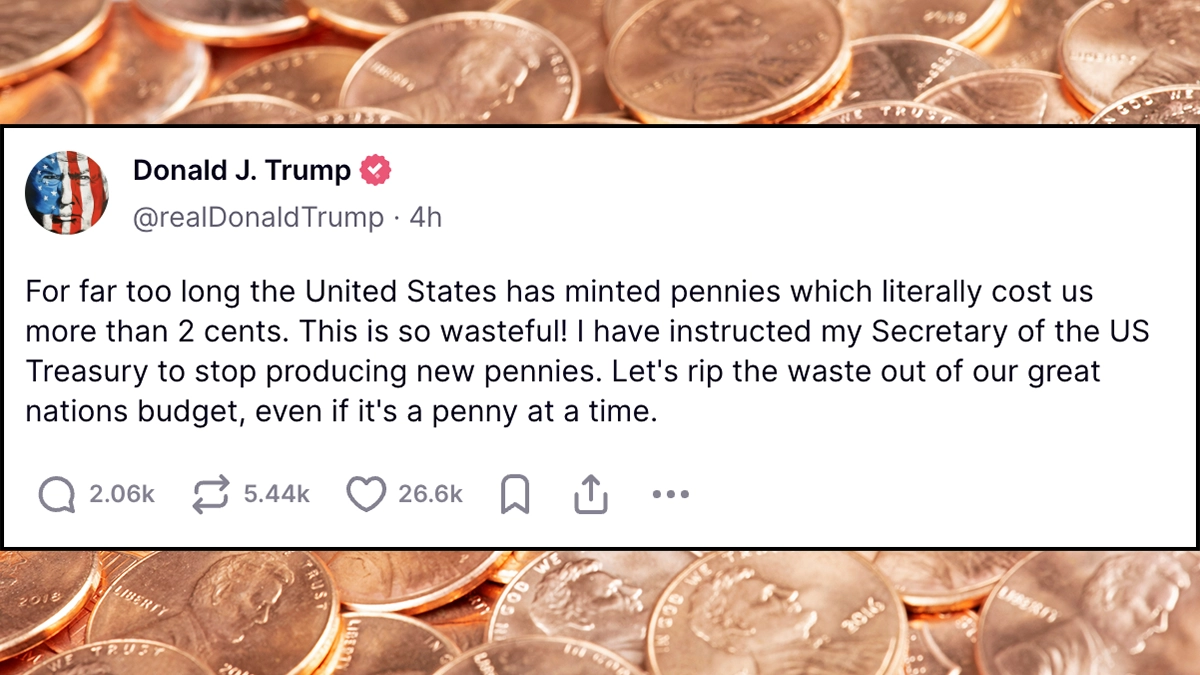
Around 9 pm Eastern, the President “truthed”:
“For far too long the United States has minted pennies which literally cost us more than 2 cents. This is wasteful! I have instructed my Secretary of the US Treasury to stop producing new pennies. Let’s rip the waste out of our great nations [sic] budget, even if it’s a penny at a time.”
The one-cent coin has been in the Congressional crosshairs for decades. Its standalone purchasing power is non-existent, and its primary use is to make change, as state sales taxes make it difficult for merchants to price products to eliminate the need for the denomination.
Congress last changed the composition of the cent in 1982, when copper was almost entirely removed and replaced with copper-plated zinc. The cent stuck around until 2009 when the Mint celebrated the 100th anniversary of the coin (and the 200th anniversary of Lincoln’s birth) with four circulating commemorative coin designs. Some speculated then that Congress might eliminate the cent in 2010, but this proved not to be the case. Instead, the United States Mint replaced the Frank Gasparro-designed Memorial Cent reverse with a Union Shield designed by Lyndall Bass and sculpted by Joseph Menna.
What the Elimination of the Cent Means for Coin Collectors
Besides leaving the nickel, dime, and quarter as the nation’s only circulating coinage, the elimination of the cent will be a boon for the coin-collecting hobby. It puts an end to the 232-year-old denomination. When the large cent was eliminated in 1857, it sparked a collecting boom that is responsible for the preservation of a number of America’s numismatic treasures. The “small” cent also played a key role in the popularization of coin collecting in the 20th century with the release of the Lincoln Wheat Cent and its low-mintage 1909-S V.D.B. variety. During the Great Depression, penny collecting became a popular pasttime with the arrival of “Penny Boards” that provided structure and storage for collectors seeking one example of each date and mintmark. In the early 1950s, the discovery of 1943 Lincoln Copper Cents (that year, due to the war effort, cents were struck in zinc-plated steel; A few were struck using 1942 planchets by mistake) made people sift through their change with a little more care. In 1960, the U.S. Mint modified the size of the date, resulting in Small Date and Large Date varieties. When the public discovered this, it set off a collector frenzy.
The 2025 elimination of the cent should spark a similar flurry of activity. On eBay, sellers have already listed 2025 Lincoln Shield Cents for sale, including the 2025-S Proof. The suspension order does not specify whether the Mint is authorized to ship any of its 2025 inventory. The cent is the highest-production coin in the Mint’s repertoire, and its elimination may lead to layoffs. CoinWeek has reached out to the United States Mint for comment and will update this article when we receive clarification on what Trump’s announcement means for the 2025 cent.
But as far as saving taxpayer money goes, the Federal Government would realize greater savings with the elimination of the dollar bill and the reformatting of the half dollar into a coin that would actually see use in commerce.
Cent Elimination Threatens Blue Collar Jobs in Pennsylvania, Colorado, and Tennessee
Even though every cent produced costs the government more to manufacture than the coin’s face value, the level of savings that would ultimately come from ending cent production is not clear-cut. The penny represents a giant share of the total number of coins produced each year by the United States Mint at its Philadelphia and Denver locations. With the cent’s elimination, the cost allocation for the Mint’s other denominations is likely to go up. The nickel, which currently costs 13.8¢ to produce, may likely cost more than 15 cents to produce, and the seignorage gained from the dime and quarter will be greatly reduced. The United States Mint also produces half dollar and dollar coins, but neither see heavy circulation.
Tennessee zinc manufacture Artazn (formerly Jarden Zinc Products) operates a 350,000-square-foot manufacturing facility in Greeneville, Tennessee, where the company produces zinc products for the automotive, architectural, and construction industries. Its contract with the Mint is so critical to the business that it has paid outside groups to lobby on the coin’s behalf whenever legislation is introduced to eliminate the cent. In the 2024 election, Donald J. Trump and Vice President J.D. Vance carried 82% of the vote in Greene County.
* * *







While I agree the cent should be discontinued, doesn’t Congress have to approve the move?
And yes – eliminating the $1 bill in favor of $1 and $2 coins, along with issuing a redesigned half, would be far more impactful.