Belgium, Italy, Netherlands and Norway are just a few countries that depict famous artists and their paintings on banknotes
By Luke Wilson – Paper Money Guaranty (PMG) ……
No matter how much time you have put into collecting paper money, you have no doubt seen plenty of people on banknotes. However, these individuals are usually men in suit and tie or generals in full military regalia. Therefore, it is a refreshing change to see people in the arts recognized for their work when their image graces their nation’s currency. In this article, I will be highlighting several artists who have been immortalized on paper, along with some information as to their artistic achievements that made them worthy to live on many years after their death.
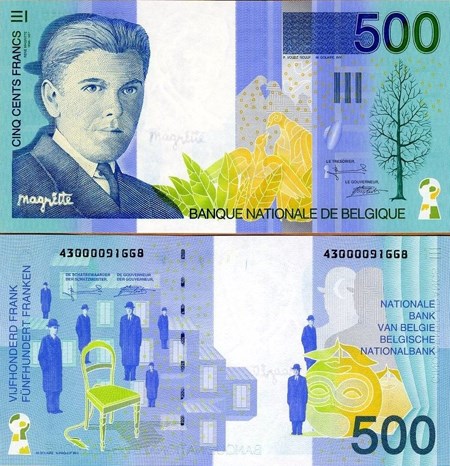
Belgium P-149; Image credit: eBay
The Belgium National Bank introduced a new series of banknotes starting in 1994 that focused almost exclusively on notable Belgian artists, including in 1998 René Magritte, who was known for his surrealistic paintings. Many of his works featured men in bowler hats, such as Golconda (1953), The Mysteries of the Horizon (1955), and his most famous work, The Son of Man (1946). This theme is referenced on the back of the note, with eight men in bowlers, as well as an apple overlapping with the denomination.
If you look closely, you can also see the shadow of a bowler hat behind the portrait of Magritte on the front of the note.
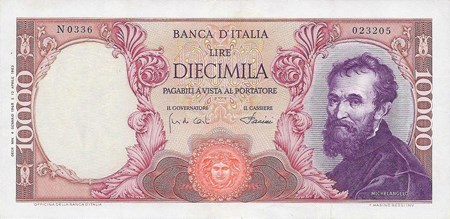
Italy P-197, front; Image credit: eBay
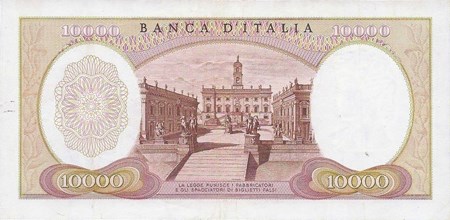
Italy P-197, back; Image credit: eBay
Michelangelo is a familiar name to most, as his paintings and sculptures are the most recognizable works in the history of art. From his Statue of David (1504), to the ceiling of the Sistine Chapel in Rome (1508-1512), Michelangelo’s art has endured over the centuries both physically and culturally. While his David appeared on Greek paper money in 1941, Michelangelo himself first appeared on the 10,000 Italian Lire note introduced in 1962 by Banca d’Italia. The back of the note features the Piazza del Campidoglio in Rome, which Michelangelo designed from 1536-1546. His design turned the piazza from its former placement facing the forum to instead face St. Peter’s Basilica, as the piazza was commissioned by the pope in order to impress the incoming Roman emperor, Charles V.
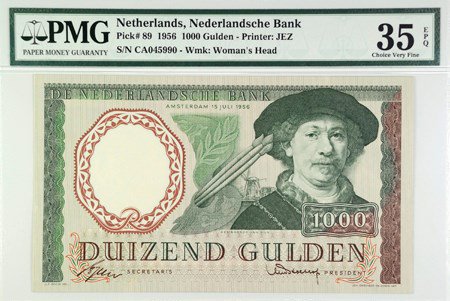
Netherlands P-89, front
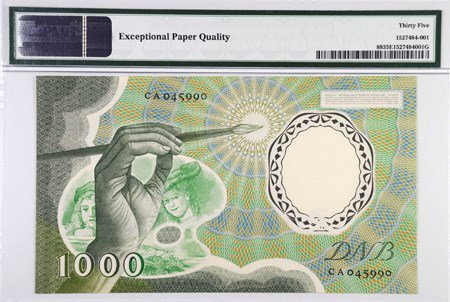
Netherlands P-89, back
In 1956, Rembrandt appeared on the 1,000 Dutch Gulden note, the last note to receive a new design in its series, which had begun in 1953.
Rembrandt was a very influential artist, whose most notable works include The Night Watch (1642), Anatomy Lesson of Dr. Nicolaes Tulp (1632), and The Sampling Officials (1662), in addition to his many self-portraits. He was known for his natural lighting, especially for portraits. The method he used is known as chiaroscuro, which was likely developed by Italian artist Caravaggio. His style would later become known as “Rembrandt lighting,” thanks to film director Cecil B. DeMille.
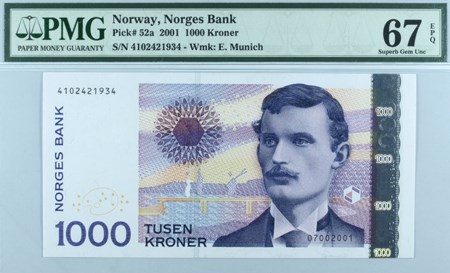
Norway P-52, front
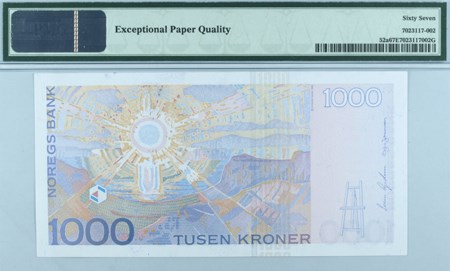
Norway P-52, back
The Norges Bank in Norway redesigned their banknotes in 1999 and added a holographic foil strip as an added security feature. For their 1,000 Kroner note, Edvard Munch was chosen. Munch was an artist who worked in the Symbolist and Expressionist movement. His work was characterized by his melancholia, as evidenced by The Scream (1893) and The Sick Child (six paintings from 1885-1926). The back of the note features The Sun (1911), which can be found on display in the University of Oslo’s aula, or auditorium.
As you can see, there are famous artists on a variety of banknotes from around the world. However, these are all but a fraction of the people whose contributions to the arts have been recognized by their home countries. Time will tell who is recognized on their nation’s currency in the future, but as long as these individuals continue to be celebrated, the world will be blessed with these reminders of their creativity and genius for many years to come.
PMG is an independent member of the Certified Collectibles Group (CCG).