


By Doug Winter – RareGoldCoins.com …… Reformatted and updated by CoinWeek

The Charlotte Mint opened in 1838. A gold rush began around 1830 after miners discovered ore in western North Carolina and northern Georgia. Transporting gold to Philadelphia for assaying and coining proved nearly impossible, so officials established mint facilities in more convenient southern locations. As a result, they chose Charlotte, along with Dahlonega, Georgia, and New Orleans.
The mint operated from 1838 to 1861, closing after North Carolina seceded from the Union with other slave-holding states. It struck gold dollars from 1849 to 1859, quarter eagles from 1838 to 1860, and half eagles from 1838 to 1861.
Collectors will find both advantages and drawbacks when choosing Charlotte gold as a primary focus.
The pros, clearly outweighing the cons, include lower prices than comparable Dahlonega issues, largely due to lower demand. These coins often survive in reasonably well-preserved condition and remain relatively affordable, with one exception (see below). Most importantly, the variety of design types makes type collecting an accessible and appealing approach.
The cons include generally lower quality compared to 20th-century coins. Fewer than 10% of surviving pieces show natural color and untouched surfaces. While prices remain relatively affordable, collectors should plan to spend at least $5,000 per coin for major types.
Let’s now examine the major types, along with basic analysis and collecting suggestions.
Charlotte Gold Dollar Coins
Charlotte produced three types of gold dollars.
The first (Type One) dates from 1849 to 1853. This type includes two of the rarest issues from the mint: the 1849-C Open Wreath, with only four or five known examples, and the 1851-C, with an estimated surviving population of 750 to 850 coins.
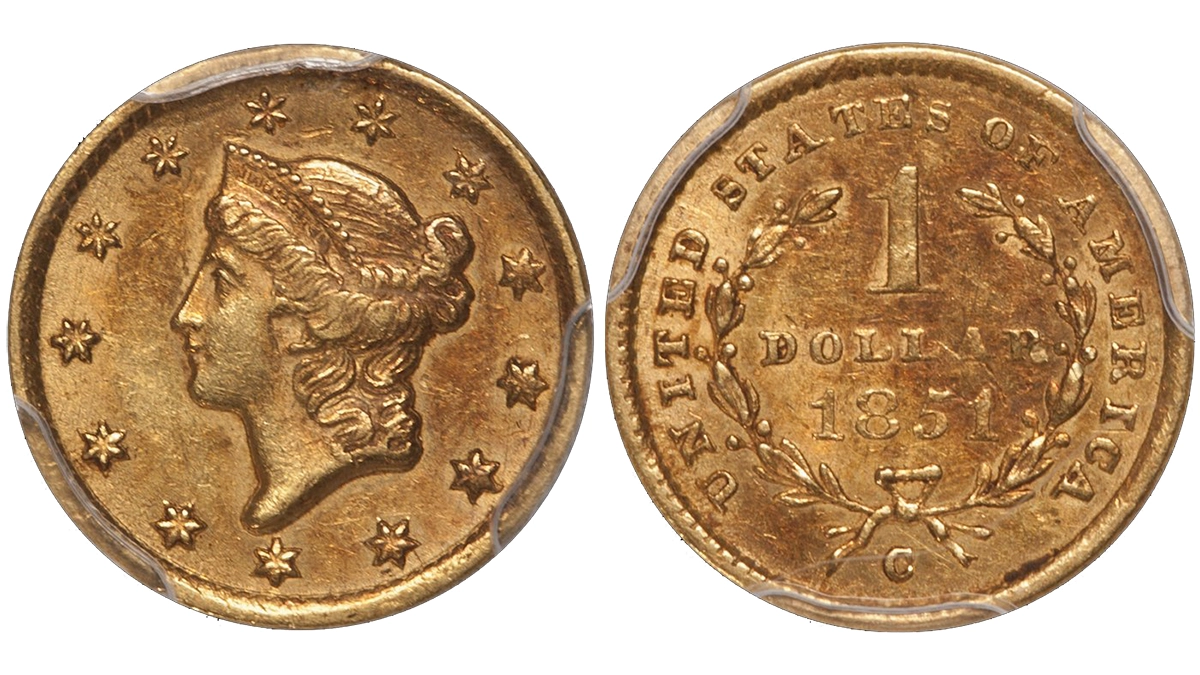
The 1851-C makes an ideal type coin for this design. It is well made, and collectors could buy a nice AU example for under $4,000 to $5000.
I recommend one of the other four dates as an alternative type coin. Each is much scarcer than the 1851-C but costs only a few thousand dollars more in nice AU, or about the same in Choice Extremely Fine.
Charlotte Type One dollars often show planchet flaws, but they still display better workmanship than the other two gold dollar types from this mint.
The second type, known as Type Two, appeared for only one year: 1855.
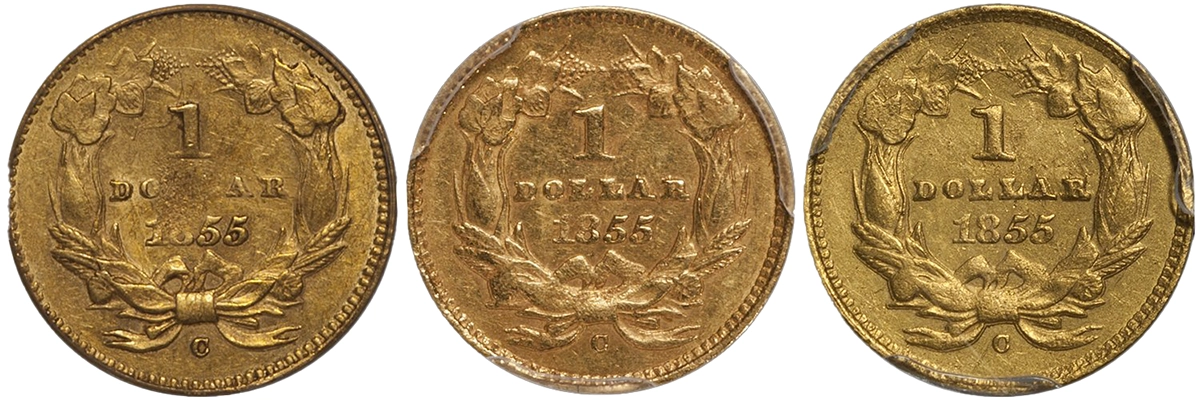
The 1855-C used a design that proved difficult to strike. As a result, most Charlotte examples show weakness and planchet flaws. Coins with strong eye appeal are scarce, but examples exist in the $6,500 to $8,500 range. High-end AU pieces typically cost $10,000 to $16,500 or more.

The mint produced the final design only in 1857 and 1859. Collectors know these as Type Three coins. The mint struggled even more with these issues than with the 1855-C. As a result, all Charlotte Type Three dollars show weak details and poor planchets. The 1859-C makes the better type coin. A decent AU example sells for about $4,000 to $6,000.
SUMMARY: Charlotte struck three gold dollar types. Collectors can assemble the trio for about $15,500 to $20,500. This estimate assumes nice AU examples for Types One and Three, and an EF40 to AU50 for the 1855-C.
Charlotte Quarter Eagles
Charlotte produced two types of quarter eagles.
The first uses the short-lived Classic Head design, struck from 1834 to 1839. Charlotte issued this design in 1838 and 1839. It stands out as the only Charlotte quarter eagle with the “C” mintmark on the obverse.

The 1838-C is scarcer than the 1839-C and has a much lower mintage. Collectors also prize it as a first-year issue. It appears more often than expected in lower grades but becomes scarce at AU55 and rare in MS60 or finer. An AU example typically costs $12,000 to $35,000 or more, depending on quality and eye appeal.
The mint produced the second quarter eagle type, with interruptions, from 1840 to 1860. It features the Liberty Head design, with the mintmark on the reverse. Completing the set by date can be challenging, but none of the 20 issues is prohibitively rare. Only two or three cost more than $10,000 in About Uncirculated. With a budget of $150,000 to $200,000, a collector could build an impressive set in about three to five years.
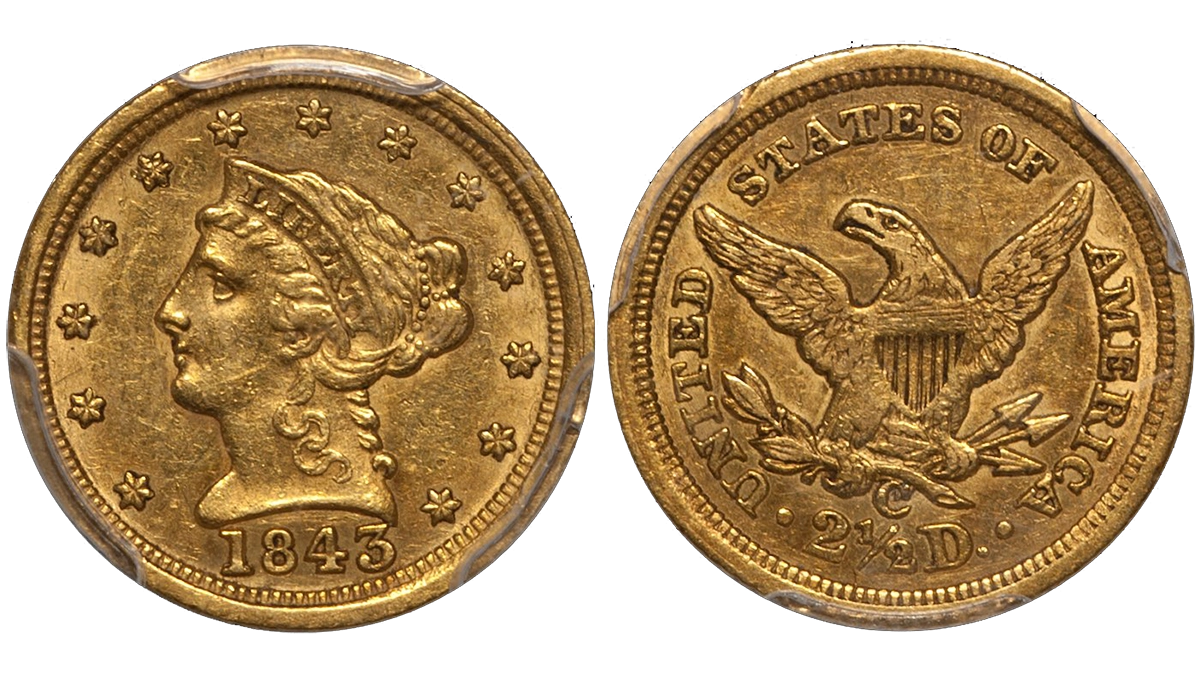
For the type collector seeking a single nice Liberty Head quarter eagle, the best dates to focus on include the 1843-C Large Date, the 1847-C, the 1848-C, the 1850-C, and the 1858-C. Any of these five that become available can be had for around $4,000-5,000+ for a solid AU coin.

If a scarcer date type coin is sought, the best dates to search for include the 1840-C, 1851-C, 1852-C, 1854-C, 1856-C, or the 1860-C. Any of these six which come available can be had for around $6,000-8,000 for a solid AU coin.
Even the most common date Charlotte quarter eagles are legitimately scarce to rare in MS60 and higher grades. The most available single date in higher grades is the 1847-C with around 20-25 known; it is closely followed by the 1858-C. However, both issues are rare in properly graded MS62 and very rare in MS63 and finer.
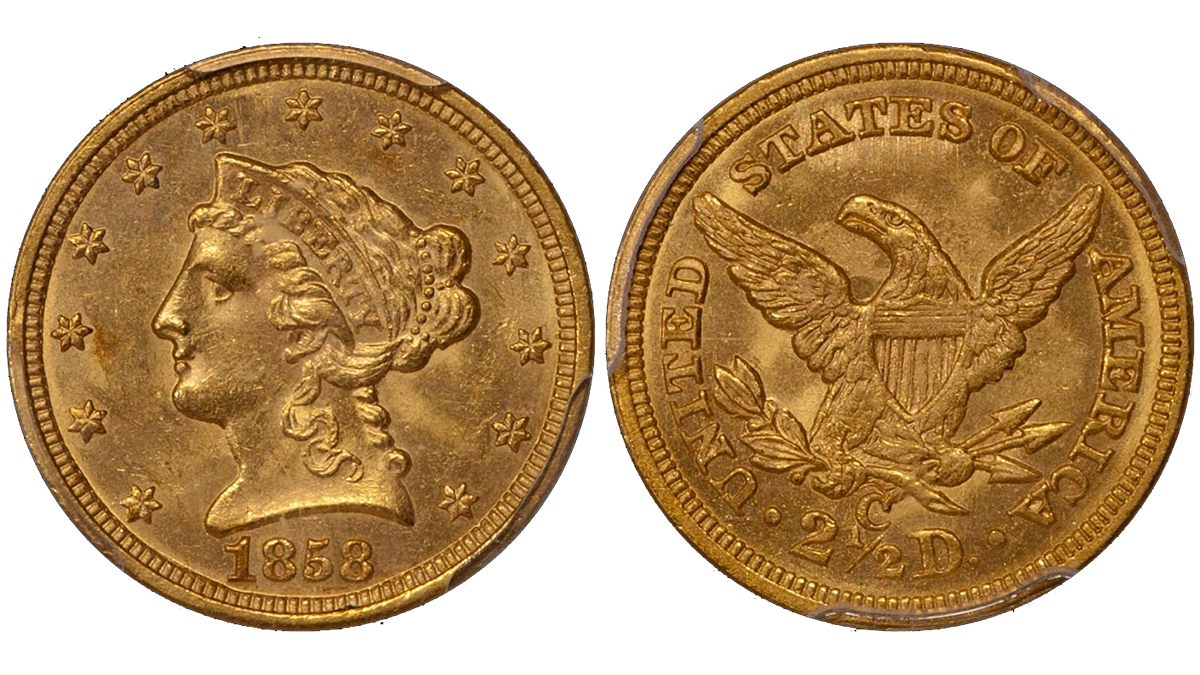
If you locate one, expect to pay at least $12,500 to $15,000 for a nice Uncirculated common-date Charlotte quarter eagle.
SUMMARY: The Charlotte Mint produced only two quarter eagle types. Collectors can buy nice EF examples of both for about $12,500 to $15,000 or more. Higher-grade pieces in MS62 or better cost significantly more.
Charlotte Half Eagles
Charlotte produced four types of half eagles.
The first type is the 1838-C. Collectors value it as the first-year issue for this denomination at Charlotte. It also marks the only use of the Classic Head design for half eagles, as the mint changed the design in 1839. (The quarter eagle kept the design through 1840.)

The 1838-C half eagle is considered one of the marquee issues from Charlotte. It is in strong demand, and well made, problem-free coins graded EF45 to AU53 are scarce, while Choice AUs are rare. Only two or three Uncirculated examples exist. You’ll have to pay around $20,000 for marginal AU, and double this for nice AU55 with natural color.
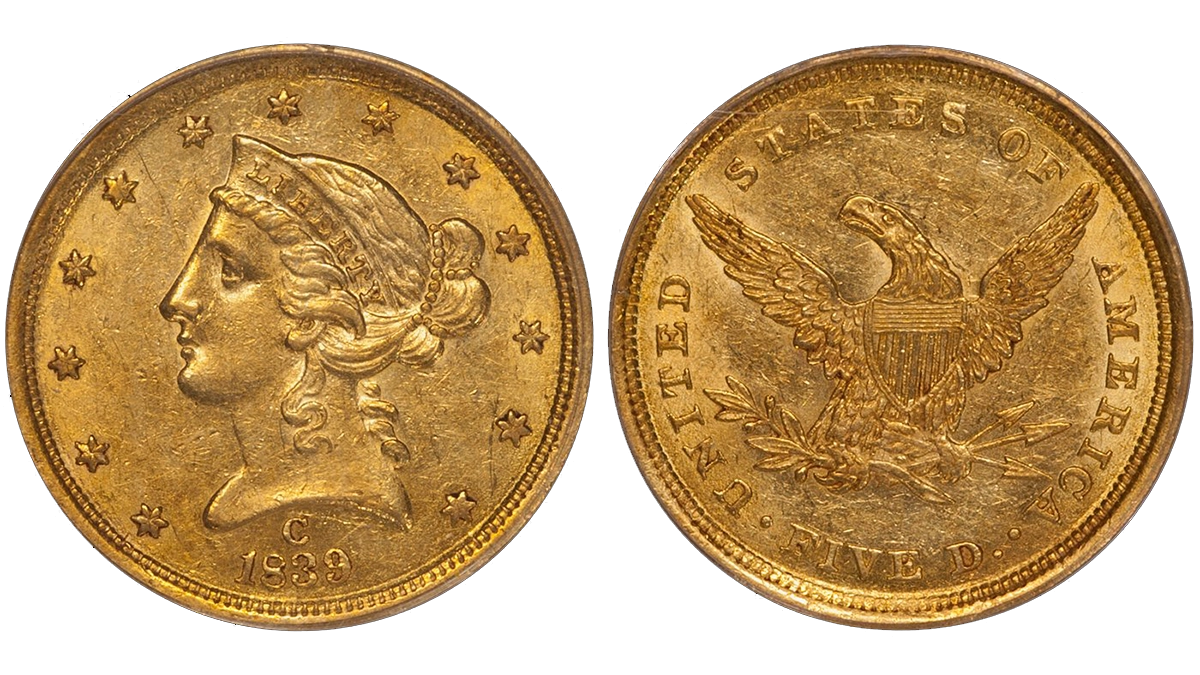
The 1839-C half eagle is also a one-year type. It features the original version of the Liberty Head design as well as the mintmark on the obverse. It is more available than the 1838-C, but it, too, has popularity that extends beyond Charlotte gold specialists. Nice EF coins have become challenging to locate while AU examples with natural color are rare. A small number of Uncirculated 1839-C half eagles exist, but few are offered for sale. You’ll likely have to spend at least $12,500 to $15,000 or more to acquire a presentable example.
In 1840, the Liberty Head was slightly redesigned while the mintmark was moved to the reverse. All Charlotte half eagles struck from 1840 through the 1842-C Small Date have a Small Letters reverse. Later in 1842, a new Large Date punch was used for the obverse while the reverse is a new type with Large Letters.

For a Small Letters type coin, all three issues (1840-C, 1841-C, and 1842-C Small Date and Letters) are available, with the 1842-C Small Date being by far the scarcest. I would suggest an 1840-C as this is numismatically significant as a first—year-of-type issue. An Extremely Fine will cost around $5,000 to $6,000, with a nice AU priced at around twice this range.
The Large Letters reverse was first used with the 1842-C Large Date variety, and it continued through 1861.

The more obtainable dates of his type include the 1847-C, the 1849-C, the 1850-C, the 1852-C, the 1853-C, the 1857-C, and the 1858-C. Any of these should be reasonably easy to locate in EF at around $4,000 to $5,000, and in AU for $6,000 to $8,000.
My advice if you are buying just one of these for type is that you be patient and selective, as a nice coin should be much more available for a half eagle than for a comparable quarter eagle from Charlotte.
Collecting this denomination by date is popular due to the fact that none of the 24 issues is very rare or very expensive. The key issues are the 1838-C, the 1839-C, the 1842-C Small Date, the 1846-C, and the 1861-C.
A very solid Extremely Fine to About Uncirculated set of half eagles from Charlotte could be assembled in a three-to-five-year period for around $250,000 to $300,000.
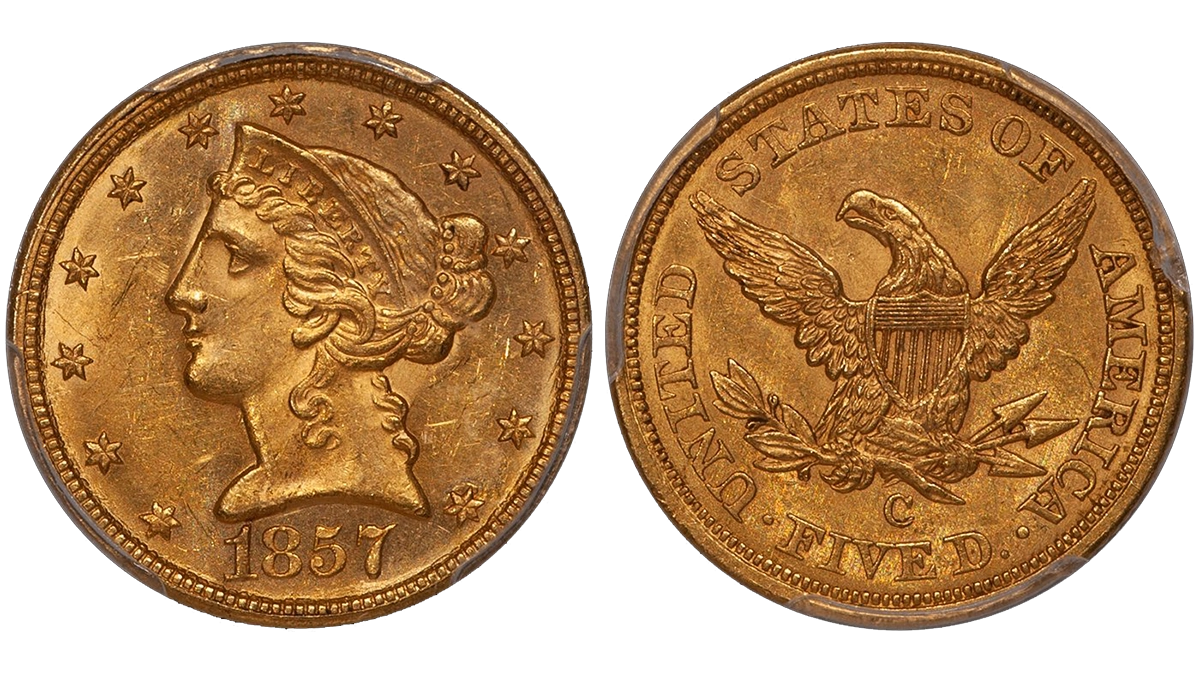
Charlotte half eagles in Uncirculated are more available than their quarter eagle counterparts. The most available dates are the 1847-C, the 1850-C, the 1853-C, the 1857-C, and the 1858-C. All half eagles from this mint become rare in MS62, very rare in MS63, and exceedingly rare in MS64 or finer.
The following table lists all nine types of Charlotte gold coins:

* * *
* * *








Nice article about this important mint.
Well written and great reference.
I’m always torn when I read articles like this now I want to collect this series. That is until I read the next article.