


Stack’s Bowers Galleries returns to the New York International Numismatic Convention with a powerful presentation of world-class material. Session 3 of the NYINC Showcase Auction, World Coins Part 2: British Isles, France, Germany & Italy (Lots 42001–42391), delivers exceptional depth, rarity, and historical importance.
Live bidding begins January 17, 2026, at 6:30 PM EST, from the InterContinental New York Barclay, Barclay Salon I in New York City, NY
Among the elite offerings, five British coins stand apart. Each piece tells a decisive chapter in monetary history while offering collectors an opportunity to acquire true numismatic landmarks.
Edward III’s Gold Noble: A Medieval Power Statement

Lot 42012 | GREAT BRITAIN. Noble,(1369–77). Calais Mint. Edward III. NGC-66.
Few medieval coins carry the authority of the Gold Noble of Edward III. Struck during the turbulent post-Treaty period, this Calais-minted example reflects England’s renewed aggression during the Hundred Years’ War.
Most importantly, this Noble represents England’s first truly successful circulating gold coinage. Earlier gold experiments failed. The Noble succeeded, and reshaped English commerce.
Why This Noble Matters
The coin dates to 1369–1377, after the collapse of the Treaty of Brétigny.
Legends on post-Treaty Nobles reaffirm Edward’s claim to the French throne.
The Calais Mint served as England’s continental gold hub, supporting the Wool Staple trade.
Iconic Design with Symbolic Force
Edward III appears standing in a ship, sword raised, shield ready. The image celebrates England’s naval dominance following the Battle of Sluys (1340). On the reverse, a floriated cross surrounds a large “C” mintmark, confirming Calais origin.
The biblical legend, IHC AUTEM TRANSIENS PER MEDIUM ILLORUM IBAT, adds spiritual symbolism and medieval superstition to an already commanding design.
At NGC MS-66, this Noble occupies elite territory among hammered gold issues.
George II’s Five Guineas: Gold at Its Peak

Lot 42088 | GREAT BRITAIN. 5 Guineas, 1741. London Mint. George II. PCGS AU-53.
The Five Guineas coin represents the summit of British gold denomination. By 1741, this massive piece functioned as a financial anchor rather than circulating currency.
George II’s reign marked the twilight of the denomination. Consequently, survivors remain scarce and highly prized.
Financial Muscle in Gold
- Weighs approximately 41.75–42.0 grams of .917 fine gold.
- Intended for large transactions and institutional accounting.
- Precedes Britain’s formal adoption of the gold standard.
Classic Design and Security
The obverse features a youthful laureate bust of George II. Meanwhile, the reverse displays a crowned shield uniting England, Scotland, France, Ireland, and Hanover, an unmistakable statement of imperial reach.
The raised edge inscription, DECVS ET TVTAMEN, protected the coin from clipping while reinforcing royal authority.
Unlike some years, the 1741 Five Guineas lacks bullion source marks, adding a layer of intrigue for specialists.
The Ultimate Countermarked Dollar: British Authority on French Silver

Lot 42108 | GREAT BRITAIN–FRANCE. Dollar (4s 9d), ND (1797–99). George III. NGC AU-50; Countermark AU Strong.
This coin stands among the rarest British emergency issues of the late 18th century. During Britain’s silver crisis, the Bank of England authorized countermarks on foreign coins to stabilize circulation.
This example transcends rarity.
- Extreme Rarity, Documented Importance
- S-3765B, KM-628, ESC-1861 (R6).
- The only straight-graded example of its type by NGC or PCGS.
- Countermarked on a 1784-M French Ecu of Louis XVI.
The bold George III oval punch dominates the obverse. Even more impressively, the coin retains deeply toned, problem-free surfaces, nearly unheard of for this issue.
Only two comparable examples surfaced publicly in the past 25 years. None match this coin’s preservation or clarity.
Victoria’s 1841 Sovereign: The Chief Coin of the World
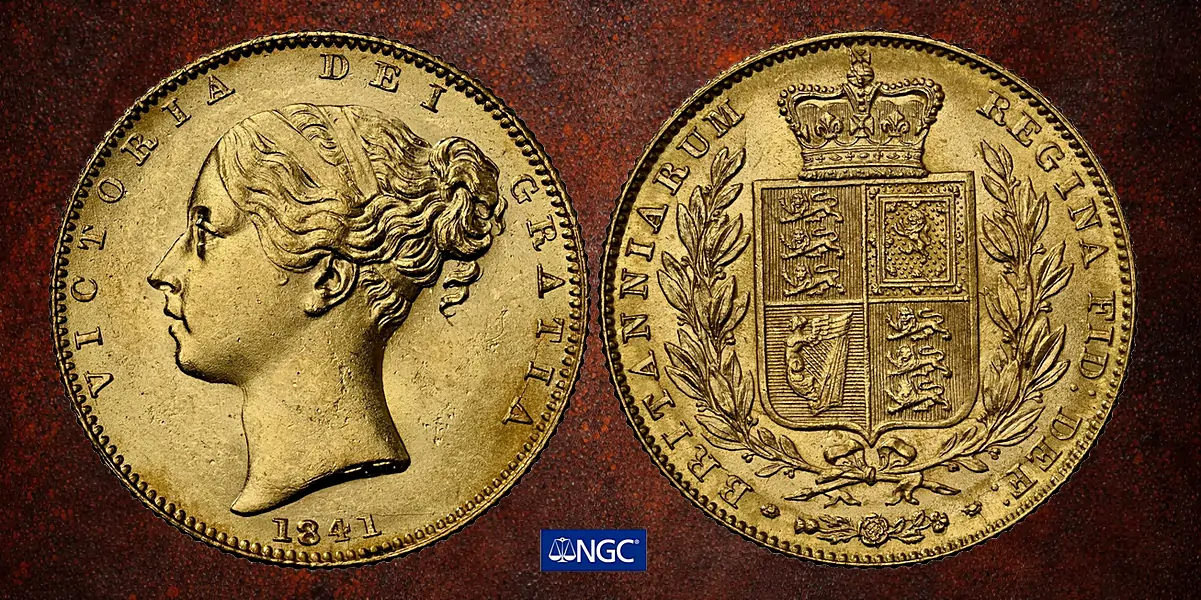
Lot 42136 | GREAT BRITAIN. Sovereign, 1841. London Mint. NGC MS-65.
By the early Victorian era, the Sovereign ruled global commerce. The 1841 issue, however, remains one of the series’ true condition rarities.
- Scarcity Backed by Numbers
- Mintage: only 124,054 pieces.
- Many examples melted over time.
- High-grade survivors command serious premiums.
Young Head Elegance
William Wyon’s “First Head” portrait presents Queen Victoria in refined relief. The reverse shield, designed by Jean Baptiste Merlen, blends heraldry with balance and symmetry.
At NGC MS-65, this Sovereign approaches the pinnacle for the date.
The Gothic Crown: Victorian Art at Its Absolute Finest

Lot 42144 | GREAT BRITAIN. “Gothic” Crown, 1847. Year UNDECIMO. London Mint. Victoria. PCGS Proof-64 Cameo.
Few coins rival the Gothic Crown for artistic impact. Issued during the height of the Gothic Revival, this masterpiece rejects Neoclassicism in favor of medieval grandeur.
A Deliberate Artistic Statement
- Designed by William Dyce, engraved by William Wyon.
- Produced primarily as proofs for collectors.
- Approximately 8,000 pieces struck.
The obverse presents Victoria crowned, richly dressed, and framed by Blackletter legend.
The reverse unites cruciform shields around a Garter star, dense with symbolism and national pride.
The edge inscription, ANNO REGNI UNDECIMO, completes the composition.
Graded PCGS Proof-64 Cameo, this example delivers sharp frost, mirrored fields, and undeniable visual power.
Final Thoughts: British Numismatics at Its Best
Session 3 of the NYINC World Coin Showcase demonstrates why Stack’s Bowers Galleries continues to lead the global market. These five British coins span medieval ambition, Georgian financial might, wartime necessity, and Victorian artistry.
Each lot tells a story. Together, they form a masterclass in British numismatic history.







Very interesting!
Great info
Cool info
I love british coins
Extraordinary coins! Beautiful and rare. Absolute gems to be preserved this long. The article was well written, and the images are wonderfully presented.