


By Blanchard and Company, Inc ……
1783 Nova Constellatio Pattern Coins: America’s First National Coinage Proposal
In 1783, Great Britain ended eight long years of war with its American colonies. Soon after, the Treaty of Paris formally concluded the Revolutionary War and recognized the United States as an independent nation.
However, peace did not bring financial stability.
Instead, the young republic faced a pressing challenge. It lacked an official national coinage. At the same time, the 13 states used different forms of official and unofficial money. As a result, commerce suffered. Confusion ruled the marketplace. Therefore, leaders needed a unified monetary system.
America’s Post-Revolution Currency Crisis
After independence, each state operated under its own monetary standards. Consequently, exchange rates varied widely. Merchants struggled to price goods. Citizens struggled to calculate value. Interstate trade proved inefficient.
Clearly, the nation required a standardized solution.
At this critical moment, Robert Morris stepped forward.
Morris served as Superintendent of Finance from 1781 to 1784. During that time, he worked to stabilize the nation’s fragile economy. Moreover, he developed a bold proposal for a unified American coinage system. For this reason, many historians consider him the driving force behind the 1783 Nova Constellatio pattern coins.
Robert Morris and the 1,000-Unit Coinage System
Morris collaborated with representatives from all 13 states. He studied their complex and overlapping currency systems. Then, he introduced a decimal-based concept built on 1,000 units.

Importantly, this structure allowed all but one of the 13 states to align their currency values with the proposed national standard.
His plan included five denominations:
- A silver Mark valued at 1,000 Units
- A silver Quint valued at 500 Units
- A silver Cent valued at 100 Units
- A copper Eight valued at 8 Units
- A copper Five valued at 5 Units
Notably, this early decimal framework predated the later federal coinage system adopted under the U.S. Constitution. Therefore, Morris’ proposal stands as a foundational moment in American monetary history.
The 1783 Nova Constellatio Pattern Coins
In 1783, officials struck these historic pattern coins in Philadelphia under the authority of the U.S. Treasury.
Benjamin Dudley, an English emigrant and skilled metallurgist, prepared the dies and struck examples of each denomination.
Today, researchers do not know how many pieces Dudley produced. However, surviving examples rank among the rarest coins in American numismatics. In total, five different 1783 Nova Constellatio pattern coin types exist.
Because of their extreme rarity, collectors and institutions prize these coins as tangible artifacts of the nation’s earliest financial experiments.
Meaning Behind “Nova Constellatio”
If you studied Latin, you may recognize the phrase Nova Constellatio. The words translate to “New Constellation.”
The design reflects that powerful symbolism.
[IMAGE SPACE – Detail of 13 Stars and Radiant Eye Motif]
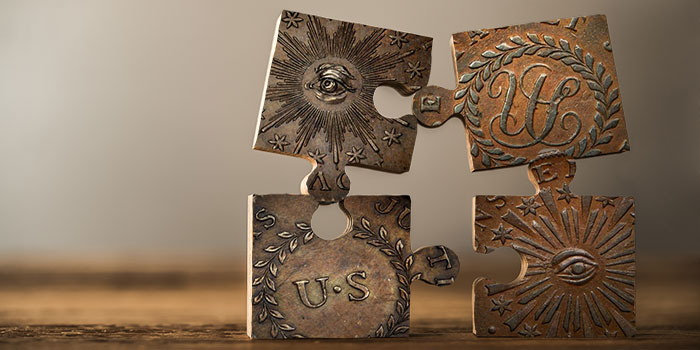
Each coin displays 13 stars arranged among rays of glory. These stars represent the thirteen original states united as a new constellation. At the center appears the Eye of Providence, symbolizing divine guidance.
Additionally, the coins feature the Latin inscriptions LIBERTAS and JUSTITIA. These words declare that Liberty and Justice would govern the new nation.
Together, the imagery and inscriptions communicate unity, independence, and national purpose.
Why the Plan Failed
Despite Morris’ careful work, the proposal never advanced beyond committee within the Continental Congress.
As a result, Congress did not adopt the 1,000-unit system. The plan stalled. Eventually, it disappeared from legislative consideration.
Nevertheless, the Nova Constellatio patterns left a lasting legacy.
The Enduring Legacy of the 1783 Nova Constellatio Coins
Although Congress rejected Morris’ coinage system, the 1783 Nova Constellatio pattern coins remain vital to America’s numismatic history.
They represent:
- The first serious proposal for a national coinage
- An early decimal-based monetary system
- A symbolic statement of unity among the thirteen states
A foundational chapter in U.S. financial development
Today, collectors regard surviving examples as ultra-rare treasures. Furthermore, historians recognize them as physical evidence of the young nation’s determination to create economic independence alongside political freedom.
In short, the Nova Constellatio patterns embody both vision and ambition. They stand at the crossroads of revolution, finance, and national identity.
For serious numismatists and students of American history alike, few coins tell a more compelling early American story.







I have learned so much through coinweek. Thanks
One of my favorite colonial coins. All colonials are under rated as far as national importance!
Our coinage might have been a lot different had these been adopted. Decimal based. Quints. Very cool.
Love Coinweek because of this. Thanks.
Some of the first US coins were very creative in design. Now they were presently doing that again with the Quarters & nickels and few pennies.
Very interesting topic. I don’t have any colonial currency myself.
A cool coin in our history. Like I said before new coinage is often boring.
Very distinctive design though…