


By Tyler Rossi for CoinWeek …Updated Dec 2025…
1) 2000-P Sacagawea Dollar and Washington Quarter Mule

Described as the holy grail of United States Mint errors, the 2000-P Sacagawea dollar and Washington quarter mule is the culmination of an unlikely series of events. First, a Mint worker responsible for a coin press striking Sacagawea dollars noticed that an obverse die needed to be replaced. Then a worker inserted the wrong replacement die. New dies are packaged with protective plastic coverings that obscure the designs, and since the Sacagawea dollar and Washington quarter have similar diameters, the wrong die was installed in the coin press. Once the mistake was discovered, the Mint was forced to pull thousands of finished coins from the collection bins. While mostly successful, 18 examples are known to have slipped through and entered circulation.
There are three different types of this error. Type 1 has a small reverse die crack at the F in OF; Type 2 has three die cracks below the eagles’ lower wing; and while Type 3 has no reverse die cracks, there is a small die gouge on George Washington’s lips. Even more interestingly, since these 18 pieces had to have been struck from three distinct sets of dies, it is evident that either this was an honest mistake repeated multiple times or additional pieces were intentionally struck. While Stack’s Bowers sold a Type 1 example for $120,000 at public auction, there are rumors that some examples have sold privately for as much as $250,000 USD.
2) 2000-D Maryland State Quarter Struck on a Feeder Finger

Modern Mint workers no longer insert coin blanks into coin presses by hand. Instead, a rotary wheel with several cupped feeder fingers spins and pushes the blank planchets into the die collar. As each blank moves into position, the die strikes with up to 100 metric tonnes of pressure. With the ability to produce 750 coins per minute, these machines move quickly and are incredibly powerful.
However, the timing of the mechanical process can sometimes slip out of sync. If a feeder finger fails to clear the die chamber in time, then it can be struck by the dies. When this happens, Mint security and quality control make sure that the feeder finger is recovered and disposed of. But in this case, we have the feeder finger – an incredibly rare occurrence. This feeder finger shows approximately half of the 2000 Maryland 50 State Quarter design, and since the “D” mint mark is visible, we know this error occurred in the Denver Mint’s Grabener press. Standard U.S. Mint feeder fingers not struck by dies are quite rare and sell for around $3,000. However, there are only approximately five known examples of feeder fingers that were struck by dies. This example was last sold by Heritage Auctions for $15,600 in 2019. Imagine what it would bring now?
3) 1943 Bronze and 1944 Steel Lincoln Cents
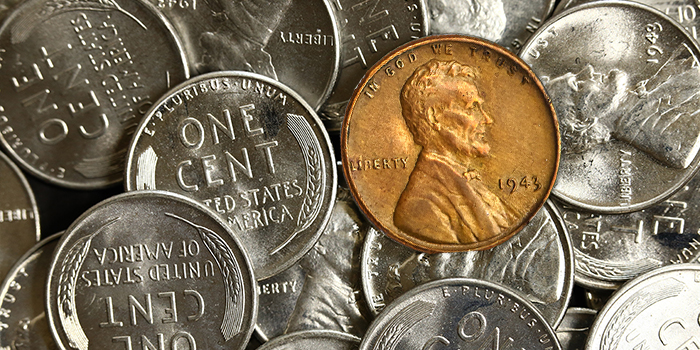
These errors, both resulting from the change in metal composition of the Lincoln cent during World War II, are two of the most well known ever produced by the United States Mint. With copper considered vital material for the Allied war effort, the U.S. Mint began using zinc-coated steel planchets for cent production in 1943. While practically the entire combined 1943 issuance (1,093,838,670 coins) was struck in steel, 20 or 21 pieces were struck on old 1942 bronze planchets that hadn’t been cleared out of the storage containers before the production of steel blanks started.

The next year, the reverse happened. While the denomination was switched back to the bronze alloy for 1944, several pieces were struck on steel planchets. With 25 to 30 known examples, the 1944 steel cent is slightly more “common” than the 1943 bronze cent. Even by the early 1950s, these errors were well known, with some newspapers posting rewards of $10,000 for authentic coins, and others selling replicas for 69 cents. The most recent 1943 bronze cent was sold in January 2023 for $240,000 and the most recent 1944 steel cent was sold in May 2023 for $24,000. Learn more about why 1943 and 1944 Lincoln Cent errors are so valuable.
4) 1862 Indian Cent Obverse Die Cap

While perhaps not the rarest of errors, this 1862 Indian cent obverse die cap is one of the most spectacular.
Obverse die cap errors are produced when a coin blank adheres to the obverse die for one or more striking. Since the machine will keep feeding in blanks, the back side of the die cap will not be struck by the reverse die and therefore be blank. Or the reverse design could also have expanded and been forced smooth as a result of the continued striking. Regardless, the larger the number of strikes, the more dramatic the error.
In this case, as the brittle metal expanded, it split into eight distinct fan-shaped pieces. This same force resulted in an unusually well-defined obverse design. As part of the famous Simpson Collection, this example was recorded as number three in David J. Camire, Fred Weinberg, and Nicholas P. Brown’s 100 Greatest U.S. Error Coins (2010) and sold for $40,800 in 2020.
5) 1979-P Anthony Dollar Overstruck on a 1978 Jefferson Nickel

Sometime in 1979, a properly struck 1978 Jefferson nickel found its way into the Susan B. Anthony dollar feeding bin and was struck for a second time. The obverse of the dollar is relatively well centered on the smaller host coin planchet, with two-thirds of the date visible at the bottom. The nickel’s Monticello reverse is rotated approximately 90 degrees clockwise. On the error’s reverse, Thomas Jefferson’s profile is near the eagle’s legs and the date is just visible on the eagle’s right wingtips.
This type of double denomination error is seriously rare for the Susan B Anthony dollar series, and there are only three other known examples: a 1999-P SBA dollar overstruck on a Georgia State Quarter; a 1979-D $1 overstruck on a 1978-D Roosevelt dime; and a 1979-P dollar overstruck on a Lincoln cent. This coin was sold for $15,275 by Heritage Auctions in 2014 and again in 2016 by Stack’s Bowers for the same amount.
6) Roosevelt Dime on a Nail

As one of the more unusual U.S. Mint errors, this dime was struck on a zinc-coated nail. When this piece came to auction in 2016, it was ironically called the ten-penny nail, despite it being struck on a six-penny nail. These names refer to the length of the nail and originate in 15th-century England.
While it is probable that this was an honest error–especially since it was released from the Mint in the standard distribution cycle–it is also possible that a Mint worker slipped the nail surreptitiously into the press.
Surprisingly this undated dime-on-nail error is not the only one of its kind! Three more Roosevelt dime-on-nail errors are known to have been produced at the Philadelphia Mint; seven 1977 cent-on-nail errors are known from the West Point facility; and a 2000-P New Hampshire quarter-on-nail is also known to exist.
Graded as an MS65 error by PCGS, the ten-penny nail was purchased by New Mexico-based collector and U.S. error coin specialist Tommy Bolack for $42,300 in 2016. At the time, Bolack also owned 10 of the 18 known 2000-P Sacagawea dollar and Washington quarter mule coins.
7) 1867 Shield Nickel Split Planchet/Delamination Error

Officially termed a “split-after-strike” error, this Shield nickel broke in half after being struck by the coin press. A lamination error, split planchets are the result of impurities being trapped in the metal. This means that a full, standard weight planchet was fed into the coin press and then fell apart at some point after being struck. What is quite rare for such an early type is that, despite being fully separated, both halves were kept together by their owners. Both faces, while essentially normal, are set against the internal sides, which display coarse striations characteristic of this error. Each half is graded as AU55 by NGC and encapsulated in individual slabs.
8) 1874 Gold Dollar with Mirror Brockage

Any error on a gold coin is rare simply because of the extra care and attention paid to the production of gold coinage by Mint workers. Nevertheless, this 1874 Type 3 Gold $1 coin managed to escape quality control.
A unique first-strike brockage, this gold coin shows a perfect brockage of the reverse design on the obverse. Before this coin was fed into the press, the previous 1874 gold dollar had become stuck to the obverse die. As a result, this coin was struck not by the obverse die, but by the reverse of the previous coin, leaving an incuse imprint. Since gold is such a soft metal, and because this coin was properly centered in the die, the obverse brockage shows practically every detail a normal reverse would display in reverse. One change, however, is that the brockage face is matte-like, while the true reverse is Proof-like.
Between 2011 and 2015, this coin was sold three times by Heritage Auctions, each time for between $30,550 and $32,312.50.
9) 1999-P Connecticut Quarter Bonded Pair

This eye-catching error coin was created when a press feeder system malfunctioned. The machine inserted a second blank planchet into the striking chamber instead of ejecting the previous properly struck coin. When this happens, the press will continue to strike, either until the coins are fused or until a Mint worker manually removes the offending coins. Due to the sheer volume of pieces produced, this most commonly occurs with one-cent coins, with known cases of five or more cents bonded together. Only 10 examples of two bonded State Quarter errors are known, and none are known with more than two.
On what can charitably be called the obverse of this piece, there are five defined strikes – all of which are off-center. Despite having full mint luster, the reverse is even messier. Displaying a partially struck design, the top planchet is obscured by the second’s smushed and irregular surfaces.
10) 1943-? Walking Liberty Silver Half Dollar 60% Off-Center Strike

Despite being one of the most common errors across most coin types, very few off-center Walking Liberty half dollars are known to exist – and none are as extreme as this example. An off-center error coin is created when a blank planchet is fed incorrectly into the press so that it is only partially in the die collar. So when the dies strike the blank planchet, the resulting coin will have only a portion of the design.
Most off-center Walking Liberty half dollars are shifted by 10% or less. While all off-center Walking Liberty halves are rare, at 60% off-center this example is extreme and potentially unique. Before its discovery, the finest known and most extreme example was off center by 50%. Below that, a 40% off-center specimen was sold for $25,000 in a private deal. Regardless, this example is much more dramatic and visually appealing.
* * *






Thank you for such a fascinating article!
One tiny quibble … “metric tonne” is a redundancy, a bit like saying “10-cent dime”. The “tonne” IS a metric unit, equal to 1000 kg.
Yes, but for those of us who are less familiar with these things, “metric tone” makes it clear. Not every hobbyist has your level of knowledge.
Thank U for info have 09 penny. Looking for the rest. Thanks for info
After searching hundreds of thousands of pennies, you realize that the AM touching on America is not so rare, and there are a lot of off-center strikes on the pennies one side thick the other thin and so on. Only two Indian heads have come my way, quite a few Wheats. And I find an occasional dime in a roll of pennies. I also find Canadian pennies. Today I’ve hit the unicorn !! I am so thrilled I cannot believe what has just surfaced in this recent roll from a $25.00 box of pennies ! WOW!! I was gonna add the pic and now I see that I can’t. OK description you can see the Lincoln Memorial on the back of a dime with Eisenhower‘s head on 1/2 on the other side, It’s got Lincoln‘s head and it’s got the torch so it’s got two presidents on a 2007 dime that’s half penny half dimes in the strike/ impressions.
@John: Just a note – while both men were top wartime leaders, the portrait on the dime is that of FDR. Eisenhower appeared on the $1 coin from 1971 to 1978.
I have collected many error coins. Unique collection. Thanks for the article.
I have a question! If mint employees aren’t allowed to take error coinage from the mint,how are they getting certified? Because none of these errors are findable without being a employee except for the occasional off center strike or die clash!
Coty, sometimes during the inspection and distributions phase of the mint process, they get overlooked.
The 1862 Indian cent obverse die cap split looks like a flower with a very beautiful center!
I am puzzled about how errors that alter the diameter or are so ridiculously obvious get into circulation.
I love these articles on rare coins
Very interesting. Just goes to show that nothing is ever perfect.
How incredibly interesting! Amazing that some of these errors were not caught.
Great set of errors would love to find one or more of these.
But are stampings on other machine parts REALLY coins?
Fun to collect but won’t fit in a coin album.
It is amazing to see such extreme errors!
The bonded quarters is a very cool find!
I love the error coins. Good luck on the coin giveaway everybody!
This was a very interesting article. I need to look at my Sacagawea dollars again – I know one of them was an oddball.
Those are some amazing errors.
Fascinating article and some spectacular errors!
Motivates you to keep an eye out for errors!
These are crazy!
Thanks for another interesting article.
With the 1874 Gold Dollar with Mirror Brockage, means there was another coin involved. I wonder if if made it out too?
Love a good error, really love an extreme error.
Interesting article on error coins
Just crazy article on errors. Want to go look at my coins now for sure. Thanks.
Some crazy errors, for sure.
I do love finding coin errors, even when they aren’t particularly rare.
What an interesting article! I guess I never realized how many errors there have been over the years!
how does the quarter(s) get out of the mint??
I have only seen pretty minor errors before, but some of those are spectacular.
Very interesting! I didn’t know about some of the more extreme error coins. I didn’t think they would have survived and still be around
Some crazy stuff
Not sure why some errors create extra value.
Wonder if the Mint employees who sneak these errors out ever get caught/punished?
Curious about this also and how many were / are done intentionally .
Amazing errors!
I love this article because I have been searching for error coins for many years , and to date I have only found 1 a jefferson nickel off center strike but I will continue to search always thank you .
Errors are wonderful to search for and better to find! I have a 4in binder full of nothing but errors.
Which I had one of each.
Very interesting article on error coins.
Love the Indian and quarter glob! I wonder how many errors haven’t been found yet?
Cool errors, I agree with previous poster’s penny errors are quite common.
Very unique!!!
i have a huge collection of error coins love collecting them
Never heard of some of these. Thanks for the info.
I’ve always been fascinated by error coins. It doesn’t matter much to me whether it’s a minor mistake like a date error or the coin is completely off-center. Almost every error I’ve found has been post-mint. Still, it would be incredible to find one that is genuine.
Error coins are a blast. Although, I wonder how many were made on purpose by employees.
Too bad the Treasury has clamped down on the mints rollers/distriuters about releasing errors they find. Some of these would have difficulty getting to us collectors now.
Great errors!
Some of the errors are truely extreme.
A group of unicorns to be sure!
Good read. I always had a suspicion many of the crazy errors you see are deliberate. I’m glad they all escaped regardless.
I gotta say these error coins are very very interesting……I never knew about most except for teh Lincoln ones
Very interesting…I didnt realize these type of errors existed.
Accidental errors or intentional errors? Interesting article.
The fact that someone actually *cleaned* that off-center Walker, though…
I would truly love to find any sort of error coin.