


By Doug Winter – RareGoldcoins.com – Reformated by CoinWeek
On the front page of my website, you will see the tagline “Coins with Character.” This has been the official motto of Douglas Winter Numismatics for many years. Not surprisingly, I am often asked by collectors a simple question: What exactly are coins with character?
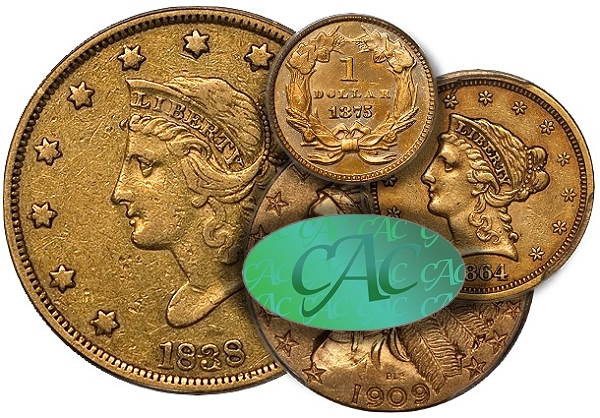
The honest answer is that there is no single definition. However, over decades of specializing in United States gold coins, I have found that the coins I gravitate toward tend to share one or more specific qualities. Together, these attributes give a coin a presence that goes beyond technical grade alone.
Original “Skin” and Choice Surfaces
In most cases, it is impossible to say with certainty that a coin is 100% original. Even pieces with a crusty or undisturbed appearance may have been lightly cleaned many decades ago. Still, as a dealer who strongly appreciates originality, I freely admit that I probably use the term “original” more than I should.
That said, I personally believe that coins with an original appearance—even if best described as “seemingly original” or “likely unmolested”, have far more character than bright, obviously dipped, or otherwise processed examples. Simply put, originality matters.
In addition, I place a premium on choice surfaces, especially in series where heavy abrasions are the norm. For example, New Orleans eagles dated from 1888 through 1906 were shipped loose in bags to Europe. As a result, nearly all surviving examples are heavily marked. Therefore, an 1895-O eagle graded MS62 with noticeably fewer marks than usual stands out to me as a coin with character, even though it is neither a major rarity nor a particularly expensive issue.
Superb and Natural Color
In some series, color alone can dramatically affect value. Morgan Dollars are the classic example. A common 1881-S that used to normally sells for $200 can bring $2,500, $5,000, or more if it displays spectacular, multi-hued toning.
Gold coins, of course, do not typically show such vivid coloration. However, from time to time, a United States gold coin will display rich, unquestionably natural color. These hues might include deep orange, warm red, or even subtle shades of purple.
Most often, this coloration results from long-term storage in an unusual environment. Examples include leather pouches with high tannic acid content, certain wood coin cabinets, or paper containing sulfur. When there is clear evidence that a coin was stored in such a manner, its appeal increases even further.
Importantly, a coin with character does not need dramatic color. Subtlety can be just as compelling. A Dahlonega half eagle from the 1840s with a dark, even green-gold patina that is absolutely correct for the issue can be every bit as special. Likewise, a late-1850s San Francisco eagle with rich, unenhanced reddish-orange color clearly possesses character without being flashy.
Significant Pedigree
Over time, the concept of pedigree has been diluted. Today, auction catalogs are filled with so-called pedigrees that mean little to anyone beyond the original owner. As a result, many collectors understandably question whether pedigree really matters.
However, truly important pedigrees add depth and character that a non-pedigreed coin often lacks. In the field of rare gold coins, there are certain names that still carry real weight with me. These include Eliasberg, Bass, Norweb, Pogue, Duckor, Battle Born, Akers, Elrod, Duke’s Creek, and Newman. In addition, shipwreck pedigrees such as the S.S. Central America and S.S. Brother Jonathan, as well as major institutional collections, remain meaningful.
A strong pedigree tells a story. First, if a coin was good enough for collectors like Steve Duckor or Brent Pogue, it is almost certainly worthy of inclusion in any serious collection I am helping to build. Second, older auction images allow me to compare a coin’s appearance across decades. Finally, pedigrees provide insight into how a coin may have been graded historically, especially when comparing early PCGS holders from sales like Bass in 1999 and 2000 to current standards.
Absolute Rarity
There are two primary types of rarity. The first is grade rarity, which refers to coins that are common in lower grades but extremely rare in high levels of preservation. A classic example is the 1901-S Liberty Head half eagle in MS67, an issue that exists in large numbers overall, yet is exceptionally rare in such a lofty grade.
The second type is absolute rarity. These are coins that are rare in any condition. An 1864-S half eagle, for instance, is scarce whether it grades Very Good or Mint State. In total, the surviving population of this date is likely no more than two to three dozen pieces.
Any attractive coin that is an absolute rarity almost automatically qualifies as one with character.
To me, however, the most special coins combine both types of rarity. Staying with the 1864-S half eagle, one of my all-time favorite United States gold coins is the Norweb/Bass PCGS MS65+ example. It is unique in Uncirculated condition. Moreover, it combines superb original surfaces, beautiful natural color, a major pedigree, and every form of rarity in a single coin.
Background History and Numismatic Significance
Finally, coins with compelling historical or numismatic backgrounds often possess an added layer of character.
Some United States gold coins have extraordinary stories behind them. The 1848 CAL. quarter eagle, struck from gold taken directly from the first California discoveries, is a perfect example. Another is the 1861-D gold dollar, conclusively struck by the Confederacy after the Dahlonega Mint was seized.
Other coins are significant because of their place in numismatic history. The 1838-C and 1838-D half eagles, for instance, were the first branch-mint issues of the denomination. In the case of the 1838-D, it was also the very first gold coin struck at the Dahlonega Mint.
These coins appeal to multiple audiences, collectors of gold, specialists in branch mints, and students of American history. That broad, layered demand is yet another essential component of what I define as a coin with character.
About Doug Winter
 Doug has spent much of his life in the field of numismatics; beginning collecting coins at the age of seven, and by the time he was 10 years old, buying and selling coins at conventions in the New York City area.
In 1989, he founded Douglas Winter Numismatics, and his firm specializes in buying and selling choice and rare US Gold coins, especially US gold coins and all branch mint material.
Recognized as one of the leading specialized numismatic firms, Doug is an award-winning author of over a dozen numismatic books and a recognized expert on US Gold. His knowledge and an exceptional eye for properly graded and original coins have made him one of the most respected figures in the numismatic community and a sought-after dealer by collectors and investors looking for professional personalized service, a select inventory of impeccable quality, and fair and honest pricing. Doug is also a major buyer of all US coins and is always looking to purchase collections both large and small. He can be reached at (214) 675-9897.
Doug has been a contributor to the Guidebook of United States Coins (also known as the “Red Book”) since 1983, Walter Breen’s Encyclopedia of United States and Colonial Coins, Q. David Bowers’ Encyclopedia of United States Silver Dollars and Andrew Pollock’s United States Pattern and Related Issues.
In addition, he has authored 13 books on US Gold coins including:
- Gold Coins of the New Orleans Mint: 1839-1909
- Gold Coins of the Carson City Mint: 1870 – 1893
- Gold Coins of the Charlotte Mint: 1838-1861
- Gold Coins of the Dahlonega Mint 1838-1861
- The United States $3 Gold Pieces 1854-1889
- Carson City Gold Coinage 1870-1893: A Rarity and Condition Census Update
- An Insider’s Guide to Collecting Type One Double Eagles
- The Connoisseur’s Guide to United States Gold Coins
- A Collector’s Guide To Indian Head Quarter Eagles
- The Acadiana Collection of New Orleans Coinage
- Type Three Double Eagles, 1877-1907: A Numismatic History and Analysis
- Gold Coins of the Dahlonega Mint, 1838-1861: A Numismatic History and Analysis
- Type Two Double Eagles, 1866-1876: A Numismatic History and Analysis
Finally, Doug is a member of virtually every major numismatic organization, professional trade group and major coin association in the US.





So many interesting coins
I don’t collect gold coins, however thus is a great article. Thanks
very interesting take on “character”