


By Doug Winter
Understanding Eye Appeal in Gold Dollars
Eye appeal refers to the combination of visual qualities that make a coin attractive to collectors. Several factors contribute to eye appeal, including strike, luster, color, and surface preservation.

Collectors often prioritize these attributes differently. Some place the greatest emphasis on original color. Others focus on the sharpness of the strike. Nevertheless, experienced collectors typically reach broad agreement when evaluating whether a coin has strong overall eye appeal.
Importantly, eye appeal does not always correlate with rarity. A rare or very rare coin may consistently appear with attractive surfaces. The 1828 Capped Head Half Eagle, for example, is a scarce coin that often displays pleasing eye appeal when available.
Conversely, some coins that are only moderately scarce rarely appear with strong visual quality. The 1796 Capped Bust Eagle illustrates this phenomenon. Although not prohibitively rare, it is seldom encountered with truly appealing surfaces.
With this in mind, let’s examine several gold dollar issues that are notably difficult to locate with strong eye appeal.
Type One Gold Dollars (1849–1854)
The first type of gold dollar was produced from 1849 through 1854. Within this short series, several issues are particularly difficult to locate in visually pleasing condition.
The Challenging 1852-D Gold Dollar
One of the most problematic coins in the Type One series is the 1852-D from the Dahlonega Mint.
Die clashing commonly affects this issue. As a result, many examples display multiple clash marks that create a very “busy” appearance in the left obverse field. In addition, most surviving examples have been cleaned or otherwise processed.
Based on my experience handling this issue, cosmetically attractive 1852-D gold dollars are extremely scarce. I can recall owning only a small number of pieces that displayed genuinely pleasing surfaces.
The Rarely Attractive 1854-D
Another Dahlonega issue that presents significant eye appeal challenges is the 1854-D.
In this case, the strike is not the primary issue. Instead, most known examples appear to have been cleaned or dipped at some point. As a result, original pieces with pleasing surfaces are extremely rare.
In my experience, I would be surprised if more than ten truly attractive examples exist. Over the past decade, I have seen only a few coins that I would consider visually appealing.
Charlotte and New Orleans Type One Issues
Gold dollars from the Charlotte and New Orleans mints are generally easier to locate with strong eye appeal than those from Dahlonega.
However, one Charlotte issue presents recurring problems.
The 1850-C
The 1850-C is typically well struck and competently produced. Despite this, attractive pieces are difficult to locate.
Many examples display subdued luster, “chewy” surface texture, or poor color caused by cleaning or dipping. Consequently, finding a pleasing specimen can be surprisingly challenging.
The 1850-O
New Orleans gold dollars are generally well made and sharply detailed. Most dates can be located without excessive difficulty.
However, collectors searching for a choice, original 1850-O with strong eye appeal may encounter challenges. Truly attractive examples appear less frequently than one might expect.
Type Two Gold Dollars (1854–1856)
The Type Two gold dollar was struck for only three years. Despite the short production run, coins of this type can be difficult to locate with strong eye appeal. This is especially true for pieces produced at branch mints.
Comparing the 1855-D and 1855-C
From a rarity standpoint, the 1855-D is the rarest Type Two gold dollar. Interestingly, however, I have encountered more appealing examples of the 1855-D than the 1855-C.
The 1855-C often shows multiple problems. These include planchet imperfections, weak strikes, and unnaturally bright surfaces caused by dipping.
At a Heritage auction, I once examined a particularly attractive PCGS AU58 example of the 1855-C. That coin served as the inspiration for this discussion. Seeing it prompted me to consider how long it had been since I encountered a similarly pleasing specimen.
While I cannot state the exact answer, my experience suggests that an 1855-C gold dollar with genuinely strong eye appeal—at any grade level—is extremely rare.
Type Three Gold Dollars (1856–1889)
Collectors generally encounter Philadelphia-minted Type Three gold dollars with reasonably good eye appeal. However, several issues within the series still present notable challenges.
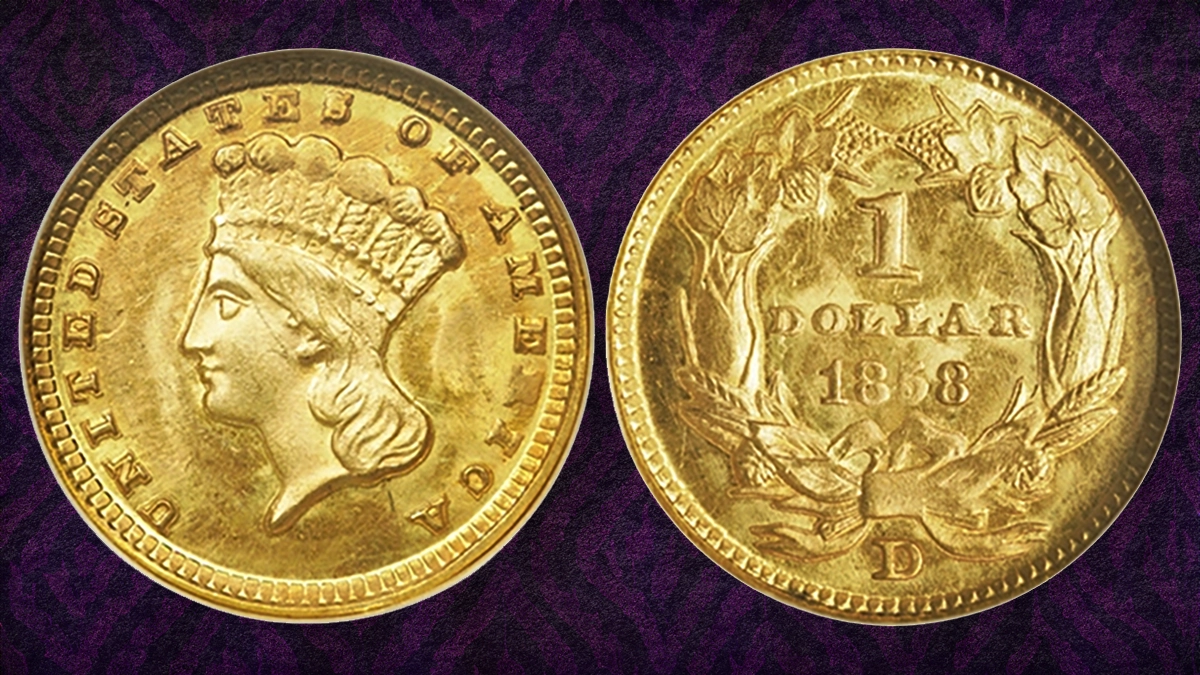
The Melted 1863 Gold Dollar
The 1863 gold dollar experienced extensive melting. As a result, relatively few circulated survivors exist.
Unfortunately, most circulated examples display poor eye appeal. Surface problems and unattractive coloration are common.
A small number of exceptional coins are known. Approximately half a dozen Gem pieces graded MS65 through MS67 exist. However, these coins reside in tightly held collections and rarely appear on the market.
The Underappreciated 1865
The 1865 gold dollar receives less attention than the 1863, yet it can also be difficult to locate with strong eye appeal.
Like many small-denomination gold coins of the Civil War era, surviving examples tend to fall into two extremes. Some are quite attractive. Others are distinctly unattractive.
In recent years, the latter category appears to represent most of the coins available to collectors.
The Prooflike 1875 Gold Dollar
Collectors widely recognize the 1875 gold dollar as a very rare date. Its mintage consisted of just 400 business strikes.
Despite its rarity, this issue often displays strong eye appeal when available. Every example exhibits prooflike surfaces due to the small production run.
When an 1875 dollar has not been harshly cleaned or mishandled, it typically shows excellent reflectivity and bold detail. These characteristics give the coin exceptional visual appeal.
Branch Mint Type Three Gold Dollars
The most difficult Type Three issues to locate with strong eye appeal come from the branch mints, particularly Charlotte and Dahlonega.
Charlotte: 1857-C and 1859-C
Only two Charlotte gold dollars were struck during this era: the 1857-C and the 1859-C. Both are difficult to find with pleasing eye appeal.
The 1857-C presents the greater challenge. Many examples display planchet waviness, rough surfaces as struck, and generally poor eye appeal.
I once sold an NGC AU58 example with CAC approval that was notably attractive. At the time, I told the buyer that it was one of the few truly appealing examples of this issue I could recall encountering.
Dahlonega: 1857-D and 1860-D
Nearly all Type Three gold dollars from Dahlonega are difficult to locate with strong eye appeal. However, two dates stand out.
The 1857-D often suffers from an uneven strike and heavy commercial use. These factors significantly reduce the visual quality of most surviving examples.
The 1860-D is considerably scarcer. Unfortunately, it usually appears with soft striking and poor coloration that often looks unnatural.
San Francisco: 1857-S and 1858-S
The San Francisco Type Three issues were struck for only a short period. Nevertheless, they present their own challenges for collectors seeking coins with strong eye appeal.
In my experience, the 1857-S and 1858-S are the two most difficult dates to locate in attractive condition. Both coins frequently show noticeable wear and rarely display pleasing color.
I have not personally handled a truly nice Uncirculated example of either date in many years.
The Toughest Gold Dollars for Eye Appeal
Unlike some coin series, the gold dollar denomination does not contain any coins that are impossible to obtain. The notable exception is the extremely rare 1849-C Open Wreath, which remains beyond the reach of most collectors.
However, several issues are exceptionally difficult to locate with strong eye appeal.
Based on my experience, the five most challenging dates, listed chronologically, are:
- 1850-D
- 1852-D
- 1854-D
- 1857-C
- 1860-D
Collectors pursuing visually appealing examples of these issues should expect a long search and considerable patience.





All that glitters is gold.
Definitely waiting for this giveaway to drop. Amazing!
nice looking coins and display
Would love to own.
Gold dollars I rarely see at shows or offerings for coin dealers. Last place I saw several for sale was at the New Orleans mint. My friend bought a couple.
It is difficult finding gold coin or any other with good eye appeal.
Where do y’all come up with all this information. Just amazing. Thanks.
I would gladly take any of them!
I’d love to add more to my gold collection
Any gold coin has eye appeal for me! After all, beauty is in the eye of the beholder. I have a 1848 example from the Philadelphia mint that was previously mounted in a bezel of some sort so it is slightly damaged, but I like it!
Beautiful coins!
thanks Doug. I grade coins daily on a forum for other collectors. the information presented here will enhance my knowledge base when assessing these coins and allow me to give the collector a little more detail about their coin.
I would still love to own these. Remember beauty is in the eye of the beholder.
Wish I had just one gold coin! It’s going to happen, just a matter of time!
i would love to have one of these gold coins
The gold dollars may not have great eye appeal but have interesting histories.
For me…any Dahlonega Gold Dollar has eye appeal!!!