


By David Thomason Alexander – Updated and reformatted by CoinWeek …..
The Roosevelt Dime and America’s Long Memory of Coinage Controversy
Most circulating United States coins have faced criticism at birth. The Roosevelt dime proved no exception.
The pattern began early. The first 1793 cents drew condemnation for their Chain reverse, borrowed from the earlier Fugio cent. Critics saw the device as a poor companion to the Liberty head obverse. A few years later, John Reich’s robust Liberty on the 1807 half dollar met ridicule as a caricature of the artist’s “fat German mistress.”
Public outrage over coin designs has rarely rested on fact. Rumor spreads easily. Correction does not. Even before the internet, false stories gained traction because they entertained. The alleged scandal surrounding Hermon McNeil’s 1916 Standing Liberty quarter, supposedly criticized for its exposed breast, remains a prime example. Serious research has never confirmed that such an outcry occurred.
Other protests leaned on historical grievance rather than evidence. Southern newspapers objected fiercely to Abraham Lincoln appearing on the cent in 1909. Some editors declared it the final step toward monarchy.
A Nation in Mourning, a Nation in Transition
That same pattern resurfaced after the death of President Franklin Delano Roosevelt on April 12, 1945, at his “Little White House” in Warm Springs, Georgia. The country stood at the close of the most destructive war in human history. Americans longed for peace and stability.
Roosevelt had carried the burdens of four presidential terms through the Great Depression and World War II. He remained weakened by poliomyelitis, contracted in 1921, which left him partially paralyzed and unable to walk unassisted. The administration concealed the full extent of his disability from public view.
To avoid scrutiny, the president used a private railroad spur beneath Park Avenue that carried his car directly into the basement of the Waldorf-Astoria Hotel. At Warm Springs, he continued hydrotherapy treatments that he once believed might restore his strength. Modern medical researchers now suggest that Roosevelt’s relentless exercise regimen may have worsened his condition rather than improved it. This interpretation reflects contemporary medical opinion and was not understood at the time.
Roosevelt and Medallic Art
By 1945, Roosevelt had long appeared on medallic works. His portrait featured on Presidential Inaugural Medals in 1933, 1937, 1941, and 1945. The United States Mint, under Director Nellie Tayloe Ross, also issued large presidential medals as part of its continuing series. Chief Engraver John Ray Sinnock designed the Roosevelt pieces.
John R. Sinnock at the Mint
Sinnock was born in 1888 in Raton, New Mexico. He studied sculpture at the Philadelphia Museum School of Industrial Arts and built his career through the Philadelphia Sketch Club and the Philadelphia Alliance for the Arts. In 1923, he joined the Philadelphia Mint as assistant to George T. Morgan. He succeeded Morgan as Chief Engraver in 1928.
Mint employment provided steady income. It offered little artistic freedom. Once approved, circulating coin designs remained unchanged for 25 years. Commemorative coins between 1921 and 1939 allowed limited expression, but the Mint no longer drove artistic innovation. Early in his tenure, Sinnock spent much of his time supporting the aging Morgan.
In 1945, U.S. silver coinage still included two exceptional 1916 designs by Adolph A. Weinman: the Walking Liberty half dollar and the Winged Liberty (“Mercury”) dime. Weinman intended the winged Phrygian cap to symbolize freedom of thought, one of the Allied war aims.
The half dollar’s striding Liberty echoed Louis Oscar Roty’s Liberty the Sower, a figure still familiar today. Both designs rank among the most admired in American numismatics.
The Washington quarter, adopted in 1932, remained a comparative newcomer and had entered circulation amid its own controversy.
Design of the Roosevelt Dime
Following Roosevelt’s death, Director Ross moved quickly. She intended to place his portrait on a circulating coin, not a commemorative issue. Gold coins no longer circulated. Silver dollars were absent. The choice narrowed to the half dollar or the dime.
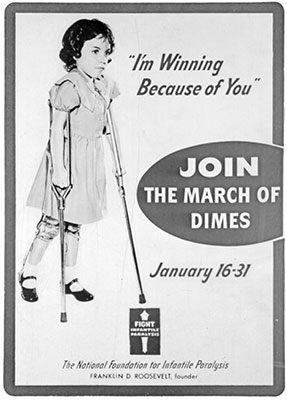
Roosevelt had become closely associated with the fight against polio. The disease surged seasonally, particularly in large cities. Schools closed. Children wore heavy leg braces. No vaccine existed. Understanding of transmission remained limited, though research intensified. The nationwide March of Dimes campaign funded much of that work. Ross focused on the dime accordingly.
The Reverse
The existing dime reverse featured the Roman fasces, a symbol of unity and strength. In 1922, Benito Mussolini adopted the fasces as the emblem of Italian Fascism. Weinman had modeled the device after the bronze fasces that still flank the Speaker’s rostrum in the House of Representatives.
By 1941, the Winged Liberty dime had exceeded its 25-year statutory lifespan. Ross authorized its replacement without congressional approval. James Hobson Morrison, a congressman from Louisiana, introduced legislation on May 3, 1945, authorizing a Roosevelt portrait. Treasury Secretary Henry Morgenthau, Jr. announced on May 17 that new dimes would enter circulation by year’s end.
The American Numismatic Association reported that 90 percent of The Numismatist readers supported the proposal. Morgenthau privately expressed doubts, believing Roosevelt did not belong in the company of Washington, Jefferson, and Lincoln. The project moved forward regardless.
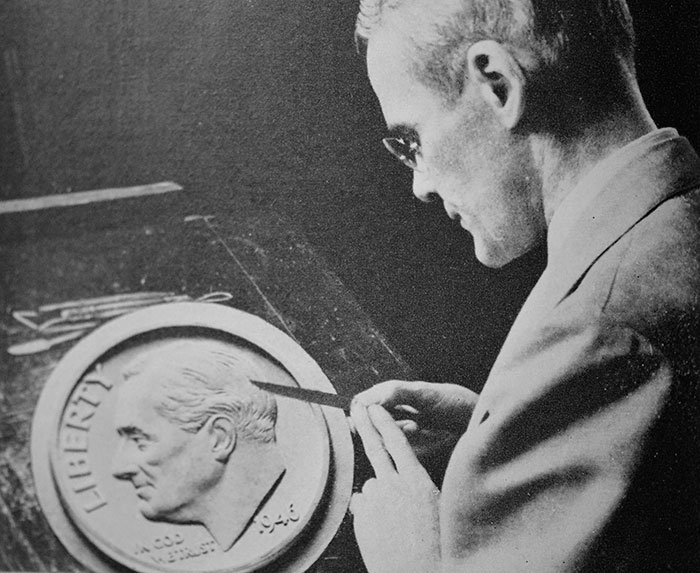
Much of the modeling work fell to Sinnock’s assistant, Gilroy Roberts, with input from the Commission of Fine Arts (CFA). The dime’s small size complicated the task.
The Obverse
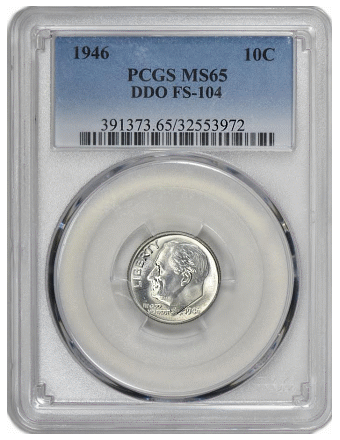
The obverse placed Roosevelt’s left-facing portrait at center. LIBERTY followed the left rim. IN GOD WE TRUST appeared in small letters below the chin. The date and mintmark sat at lower right. Few noticed the tiny initials “JS.”
The first proposed reverse showed a hand grasping a flaming torch, flanked by olive branches. Objections followed immediately. Sinnock revised the design. He centered the torch, placed olive and oak branches on either side, and arranged E PLURIBUS UNUM in an awkwardly segmented line. All lettering appeared in bold sans-serif type.
Treasury Secretary Fred Vinson initially rejected the models. Sculptor Lee Lawrie persuaded him otherwise.
Sinnock soon fell gravely ill. Director Ross informed the CFA of the approvals only after authorizing production. The Commission objected to the process. That haste fueled later controversy.
Critical opinion divided. Art historian Cornelius Vermeule praised the coin as “clean, satisfying, and modestly stylish.” Others criticized the portrait’s rounded head shape, arguing it failed to resemble Roosevelt accurately. Comparison with presidential medals confirms that the facial features match, though the cranial proportions differ.
The dime entered circulation nonetheless.
“Uncle Joe” Signs the Dime
No source records the exact moment the controversy erupted.
By 1946, wartime alliances had collapsed. Soviet control of Eastern Europe hardened. Public anger turned toward perceived betrayal. Decisions made at Tehran, Cairo, Yalta, and Potsdam faced renewed scrutiny.
Former Vice President Henry A. Wallace led the Progressive Party to defeat in 1948. Senator Claude Pepper of Florida suffered political ruin after praising Josef Stalin as “Uncle Joe.” Such language had sounded acceptable in 1944. By 1946, it had become toxic.
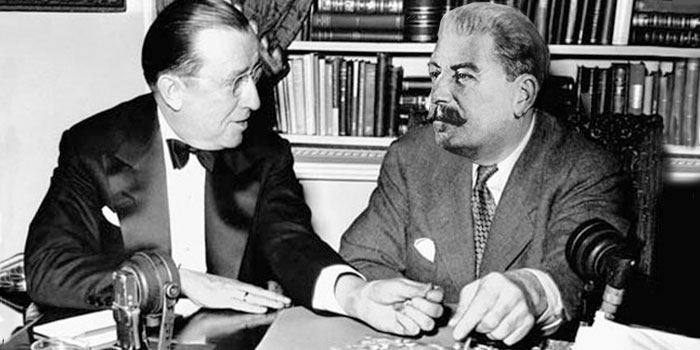
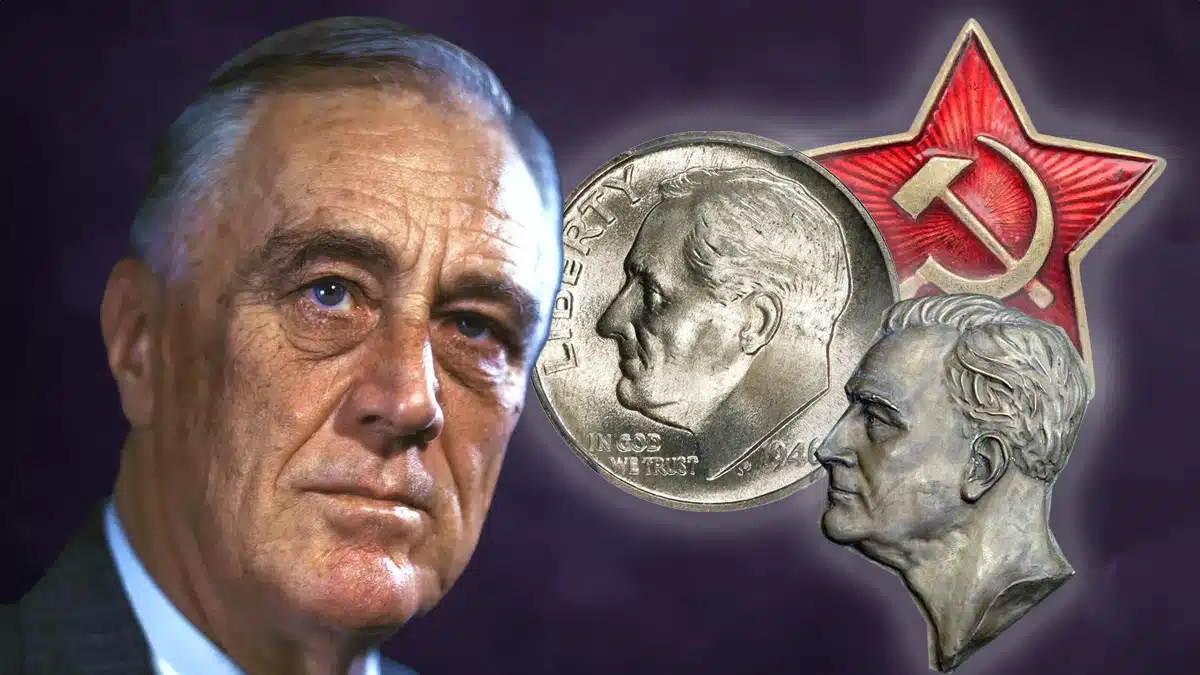
Rumor seized on the dime’s initials. “J.S.” became “Joe Stalin.” The Treasury Department issued formal denials. The story spread anyway, amplified by the rising influence of Senator Joseph R. McCarthy.
No evidence supports the claim. The initials remain on the dime today.
Researchers have never identified the story’s origin. As with the alleged outrage over the 1916 quarter, repetition has replaced documentation.
Selma Hortense Burke and the Question of Authorship
The fixation on initials has obscured a more substantive question: who designed Roosevelt’s portrait?
Some scholars and artists argue that the dime’s head derives from work by Selma Hortense Burke (1900–1995), an African-American sculptor active in the Harlem Renaissance. Burke trained as a nurse and educator and moved in circles that included Langston Hughes, Ethel Waters, and Sinclair Lewis.
In 1943, the CFA announced a competition for a plaque honoring Roosevelt’s Four Freedoms. Burke won. She insisted on sculpting from life. Despite wartime constraints, Roosevelt agreed to sit for her.
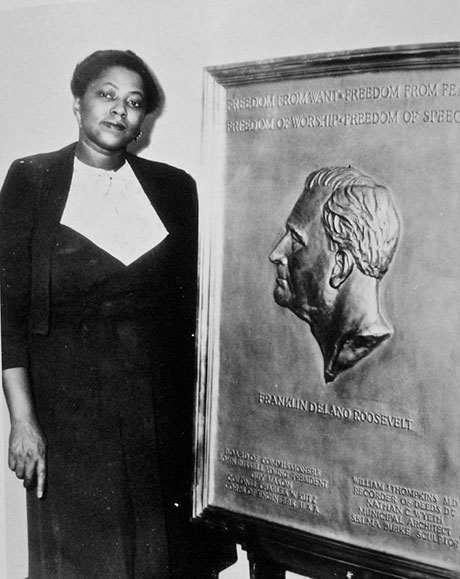
The plaque was dedicated at the Recorder of Deeds Building in Washington, D.C. Eleanor Roosevelt felt the likeness appeared too youthful. Roosevelt’s son James later stated that Burke’s work influenced the dime. The Franklin D. Roosevelt Presidential Library has echoed that belief.
The historical record does not conclusively resolve the issue. Sinnock remains the official designer. Burke’s influence remains plausible but unproven.
With the Stalin myth now recognized as fantasy, numismatists may find greater value in examining that unresolved question.
* * *





The author misstates the Roosevelt dime’s original mint mark position. From the coin’s inception through 1964 the D or S mint mark appeared on the reverse side, as was the practice for all then-current denominations except the cent. The mint mark was moved to its current location near the date in 1968, and Philadelphia issues finally acquired a “P” in 1980.
This article is very interesting and I had no idea of this controversy.
Very interesting story. We have lost so much real information from the old days due to the lack of communications and documentation in the “old days”.
Great read!!! Lots of history!!!!
Imagine how the JS speculation would have taken off if the internet had been available! Some things don’t change — People are always looking for conspiracies.
Excellent information.
Oh, mercy…!
I learned several new things today.
So conspiracy theories about secret signals are nothing new. Another interesting article.
Most of this history, I never knew. It’s good to learn new things.
Excellent read….true history of a valuable coin.
It is mind boggling how such conspiracy theories become so popular.
JS controversy, “Just Stupid”
That’s quite interesting
I recall the issue with the JS that I heard as a kid, in the middle of the cold war. It was well disproven at that time.
Super interesting connection to history
Interesting… Thanks for sharing.
Has there ever been any proposal to change the design of the dime?
Will the dime’s design ever be changed?
The dead president series of coins are probably the ugliest in our history.
Raises some interesting questions
Very interesting.
History is always interesting but never surprising
All denominations have dead president effigies. In my opinion, the head of Roosevelt seems out of proportion to the size of the dime. But, I would prefer that all of the denominations expressed the Ideals of America.For this year, 2026, that is happening, but I would like to see that continue.
This is the first time ever hearing about the dimes history.
From the “you can’t make this stuff up” category…
I never knew those facts about the Roosevelt dime. Very interesting article.
So amazing how so much went into the little ole’ dime. All the transitions and historical facts in the article were very interesting.
Interesting indeed.
My first encounter with any controversy about this coin.
Fascinating!
Interesting article, shows how a controversy can come from nothing.
Great historical backround.
Interesting read
I’ve heard this conspiracy theory before. I’m glad that it never really got any traction.
Very interesting article
Crazy how even the smallest and most common things can have the wildest history
There’s an existing Congressional “directive” that coin designs should be revised every 25 years. But in the case of the FDR dime, it’s now been 80 years, and featuring a man who only lived to the age of 63, mysteriously passing away at a health spa in Warm Springs, Georgia. If the U.S. Mint coin designers can’t come up with something better, maybe just revert back to the 1916-1945 Mercury Dime design.
@Richard Vail: According to everything I’ve read, there’s no regulation that _requires_ design changes every 25 years. The directive regarding changes was issued way back in 1890 and is now codified as 31 U.S.C. §5112. It states that designs MAY be changed after 25 years but doesn’t mandate them. More-frequent changes are permitted but only with congressional approval.
That said, I agree fully that it’s time to move away from the somewhat monarchical practice of depicting late presidents on both coins and paper currency.
FWIW, Roosevelt’s death was anything but mysterious. His health had been in serious decline for a long time due to a combination of his partial paralysis and the stresses of leading the nation through WWII. At that time it was very difficult to treat hypertension. His medical records showed that by late 1944 he was often in the 260/150 range with systolic spikes as high as 300.
I have always enjoyed the design.
Well, I just thought I knew history! What an interesting read, thank you…
so much good info.
Burke’s rendition of Roosevelt bronze plaque does bare a distinct likeness to Roosevelt Dime. No credit is given to her.
Very interesting
I never knew about this.
Rumor spreads easily. Correction does not, is the motto for our current government and the fraud and riots in Minnesota!
Interesting article, I never thought the Burke rendition was in any way similar to the design by Sinnock. Burke was a talented artist in her own right, but Sinnock’s work is dissimilar in many ways. Also note, there will be similarities when one is doing a portrait.
Wow! Very interesting. I never heard of this.
Interesting story.
Great president. Failing health and got us through WW2.