

When the United States Mint makes mistakes, coin collectors reap the benefits
By Blanchard and Company, Inc ……
Mint misstrikes and error coins are one of the most exciting areas in rare coin collecting. And these coins are often valued significantly higher than a coin in its intended condition. The scarcity and unique stories behind these coins create an allure and mystique within U.S. numismatic history.
Adding to this is the fact that errors happen less frequently now, making earlier mistake coins even more valuable. A new coin production process began in 2002 that nearly eliminated error coins from going into circulation. Coins are filtered through automated counters that flag imperfect examples. Thus, very few error coins have entered circulation since then.
Let’s take a look at five intriguing error coins from history that rare coin collectors still search for today.
1802/01 Draped Bust Quarter Eagle
The 1802/01 Draped Bust Quarter Eagle is an extremely scarce, unique overdated error coin. Overdate coins are early examples of mint errors. These occurred when a date or part of a date was punched into a finished working die that already featured an older date. It is estimated that there are roughly 200 United States Mint overdates and experts believe these occurred amid die shortages or a desire to avoid the labor required to create a new die.
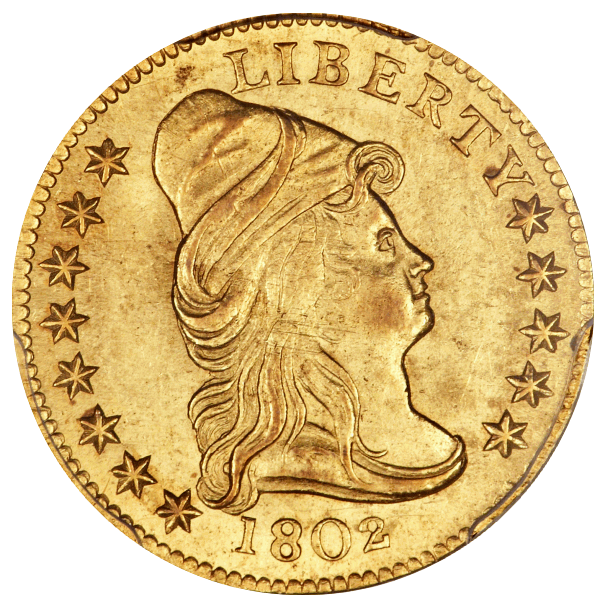
Modern technology removed the potential for overdates as the conditions that facilitated them changed in 1909. The Indian Head Cent was the last issue where the date was punched into the working die by hand. In all subsequent years, the date is included on the master die.
1906 Indian Head Cent struck over a Mexican Gold 5 Peso
In 1906, an error occurred with the Indian Head penny that was struck over a Mexican gold 5-peso coin. Indeed, 1906 was the first year that this error could have been made as this is the year the U.S. Mint began striking coins for Mexico. It was also the only year that the Mint struck 5 peso coins, during which they produced four million pieces.

Discovered while searching bulk US coins at a coin show, despite the uneven strike of the overtype, this coin is much more than just a simple curiosity.
No traces of the undertype are visible on the faces, so the only place the design has been affected is the edge. This error coin has an edge inscription “INDEPENDENCIA Y LIBERTAD” instead of the standard plain edge of an Indian Head cent.
1937-D 3-Legged Buffalo Nickel
This may well be one of the most famous error coins in U.S. Mint history. In the rare coin world, a 1937-D Nickel with a three-legged Buffalo has become a legendary numismatic prize.
Minted from 1913 through 1938, the imposing and memorable coin designed by James Earle Fraser features a handsome Native American on the obverse and a bison on the reverse. It is believed that Black Diamond, a buffalo in New York’s Central Park Zoo, served as the inspiration for the coin’s reverse.
In 1937, the Denver Mint produced 17,826,000 of these legendary nickels composed of 75% copper and 25% nickel. That year, a Denver employee named Mr. Young took his job quite seriously. He over-polished the reverse die with an emery board in an effort to remove clash marks. The result of the excessively polished die variety was that the front leg of the Buffalo was missing! Hence the Denver Mint created three-legged Buffalo nickels in 1937. Collectors in the late 1930s quickly discovered the mint error and the 1937-D nickel became a classic even in its own time.
The 1943 Lincoln Cent struck over a struck 1943 Mercury Dime
The 1943 Lincoln Cent struck over a struck 1943 Mercury Dime is a remarkable and rare double denomination error coin. Naturally enough, it was created when a dime was mistakenly fed into a printing press coining cents.
This error is a legendary numismatic error where a penny’s design was impressed onto an already minted 90% silver dime.
Itdiffers from the more common “wrong planchet” error where a cent is struck on a blank dime disc; in this case, the underlying Mercury Dime design is often still visible beneath the Lincoln portrait.
This error coin combines the three-pronged popularity of the Lincoln Cent, the Mercury Dime, and the 1943 date caused by the desirability of the famous 1943 copper cents.
The 2000-P Sacagawea Dollar Mule
Sacagawea was a Shoshone woman who helped Meriwether Lewis and William Clark on their exploratory expedition from North Dakota across the Rocky Mountains to the Pacific Ocean and back in 1805-6. Her work as an interpreter proved invaluable, and her presence in the group also demonstrated the peaceful nature of the mission. In the year 2000, the United States Mint honored Sacagawea and her contributions to the early explorations of our great nation with the Sacagawea Golden U.S. Dollar coin. The coin was minted under the auspices of the United States $1 Coin Act of 1997.
By and large, the majority of Sacagawea coins are not rare and circulated coins do not carry numismatic value. They are also not made of gold, despite the “golden” color and name. The coins were composed of primary copper (77%), with small portions of zinc, manganese, and nickel.
However, a 2000-P Sacagawea dollar/Washington quarter mule error sold for $192,000 USD back in 2018. A mule is a coin struck with obverse and reverse dies that were not supposed to be paired with each other. In this case, the obverse reveals a Washington quarter, while the reverse reveals a Sacagawea dollar. About two dozen of these major errors were struck at the Philadelphia Mint.


I have some very interesting coins that I believe are worth some money… I need to have them looked at…
Always learn something new here. Did not personally know about any of these before.
I would love to find one of these
There’s sure is a lot of things to remember. It sure is good that most of it is easy to look up. Still, y’all’s info is great reading.
Very interesting!
I would absolutely love to find an error coin! I need to start examining my stack!
First time I’ve heard an explanation of why it’s called a mule. I always thought these were intentional test strikes with non matched dies. As always interesting info from coinweek.
Very interesting article.
I’m surprised that the 1942 over 41 Mercury dime wasn’t mentioned.
Squirrel – We could have made a list of 20, as you know. The 42 0ver 41 will certainly be in the next installment.
Never knew about the Washington/Sacagawea Mule error before. Could be some of these errors are still possible to find.
A very informative article.