


By Charles Morgan and Hubert Walker for CoinWeek Notes …..
The 1976-D Bicentennial Quarter is still doing its job, nearly a half-century after its issue in 1975 and 1976. Introduced alongside redesigned half dollars and dollar coins to mark the 200th anniversary of the signing of the Declaration of Independence, the quarters were struck in the largest quantities of the three. A slightly larger mintage and a couple of notable varieties distinguish the Denver Mint issues from their Philadelphia counterparts. The United States Mint struck both in large enough quantities that consumers still encounter the coins in circulation.
Collectors Lobbied Hard for Bicentennial Coins
In the early 1970s, the nation prepared to mark its bicentennial anniversary. The American Revolution Bicentennial Commission’s Coins and Medals Advisory Panel, formed in 1970, recommended new designs for all denominations and one commemorative coin, an approach opposed by the Treasury Department. Mint Director Mary Brooks articulated the Treasury’s opposition before the Commission.
According to her testimony, commemorative coins:
“[D]o not serve as a medium of exchange, are not readily available and recognizable to the public, invade the production capacities of the Mint and… have been the subject of hoarding and profiteering. In short, commemorative coins tend to defeat the purpose of the coinage system.”
Collectors pushed for not only a full redesign of circulating coinage but also multiple dedicated non-circulating commemorative coins, including a gold issue. In November 1972, Treasury officials agreed to add the date 1776 to 1976’s coinage but would not change the coinage in any way to commemorate the Bicentennial. Congress ultimately took a middle path.
 According to a July 8, 1979, New York Times numismatic column by Ed Reiter, “It was only at the prodding of key hobby leaders, and interested members of Congress, that the quarter was also included.”
On October 18, 1973 – two days before the “Saturday Night Massacre” of the Watergate saga – President Richard M. Nixon signed a bill, S. 1141, that became Public Law 93-127, which authorized changes to the designs and inscriptions of the quarter, the half dollar, and the dollar. New designs “emblematic of the Bicentennial of the American Revolution” would be accompanied by a double date, 1776-1976, on the three largest denominations struck by the Mint in the mid-1970s. The law was amended on December 26, 1974, to allow for the minting of silver-clad Bicentennial coinage.
No 1975-dated quarters would be struck.
The Treasury announced a design competition that began on October 23, 1973. A panel of five judges appointed by the National Sculpture Society judged a nationwide design competition, with winners receiving $5,000. The Treasury announced the new designs on March 7, 1974, with Mint Director Mary Brooks appearing on the Today show to spread the word.
Bicentennial Quarter Released to Great Fanfare
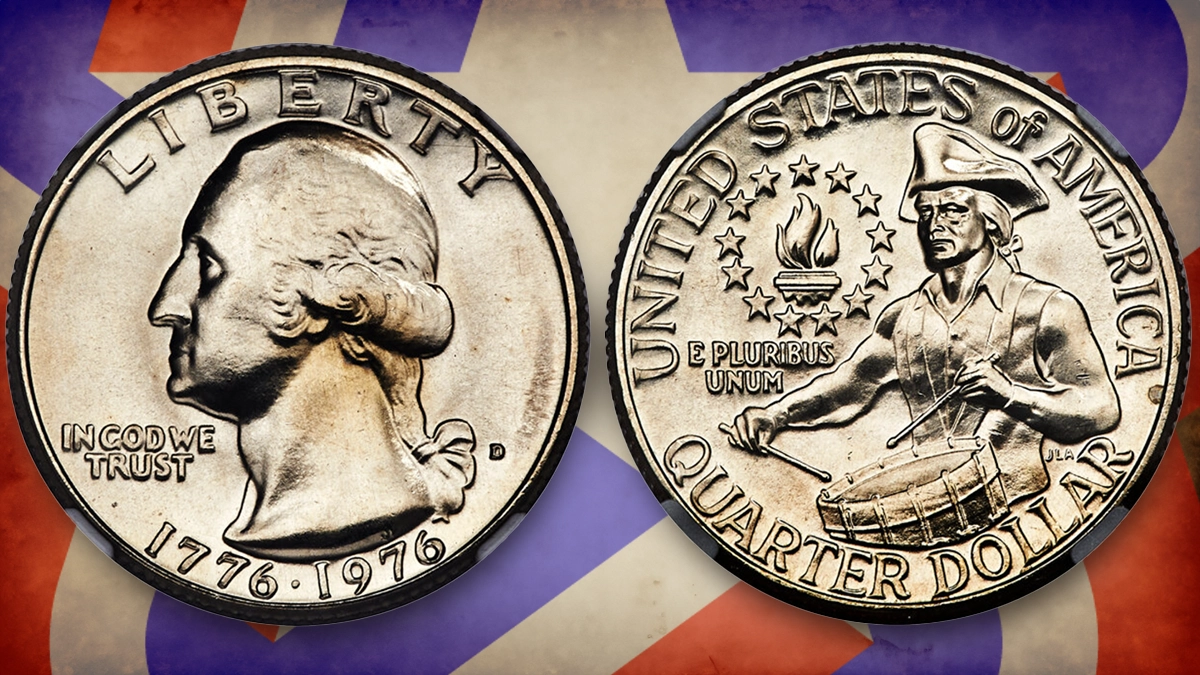
The first trial strikes were struck at the Philadelphia Mint on August 12, 1974, at 11:00 AM Eastern by Mary Brooks and the artists who created the three Bicentennial designs. Jack L. Ahr’s design for the quarter, which features a colonial drummer and what the U.S. Mint’s website describes as a “victory torch” surrounded by 13 five-pointed stars, was selected for the quarter.
Nine hundred and fifty-four million quarters were distributed between August 1975 and June 30, 1976, according to the 1976 Mint Director’s Report – a 140% increase over the same previous period. “Mint officials attribute the demand for the coins to their commemorative value and … relatively limited numbers,” the report stated.
Production continued through the end of 1976.
The dual-dated quarters were released with a public ceremony in Chicago at 12:30 PM on August 18, 1975. Ahr, as well as the designers of the Bicentennial reverses of the dollar and the half dollar, were invited; Ahr lived in Arlington Heights, a Chicago suburb, at the time. Director Brooks shared her feelings about the quarter in the press release announcing the release:
“The quarter, in particular, has a most romantic history. It gets me thinking of swashbuckling pirates, chests full of Spanish ‘pieces of eight’ and the colorful expression ‘two bits.’”
1976’s Bicentennial coinage was successful, at least according to the Mint. A September 11, 1976, Mint press release pointed out that “citizens are acquiring circulating versions of the nation’s new Bicentennial coins at record rates”, citing the high U.S. public demand. The release also quoted Director Brooks; whatever her or the Treasury’s reservations about the commemorative coinage, she said “The popularity of the coins is a tribute to the nation… It confirms that Americans have great pride in their country and its heritage.”
A 1977 Mint press release pointed out that “During the past 3 years, the Mint’s major numismatic programs have almost doubled in number.” Brooks is again quoted, saying that the volume of numismatic products sold “represents numismatic history at the Mint.”
Not all reviews were so glowing.
Ed Reiter’s July 8, 1979, New York Times story, which was titled “Bicentennial Hangover”, summarized the hobby’s reaction to the Bicentennial coin program, calling it “a coinage saga that has gotten, at best, mixed reviews from the nation’s hobbyists.” According to Reiter’s article, the designs “were received with less than universal acclaim” and the Mint was having difficulty selling surplus Uncirculated sets, as well as silver-clad Uncirculated and Proof Sets.
* * *
1976-D Bicentennial Quarter Market Data and Noteworthy Specimens
Outnumbering their Philadelphia siblings by a little more than 50 million, 1976-D Bicentennial Quarters are affordable in almost every grade, though experienced collectors might seek out elusive fully struck examples and pay a little more than usual for such pieces – especially if the desired coin is graded MS68. Variety hunters have a couple of major DDO varieties to consider, and the occasional major error does come up for auction. But while Ahr’s design and the unusual double date are curiosities to many consumers, who sometimes set them aside, the coin is not a priceless rarity despite what sensationalist articles promoted online suggest.
 Bicentennial Quarters were struck for circulation at both the Philadelphia and Denver Mint facilities in such quantities that examples of both 1976 (P) and 1976-D can still be found fairly easily in circulation. The Denver Mint struck 860,118,839 dual-date 1776-1976 quarters in 1975 and 1976.
Fully-struck 1976-D Washington Quarters are not common. According to a CoinWeek article by Charles Morgan and Hubert Walker, 1976 and 1976-D quarters are often “not fully struck,” especially on the drum’s top rim and clasp – though most of the Bicentennial Quarters are “attractive and well-made coins.” The article concludes by saying that “finding a blazingly nice coin that’s free of scratches and bag marks PLUS a full drum is a special coin, indeed.”
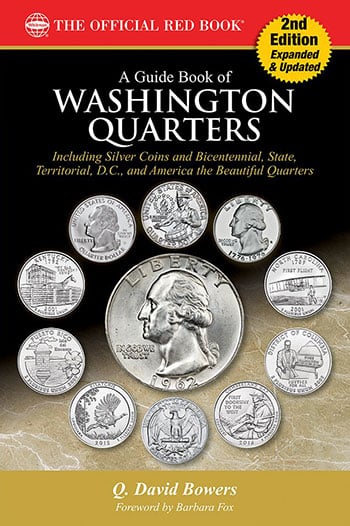
Q. David Bowers’ Guide Book of Washington Quarters (2nd Ed., 2017) does not have much to say about the 1976-D issue, though it notes that the issue is “Common in Mint State, although gems are in the minority.”
At the time of writing (September 2024), PCGS records 3,038 grading events for 1976-D quarters. PCGS reports 59 FS-101 and 97 FS-102 varieties. NGC reports 1,491 grading events, 23 of which are FS-101 varieties and three of which are FS-102s. Hundreds of examples are reported by both services graded MS65, 66, and 67. PCGS reports 13 examples graded MS68, and NGC reports 15 – both up one from six months ago at the time of this writing in September 2024. In January 2017, NGC had certified only a single example in that top grade.
PCGS had four examples certified MS68 from late 2011 to early 2012, according to a January 2012 Heritage listing. The NGC population has increased slowly, progressing from five to 15 since 2017.
Examples demonstrating light to heavy circulation can still be found with some searching, so there is no real premium for such coins. Certified examples in higher uncirculated grades command some premium, depending on the numerical grade. Auction results from the last decade suggest that MS66 examples generally sell for between $10 and $40, and MS67 examples sell for between $30 and $100. The handful of quarters that earn an MS68 grade sell for thousands; an example graded by PCGS sold in a Legend auction for $5,170 in January 2018. An NGC MS68 example sold in May 2022 for $1,740. The most recent PCGS coin that sold, brought $2,600.
Major Bicentennial error coins are sought after by collectors. A 1976-D quarter obverse die cap error sold in an August 19 Stack’s Bowers sale for $2,880.
Top Population: PCGS MS68 (14, 9/2025), NGC MS68 (15, 9/2025), and CAC MS66 (0:2 stickered:graded, 9/2025).
- PCGS MS68 QA #50939892: “The Neon Lights Collection,” GreatCollections, January 5, 2025, Lot 1720656 – View.
- PCGS MS68 #49686355: GreatCollections, September 22, 2024, Lot 1312068 – View.
- NGC MS68 #6835342-006: Heritage, May 12, 2024, Lot 7249 – $990.
- NGC MS68 #6060937-003: Heritage, May 4, 2022, Lot 3489 – $1,740.
- PCGS MS68 #34207495: Legend Rare Coin Auctions, January 25, 2018, Lot 174 – $5,170.
- NGC MS68 #1876962-025: Heritage, January 8, 2012, Lot 11052 – $3,220; “The Mile High Collection,” Heritage, January 5, 2017, Lot 4804 – $6,462.50.
- PCGS MS68 Teletrade, May 29, 2000, Lot 1434 – $261.60.
- PCGS MS68 Teletrade, March 3, 1997, Lot 1362 – $141.70.
* * *
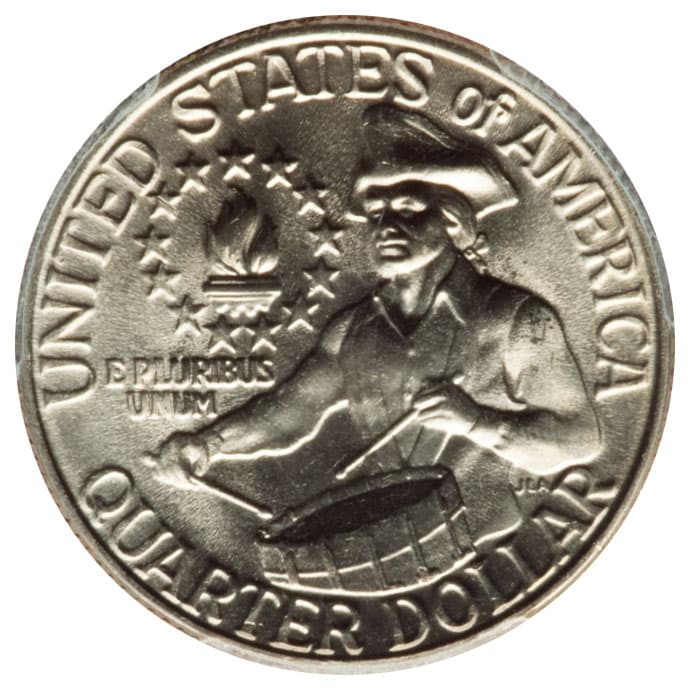
Design
Obverse:
John Flanagan’s obverse design features a left-facing portrait of George Washington based on the Jean-Antoine Houdon bust of 1786. LIBERTY wraps around the top of the coin, above Washington’s hair. The dual date “1976-1976” wraps around the bottom, below Washington’s bust truncation. To the left of Washington is the national motto IN GOD WE TRUST; to the right is the D mintmark for Denver.
Reverse:
Jack Ahr’s colonial drummer occupies most of the reverse, with a small “victory torch” surrounded by 13 five-pointed stars on the left. The legend UNITED STATES OF AMERICA wraps clockwise around the top half of the quarter, while cradled counterclockwise at the bottom is the denomination QUARTER DOLLAR. The motto E PLURIBUS UNUM is crammed between the torch and the drummer’s right arm.
Edge:
The edge of the 1976-D Bicentennial Washington Quarter, like all Washington Quarters, is reeded.
1976-D Bicentennial Quarter Varieties
Varieties of 1976-D Washington Quarters were reported around the time of the coins’ release. A September 26, 1976, Chicago Tribune column reported on a variety with significant doubling visible on “LIBERTY”.
The Cherrypickers’ Guide to Rare Die Varieties of United States Coins (“Cherrypickers’ Guide”) lists two major doubled die obverse (DDO) varieties of the 1976-D Bicentennial Quarter: FS-25-1976D-101 (FS-101) and FS-25-1976D-102 (FS-102). Both Cherrypickers’ Guide varieties are attributed by PCGS and NGC. FS-101 varieties have doubling on LIBERTY, the motto, and the date, though the authors note that “[g]enerally, only early die state specimens will show doubling on the motto.” FS-102 varieties have “moderate doubling” only on “LIBERTY” and the authors think that “this variety may prove very rare.”
A 2019 Heritage Auctions listing described the FS-101 as “easily the most significant die variety of the Bicentennial type.”
Variety Vista also lists two DDO varieties (also with doubling on LIBERTY), as well as one repunched mintmark variety.
Coin Specifications
| Country: | United States of America |
| Year of Issue: | 1976 |
| Denomination: | Quarter Dollar (25 Cents USD) |
| Mintmark: | D (Denver) |
| Mintage: | 860,118,839 |
| Alloy: | Outer layers of .750 copper and .250 nickel; inner core of pure copper |
| Weight: | 5.67 g |
| Diameter: | 24.30 mm |
| Edge: | Reeded |
| OBV Designer: | John Flanagan |
| REV Designer: | Jack L. Ahr |
| Quality: | Business Strike |
* * *




I have one of those quarters
HP Heaku45 Sirian blessings
✌ That’s me I was born
My daughter is a Bicentennial Baby too and a Leap Day baby at that. What a wonderful year that was. Happy Birthday to you.
WOW. That was supposed to be my birthday. But I was born a little late. I still wonder what it would have been like to be born on Leap Year Day.
Well John you would be doing a lot of leaping around
I have one of a kind 1976 d quarter in beautiful shape color. What recommendations are there to find out if it’s one of the few double full drum coins that are in circulation.
That is a great article about the Bicentennial quarter. Sadly as a family member collected every one she found over 30 years thinking they may have more value in the future, she cashed over 3k in quarters to invest elsewhere. I inherited a modest amount she retained with her coin collection. We enjoy going through them looking for oddities.
I’m pretty positive I have the same coin as your describing. The D is double stamped an the lettering in Liberty looks like it was double stamped also.
I got a quarter but of bicentennial and on the back it is painted very beautiful how could I send you a picture so you could see it thank you
Are the bicentennial quarters worth anything because I have a lot of those?
@Teresa Serritella As the article explains, circulation-strike bicentennial coins are neither rare nor valuable.
What should I do with these quarters? I’d like to sell
Don’t sell because no one will buy. They are worth a quarter only. Now if you have the silver variety (which I possess several) that’s different, they are worth selling
Is the drum bboy quarter vaul for anything els
I’ve got a handful of the bicentennial quarters!
I would like to how much my coins are worth.
What makes the value of the collectable ones?
What about the half dollar with the drummer boy
@Priscillo Jackson There is no bicentennial half dollar with a drummer boy, only a quarter. The bicentennial half depicts Independence Hall on the reverse. Given the number produced, neither of these coins struck in clad composition are going to be very valuable. The only ones that have a significant premium are either in top condition or are the special 40% silver varieties made for collectors.
What are the 1776-1976 Bicentennial Quaters worth? I have approx. $70-$90 worth of these Quaters.
$70 to $90
@Ignacio Camaco As the article explains, circulation-strike bicentennial quarters (rather than “quaters”) are generally not valuable. Your coins are unlikely to be worth more than a quarter each.
I’ve been collecting them from change since I was a kid. I have probably about 60 dollars worth of them. Also have three graded Silver Proofs with the “S” marking from the San Fran mint.
I have one of these coins and it is larger than the normal quarter. We have both to compare the differance.
I believe that I’ve got the most uncommon ones
I have Bicentennial Washington Quarter with a D mint mark and one with no mark. A Dime with a head with wings on the ears. Other side a column wrapped with tree branch. A $1.00 Martin Van Buren coin. A statue of Liberty on the other side.
The dime with wings on its ears is a Mercury Dime
That is a mercury dime. I have one or two.of those from my dad’s collection
@Frank E The D mint mark indicates the Denver mint, while the lack of a mint mark on older coins (or current cents) indicates they were made in Philadelphia. All of those mints’ bicentennial coins were made in cupronickel so they have no added value. The Martin Van Buren coin is a modern presidential dollar struck in 2008. It’s made of brass; if you got it in change it has no added value.
Most of the 1976 quarters have only face value.Due to the high inflation rate the coin value is moot.Keeping only the die errors.
I have one a bicentennial quarer
Just had one in my hand not so long ago. In the quick-paced shuffle of life I don’t always scrutinize the coins that I get but I noted that Bicentennial Quarter. I may still have it. Seeing one always makes me nostalgic for 1976, that year of our Nation’s 200th Birthday.
Why if you will never sell lol
I have a Spitting Horse. It is a fun keeper.
I have a bicentennial quarter that looks all copper color .I’m meant congratulations.how much can I get .and don’t tell me face value. K , I no it’s rear .
I have one to 1776-1976 D mint Bicentennial Goerge Washington How much should sell it for,I hope I can get a fair price for it in the coin shop
@No Assuming your coin is in average condition, a fair price is 25¢. As the article clearly explains circulation-strike bicentennial coins are neither rare nor valuable.
I have 8 of those and one gold painted quarters and many old coins and very old 2 dollar bills with red tags
I have 7 no mint ones & 1 D that’s a blob then 3 half dollar ones & like 60 or so wheat pennies starting at age 1909 & up…
I have an original 1976 bicentennial quarter,been had it since it’s first came out.its a rarity.
@Randy Walker As explained in the article, circulation-strike bicentennial coinage is neither rare nor valuable. Unless your coin is in spectacular condition or is one of the special 40% silver collector’s versions, it’s not going to be worth more than face value.
I have 2 or 3 bicentennial quarters. A Susan b Anthony dollar very shiny…a shiny 1942 nickel. It’s in perfect condition just very silvery, and 2 gold dollars. Is it worth selling?
@Renee Barton Assuming your quarters and SBA dollar were found in change, they’re only worth face value despite their age.
Similarly, assuming the “gold” dollars are modern issues they’re actually made of manganese-brass and are only worth face value in circulated condition.
The 1942 nickel would need in-person inspection. Not only were they struck at three different mints, there were two different compositions due to wartime metal shortages.
I have a 1776- 1976 one dollar coin
I have a 1776 1976 they said that only value only twenty five cent Thanks
I have the 1776 too 1976 quarter too so is it worth
@Franklyn Unless it’s an error or in top condition, 25¢. Please re-read the article for details.
How much can I get for my 1776-1976 bicentennial quarter?
My name is Quentin owens and I have 10 bicentennial quarters how much each quarter worthy in dollars?
I have the same as you what did you do to get it graded
@QuentinOwens As the article explains, most bicentennial coinage is neither rare nor valuable. If your coins are from Denver (D) or Philadelphia (no mint mark at that time) each one is worth only its face value, $0.25 in dollars.
I have 100s of them. Collected sense was a kid. An alot older now. How go about finding values of them.
I have a 1776-1976 quarter. Who do I contact to get a price
@Sharon Nunley The article gives many details about how much these coins are worth … or are not worth, depending on their mint mark and quality. The vast majority have not appreciated in value.
I collected a lot of them in the past couple of years to make business to give different country for people less unfortunately as we are but also for the people here in are Nation we are supposed to give freely to be blessed cause God gave for us
I have a coin that has a golden center & silver around the center what are the best websites for researching such coins
I would love to know more about collecting coins. Thank you
I have a bicentennial quarter that has a broken drummer stick and other die marks/ chips.
This design was a nice change from the usual eagle.