


By Charles Morgan and Hubert Walker for CoinWeek Notes …..
On July 23, 1965, President Lyndon B. Johnson signed the Coinage Act of 1965 into law, essentially ending silver’s 170-year run as the coin of the realm. The half dollar retained some of its silver content (debased from 90% to 40%), but under the new law, the dime and the quarter would be struck in a copper-nickel sandwich metal.
The new metal was harder and slicker, and the quality of impressions from the dies suffered. The new quarters were also lighter, weighing 5.67 grams instead of the silver standard of 6.25 grams.
The transition from silver to clad coinage took three years. During this time, the United States Mint produced both silver and clad coins. The silver coins were dated 1964, while the clad coins were dated 1965. Since the Mint did not apply branch-identifying mintmarks to clad coins during the first three years of production, it’s impossible to discern which facility struck any given 1965 Washington Quarter.
This was purposeful, as Mint leadership believed that the insatiable demand of speculators and coin collectors had caused a nationwide coin shortage. This shortage had the Mint operating round-the-clock, unable to keep up with demand. In reality, modern conveniences like vending machines and pay telephones were “hoarding” coins at record numbers.
With the date freeze and the unprecedented mintage of the 1965 coins, the collector/investor market for coin rolls collapsed. But another Mint decision also contributed to the story of the 1965 quarter.
From 1947 to 1964, the U.S. Mint offered collectors the opportunity to purchase uncirculated and Proof versions of each year’s coin in the form of Mint and Proof Sets. Starting in 1965 and continuing through ’67, the Mint did not produce these popular products and issued Special Mint Sets instead. These sets were hybrid issues–not quite Proofs, not quite business-strike coins, but something in between. Without having a million-plus Mint Sets for the 1965 issue available, the only source for uncirculated coins from this date would have been from bags or rolls held back at the time of the coin’s release. Because of this, the 1965 Washington Quarter is similar to the 1983-P.
The 1965 Washington Quarter Is Important, but Is It Valuable?
The 1965 Quarter does not circulate now with the same frequency as it once did. Through the mid-to-late 1980s, the 1965 Washington Quarter was ubiquitous and its almost two-billion-piece mintage will never be surpassed. Yet after six decades, any examples that still circulate will likely be found in grades VF and below. These coins may have a slight value over face value if sold on eBay, but we doubt they would sell consistently for any price over $1. The coins with actual value are found in Gem Mint State (MS65 or better).
The real problem with finding uncirculated examples is that so many Special Mint Set coins proliferate the market. Without expertise, a seller and buyer may not be able to identify a 1965 business-strike coin accurately. Additionally, most certified coins to date are Special Mint Set coins because SMS coins are typically nicer and more available for bulk submissions. Recent eBay auctions for the business-strike 1965 Washington Quarter in MS66 show prices of about $12-$15 per coin. The value increases in MS67 to about $100 or more.
Above these grades, auction values escalate. Buyer beware! Conditional Rarities are highly volatile and as populations increase, values come down – and often collapse. Our listings below show several top-pop and near-top-pop coin auctions from 2019 to the present; note the price history.
* * *
Market Data and Noteworthy Specimens
Top Population: PCGS MS68 (1, 10/2025), NGC MS68+ (1, 10/2025), and CAC MS66 (1:0 stickered:graded, 10/2025).
- NGC MS68+ #6208880-003: GreatCollections, January 30, 2022, Lot 1099562 – View; GreatCollections, August 7, 2022, Lot 1203023 – View; GreatCollections, November 5, 2023, Lot 1465764 – View.
- NGC MS68 #6208880-002: Heritage Auctions, June 4, 2024, Lot 21178 – $1,020.
- NGC MS68 #6880075-001: Heritage Auctions, April 30, 2024, Lot 21235 – $1,050.
- NGC MS68 #3560546-001: GreatCollections, May 16, 2021, Lot 981088 – View; GreatCollections, August 27, 2023, Lot 1000453 – View.
- NGC MS68 #6073514-002: GreatCollections, August 13, 2023, Lot 1396874 – View.
- PCGS MS68 QA #47455065: Heritage Auctions, July 20, 2023, Lot 3054 – $11,400. Secure Shield holder.
- NGC MS68 #5709161-004: GreatCollections, December 6, 2020, Lot 913620 – View.
- NGC MS68 #3735288-003: Heritage Auctions, October 18, 2019, Lot 3623 – $1,920; GreatCollections, August 28, 2022, Lot 946124 – View; GreatCollections, July 30, 2023, Lot 1406414 – $1,043.74. Brilliant. Long die crack on the reverse, from 12 o’clock through S O to the top right of the eagle’s wing.
- PCGS MS67+ #46556520: Heritage Auctions, April 3, 2023, Lot 50089 – $576. Rainbow toning along the obverse and reverse periphery.
- PCGS MS67+ #40520762: Heritage Auctions, January 26, 2021, Lot 27385 – $720. Peacock toning on both sides.
- PCGS MS67+ #25677825: “The jwb1040 Collection,” Heritage Auctions, February 22, 2018, Lot 3663 – $840; GreatCollections, July 5, 2020, Lot 852951 – View.
- PCGS MS67+ #84332622: As PCGS MS67 #25636033. Heritage Auctions, January 8, 2017, Lot 9509 – $352.50. As PCGS MS67+ #84332622. Heritage Auctions, September 7, 2017, Lot 3404 – $2,040. Upgraded one-half point; Heritage Auctions, January 4, 2018, Lot 4530 – $1,440. Attractive target toning in golden tan, yellow, and cerulean blue. Hit on the cheek. Deep hit in left field. Hit in hair. Square hit on bust truncation.
- PCGS MS67+ #81947785: As NGC MS68 #5709161-004. Heritage Auctions, June 7, 2020, Lot 7167 – $1,320. As PCGS M67+ #81947785. Heritage Auctions, January 5, 2017, Lot 4801 – $2,585; “Charlie O’s Collection,” Heritage Auctions, June 9, 2019, Lot 7437 – $660. On the obverse, light scattered stains along the periphery at 3 and 9 o’clock. Crossed to PCGS, downgraded by 1/2 point.
1965 Washington Quarter Struck on a Silver Planchet
While the Coinage Act of 1965 stipulated that all quarters would be struck in the new copper-nickel clad sandwich metal, a small number of .900 fine silver blanks were used to strike 1965-dated quarters. This probably inadvertent mistake created at least a dozen highly-coveted transitional errors.
- ANACS MS60 #824656: Stack’s Bowers, November 4, 2016, Lot 4620 – $6,462.50.
- PCGS AU58 #14114143: Stack’s Bowers, March 2011, Lot 638 – $9,200; Heritage Auctions, June 5, 2014, Lot 4504 – $14,687.50. Curved stain to the right of Washington’s head. Stain at 9 o’clock.
- NGC AU55 #1626814-001: Heritage Auctions, September 6, 2018, Lot 3057 – $8,400. Large dark spot on Washington’s forehead. Horizontal scratches in the left field and the back of Washington’s neck.
- NGC AU55 #1721999-001: Heritage Auctions, February 4, 2014, Lot 5132 – $8,812.50. Rim hit, leaving three marks in the left obverse field. Diagonal hit on bust truncation. Diagonal streaky toning on the obverse. 6.14 grams.
- PCGS AU53 #31080427: As NGC AU50. American Numismatic Rarities, July 25, 2003, Lot 604 – Passed. As PCGS AU53 #31080427. “The Alfred V. Melson Collection,” Stack’s Bowers, November 2014, Lot 10276 – $7,050. Crossed to PCGS and upgraded. Alfred V. Melson Collection on insert.
- PCGS AU50 #46444312: Stack’s Bowers, November 16, 2023, Lot 6709 – $7,200. 6.19 grams.
- NCS AU Details #5024056-002: Stack’s Bowers, June 15, 2022, Lot 2290 – $5,040. Rim damage. 6.1 grams.
- PCGS XF45 #21271897: Stack’s Bowers, August 19, 2021, Lot 6308 – $7,500.
- ICG EF40: Stack’s vowers, August 2014, Lot 3377 – $4,500.
1965 Washington Quarter, FS-101. Doubled Die Obverse
- PCGS AU58 #83560537: Heritage Auctions, March 14, 2018, Lot 23573 – $360.
- NGC AU58 #307248-001: Heritage Auctions, February 16, 2007, Lot 3895 – $488.75; GreatCollections, January 2, 2022, Lot 1098074 – View.
- PCGS AU55 #11274714: Heritage Auctions, January 8, 2012, Lot 11047 – $575. Discovery coin. Attributed by Tom DeLorey at Coin World.
1965 Washington Quarter, FS-102. Doubled Die Obverse
- PCGS MS65 #30171813: Heritage Auctions, March 14, 2018, Lot 23574 – $720; Stack’s Bowers, May 29, 2019, Lot 5479 – $550 Reserve Not Met; GreatCollections, August 4, 2019, Lot 736071 – View.
* * *
Design
Obverse:
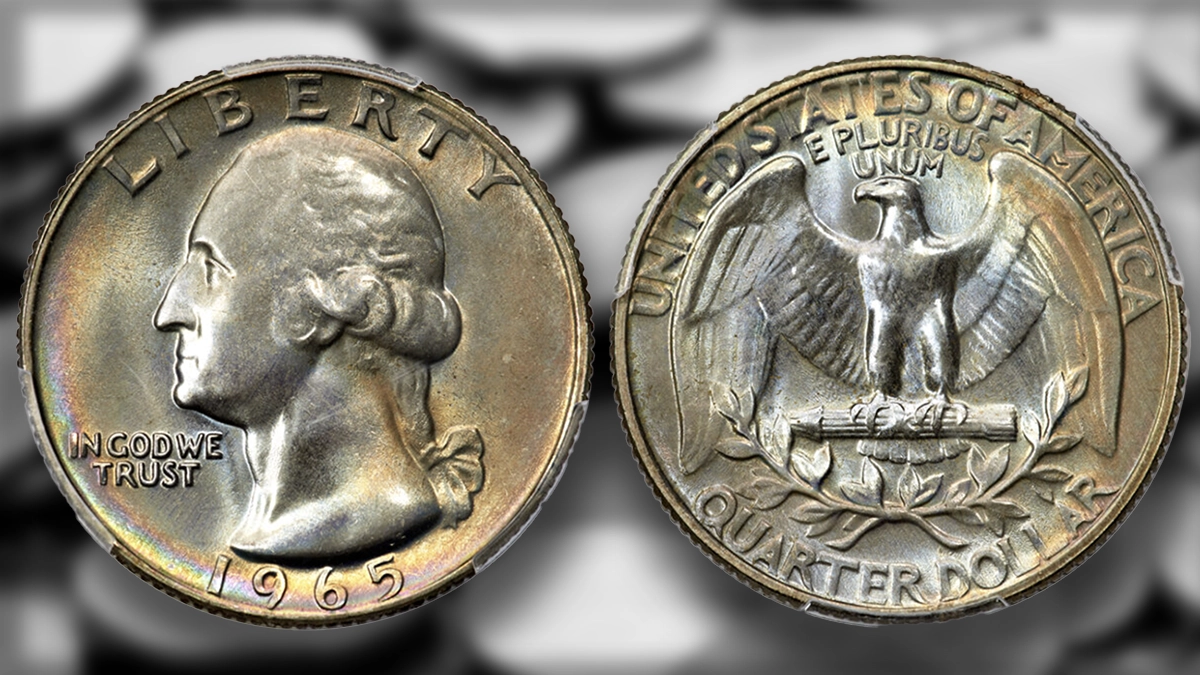
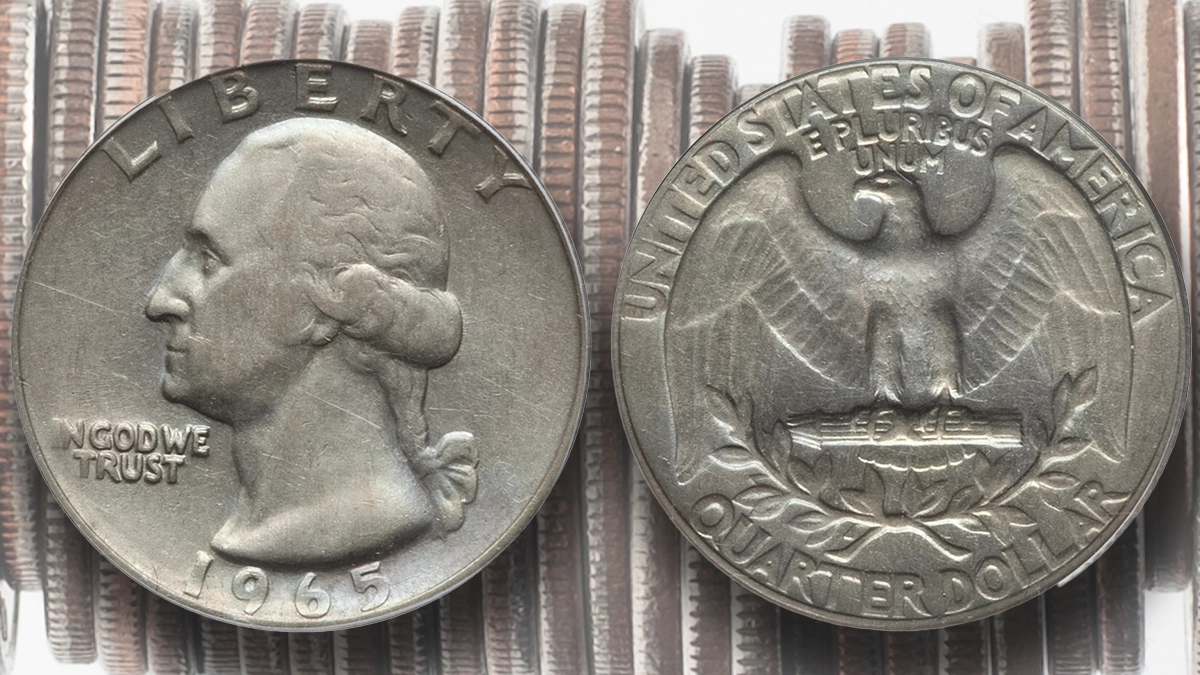
Designed by John Flanagan, the obverse of the 1965 Washington Quarter is based on a bust of the general created by the neoclassical French sculptor Jean-Antoine Houdon in 1785. However, Flanagan’s design differs from the original bust in several ways, such as a slightly different head shape and several curls of hair that are not on the bust; for comparison, the bust can be viewed at the late president’s Virginia estate, Mount Vernon. Under the left-facing bust’s chin is the motto IN GOD WE TRUST. The legend LIBERTY runs along the top of the coin’s field, and the date 1965 is below. In small letters, Flanagan’s initials JF can be found above the “5” in 1965 at the base of the bust.
Reverse:
Unlike the obverse, no restrictions were placed on the candidate sculptors when designing the Washington Quarter reverse. Flanagan’s reverse is dominated by a heraldic eagle with outstretched wings and a left-facing head. The eagle is perched on a neat bundle of arrows with two intertwined olive branches below. The two main inscriptions above the eagle are the legend UNITED STATES OF AMERICA and the motto E PLURIBUS UNUM. Finally, at six o’clock on the design is the denomination written out as QUARTER DOLLAR.
Edge:
The edge of the 1965 Washington Quarter is reeded. As struck, the top and bottom edges will appear grey, while the center will appear copper colored.
Designer
John Flanagan was born in New Jersey in 1865 and lived in New York for most of his life. He began working with Augustus Saint-Gaudens in 1884 at the age of 20 and quickly became a well-known sculptor and medallic artist in his own right. Saint-Gaudens made introductions for Flanagan at the United States Mint. While the Washington Quarter was his sole numismatic design, Flanagan designed numerous famous medals and sculptures, including the official medal of the 1915 Panama-Pacific International Exposition, the official Verdun medal gifted to France by the United States Government, and the 1924 bust of Saint-Gaudens. Flanagan was also a member of the American Numismatic Society (ANS).
Coin Specifications
| Country: | United States of America |
| Year of Issue: | 1965 |
| Denomination: | Quarter Dollar (25 Cents USD) |
| Mintmark: | None (Philadelphia and Denver) |
| Mintage: | 1,819,717,540 |
| Alloy: | Outer layers of copper-nickel (.750 copper and .250 nickel) bonded to pure copper inner core. |
| Weight: | 5.67 g |
| Diameter: | 24.30 mm |
| Edge: | Reeded |
| OBV Designer: | John Flanagan |
| REV Designer: | John Flanagan |
| Quality: | Business Strike |
* * *





I have a 1970 D quarter it seems to have extra weight and I have pis of it. On front the chin is bulged and longer and on the back the eagle is also bulged and rounded out. Bulged on both sides. I haven’t seen one like this before and would appreciate if anyone could help me find out about it.
WHAT IS A 1964 WHEAT PENNY WORTH TODAY ? REPLY !
You might want to check out our Lincoln Wheat Cent hub page: https://coinweek.com/lincoln-wheat-cent-1909-1958/
Or check out our Lincoln Memorial Cent page hub: https://coinweek.com/lincoln-memorial-cent-bronze-1959-1982-history-value/
@Karen Lively Are you sure it’s a wheat cent? The wheat-ear reverse was replaced by the familiar Lincoln Memorial reverse starting in 1959. If your coin has the Memorial on its reverse, you have one of the billion-plus cents minted with that date. Unless it’s in spectacular condition it’s unlikely to be worth more than face value. Some points to remember:
> While bronze-alloy Lincoln cents are worth more than face value for their copper content, it’s both illegal to melt them and recovering the copper would cost more than the scrap value.
> Yes, there’s at least one _suspected_ 1959 transitional error cent that has the wheat-ear reverse but it’s highly unlikely such an error occurred again five years later.
> The term “wheat cent” refers only to cents with the wheat-ear reverse, issued from 1909 to 1958. It’s not a generic name for all Lincoln cents.
How about a 1965 quarter @ 5.76 grams?
@Jason Strickland The Mint’s tolerance range for clad quarters is 5.44 to 5.90 gm. Your coin’s well within that range; its slight extra weight is most likely due to a thicker planchet and isn’t a minting error.
I have a question?? So did any of the 1965 quarters have a mint mark on them???? Cause I found one that has a D or a P on the reverse above the last R in quarter.
@Gerardo I’d advise having your coin checked by a numismatic expert. While the standard position for mint marks on Washington quarters dated 1932-1964 was above the R in QUARTER, mint marks were discontinued for all denominations between 1965 and 1967. That leaves open two possibilities:
> Your coin was altered by someone after it was struck.
> Your coin is a transitional error that occurred when a reverse die for a 1964-D quarter was accidentally mated to an obverse die for a 1965 coin.
The first case is more likely because mismatched dies would have produced more than a single error. Over the last six decades some would almost certainly have been found and documented. However because both 1964- and 1965-dated coins were being struck simultaneously the possibility of a transitional error can’t be ruled out.
I would say that your coin is more than likely an altered one. Is your “1965-D” quarter silver, or clad. If it’s silver, then it is most assuredly an altered coin, where someone took a 1963-D or a 1964-D quarter, removed the mintmark, and then put the 1965 date on it. If it is clad then I would say that it is definitely a counterfeit. Either way, if you are not comfortable with checking this yourself, then take it to a reputable coin dealer in your nearest town.
Thank you LBJ!
Got a collection of Washington quarters and Franklin halves from when I was a teenager. I am now approaching 70, trying to restart the collecting fire again! Any suggestions?
Who would think clad coins had any collector value!
As always, a great article about a more common coin. I always like these articles better because it is about a coin I probably have 100 of. Thanks!
One of my favorite coins.
Great information!
1965 Quarter was a great transition from silver. I think unfortunately that because it was hard to bring up a good strike on the new metal so there are not very many in high grade with definition. Makes it kind of a sleeper, and only to be worth more as time goes on.
I guess the next step will be plastic or paper coins.
You can get more clad quarters in your pockets then silver ones. LBJ knew who shot Kennedy.
Great article. I learned quite a bit about these quarters. I have quite a few of them, but didn’t know the back story. Now I do.
I wasn’t at all aware of the differences in the ’65 Washington quarter. Here I go again…..sorting quarters.
Love the double die obverse.
interesting
I usually give of a sigh of disappointment when I look at my change and find a 1965 quarter or dime. “So close”. I guess I will have to pay extra attention. I sometimes get some decent specimens as change from dealers. They were probably most likely taken from sets, which I am sure they get a lot of. There is not enough time in the day or night to search ever variety of every coin. Heck, hard enough researching Morgan VAMs.
Great article!
Forwarding to a friend who may actually have a silver 1965 quarter. Thanks!
I absolutely love the original Washington quarter design that was used before the Statehood Quarter designs. I think the design was simple, yet elegant. While I think the Statehood Quarter program was a cool idea, I feel like the mint tries to do to much with the questers nowadays.
I couldn’t agree more.
A great article about a more common coins.
Well that was interesting. I, of course, would have caught any 1964 or earlier as valuable for their silver. I have a pot of 1965 and up Washington quarters.
I know the odds are small, but I’ll be sorting for valuable 1965’s tonight.
So the 1965 quarters in circulation do not contain any silver?
Great info on the ’65 quarter.
Love to find one of these minted on a silver planchet by mistake.
I didn’t know this early history of the quarter. Very informative article.
This is why I love collecting coins. Thanks.
It was a sad time when clad replaced silver.,
The obverse is the most interesting coin that I have read about lately.
I would be very cautious about buying any coin on Ebay given the proliferation of fakes and misrepresented coins there. Even sellers with 100% positive reviews are suspect since it’s too easy for the dishonest sellers to have their “partners in crime” post bogus positive reviews that slip past Ebay’s fraud control measures. Like buying from any questionable source, it’s “buyer beware” or you could end up with a coin in your collection you think has value, only to discover at a later date you were swindled.
Awesome info.
Following the “Coin Universe” is so Fascinating. Not only is it educational, but it is fun. I’ve heard Urban Legends about this rare coin or misprint error and not only are most of them true, there are so many more than one might imagine. The odds of finding one increase as does motivation in thr search. lol.
The “close but no cigar” quarter.
They say you learn something new every day and this is it for me!
my late grandfather had a bag of Quarters that i inherited they were almost mint condition
I had always assumed that the 65s were all minted in Philadelphia, since there were no mint marks. Learn something new every day!
Great article. Kind of explains why it is rare to find a coin older than 1965 in circulation.
The 1965 Quarter is still found abundantly in coin roll hunting.
Great article, did not know about the double dies.
Great read. Thanks
It’s funny how often I seem to come across examples of the 65 in circulation, still. But, as the article implies, these are usually some of the most heavily-circulated-looking clad quarters I’ll find…and this is honestly how I tend to notice them (worn enough to stand out in a change drawer).
It’s nice to see that these workhorse coins are beginning to receive some of the respect that they deserve, in fine articles such as this one. As a teenager throughout the 1970’s, I have spent countless amounts of these coins on comic books, candy, soda machines, Twinkies, pinball machines. Later, in my college days, towards the start of the 1980’s the pinball machines would be replaced by video game machines (Space Invaders, Astroids, Pac-Man, etc.) and parking meters. It’s a testiment to how well they were made when you think of even after 60 years of constant use, they are still circulating, and are identifiable. Heck, a Standing Liberty Quarter minted in 1917 (with constant use) could be practically dateless and worn flat by around 1921, less than after 5 years!