



By Charles Morgan and Hubert Walker for CoinWeek Notes …..
What Is the Lincoln Memorial Cent?
The Lincoln Memorial Cent was first issued in 1959. It was the second reverse design used in the Lincoln Cent series, which was introduced originally in 1909 to commemorate the 100th anniversary of the birth of 16th president Abraham Lincoln. The 150th anniversary of that event occasioned another design change: the replacement of the wheat seed heads on the reverse with a depiction of the Lincoln Memorial located at the west end of the National Mall in Washington, D.C..
Popular with the public ever since its opening in 1922, the Memorial’s image on a coin was not as well received. The design by United States Mint Assistant Engraver Frank Gasparro was criticized as being unbalanced and too simplistic because of the low relief needed for efficient coinage, though perhaps for some the fault was simply that the wheat design was no longer in use.
The initial composition of the Memorial Cent was the same copper, tin, and zinc used for the last Wheat Cents, but because of a shortage of tin, cents minted from late 1962 through the end of the type were comprised only of copper and zinc. This last composition is technically brass, with tin generally considered a necessary component of bronze, but many describe the cents as being made of bronze.
Thousands of business strike bronze/brass Lincoln Memorial Cents are listed in census/population reports at PCGS and NGC, categorized by color definition (BN, RB, and RD, for Brown, Red-Brown, and Red), with most in grades of MS60 and finer and classified as Red. Prices are very modest for many issues to grades of Premium Gem, jumping to expensive and very expensive (with a few exceptions) as MS67 and finer. Higher-priced issues include the 1960 D Over D, Large Date Over Small Date; the Prooflike 1965, 1966, and 1967 Cameo and Deep Cameo Special Mint Set pieces; the 1969-S Doubled Die Obverse (DDO) (extremely expensive in all grades); the 1970-S Large Date DDO; the 1971 DDO; and the 1972 DDO.
Several thousand Proof bronze/brass Memorial cents have been certified, many as Red and with Cameo/Deep Cameo designations. Prices are modest for many dates up to and including PR69, though higher to much higher for Cameo and Deep Cameo examples. Higher priced issues include the 1960 Large Date Over Small Date, the 1970-S Small Date in Cameo/Deep Cameo, and the 1971-S DDO.
The Controversial Aluminum Cent
In late 1973, the Mint looked again at alternate cent compositions, this time because copper prices were rising to the point where the metal value would have exceeded face value. In response, over 1.5 million aluminum cents were minted with a 1974 date, but because of concerns from the vending industry, all but a few of the coins were melted. One survivor is in the Smithsonian, and perhaps 10 or more other pieces are held by the public. However, because private possession of the aluminum cent is illegal no matter how one ends up with the coin, such trials or patterns will be seized by the government.
At the 2016 ANA World’s Fair of Money, CoinWeek was able to film the display of a 1974-D aluminum cent that the Mint had recently confiscated after years of litigation.
Lincoln Memorial Cent Varieties
Several modifications have been made to the type’s design, many of which were intended to improve die life. This has resulted in several varieties of interest to the specialist. A short list of notable varieties includes the 1960 and 1960-D Large Date and Small Date; the 1960 D Over D, Large Over Small Date; the 1969-S Doubled Die Obverse; the 1970-S Small Date High 7, Large Date Low 7, and Doubled Die Obverse; the 1971-S DDO; the 1972 DDO; the 1979-S Filled S and Clear S; the 1981-S Filled S and Clear S; and the 1982 Large Date and Small Date.
In 1982, the cent composition was changed once again in response to increasing metal prices, to a mostly zinc core with a pure copper plating. Today, many question the continuance of a denomination that may have outlived its commercial utility.
In-Depth Memorial Cent Date Analysis by CoinWeek Notes
The editors of CoinWeek have studied the Lincoln Memorial Cent in-depth and have published collector guides on several popularly collected issues. The following are three of our most popular coin-collecting guides.
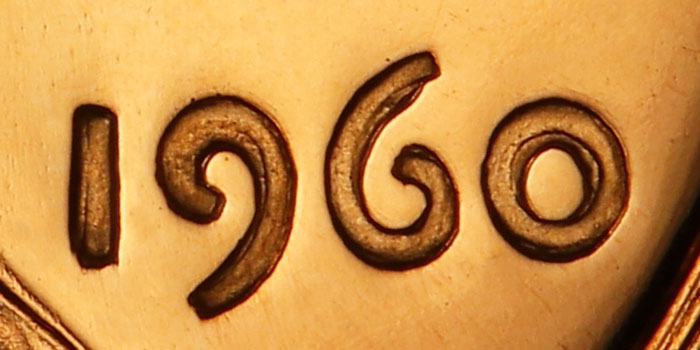
The 1960 Proof Lincoln Cent offers variety collectors an affordable challenge with a few fun overdate varieties.
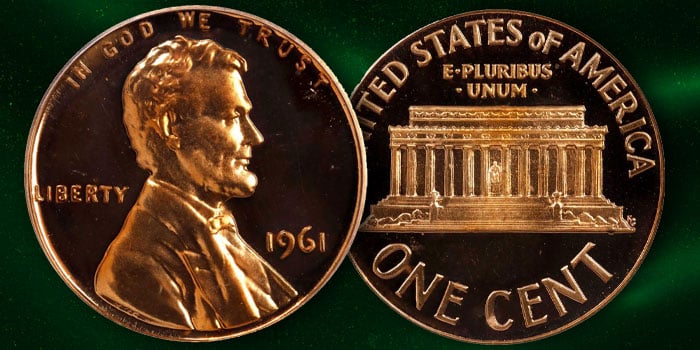
The 1961 Lincoln Cent in Proof generally has a beautiful mirrored finish. Some examples that were struck with fresh dies will exhibit cameo frost on the devices. 1961 Lincoln cent Proofs with Cameo or Deep/Ultra Cameo frost can sell for hundreds of dollars.
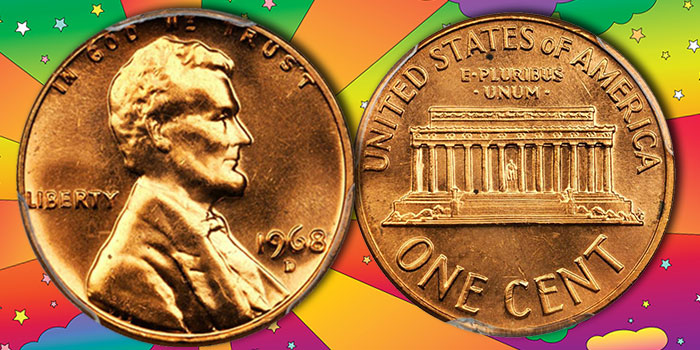
The 1968-D Lincoln Cent has a distinctive bowl-shaped appearance. By this year, the hubs used to create coin dies had become sufficiently worn and the details on the Lincoln design were largely smoothed over. This is a popular issue for those interested in learning about hub deterioration.
Additional Lincoln Memorial Cent Coin Resources
- 1959
- 1968
- 1969-S
- 1971-D
- 1974
- 1976
- 1976-D
- 1978
- 1980
- 1980-S Proof
- 1982
- 1991-D
- 1992-D (with discussion of Close AM)
Design
Obverse:
A right-facing Lincoln occupies most of the obverse. At the top, inside a raised rim and above Lincoln’s head, is the motto IN GOD WE TRUST. To the left of the portrait is the word LIBERTY, and to the right and slightly lower, is the date. Bronze/brass Lincoln Memorial Cents were minted at Philadelphia, Denver, and San Francisco; D and S mintmarks appear below the date.
Reverse:
The reverse center has a prominent depiction of the Lincoln Memorial, with the statue of Lincoln visible within. To the right of the Memorial’s base are designer Frank Gasparro’s initials FG. The legend UNITED STATES oF AMERICA at the top and the denomination written out as ONE CENT at the bottom form nearly a complete text circle inside the raised rim. The motto E PLURIBUS UNUM is placed above the Memorial, with UNUM on a separate line; centered dots are located between E and PLURIBUS and on each side of UNUM.
Edge:
The edge of the Lincoln Memorial Cent is plain or smooth, without reeding or edge lettering.
Coin Specifications
| Lincoln Memorial Cent | Bronze |
| Years of Issue: | 1959-82 |
| Mintage (Circulation): | High: 10,712,525,000 (1982); Low: 258,270,001 (1968-S) |
| Mintage (Proof): | High: 4,149,730 (1976-S); Low: 1,149,291 (1959) |
| Alloy: | .950 copper, .050 tin and zinc (1959-62); .950 copper, .050 zinc (1962-82) |
| Weight: | 3.11 g |
| Diameter: | 19.00 mm |
| Edge: | Plain |
| OBV Designer: | Victor D. Brenner |
| REV Designer: | Frank Gasparro |
* * *
Additional References
Bowers, Q. David. The Experts Guide to Collecting and Investing in Rare Coins. Whitman Publishing.
–. A Guide Book of Lincoln Cents. Whitman Publishing.
–. A Guide Book of United States Type Coins. Whitman Publishing.
Breen, Walter. Walter Breen’s Encyclopedia of U.S. Coins. Doubleday.
Guth, Ron, and Jeff Garrett. United States Coinage: A Study by Type. Whitman Publishing.
Lange, David W. The Complete Guide to Lincoln Cents. Zyrus Press.
Taxay, Don. The U.S. Mint and Coinage. Arco Publishing.
Yeoman, R.S., and Kenneth Bressett (editor). The Official Red Book: A Guide Book of United States Coins. Whitman Publishing.
* * *




I have a 1960D BRONZE penney. I am confused by how many were made back then. It is in used
condition. I have never had a BRONZE penney before
@Alan Cooper
As the article notes, ALL Lincoln Memorial cents minted through late 1962 are made of bronze (95% copper alloyed with 5% tin and zinc). Thus if you’ve ever encountered a penny (sp) from that time period you’ve had a bronze one.
Over a billion and a half 1960-D cents were minted, comprising the two major varieties Large Date and Small Date. Except for high-end specimens they’re very common with only modest premiums.
I have an old Lincoln Memorial Cent collection book starting 1959, my grandmother purchased it in 1970 and many of the coin slots remain unlabeled. How do I obtain a list of the coins that I should be looking for each year to complete the collection?