


By Charles Morgan and Hubert Walker for CoinWeek Notes …..
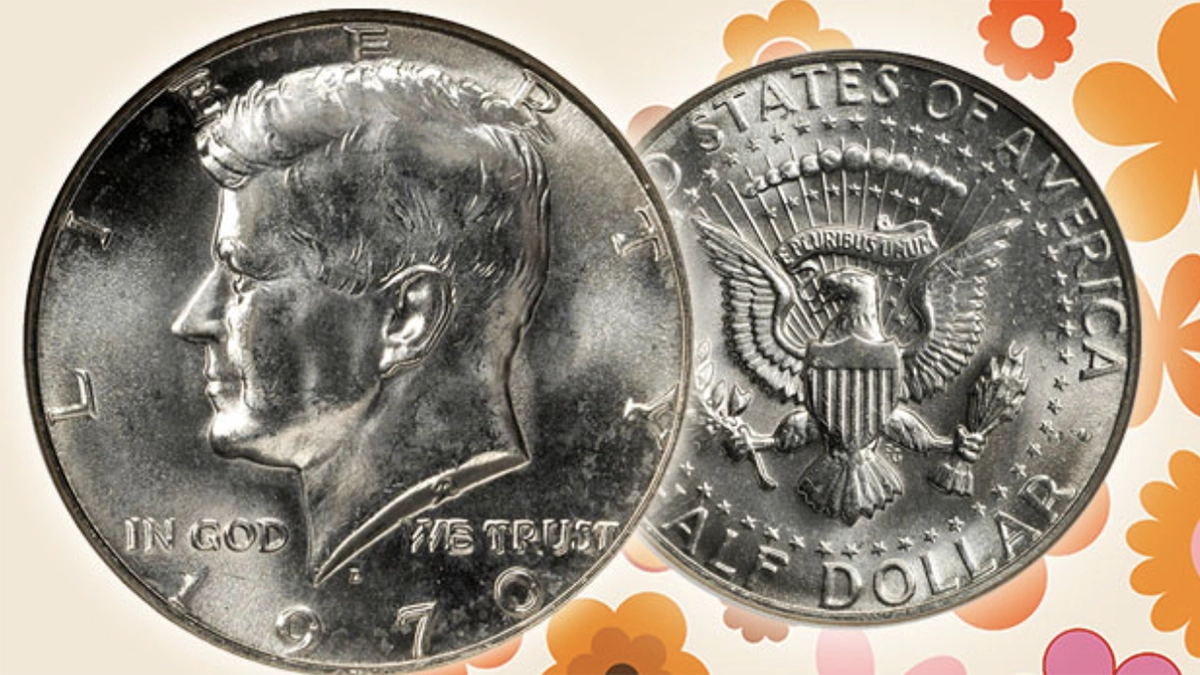
The 1970-D Kennedy Half Dollar was the last of the regular-strike silver-clad half dollars. Its release surprised collectors, as it was available only in Mint Sets that year. The United States Mint did not publicize this fact, and by the time collectors noticed the importance of the issue, it was too late to order one. Over two million Mint Sets were produced, making the 1970-D the lowest-mintage business-strike Kennedy Half until 2006, when the Mint could no longer wait out changing public consumption patterns.
Background
The 1960s were a time of radical change, and collectors know this applied to the nation’s coins as well. The post-war economic boom and the advancement of vending machine technology meant that Americans needed a lot more coins in their purses and pockets for day-to-day commerce. At the same time, global demand for silver increased dramatically. To preserve the market price of silver below the face value of U.S. currency so people wouldn’t exchange bills for more valuable bullion or melt coins from circulation, the Treasury Department sold off its silver reserves. This dampened but did not stop the price rise.
Nevertheless, demand was so high that the Treasury eventually bought more silver than it sold. The Mint realized that soon there would not be enough silver to strike enough coins to keep the American economy on a healthy footing. Silver would have to come out of circulation.
In 1964, the Mint instituted a date freeze on silver quarters, dimes, and half dollars until it produced what it thought were enough silver coins to meet the immediate needs of business. It also began production on copper-nickel clad coins, which had been authorized by the Coinage Act of 1965. A date freeze of sorts was in effect for the new clad coins since pieces dated 1965 were produced over about 18 months. But once the Mint was confident that the full mintage of clad coinage could meet the demands of commerce, the production of silver coins ceased. Sort of.
Because while quarters and dimes were now minted according to the new copper-nickel layered composition, the silver content of Kennedy Half Dollars was instead reduced from 90% silver/10% copper to 40% silver/60% copper. The half dollar was treated this way because it was the nation’s largest denomination of coin at the time, and the Federal Government wanted to prevent any real or imagined harm to both the economy and national prestige.
Mint efforts to assuage coin shortages from the sudden penetration of vending machines and other coin-operated devices into the American marketplace–not to mention the booming economy–sometimes came at the expense of coin collectors. Besides the aforementioned date freezes, coins were issued without mint marks, and neither proof nor mint sets were produced. And even though it wasn’t entirely devoid of silver, collector interest in the 40% Kennedy half was tepid.
By 1970, and much like what had happened earlier to the quarter and dime, the Mint had determined that enough silver-clad Kennedy half dollars had been made for circulation that no more production was needed. Therefore, 1970 business-strike Kennedy Halves were produced only for that year’s Mint Sets, and only at the Denver Mint. Proof Kennedy Halves were still struck at San Francisco in 1970, and bear the “S” mintmark.
Regular buyers of the Mint’s annual products were caught by surprise. The ordering window for 1970 Mint Sets had already passed, so for the first time in several years, a modern Mint product was an eagerly sought-after collectible. Prices in the secondary market for both the coin and the Mint Set jumped in response, spurred on by the fact that the 1970-D was now the last silver Kennedy Half Dollar (albeit at the reduced 40 percent). Starting in 1971, even the half dollar consisted of copper and nickel.
Today, the 1970 Mint Set still sells for more than the issue price on online marketplaces like eBay. Naturally, the price is being driven by attrition as collectors have opened or destroyed numerous Mint Sets hunting for the 1970-D 50¢. But the set doesn’t go for the hundreds of dollars that some speculators have driven the price toward over the last 47 years. The 1970-D Kennedy Half is a good example of how much hype can or cannot do.
As graded by third-party grading services, the MS62 to 65 range is typical for the 1970-D Kennedy half. Keep in mind, however, that any Kennedy Half Dollar of the period–and specifically this issue–is going to feature possibly significant contact marks on President Kennedy’s cheeks, hair, and around his eyes. Even an MS66 can look rough. A survey of recent sales shows that a decent-looking MS66 will sell for $200-$250 at auction.
The 1970-D Kennedy Half Dollar is scarce in MS67 and sells for $7,000 or more. These elusive conditional rarities exhibit the bare minimum number of contact marks, have brilliant luster, and great eye appeal. Check out the “Market Data” section below to see sales that we’ve tracked; the sold PCGS MS67+ was upgraded from a PCGS MS67 sometime after April 2020.
The same applies to the highlights of the eagle on the reverse. This is because the silver-clad Kennedys are softer than their copper-nickel-clad counterparts from later years. And it appears that people just weren’t nice to the Kennedy Half Dollar in general.
* * *
Market Data and Noteworthy Specimens
The PCGS MS67+ population stood at one before March 2024. Between March and October, PCGS added a second coin to its census. Since then, the firm has certified a third coin. We expect slight price declines from the 2024 record-setting GreatCollections sale as more coins become available, and wonder if a particularly nice example might eventually break into the MS 68 grade. If that happens, expect that coin to sell for $12,000 – $15,000.
NGC reports two coins in their top pop grade of MS67+. The company certified these coins in the summer of 2024. Since then, the top pop census has remained unchanged, but the NGC MS67 population has increased from 19 to 24 during the same period.
CAC, having become a full-service grading firm in 2023, has certified just one example at MS67.
Top Population: PCGS MS67+ (3, 4/2025), NGC MS67+ (2, 4/2025), and CAC MS67 (1, 4/2025).
- PCGS MS67+ QA #46448153: GreatCollections, December 1, 2024, Lot #1710545 – View. Gold toning throughout, with red, green, and purple toning on the obverse along the upper periphery. Reverse is brilliant.
- PCGS MS67+ #40685810: As PCGS MS67 #38881507. GreatCollections, April 5, 2020, Lot 812689 – View. Pale gold and blue toning; As PCGS MS67+ #40685810. GreatCollections, March 14, 2021, Lot 829176 – $10,694. Upgraded 1/2 point. Top pop, pop one when sold.
- PCGS MS67 #39478184: eBay, March 24, 2025 – $5,695.
- NGC MS67 #6820519-002: GreatCollections, June 2, 2024, Lot 1542558 – View.
- NGC MS67 #6820398-003: GreatCollections, May 26, 2024, Lot 1544011 – View.
- NGC MS67 #6820268-005: GreatCollections, May 26, 2024, Lot 1543989 – View.
- NGC MS67 #6819194-008: GreatCollections, September 24, 2023, Lot 1346225 – View. Brilliant.
- NGC MS67 #6100293-002: GreatCollections, July 30, 2023, Lot 1398060 – View. Bright and Brilliant. PQ coin.
- PCGS MS67 #25214551: Heritage Auctions, February 2016, Lot 3263 – $4,700; Heritage Auctions, July 15, 2022, Lot 3776 – $5,280. Mostly brilliant. Light tarnish along the periphery of the obverse. More scattered tarnish on the reverse. Tiny nick on upper cheek. Horizontal scratch on the base of the shield. Immaculate fields.
- PCGS MS67 #25285583: Heritage Auctions, August 7, 2014 – $4,112.50; “The Mile High Collection,” Heritage Auctions, January 5, 2017, Lot 4936 – $3,760; Heritage Auctions, February 25, 2022, Lot 3600 – $3,360. Mostly brilliant. Flecks of tarnish on the obverse and reverse. Numerous contact marks on the face, neck, and hair.
- NGC MS67 #5859374-006: GreatCollections, May 16, 2021, Lot 909617 – View. Borderline PL. Brilliant. Deep contact mark above the designer’s initials. Horizontal scratch across the middle of the shield.
- PCGS MS67 #25001792: “The Maltese Collection,” Heritage Auctions, October 16, 2020, Lot 3445 – $6,300. Brilliant with light tarnish. Contact marks on bust truncation. Horizontal mark above RUS. Diagonal mark at the bottom of the shield. Contact mark on the right side of the eagle’s tail feathers.
- PCGS MS67 #25376024: Heritage Auctions, October 30, 2015, Lot 4689 – $4,935. Vennekotter Collection on insert. Brilliant. Discoloration on nostril. Light hits in the hair. Dark reflectivity at the highest point of the cheek, going down to the jaw. Light scuffs at the base of the shield.
- PCGS MS67 #5446856: Heritage Auctions, September 19, 2003, Lot 7403 – $2,300. Brilliant. Hit at the corner of the lip. Small die gouge on reverse below the star below IC of AMERICA.
* * *
Design
Obverse:
The obverse of the Kennedy Half Dollar was designed by Gilroy Roberts, Chief Engraver at the United States Mint from July 22, 1948, to February 11, 1965. Roberts also designed President Kennedy’s inaugural medal, which served as the basis of the present design.
The central motif is an effigy of the 35th President of the United States, the late John Fitzgerald Kennedy. A war hero and (at the time) the youngest person ever to serve as president, Kennedy was inaugurated on January 20, 1961, and assassinated on November 22, 1963. The nation’s grief was such that Congress and the U.S. Mint rushed through a design change on the half-dollar denomination to commemorate the bereaved president.
Atop the upper half of the rim is the inscription LIBERTY, with Kennedy’s hair covering the bottom portions of the letters “B”, “E”, and “R”. The date 1970 is cradled at the bottom of the coin, while the national motto IN GOD WE TRUST is inscribed in a straight line above the year but divided by the sharp truncation of Kennedy’s neck. The mintmark D is on the right side of the point of this truncation.
Gilroy Roberts’ initials are located on the truncation line of Kennedy’s bust, above the “WE” on the bottom right side of the coin.
Reverse:
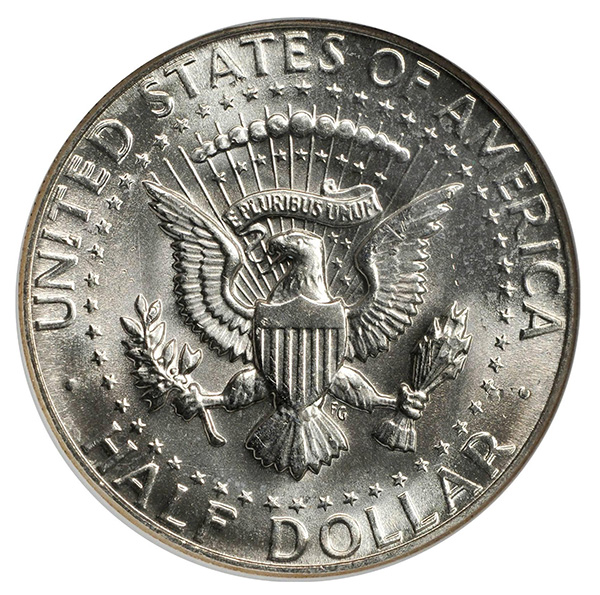 Roberts’ assistant Frank Gasparro designed the reverse. He based the eagle on the presidential coat of arms from the Seal of the President of the United States, which itself is based on the obverse of the Great Seal of the United States. The presidential seal in its current form was finalized by President Harry S. Truman in 1945, though the number of stars on the seal (and hence the coin) went from 48 to 50 as the states of Alaska and Hawaii entered the Union.
The heraldic eagle’s wings and legs spread in four directions. The left talon (viewer’s right) holds a bunch of arrows, a symbol of war, while the right claw (viewer’s left) holds an olive branch, a symbol of peace. It is traditional to have the eagle face one side or the other relative to national circumstances at the time of striking; in this instance, the eagle faces towards the olive branch despite America’s involvement in Vietnam and other conflicts around the world.
Frank Gasparro’s initials FG are between the eagle’s left leg and tail feathers.
A Union shield covers the eagle’s breast. Vertical bars representing the 13 red and white stripes of the American flag run down most of its face, the stripes representing the original 13 colonies of the United States. The top of the shield (a horizontal band is known in heraldry as a chief) features no stars.
Immediately above the eagle’s head is a scroll featuring the motto E PLURIBUS UNUM. The design behind and above the eagle, which consists of 15 rays, nine stars, and a mass of clouds, is called a glory and is a common design element of both heraldry and an earlier period of numismatics.
The legend UNITED STATES OF AMERICA runs clockwise along the top rim of the reverse, while the denomination HALF DOLLAR runs counterclockwise along the bottom. Dots are between the two inscriptions at both ends. Surrounding the eagle is a ring of 50 stars, representing the 50 states of the Union at the time of the coin’s production.
Gasparro became Chief Engraver of the U.S. Mint on February 11, 1965, after Roberts’ work with the Franklin Mint caused the Mint to let Roberts go. Gasparro had served as Roberts’ assistant for three years between ’62 and ’65. Besides the Kennedy Half Dollar reverse, Gasparro had also designed the Lincoln Cent Memorial Reverse, the Eisenhower Dollar obverse and regular reverse, and the Susan B Anthony Dollar, among other works.
Frank Gasparro retired from the Mint on January 16, 1981.
Edge:
The edge of the 1970-D Kennedy half dollar is reeded.
Designers
Gilroy Roberts was the ninth Chief Engraver of the U.S. Mint, serving from 1948-1965. He is primarily remembered for his design of the Kennedy Half Dollar obverse.
Frank Gasparro was an American medalist and coin designer. After serving as an assistant engraver to Gilroy Roberts, he became the 10th Chief Engraver of the United States Mint, serving from 1965-1981 (View Designer’s Profile).
Coin Specifications
| Country: | United States of America |
| Year of Issue: | 1970 |
| Denomination: | Half Dollar (50 Cents USD) |
| Mintmark: | D (Denver) |
| Mintage: | 2,150,000 |
| Alloy: | .400 silver, .600 copper |
| Weight: | 11.5 g |
| Diameter: | 30.6 mm |
| Edge: | Reeded |
| OBV Designer: | Gilroy Roberts |
| REV Designer: | Frank Gasparro |
| Quality: | Business Strike |
* * *





The real sleeper in respect to rarity which is slowly being realized is the 1964 proof accented hair Kennedy half. The assumed mintage for this variety is extremely low in the 200 000 range. It has the real potential to be a coin that becomes one that a collector looks back and wonders why they didn’t hoard more or even grab some of them.whwn they were in a mire accessible cost range as they are now.
I have 4 of those half dollars an two more that are silver Dollars I could let them go for a price
Hello ..they 1970? If so I’m interested.
In retrospect it was a colossal mistake for the Mint to have persisted with silver halves, even at a reduced .400 fineness. The (artificially pumped) run-up in silver prices during the late 1960s made even those clad issues worth more than their face value, leading to many being removed from circulation and melted. In addition it later fueled the myth among non-collectors that ALL halves, including those minted after 1970, contained at least some silver which added further to the hoarding problem.
One wonders if the 50¢ piece might have remained in circulation had the Trasury given up the idea of treating it as a prestige coin and simply converted it to cupronickel in 1965 as well.
Of course there’s also the unanswered question of whether the Franklin design could have or should have been resumed in 1965 as well, but that’s a different consideration.
The Kennedy Half Dollars have flaws.
Parts of the letters above the head are in the hair. Also, the EAR of Kennedy is different in a lot of the coins. Are any of these Collectable?
@Bette Farwell If you do an image search for Kennedy halves, the motto over the head will be partially-obscured on ALL of them. It’s not a flaw, it’s a design choice to allow the portrait to be a bit larger. The same technique’s been used on other coins as well, including the new quarters. If you think about it for a moment, it’s extremely unlikely that the Mint would have issued a flawed image for over half a century.
Thank you, it’s very helpful for me I collect coins and I understand more about them for y’all posting. Also could you tell or give me a guess on how much a 1909 gold 2 1/2 Dollar coin would be worth. Thank You.
Condition, Condition, Condition. A 1909-P in Au-50 condition goes between 525. – 600.
Yes I have like seven of them and I’m looking to get rid of them,also I have a silver penny,I would like to see maybe what it is worth
@Elisha cleverbartoe I’m guessing your “silver penny” is a 1943 Lincoln wheat cent. If so, it’s actually made of zinc-coated steel rather than silver.* Over a billion such coins were struck by the three mints then operating; unless yours is in top-quality condition it’s unlikely to be worth more than 50 to 75 cents at retail.
The Mint changed the cent’s composition from a 95% copper alloy because copper was needed for the war effort. The steel used for making pennies was lower-grade metal not suited for wartime use. For a number of reasons the coins proved to be unsatisfactory in commerce forcing the standard bronze alloy to be resumed in 1944. Much of the copper used in those and 1945 cents was recovered from spent ammunition leading to the nickname “shellcase cents”.
(*) If you think about it for a second or two, cents are larger than dimes which at the time contained 10¢ worth of silver; making pennies with 12¢ to 15¢ of silver wouldn’t have made “cents”.
I have mint’s in 1970 would love to sell d -kennedy-half -dollar and alot of Kennedy have dollar.
Far to vague of a description. Depending on condition, it may only be worth melt value. Could be worth from $200.00 up.
@Bette Farwelll: The letters in LIBERTY appearing behind Kennedy’s hair is _not_ a flaw in any way. It was purely an artistic decision made by designer Gilroy Roberts. If you check any pictorial reference you’ll find that ALL Kennedy halves have the same arrangement.
Other familiar US coins with a device (image) that overlays one of the legends include Mercury dimes and Walking Liberty halves. In addition, many other designs’ devices interrupt but don’t overlay a legend. None of these are errors.
I hAve a 1970 half that on the front the 9 on the date is cut short have not been able to find this error anywhere
@Bette Farwell: Kennedy’s hair covering part of the word LIBERTY is _not_ a flaw. If you look at images of other dates, it’s part of the design of all Kennedy halves. It’s a common artistic method that allows the portrait to be slightly larger.
The same idea’s been used on several other US coins; e.g. Peace dollars, Barber and Walking Liberty halves, and Mercury dimes, On some other denominations like Standing Liberty quarters and certain Innovation dollars, the image interrupts the motto but doesn’t cover it.
I get 1970 half dollars
I have a 1946 reverse double die half dollar how id like to no it’s value and were I could sale it
I HAVE TWO HALF DOLLARS OF JOHN F. KENNEDY ONE IS 1969, 1970 ARE THEY WORTH MUCH!!
I have 4 half dollars of John f.kennedy all 1970 are they worth much
How do I sell my collection I am 71 and want sell before my kids take it to bank and cash it out .
Take a photo, and list them on e-Bay. If you have a larger collection, send them to auction. If you can tell .e the kinds of coins, I can recommend appropriate auction houses.
I have some Kennedy half 1970 I have 4 of them and some 1972 on up to 1988
@Bobby Tucker The 1970 coins are 40% silver and are worth at least their melt value, likely more if they’re still in their original packaging. Details are given in the article.
Any circulation-find half dollar dated 1971 or later is made of cupronickel and will be only worth face value unless it’s in top-quality condition.
I 40 coins, need to look at!
I have one of the half dollar so far
I have 3 1971 worth any thing
@Norrice: Yes, 50¢ each. The coins don’t contain any silver.
I have bicentennial half dollar dollar,and quarter and several other coins even a 1914-1919 penny a quarter with one side the face is there but no back can you help me gettingon how do i sell them ?
Best bet for a small collection is e-Bay
I melted mine and made jewelry rings and things.
No they are not Tammy unless they are like brand new like they had just come out of the mint