


A New Nickel Design Debuts in 1938
In 1938, the United States Mint introduced the Jefferson nickel, bringing an end to the Buffalo nickel after a 25-year production run. The new five-cent piece honored Thomas Jefferson, the third president of the United States and a Founding Father.

The redesign followed a public competition held in 1937. The Treasury Department opened the contest to “all American sculptors.” German-born American artist Felix Oscar Schlag won the competition and received a $1,000 award for his submission.
Felix Schlag’s Winning Design
Schlag’s obverse design features a left-facing portrait of Jefferson. Art historian Cornelius Vermeule later observed that the portrait closely resembles Jean-Antoine Houdon’s 1789 bust of Jefferson. The essential elements of this obverse design remained in use on the Jefferson nickel for 66 years.
Schlag’s original reverse design did not receive the same longevity. His initial concept depicted Monticello in a three-quarter perspective, an approach that emphasized architectural depth and visual interest. The Treasury Department rejected this version and requested revisions. The most significant change replaced the angled view with a flat, head-on depiction of Monticello. That revised reverse became standard for circulation-strike Jefferson nickels and remains in use today, although commemorative issues have featured alternative reverse designs.
Under the terms of the design competition, Schlag did not receive additional compensation for making these changes.
The 1938 Jefferson Nickel in Production
The Philadelphia Mint struck 19,496,000 Jefferson nickels dated 1938. Despite this substantial mintage, the coins did not enter circulation until late in the year.
Because 1938 marked the first year of issue for a new coin design, many people saved examples from circulation. Some collectors actively accumulated rolls of the new nickels. As a result, the 1938 Jefferson nickel remains relatively common in most grades, though it no longer appears in everyday circulation.
Strike Characteristics and Production Quality
The United States Mint produced the 1938 Jefferson nickel with strike quality that is best described as inconsistent. While examples with strong detail do exist, fully struck coins are not the norm.
Many 1938 nickels were struck from fresh hubs, which helped preserve detail in early production. Even so, the true scarcity of consistently well-struck Jefferson nickels would not become widely apparent until later decades, particularly during the 1950s and 1960s.
Full Steps and Strike Detail
Collectors and researchers often evaluate Jefferson nickels based on the presence of Full Steps on the reverse design.
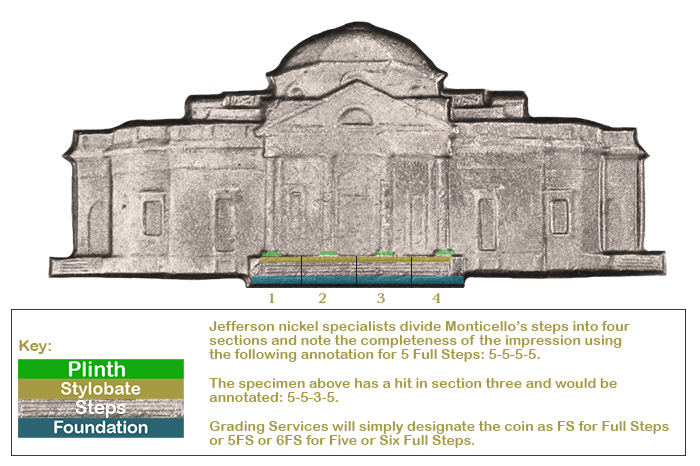
The steps appear between the stylobate— the flat pavement supporting the four front columns of Monticello— and the foundation block at the base of the structure. Several factors influence whether the steps remain fully defined. These include die condition, striking pressure, and incidental contact with other coins after striking.
Because of these variables, Full Steps examples represent a subset of overall production rather than the standard appearance for the issue.
Design Details
Obverse
The obverse shows a left-facing bust of Thomas Jefferson, complete with a colonial-era pigtail. The portrait closely resembles Houdon’s 1789 bust in both proportion and detail. Jefferson’s head nearly touches the rim, while a slight truncation appears at the lower edge where his left shoulder meets the coin’s border.
The motto IN GOD WE TRUST arcs clockwise along the left side of the coin, beginning near Jefferson’s chest and extending toward his hairline. Although this phrase became the official national motto in 1956, it had appeared on United States coinage long before that designation.
On the right side, the inscriptions LIBERTY and the date 1938 run clockwise behind Jefferson’s profile. A small five-pointed star separates the two inscriptions.
Reverse
The reverse features a frontal view of Monticello, Jefferson’s home near Charlottesville, Virginia. Jefferson designed the building himself, drawing inspiration from neoclassical architecture and principles of the Italian Renaissance. The name “Monticello” comes from Old Italian and translates to “mound” or “little mountain.”
Although the flattened rendering reduces the sense of depth found in Schlag’s original concept, well-struck examples still display notable detail in the steps, portico, and columns. The octagonal shape of the dome remains visible despite the simplified perspective.
At the top of the reverse appears the motto E PLURIBUS UNUM. The inscription MONTICELLO, added at the Mint’s direction, appears directly beneath the building. Below that, FIVE CENTS forms a gentle curve, while UNITED STATES OF AMERICA runs counterclockwise along the lower rim.
Edge
The edge of the 1938 Jefferson nickel is plain, without reeding or lettering.
The Designer: Felix Schlag
Felix Schlag was born in Frankfurt, Germany, in 1891. He received his formal artistic training at the Munich University of Fine Arts before immigrating to the United States in 1929.
Schlag died in 1974. Although he won numerous art competitions and commissions during his career, the Jefferson nickel remains his only coin design.
Coin Specifications
- Country: United States of America
- Year of Issue: 1938
- Denomination: Five Cents (USD)
- Mint Mark: None (Philadelphia)
- Mintage: 19,496,000
- Alloy: 75% Copper, 25% Nickel
- Weight: 5.00 grams
- Diameter: 21.21 mm
- Edge: Plain
- Obverse Designer: Felix Schlag
- Reverse Designer: Felix Schlag
- Quality: Uncirculated, Proof
* * *





Would like a list of coins, that are rare an possibly worth money.
With all due respect, that’s an unbelievably tall order! Hundreds of thousands of different kinds of coins have been struck in this country and elsewhere, so what you’re asking for is better found in various books and online sites. E.g. search for “US coin values” or a similar phrase. There are also a number of well-known printed guidebooks such as those issued by Whitman or Krause.
Some things to keep in mind:
– Retail prices prices are going to differ significantly from wholesale prices.
– A coin’s condition (the amount of wear, any damage, etc.) is usually a major factor in its value.
– Two otherwise identical coins except for date and/or mint mark can have major differences in their value.
– Any coin that’s apparently of high value should be examined and graded by a professional.
– As a corollary, many super-rare coins have been heavily counterfeited. E.g. there are only a handful of genuine 1804 silver dollars but carloads of fakes are out there.
– As a second corollary, be cautious of coins promoted via TV sales, eBay, and other auction-type sites. Many are legit but a lot aren’t, and it’s hard to tell remotely.
– In the US and most other major countries, it’s extraordinarily tough (but not impossible) to find very rare coins in circulation. E.g. the chances of finding a 1943 bronze cent in change are about 10^-40.
I have this nickel 1938 Jefferson and 1942 s and much more I been collecting penny dimes nickol quarter for 3 yrs but I never check there vale yet first time
Thanks for running this piece. To the extent I have a real specialty in U.S. coins, it is nickels, 3-cent and 5-cent. I especially like the variations at the beginnings of all the 5-cent nickels – Shield, Liberty, Buffalo, and Jefferson.
I got one today with my change from McDonald’s. Always look at your change when you get it
The previous commenter Keith’s find is telling. Because of their long production run, mostly unchanged until recently, Jefferson nickels are perhaps the likeliest denomination to find moderately valuable and older dates in one’s pocket change. Pre-’65 silver coinage and older pre-’60 Wheat Cents tend to stand out, while nice older Jefferson nickels sort of blend in. I even caught a ’42 D wartime “silver” one in my change very recently.
I have 1938 Jefferson nickel know MetMark could you tell me the value of it.
??? Do you mean “no mint mark”?
Also don’t forget that the mint mark position on older Jefferson nickels is on the reverse, to the right of Monticello rather than on the obverse near the date where it’s been located since 1968.
In any case, as the article notes 1938 Jefferson nickels aren’t rare in circulated condition. Auction prices as of this writing are in the 50¢ range for Philadelphia coins (no mint mark), $1.10 for Denver, and $1.50 for San Francisco.
Can u tell me about indian pennys from 1866 to 1909 thank you
Hi I have a question the red book says that there were 19,365 proof Jefferson nickels made in 1938. Then it says there were 8,046 proof sets made so how many proof nickels were made in 1938?
I have a few 1938 Jefferson nickels. I found nearly all in circulation. Of course I’m 60 and this took many years. Been collecting coins since late 70s.
I gave my son a complete set of Jefferson’s all in MS66 and most Full Steps.